
BIOGRAPHIES OF NAMIBIAN
PERSONALITIES
in alphabetical order
KLAUS DIERKS
Copyright © 2003-2004 Dr. Klaus Dierks
I - Q
001550
Ickler
* in Germany
+ .1900
---
Ickler was a missionary of the Rheinische Missionsgesellschaft in Ovamboland. He died in
1900.
---
Gender: m
Field of activity: REL
Profession: Missionary
Namibia National Archives Database
002284
Iilonga yaNyango, Ovamboland (Uukwambi) King
*
+ ca. 1800
---
The tenth Uukwambi King on record was King Iilonga yaNyango (around
1800). He followed King Nuukata waTshiinga (1780-1800). His successor was the eleventh
Uukwambi King Tshikesho (before 1860).
---
Gender: m
Field of activity: POL
RAW DATA: Chronology of Namibian History, 2003 (Dierks);
002292
Iipumbu, Herman, Ovamboland (Uukwambi) King
*
+
---
The nineteenth Uukwambi King since 1991 is Herman Iipumbu. He
indirectly followed the famous Uukwambi King Iipumbu ya Tshilongo (1907-1932)
who was deposed by the South Africans in 1932.
---
Gender: m
Field of activity: POL
RAW DATA: Chronology of Namibian History, 2003 (Dierks);
002288
Iipumbu ya Nangaku, Ovamboland (Uukwambi) King
*
+ .1863
---
The fourteenth Uukwambi King was King Iipumbu ya Nangaku
(1862-1863). He followed King Nuyoma wIipumbu (1860-1862). Iipumbu founded his capital at
Okashangu. The 15th King Tshikesho tshEelu (1863) followed King Iipumbu ya Nangaku after
his death in 1863, but died in the same year.
---
Gender: m
Field of activity: POL
RAW DATA: Chronology of Namibian History, 2003 (Dierks);
000919
Iipumbu ya Tshilongo, Ovamboland (Uukwambi)
King
* .1873 at Onatshiku
+ 09.09.1959 at Oshikuku
---
Iipumbu ya Tshilongo was born in 1873 at Onatshiku.
He was the eighteenth King of the Uukwambi area. He ruled from 1907 until 1932. He followed King Negumbo lya Kandenge (1875-1907). Iipumbu ya Tshilongo (son of Tshilongo Uupindi), was born at Onatshiku near Elim
during the reign of King Nuyoma in 1873. He established his capital at Omapona and later
again at Onatshiku. At the end of 1922 King Iipumbu ya Tshilongo armed his people and
ordered them to guard the Onolongo and Ondangwa routes into his territory in order to
prevent "whites" from entering his country. On 13.05.1924 the Roman-Catholic
Church received permission from King Iipumbu ya Tshilongo to establish a mission station
at Oshikuku (with permission of the SWA Administration for the Uukwambi and Ombalantu
areas). In July/August 1932 King Iipumbu ya Tshilongo had resisted both the Finnish
Mission and SWA Administration since 1922. From this time onwards the records of the
mission and the administration were full of complaints about him. Complaints were lodged
about his intransigence, especially regarding migrant labour that was not as forthcoming
from Uukwambi as required by the colonial administration. But it also emerged from
archival records and oral history that King Iipumbu ya Tshilongo was a tyrant whose
autocratic and often arbitrary rule made many of his subjects flee the Uukwambi area for
neighbouring districts. His alleged and real sexual misdemeanours made him unpopular. He
even wanted to marry one of his social or allegedly biological daughters, Neekulu ya
Shivute. Neekulu fled to the Finnish Missionary at Elim. Iipumbu sent some of his soldiers
to fetch her forcefully and even threatened the missionary station at Elim (Neekulu
finally found refuge with missionary Emil Liljeblad at Oshigambo in the Ondonga area). All
these events led to his deposition. The Resident Commissioner in the north, Carl Hugo
Linsingen "Cocky" Hahn, was pivotal in deposing Iipumbu. He used military
aircraft and machine guns to demoralise the Uukwambi forces at Ombwelafuma. In the mean
time Iipumbu tried to obtain support from the Portuguese colonial authority at Ombandja in
Angola. This support was however not forthcoming. The Portuguese informed
"Cocky" Hahn of Iipumbu’s activities. During Iipumbu’s absence from
the Uukwambi area, Hahn used the opportunity to attack the Uukwambi with the assistance of
some Uukwanyama and Ondonga warriors under the command of Nehemia Shoovaleka. Iipumbu was
finally arrested at Onemedhiya and forced into exile in the Kavango after South African
war planes bombed his residence. Iipumbu stayed until 1938 in the Kavango and returned
home to Amupolo after falling sick. The Ovambo call King Iipumbu ya Tshilongo
"Ndilimani", meaning "dynamite" in the Oshivambo language.He
died at the Catholic Hospital in Oshikuku on 09.09.1959. There was no king in the Uukwambi
area until 1991. His indirect successor is Uukwambi King Herman
Iipumbu (1991-).
---
Gender: m
Field of activity: POL
Profession: Traditional leader
RAW DATA: Ndonga Anthology; Chronology of Namibian History, 2003 (Dierks);
002272
Iita ya Nalitoke, Ovamboland (Uukwaluudhi) King
*
+ .1909
---
The tenth Uukwaluudhi King was King Iita ya Nalitoke. He followed
Niilenga yAmukwa in 1908. He ruled from 1908 until his death in 1909. Iita ya Nalitoke
died in 1909. His successor was the eleventh Uukwaluudhi King Mwaala gwa Nashilongo
(1909-1960).
---
Gender: m
Field of activity: POL
RAW DATA: Chronology of Namibian History, 2003 (Dierks);
002230
Iitana yaNekwiyu, Ovamboland (Ondonga) King
*
+ 26.09.1884 in Namibia
---
Iitana yaNekwiyu was the ninth Ondonga King and
followed Kambonde ka Nankwaya in 1883. He ruled from 1883 until 1884. His capital was at Onampundu, near Onayena. Iitana yaNekwiyu died on 26.09.1884.
He was succeeded by two Ondonga kings: King Kambonde kaMpingana (1884-1909) with the
capital Onamayongo (or Okaloko according to other oral evidence)(western Ondonga) and King
Nehale (1884-1908) with the capital Onayena in the Oshitambi area (eastern Ondonga). The
Finnish Missionary Society supported King Kambonde against King Nehale with weapons and
ammunition because King Nehale was perceived to be an "enemy of the European mission
work in Africa".
---
Gender: m
Field of activity: POL
RAW DATA: Chronology of Namibian History, 2003 (Dierks);
002257
Iiyambo yIileka, Ovamboland (Ongandjera) King
*
+ .1887
---
The nineteenth Ongandjera King was King Iiyambo yIileka (1878-1887)
who followed Tsheya tsUutshona. He established his capital at Engonda. King Iiyambo
yIileka was killed by the later King Tshaanika Tsha Natshilongo (1887-1930) in 1887.
---
Gender: m
Field of activity: POL
RAW DATA: Chronology of Namibian History, 2003 (Dierks);
000761
Ikela, Nicodemus
[Cabinet - nickname]
* 01.01.1926 in Namibia
+ 07.09.2002 at Windhoek
---
Nicodemus Ikela was born on 01.01.1926. He was a SWAPO activist in Windhoek-Katutura. He
died on 07.09.2002 at Windhoek.
---
Gender: m
Field of activity: POL
Namibia National Archives Database
002322
Imalwa, Olivia-Martha
*
---
Olivia-Martha Imalwa grew up in northern Namibia during the colonial era where prospects
of empowerment opportunities for "black" women were not at all big. She went
into exile to Angola in 1982 where she came into contact with the law profession for the
first time. After 1982 SWAPO sent her to Lusaka in Zambia to study at the United Nations
Institute for Namibia (UNIN). She graduated from UNIN in 1985, after passing with
distinction, and continued her studies at the University of Warwick in the United Kingdom
where she obtained her LLB degree with honours in 1988. She returned from exile in 1989,
and was soon after independence in March 1990 appointed as the co-ordinator for the Legal
Assistance Centre team at Ongwediva, or the Human Rights Centre as it was still known in
1990. In 1992 she became State Prosecutor at Oshakati. During 1996 she was appointed by
the former Prosecutor General, Advocate Hans Heyman, as the Control Prosecutor for Opuwo,
Outapi, Oshakati, Ondangwa, Eenhana, Rundu and Katima Mulilo. In 1998 Imalwa became
a State Advocate in the High Court of Namibia, only to be transferred back to Oshakati as
a Control Prosecutor one year later. In 2000 she was appointed as Deputy
Prosecutor-General of Namibia. In January 2004 she became the Prosecutor-General of
Namibia, succeeding Advocate Joe Walter who acted in this position during 2003 and
Advocate Hans Heyman who retired as Prosecutor-General in 2002.
---
Gender: f
Married to: Veikko Imalwa: four children
Field of activity: LAW
Function: Prosecutor-General
RAW DATA: Informanté Vol. 1, No. 1, 2004
000096
Imenene, Naboth
*
---
Naboth Imenene was an evangelist in the ELOC Church. He was arrested November 1976. He was
tried in the Windhoek Supreme Court in July 1977, accused of aiding SWAPO guerrillas in
the Oniipa and Onyuulaye areas. He was sentenced to five years imprisonment on Robben
Island.
---
Gender: m
Field of activity: POL
Namibia National Archives Database
000918
Immelman, Willem Hendrik
* 11.02.1904 at Sutherland, Cape Province, South Africa
---
Willem Hendrik Immelman was born on 11.02.1904 at Sutherland in South Africa. He was
educated in Sutherland and Paarl. He was the Manager of the Electrical Division of
Windhoek Universal Motors. He was Mayor of Windhoek from 1954 until 1955.
---
Gender: m
Field of activity: BUS
Functions: Mayor - Windhoek - 1954-1955
Married to: Josina Immelman, née Reyneke, married 1927-
Father: Jasper J. Immelman
RAW DATA: WWSA 1959;
000937
Indongo, Frans Aupa
* 15.01.1936 at Ongwediva
---
Frans Aupa Indongo was born on 15.01.1936 at Ongwediva as the third of six children. He
spent his early childhood herding his father's cattle. He was educated at Amutanga and
Omega Primary Schools. He taught at Omega Primary School from 1952 until 1955. From 1956
he was a migrant labourer, employed by Walvis Bay Municipality. He started his business
ventures with investing in sewing machines and making clothing. He established a
"cuca shop" at Omusimboti in 1961 and expanded rapidly to become the owner of a
supermarket chain, then diversifying into other sectors of the economy, becoming one of,
if not the wealthiest, persons in Namibia.
---
Gender: m
Field of activity: BUS
Mother: Kandjengo Enkono
Father: Indongo Enkono
RAW DATA: New Era 29.04.2001;
001030
Indongo, Inatu
*
---
Inatu Indongo grew up in exile. He is a fashion designer and artist. He hold his first
solo exhibition in March 2002 at the Franco-Namibian Cultural Centre.
---
Gender: f
Field of activity: ART
Mother: Indonga
Father: Iyambo Indongo
RAW DATA: The Namibian 08.03.2002; Otweya no. 3; Sister Namibia vol.14 no. 2;
000097
Ipanguela, Joseph
*
---
Joseph Ipanguela was detained in the first half of 1968. He was held in Pretoria Central
Prison before being tried in Windhoek in July 1969, accused of conspiring to overthrow the
SWA Administration by force to replace it with a SWAPO-led government. He was sentenced to
life imprisonment on Robben Island.
---
Gender: m
Field of activity: POL
Collections/Papers:
1). NAN: PRI 3/12 (Prison file)
000187
Irle, Emilie
[Schweissfurth, Emilie - birth name]
* 29.07.1839 at Elberfeld, Germany
+ 03.08.1888
---
Emilie Irle, née Schweissfurth, was born on 29.07.1839 at Elberfeld in Germany. She was
the first wife of the Rhenish Missionary Johann Jakob Irle (married 21.01.1872). They had
five children. She died on 03.08.1888.
---
Gender: f
Married to: Johann Jakob Irle (1843-1924), married 1872-1888
RAW DATA: Vergissmeinnicht 1893:51; Faulenbach;
000182
Irle, Hedwig
[Rohden, Hedwig von - birth name]
* at Barmen, Germany
---
Hedwig Irle, née Rohden, was the second wife of the Rhenish Missionary Johann Jakob Irle.
She wrote popular brochures about mission work among the Ovaherero. Both she and her
husband were outspoken critics against the genocidal campaign against the Ovaherero
following the uprising in 1904. They had two children.
---
Gender: f
Married to: Johann Jakob Irle (1843-1924), married 1890-
RAW DATA: Drechsler 1966:307;
000188
Irle, Johann Jakob (Snr.)
* 28.01.1843 at Hatzfeld, Germany
+ 07.09.1924 at Witten, Germany
First entry to Namibia: 1868
Last departure from Namibia: 1903
---
Johann Jakob Irle was born on 28.01.1843 at Hatzfeld in Germany. He was trained as a
carpenter. He joined the Rhenish Missionary Society after two years' military service.
Irle arrived at Okahandja with Phillipp Diehl on 18.05.1870. Firstly the two missionaries once again established a mission station at Maharero’s werf (village)
at Okahandja – the first since Kolbe had fled from Okahandja in 1850. Diehl worked at
Okahandja until 1890 when Maharero dies. On 23.09.1870 leaders (Jan Jonker Afrikaner, Maharero, Kido Witbooi of Gibeon, David Christian
Frederiks of Bethany and Jakobus Isaak of Berseba) and missionaries (Hahn, Diehl and Irle
of Okahandja, Brincker of Groß Barmen, Olpp of Gibeon, seven Finns and the trader C
Conrath) organised a peace conference at Okahandja. A peace treaty was signed in which Jan
Jonker was designated "co-regent", i.e. Maharero’s subordinate. Ten years
of peace followed after this. For a short while Irle was in 1870 in charge
of the mission station Otjikango. On 09.10.1872, he founded the mission station Otjosazu,
and there he worked among the Ovambanderu until his return to Germany in 1903. He
published extensively about the Otjiherero language and culture, including the standard
works "Die Herero : ein Beitrag zur Landes-, Volks- und Missionskunde"
(Gütersloh 1906) and "Deutsch-Herero-Wörterbuch" (Hamburg 1917). Both he and
his wife Hedwig were outspoken critics of the genocidal anti-Ovaherero campaign following
the German Ovaherero War in 1904. For instance, during 1913, when
the ill-treatment of Namibian indigenes continued, many German settlers arrogated to
themselves the right to manhandle their African labourers what they euphemistically called
"paternal chastisement". The case of the farmer Ludwig Cramer (farm
Otjisororindi at the Black Nossob) was a particularly sad example. The Rhenish Missionary
Johann Jakob Irle reported Cramer’s maltreating of his labourers to the police. The
police investigation revealed that Cramer had whipped two pregnant African women on two
successive days with such brutality that they miscarried. Two more women even died as a
result of the beatings. Cramer was charged with assault and battery in eight cases (seven
of his victims being female) and sentenced to one year and nine months in prison. A court
of appeal commuted the sentence to four months in jail plus a fine of 2 700 Marks. This
judgement was virulently attacked by Cramer’s wife, Ada Cramer, who, the court
records show, had assisted her husband in his excesses. She later published a book where
she played down and justifies the crimes committed by her husband. Irle was
married twice: Emilie Schweissfurt from Elberfeld (from 21.01.1872 to 03.08.1888), five
children, and Hedwig von Rohden from Barmen (07.07.1890), two children. He died on
07.09.1924 at Witten in Germany.
---
Gender: m
Field of activity: REL
Profession: Missionary
Married to: <1>Emilie Irle, née Schweissfurt (1839-1888), married 1872-1888
<2>Hedwig Irle, née Rohden, married 1890-
RAW DATA: P. Reiner 1992:416; Quellen 28A:105; Vergissmeinnicht 1893:51; Faulenbach;
Drechsler 1966:111, 119-120, 162, 170, 187, 307, 326, 329-330, 336, 342, 345, 347, 349,
351, 353, 355; Chronology of Namibian History, 2003 (Dierks);
000183
Irle, Jakob (Jnr.)
* 10.05.1878 at Otjosazu
---
Jakob Irle (Jnr.) was born on 10.05.1878 at Otjosazu. He was the son of Rhenish Missionary
Johann Jakob Irle. After education in Germany, he went back to Namibia as a missionary
himself in 1906. He was stationed at Gobabis. He was married to Elisabeth Ohlmann in 1915.
---
Gender: m
Field of activity: REL
Profession: Missionary
Married to: Elisabeth Irle, née Ohlmann, married 1915
Mother: Emilie Irle, née Schweissfurt (1839-1888)
Father: Johann Jakob Irle (1843-1924)
Collections/Papers:
1). DELK Gobabis (allegedly kept in the church vestry)
002025
Irons
*
---
Irons was a trader and carpenter. He was an elderly Englishman who once worked for Carl
Hugo Hahn at Otjimbingwe, where he lived with his wife and daughter. He was a trader at
Okahandja in 1876.
---
Gender: m
Namibia National Archives Database
000907
Isaacks, Robert Harrison
* 07.06.1976 in Namibia
+ 21.03.2002 in Namibia
---
Robert Harrison Isaacks was born on 07.06.1976. He was a community activist, actor and
playwright who worked with the Serpent Players and the Bricks Community Project. He died
at the age of 25 on 21.03.2002 through a fire accident.
---
Gender: m
Field of activity: ART
Profession: Actor
Father: Simon Gaoseb
Namibia National Archives Database
000910
Isaacs, W.
* 02.09.1926 in Lithuania
First entry to Namibia: 1954
---
W. Isaacs was born on 02.09.1926 in Lithuania. He was educated in Johannesburg. He was a
businessman and came to Namibia in 1954. He was a Partner with P.J. Malherbe C.
---
Gender: m
Field of activity: BUS
Profession: Businessman
RAW DATA: WWSA 1959;
000921
Isaacson, Maurice Arthur
* 09.11.1899 in Lithuania
First entry to Namibia: 1907
---
Maurice Arthur Isaacson was born on 09.11.1899 in Lithuania. He came to South Africa 1902.
He was educated at Cape Town. He came to Namibia 1907. In 1920 he joined the law firm
Lorentz & Bone. He was director of various companies.
---
Gender: m
Field of activity: LAW BUS
Profession: Lawyer Businessman
Married to: Anne Isaacson, née Stein, married 1935
Father: Louis Isaacson
RAW DATA: WWSA 1959
001551
Isaak, Andries
*
---
Accompanied Jakob Marengo during May 1906.
---
Gender: m
RAW DATA: Drechsler 1966:360;
000550
Isaak, Diederik, |Hai-|khauan Captain (Berseba Nama)
[|Gurob #Khaxamab - Nama name]
[Isaak, Didrik - alternative spelling]
*
---
Diederik Isaak's Nama name was |Gurob #Khaxamab. He was Deputy Captain at Berseba between
1893 and 1895, sharing leadership with Eduard Isaak until June 1894, when his rival,
Diederik Goliath, was installed as a new captain. In the leadership struggle which emerged
when Jacobus Isaak died in December 1892, the community split along a preparedness to join
Hendrik Witbooi's fight against German colonialism on the one hand, and to live with it on
the other. Diederik Goliath was apparently prepared to accommodate the Germans. Diederik
Isaak became a "Witkam", joined Hendrik Witbooi in June 1894 and left Berseba
with a substantial following.
---
Gender: m
Field of activity: POL
Functions: Deputy Captain - |Hai-|khauan - 1893-1895
RAW DATA: Lau 1995:237; Budack 1972:254-255;
002126
Isaak, Diederik, |Hai-|khauan Captain (Berseba Nama)
[#Ariseb |Aiomab - Nama name]
*
+
---
After the death of Captain Edward Isaak (Jnr.) in 1959, Diederik Isaak (#Ariseb
|Aiomab)(1959-1970s) was appointed as successor. He was the ninth in the recorded
genealogy of the |Hai-|khauan captains. Subsequently, the cleavage between the Goliath and
Isaak clans again rifted into the open. Consequently the South Africans appointed a second
|Hai-|khauan Captain, David Christian Goliath (|Gurob gaib #Khaxamab)(1959-1970s). The
whole issue became intertwined both with the struggles around the implementation of the
Odendaal Plan and with emerging party policies between the pro-South African Bantustan
development and pro-independence forces. The Isaak group supported the South African
Namaland dispensation with the later (1977) Democratic Turnhalle Alliance (DTA) while the
Goliath group joined the South West Africa People's Organisation (SWAPO) in the 1970s.
---
Gender: m
Field of activity: POL
Functions: Captain - |Hai-|khauan - 1959-1970s
Raw Data: Budack 1972:254-255; Chronology of Namibian History, 2003 (Dierks);
002119
Isaak, Dirk, |Hai-|khauan Captain (Berseba Nama)
[|Aiob ||Êi-gaosenmab - Nama name]
* South Africa
+ ca. 1850
---
Dirk Isaak (|Aiob ||Êi-gaosenmab) was the predecessor of Captain Paul Goliath (#Hobexab)
of !Autsawises (Berseba). He died around 1850.
---
Gender: m
Field of activity: POL
Functions: Captain - |Hai-|khauan - before 1850
married to: #Khaxas
Raw Data: Budack 1972:254-255; Chronology of Namibian History, 2003 (Dierks);
000551
Isaak, Edward, |Hai-|khauan Captain (Berseba Nama)
[Izaak, Eduard - alternative spelling]
[#Khaxab !Nagamâb |Aiomab]
*
---
Edward Isaak's Nama name was #Khaxab !Nagamâb |Aiomab. He was the brother of Jakobus
Isaak and Deputy Captain in Berseba until at least June 1894.
---
Gender: m
Namibia National Archives Database
002123
Isaak, Edward (Snr.), |Hai-|khauan (Berseba Nama)
[|Khurib #Khaxamab - Nama name]
*
+ at Berseba
---
Edward Isaak's (Snr.) Nama name was |Khurib #Khaxamab. He was the adversary to
|Hai-|khauan (Berseba Nama) Captain Diederik Ruben Goliath (1933-1938). When Captain
Diederik Ruben Goliath was deposed by the South Africans in 1938 and two Deputy Captains
(Edward Isaak (Snr.) and David Vries (|Gurob Tsauramab)(1938-1956)) were appointed, Edward
Isaak (Snr.) declined the offer. His son Edward Isaak (Jnr.)(||Khaub Khurimab)(1938-1959)
was appointed instead.
---
Gender: m
Field of activity: POL
RAW DATA: Budack 1972:255; Chronology of Namibian History, 2003 (Dierks);
002124
Isaak, Edward (Jnr.), |Hai-|khauan (Berseba Nama)
[||Khaub |Khurimab - Nama name]
*
+ .1959 at Berseba
---
Edward Isaak's (Jnr.) Nama name was ||Khaub |Khurimab. He was the seventh in the recorded
genealogy of the |Hai-|khauan captains. When Captain Diederik Ruben Goliath (1933-1938)
was deposed by the South Africans in 1938 and two Deputy Captains (Edward Isaak (Snr.) and
David Vries (|Gurob Tsauramab)(1938-1956)) were appointed, Edward Isaak (Snr.) declined
the offer. His son Edward Isaak (Jnr.)(||Khaub Khurimab)(1938-1959) was appointed instead.
He died 1959 in Berseba and was followed by Diederik Isaak (#Ariseb |Aiomab)(1959-1970s).
The power struggle between the Isaak and Goliath clans got momentum again. Therefore the
South Africans appointed a second captain, David Christian Goliath (|Gurob gaib
#Khaxamab)(1970s-1976).
---
Gender: m
Field of activity: POL
RAW DATA: Budack 1972:255; Chronology of Namibian History, 2003 (Dierks);
001552
Isaak, Hendrik Samuel
* in Namibia
+ in Namibia
---
Since 1949, Pastor of the Rhenish Mission in Gibeon.
---
Gender: m
Field of activity: REL
Profession: Clergy
RAW DATA: Schlosser 1958;
000528
Isaak, Jakobus, |Hai-|khauan Captain (Berseba Nama)
[#Khaxab gaib |Aiomab - Nama name]
[Izaak, Jakobus - alternative spelling]
*
+ 12.12.1892 at Berseba
---
|Hai-|khauan Captain Paul Goliath (#Hobexab) died 1869 at Berseba. He was followed by
Jakobus Isaak, Goliath's brother-in-law and was officially installed by 1873. Jakobus
Isaak was the second in the recorded genealogy of the |Hai-|khauan captains. His Nama name
was #Khaxab gaib |Aiomab. He was one of the organisers of the Okahandja Peace Conference
of September 1870. In November 1876 he was part of negotiations with William Coates
Palgrave from the Cape Colony in South Africa but later he formed a unity front, together
with Moses Gibeon of Gibeon and Hermanus van Wyk of Rehoboth, against Palgrave. In 1880 he
was part of the Nama groups who attacked the Ovaherero. In the Battle of Otjikango
(December 1880) Isaak survived and escaped to Berseba. On 13.06.1882 the Rhenish
Missionary Society (Diehl, Krönlein and Eich) negotiated a peace treaty between most of
the Nama communities, including the Berseba Nama under Jakobus Isaak. On 28.07.1885 Isaak
concluded a protection treaty with the Germans (Büttner). However, under him the
Berseba Nama were supportive of Hendrik Witbooi, many directly joined him. He died on
12.12.1892 at Berseba. His successor was Christian Goliath (ca. 1900-ca.1925).
---
Gender: m
Field of activity: POL
Functions: Captain - Berseba - 1869-1892
married to: |Guros
RAW DATA: Chronology of Namibian History, 2003 (Dierks);
001554
Isaak, Samuel
*
---
Son of |Hai-|khauan Captain Jakobus Isaak of Berseba.
---
Gender: m
Namibia National Archives Database
000922
Isenberg, Hans
* 31.08.1914 in Germany
---
Hans Isenberg was born on 31.08.1914. He was educated in Germany. He came to South Africa
in 1934. He served in the SA Air Force in South Africa and Italy during World War II. He
pioneered in establishing modern meat canning in Namibia, and was director in several
companies.
---
Gender: m
Field of activity: BUS
Married to: Ruth Isenberg, née Loewenstein
RAW DATA: WWSA 1959;
001555
Israel, Sigmund
*
---
Employee of Adolf Lüderitz.
---
Gender: m
RAW DATA: Drechsler 1966:36, 330;
000098
Itengula, Ruben
*
---
Ruben Itengula was charged in February 1977 with participating in terrorist activities,
and remanded in custody. He was tried in Windhoek in June 1977, found guilty of
infiltrating into northern Namibia with a sub-machine gun and rocket launcher and
canvassing support for SWAPO. He was sentenced to life imprisonment, eventually reduced to
20 years on appeal, on Robben Island.
---
Gender: m
Field of activity: POL
Collections/Papers:
1). NAN: PRI 3/24 (Prison file)
000923
Ithana, Pendukeni
* .1952 in Namibia
---
Pendukeni Ithana was born in 1952. She entered politics at school, and held posts in the
SWAPO Youth League. She participated in the student protests against the internal
elections in Ovamboland in August 1973. In 1974, she left into exile to Angola, then
Zambia at the age of 22. She was amongst the first women to fight in PLAN. She studied
Public Administration and Management at UNIN, Lusaka, and law by correspondence at the
London University. She was elected as the Secretary of the SWAPO Women's Council in 1980.
She is a Member of SWAPO Central Committee. She returned to Namibia 1989. She was a Deputy
Minister for Wildlife, Conservation and Tourism from 1990 to 1991, Minister for Youth and
Sport from 1991 to 1996, Minister for Lands, Resettlement and Rehabilitation from 1996
until 2002 and Attorney-General since 2002.
---
Gender: f
Field of activity: POL
Functions: Secretary - SWAPO Women's Council - 1980-
Deputy Minister - Wildlife, Conservation and Tourism - 1990-1991
Minister - Youth and Sport - 1991-1996
Minister - Lands, Resettlement and Rehabilitation - 1996-2002
Attorney-General - 2002-
Married to: Joseph Ithana
RAW DATA: Chronology of Namibian History, 2003 (Dierks);
000759
Ithete, Nangolo
* 22.05.1941 at Okahao
+ 23.09.2002 at Windhoek
---
Nangolo Ithete was born on 22.05.1941 at Okahao. He joined SWAPO in the early 1960s. He
went into exile in 1963 to Dar-Es-Salaam. He studied in Yugoslavia until 1975. He served
as a Deputy Minister of Home Affairs, later of Environment and Tourism, from 1990-2000. He
died on 23.09.2002 at Windhoek.
---
Gender: m
Field of activity: POL
Functions: Chief Representative in Zambia - SWAPO - 1976-
Chief Representative in Nigeria - SWAPO - 1985-
Deputy Minister of Home Affairs - Namibia - 1990-1994
Deputy Minister of Environment and Tourism - Namibia - 1995-2000
Married to: Nangula Ithete
Namibia National Archives Database
000099
Itika, Sakeus Philippus
*
---
Sakeus Philippus Itika was detained in mid-1966. He was charged in mid-1967 under the
Terrorism Act. He was tried with other Namibians in the Pretoria Terrorism Trial
from September 1967 until February 1968. He was sentenced to life imprisonment, which
eventually was reduced to 20 years on appeal, on Robben Island.
---
Gender: m
Field of activity: POL
Collections/Papers:
1). NAN: PRI 3/26 (Prison file)
000189
Iverson
*
+ xx.05.1868 at Walvis Bay
---
Iverson was a Dane, one of the few traders sympathetic to the Orlam Afrikaners. However,
by 1866, he had become a trader and agent for Carl Hugo Hahn, whom he accompanied to
Ovamboland during the same year, and was killed at Walvis Bay by an Orlam Afrikaner
commando shortly after starting his new job (in May 1868, according to Reiner; by the end
of 1867, according to Tabler).
---
Gender: m
Field of activity: BUS
Profession: Trader
RAW DATA: P. Reiner 1992:416; Lau 1989:303; Metzkes 1962:54;
000459
Iyambo, Israel Patricka
* 01.01.1937
+ 25.07.1991
---
---
Gender: m
Field of activity: POL
Married to: D. Ndayelelwa
Namibia National Archives Database
000549
Izaak, Abel Christian
[Isaak, Abel Christian - alternative spelling]
*
---
Abel Christian Izaak was an elder brother of Hendrik Witbooi's close associate Samuel
Izaak. He was baptised and confirmed at Berseba in 1873. He was appointed as Deputy
Captain for the remaining Witboois at Gibeon upon Moses Witbooi's death, when Hendrik
Witbooi decided to remain in his northern stronghold Hoornkrans with the bulk of his
soldiers.
---
Gender: m
RAW DATA: BRMG 1874:82, 1891:142; Conradt s.d.:173;
000557
Izaak, Jakob
[Isaak, Jakob - alternative spelling]
*
---
Jakob Izaak was an official under Hendrik Witbooi. Apparently he was an elder of the
congregation at Gibeon before leaving with Hendrik Witbooi, but was officially relieved of
this office by Rhenish missionary Heinrich Friedrich Gottlieb Rust when Izaak joined
Witbooi as the first conflicts with the Rhenish Missionary Society emerged in 1884.
---
Gender: m
RAW DATA: Quellen 17:6.1.1881, 15.3.1883;
000559
Izaak, Samuel
[Isaak, Samuel - alternative spelling]
[Izaak, Hendrik - birth name]
* .1856
---
Samuel Izaak's pre-baptismal name was Hendrik. He was Deputy Captain of the Witboois at
least until 1899, and military leader, one of Hendrik Witbooi's closest associates. Samuel
Izaak was one of the four scholars especially selected and trained by Rhenish Missionary
Olpp for religious office and service in the mission. The oldest and "most
advanced", Samuel, was sent to Keetmanshoop for further studies with Rhenish
Missionary Hegner in 1874, and was recorded as being a "schoolteacher" during
the consecration of Gibeon's church in 1876. His position in the Gibeon congregation was,
however, shaken when he fathered an illegitimate child in 1881. He worked in Gibeon again
as a school teacher in 1896/97, perhaps longer. The German administration perceived him as
"deutschfreundlich" (German-friendly). Izaak led Witbooi troops under German
command at several occasions, including during the wars against the Khauas Nama and
Ovambanderu communities in 1896 and the war against the Bondelswarts (!Gami-#nun) in 1903.
He joined Hendrik Witbooi in the Nama German War from October 1904 onwards and capitulated
soon after Hendrik Witbooi's death on 29.10.1905.
---
Gender: m
Field of activity: POL
Mother: Margarete Izaak
Father: Hendrik Izaak
RAW DATA: Quellen 17:18.6.1881; BRMG 1877:30; Drechsler 1966:96, 207, 211, 220-222,
249-250, 339, 341, 360;
001561
J'Ameja, Tuomas
*
---
---
Gender: m
Namibia National Archives Database
001556
Jackson, Albert
* .1873 at Hohensalza, Ostpreussen, Germany (now Poland)
+ 05.09.1959 at Port Elizabeth, South Africa
---
Trader in Namibia.
---
Gender: m
Field of activity: BUS
Profession: Trader
RAW DATA: SWA Annual 1972:73;
000353
Jackson, Rashleigh Edmond
*
---
Rashleigh Edmond Jackson, a diplomat from Guyana, served as President of the United
Nations Council for Namibia from 1974 to 19.. .
---
Gender: m
Field of activity: POL
Profession: Diplomat
Functions: Permanent Representative of Guyana to the United Nations
President - United Nations Council for Namibia
Namibia National Archives Database
000364
Jacomet, Juerg
*
---
Juerg Jacomet, a Swiss arms dealer, was linked to arms supplies to South Africa and to
plans of dumping nuclear waste in Namibia. His business connections included the head of
South Africa's biomedical weapons program Dr. Wouter Basson, and the Swiss Walter Rihs
junior and senior who operated fraudulent business firms in Namibia between 1988-1998.
---
Gender: m
Field of activity: BUS
Namibia National Archives Database
002152
Jager #Aimab, ||Ô-gain Captain (Groot Doden)
[#Aimab - Nama name]
*
+
---
Jager #Aimab was the Captain of the ||Ô-gain (or Groot Doden) from the Kuiseb River
around 1860 until the 1870s. During the Namaland conflicts in the 1850s/1860s Jager #Aimab
was, together with the ||Khau-|gõan (Swartboois), an ally of the Ovaherero against Jonker
Afrikaner of the Orlam Afrikaners. In January 1858 he was one of the signatories of the
Hoachanas Peace Accord. In March 1864 he attacked, together with Andersson's Ovaherero
Army, the Orlam Afrikaners in the Battle of Witvley. In July 1865 #Aimab, together with
||Oaseb of the Kai||khaun and Hendrik Henricks of the ||Hawoben, defeated Kido Witbooi
with his allies, David Christian Frederiks of Bethany and Paul Goliath of Berseba, in
Gibeon. In October 1866, however, Kido Witbooi was successful to defeat ||Oaseb with his
ally #Aimab. After the death of Jager #Aimab, he was followed by Henrik Windstaan
(Kol)(around 1880).
---
Gender: m
Field of activity: POL
RAW DATA: Chronology of Namibian History, 2003 (Dierks);
001558
Jäger, Franz
* in Germany
---
Catholic missionary.
---
Gender: m
Field of activity: REL
Profession: Missionary
Namibia National Archives Database
000924
Jaeger, Fritz, Prof.
* 08.06.1881 at Offenbach/M, Germany
First entry to Namibia: 1913
Last departure from Namibia: 1919
---
Fritz Jaeger was born on 08.06.1881 at Offenbach in Germany. He was a geographer,
Professor at the universities of Berlin and Basel. He travelled and researched extensively
in Africa. He was sent to Namibia by the German Colonial Office in 1913 (together with Leo
Waibel) where he researched, at times interrupted by the First World War, until 1919.
---
Gender: m
Field of activity: SCI
Profession: Geographer
Father:
Collections/Papers:
1). Bundesanstalt für Landeskunde und Raumordnung, Bad Godesberg
2). NAN: A.1 (Diaries of travels in Namibia; articles; biographical details;
bibliographical details)
RAW DATA: Dt.Koloniallexikon;
000560
Jager, Fanuël
*
---
Fanuël Jager was the bearer of high office under Hendrik Witbooi. Possibly the Jager
family once belonged to the Orlam Afrikaners but joined Witbooi at some stage.
---
Gender: m
Namibia National Archives Database
001559
Jager, Jacobus
* in Namibia
---
Schoolmaster in Rietmond.
---
Gender: m
Field of activity: EDU
RAW DATA: JBRMG 1903:18;
001648
Jager, Johannes
* in South Africa
+ .1825 at Dabegabis near Warmbad
---
African assistant of missionary Threlfall, was murdered with him near Warmbad in 1825.
---
Gender: m
Field of activity: REL
Namibia National Archives Database
001560
Jahanika, Erastus
*
---
Erastus Jahanika was a Rhenish mission assistant at Otjimbingwe in 1907.
---
Gender: m
Field of activity: REL
RAW DATA: JBRMG 1907:31;
002026
James, John
*
---
John James was a trader and transport rider. His stay in Namibia is documented between
1877 and 1878.
---
Gender: m
Field of activity: BUS
RAW DATA: Tabler 1973:60;
001553
Jameson, Leander Starr
*
---
Prime Minister of the Cape Colony.
---
Gender: m
Field of activity: POL
RAW DATA: Drechsler 1966:259, 304, 365;
001562
Jantje, Ebsom
* in Namibia
---
Schoolmaster in Lüderitzbucht in the 1930s.
---
Gender: m
Field of activity: EDU
Father: Jacob Jantje
RAW DATA: Schlosser 1958:97;
001563
Jantje, Jacob
* in Namibia
---
Jacob Jantje was a schoolmaster at Walvis Bay in 1903. He was an evangelist of the Rhenish
Mission in Lüderitzbucht in 1930. He established contact with the African
Methodist Episcopal Church (AMEC) in Lüderitz in the 1930s.
---
Gender: m
Field of activity: EDU REL
RAW DATA: Schlosser 1958:96f.; JBRMG 1903:19;
000561
Jantze, Johannes Christian
[Jantse, Johannes Christian - alternative spelling]
*
---
Bearer of high office under Hendrik Witbooi.
---
Gender: m
Namibia National Archives Database
000736
Jantze, Abraham
[Jantse, Abraham]
*
---
Appears in Hendrik Witbooi's "Debt Book" in a list of unclear purpose.
---
Gender: m
Namibia National Archives Database
002027
January
* in South Africa
+ .1891 in Angola
---
January was a hunter. He was a Zulu who lived in Hereroland for many years. He had a
Baster wife and spoke English, Afrikaans and several African languages. His presence in
Namibia is documented between 1876 and 1882, and he went on hunting trips to Kaokoveld and
Ovamboland. He was later an elephant hunter in Angola. In 1891 he joined a Portuguese
military expedition against the Ombandja, and was killed in action.
---
Gender: m
RAW DATA: Tabler 1973:60-61;
002261
Japhat Malenga Munkundi, Ovamboland
(Ongandjera) King
*
+
---
The current Ongandjera King is Japhat Malenga Munkundi. He rules
since 1971 in Okahao.
---
Gender: m
Field of activity: POL
RAW DATA: Chronology of Namibian History, 2003 (Dierks);
001566
Japhta
*
---
Japhta was an Undercaptain of the ||Hawoben (Veldschoendragers). He participated in the
German-Namibian War 1903-1908 and surrendered 1907 in Hasuur together with a section of
the !Gami-#nun (Bondelswarts).
---
Gender: m
Field of activity: TRA
RAW DATA: JBRMG 1907:25;
001564
Jenny, Hans, Dr.
* at Switzerland
---
Hans Jenny was a Swiss writer. He studied economics in Zürich, specialised in African
studies, travelled extensively in Africa and wrote numerous books and articles. His
publications on South Africa and Namibia are apologetic of Apartheid and settler policies
and in favour of South African rule over Namibia.
---
Gender: m
Field of activity: WRI
Profession: Writer
Namibia National Archives Database
002320
Jimmy, Joseph Obgeb
* 1951 at Lüderitz
+ 02.02.2004 at Windhoek
---
Joseph Obgeb Jimmy was born in 1951 at Lüderitz. He received his schooling at the St.
Peters Primary School in Lüderitz and the Damara Nama High School in Windhoek. He
obtained his secondary education at the Augustineum High School in Windhoek. Jimmy was a
cosmopolitan child of the Old Location in Windhoek. He learnt about the tragic story of
the Old Location Uprising in December 1959 and drew the correct lessons and dynamic
inspiration from that painful Namibian experience. Consequently Jimmy went into exile to
join the liberation struggle. He received military training at Oshatotwa in Zambia's
Western Province. There he worked for the SWAPO Office of Information and Publicity. From
1974 to 1975 he worked for "Voice of Namibia", SWAPO's radio programme in
Lusaka. From 1975 to 1978 he was the supervisor for the "Voice of Namibia" in
Dar-Es-Salaam in Tanzania. He then attended the University of Dar-Es-Salaam (Adult
Education Division) from 1976 to 1977, studying international law. From 1978 to 1979 he
was Assistant Secretary for Information and Political Orientation in the SWAPO Youth
League in Luanda in Angola. From 1979 until 1982 he became Deputy Secretary General for
the Pan African Youth Movement in Algiers, Algeria. From 1982 to 1986 he was SWAPO's Chief
Representative to the Nordic countries, based in Stockholm, Sweden. From 1986 to 1988 he
was the Co-ordinator for Protocol and Liaison at the SWAPO Department for Foreign Affairs
in Luanda. From 1989 to 1990 he was the Personal Assistant to the Director of the SWAPO
District Elections Office in Windhoek. From Independence Day on 21.03.1990 to October the
same year he served as Director of Multilateral Affairs and from 1991 until 1993 as
Under-Secretary in the Ministry of Foreign Affairs. In the time between October 1990 and
August 1991 he served as Charge d'Affairs in Ethiopia and from October 1991 to June 1992
in the same capacity in Germany. Jimmy's last diplomatic posting was as Namibia's First
High Commissioner to Zimbabwe between 1993 and 1996. He died on 02.02.2004 at Windhoek and
he is survived by seven children.
---
Gender: m
Field of activity: ADM POL
Profession: Diplomat
RAW DATA: Obituary: The Namibian: 06.02.2004
001567
Jobst, Walter
* in Germany
+ 25.10.1903 at Warmbad
---
Walter Jobst was a Schutztruppe officer in the rank of Lieutenant and Distriktsamtmann for
Warmbad from 1901 to 1903. His rash action against the !Gami-#nun (Bondelswart) Captain
Jan Abraham Christian in 1903 provoked the Bondelswart uprising of October 1903 which was
the ignition spark for the German Namibian War of 1903 until 1908. On 25.10.1903 a dispute about judicial power and the right to possess weapons arose between the
Bondelswart Nama and the Germans. Bondelswarts Chief Jan Abraham Christian and German
District Chief Lieutenant Walter Jobst were killed during a violent clash in Warmbad. The
Bondelswarts rose up under the leadership of Johannes Christian, who succeeded his elder
brother Abraham Christian, and Leutwein later reported that Jobst was mistaken in his
judgement to use violence against Abraham Christian. In the ensuing war against the
Bondelswarts, the Germans were supported by Hendrik Witbooi.
---
Gender: m
Field of activity: MIL ADM
Profession: Military officer
RAW DATA: Hubatsch; Drechsler 1966:131-132, 136, 346, 351; Chronology of Namibian History,
2003 (Dierks);


Copyright of Photos: Dr. Klaus Dierks
001423
Jochmann, Hugo
* 10.12.1879
---
Schutztruppe officer.
---
Gender: m
Field of activity: MIL
Profession: Military officer
RAW DATA: Fischer 1935:233;
001568
Jod, Jacobus
* ca.1895 in Namibia
---
Jacobus Jod was a pastor of the African Methodist Episcopal Church
(AMEC) in Mariental (1953), a brother of Petrus Jod (Jnr.).
---
Gender: m
Field of activity: REL
Father: Petrus Jod
RAW DATA: Schlosser 1958;
001570
Jod, Petrus (Snr.)
* 27.12.1863 at Gibeon
+ 29.10.1905 at Vaalgras (Koichas)
---
Petrus Jod (Snr.) was born on 27.12.1863 at Gibeon. He was a senior official under Hendrik
Witbooi, most of the time in the rank of "Magistraat". He acted as a scribe.
Many entries in the various Witbooi journals are in his handwriting. He died in the
German-Namibian War of 1903-1908. He was the father of several leading members of the
Witbooi community, i.a. Petrus Jod (Jnr.). He died in action against the Germans during
the German Namibian War 1903-1908, side on side with Henrik Witbooi, in the skirmish of Vaalgras (Koichas) on 29.10.1905.
---
Gender: m
Children: Petrus Jod (Jnr.)(1888-)
Jacobus Jod
RAW DATA: Schlosser 1958:76;
001569
Jod, Petrus (Jnr.)
* 22.10.1888 at Gibeon
+ in Namibia
---
Petrus Jod (Jnr.) was born on 22.10.1888 at Gibeon. He was the eldest son of Petrus Jod
(Snr.). He was a teacher, later a pastor of the African Methodist
Episcopal Church (AMEC). He was a leading figure in the establishment of
AMEC in Namibia.
---
Gender: m
Field of activity: REL
Father: Petrus Jod
Collections/Papers:
1). NAN: A.353 (Copies of letters to Administrator of SWA)
RAW DATA: Schlosser 1958:74;
001571
Jod, Willem Moses
* .1919 in the vicinity of Gibeon
---
Willem Moses Jod was born in 1919 in the vicinity of Gibeon. He was a nephew of Petrus Jod
(Jnr.), a teacher of the African Methodist Episcopal Church
(AMEC) in Gibeon.
---
Gender: m
Field of activity: EDU
RAW DATA: Schlosser 1958:81;
001424
Jodtka, Paul
* 02.01.1873
+ 14.01.1918
---
Schutztruppe officer.
---
Gender: m
Field of activity: MIL
Profession: Military officer
RAW DATA: Fischer 1935:233;
000925
Johannes, Axel
* 21.05.1945 in Namibia
+ 06.06.1999 at Windhoek
---
Axel Johannes was born on 21.05.1945. In 1966 he became Secretary of the SWAPO Youth
League. During 1976 he became the Secretary General of SWAPO (elected by Internal
Congress). He was frequently jailed and tortured between 1966 and 1979. On 13.09.1966,
after the Battle of Omugulu-gOmbashe on 26.08.1966, Andimba Toivo
Ya Toivo, SWAPO’s secretary at Ondangwa, and 44 other prominent SWAPO members were
detained and later tried and imprisoned on Robben Island ("Terrorism Trial": The
State vs Tuhadeleni and Others). Some of those arrested were detained without trial
for over a year, or until the passing of the Terrorism Act, No. 83 of 1967, which was made
retroactive to 27.06.1962. Among the arrested SWAPO members were Immanuel Gottlieb
Nathaniel "Maxuilili" (restricted to house arrest until 1985), Eliazer
Tuhadeleni, Axel Johannes and John Ya Otto (some were arrested in December). During 1974
many SWAPO supporters left the country or were detained by the South Africans. Among those
detained were Axel Johannes, David Meroro and Thomas Kamati. Between 1974 and 1978 Axel
Johannes was repeatedly detained and tortured in an attempt to make him a state witness
against Hendrik Shikongo and Aaron Mushimba in the Swakopmund trial following the
assassination of King Filemon Elifas in 1975 (Chief Minister of the tribal Ovambo
Executive and Ondonga King Filemon (Shuumbwa) yElifas lyaShindondola was killed in
Onamagongwa in the Ondangwa area on 16.08.1975. SWAPO National Chairman David Meroro
denied that SWAPO was responsible for his death. Many SWAPO supporters, inter alia
the leader of SWAPO in Ovamboland, Skinny Hilundwa, were arrested after the killing of
Elifas. Many of SA’s subsequent suppression measures were carried out in terms of
legislation which had now been made applicable to Namibia, namely the Riotous Assemblies
Act of 1956 and the Suppression of Communism Act of 1950, which was later renamed the
State Security Act of 1950. Aaron Mushimba, Axel Johannes, Hendrik Shikongo and Victor
Nkandi were all arrested together and sentenced to death in the Swakopmund trial. After
hearing argument on appeal, the Appellate Division of the Supreme Court of South Africa in
Bloemfontein set aside the conviction and sentences on the ground of irregularities in the
court proceedings (March 1977 and 24.10.1977 in the case of Nkandi). All the accused were
released and went later into exile). On 27.03.1978 Clemence
Kapuuo was, in the presence of Gerson Hoveka from the Epukiro Reserve, and other friends,
assassinated in Windhoek/Katutura. Clashes between Ovambo and Ovaherero followed in
Katutura and Okakarara. Quickly the South African Administration accused SWAPO of the
murder, although nobody was ever formally charged with the killing. The killing was never
clarified. If the question is asked who benefitted from the murder, the scenario becomes
clearer. Axel Johannes was charged by the South African security forces with the murder,
tortured and mock executed, although he could prove that he was not in Windhoek during the
incident. The killing, and the accusation which was levelled against SWAPO, was used to
justify the crackdown by the South African Defence Forces on SWAPO followers inside
Namibia and on SWAPO bases outside Namibia, thus efficiently and effectively derailing the
United Nations peace process in 1978/1979. Finally it led to the fall of the Vorster
government and the advent of P.W. Botha’s government of and his
"securocrats". Consequently Axel Johannes went into exile in 1979,
after years of detention and torture by the South Africans. Later he became a Member of
the SWAPO Central Committee. After repatriation in 1989 until his death, he worked at the
State House in Windhoek. He died on 06.06.1999 at Windhoek.
---
Gender: m
Field of activity: POL
Married to: Aina Johannes
Collections/Papers:
1). NAN: PRI 3/1 (Prison file)
000562
Jonas
*
---
Jonas was a church elder of the Christian congregation at Hoachanas in the 1880s. He was
sent as a messenger to Hendrik Witbooi from Hoachanas to Lidfontein.
---
Gender: m
Namibia National Archives Database
002028
Jones
[Jones, Honest - nickname]
*
---
Jones was a miner and trader. He worked for the Walvisch Bay Mining Company in 1857. Later
he was a trader with residence at Kurikaub on the Swakop River below Otjimbingwe. His stay
in Namibia is documented until 1864.
---
Gender: m
RAW DATA: Tabler 1973:61;
000926
Jooste, Frans Helm
* 23.10.1909 at Bethal, Transvaal, South Africa
First entry to Namibia: 1933
---
Frans Helm Jooste was born on 23.10.1909 at Bethal in South Africa. He was educated at
Bethal and Heidelberg (South Africa). He came to Namibia in 1933. He was principal of
various schools, and Mayor of Otjiwarongo. He became the Managing Director of Jooste
Scott, Otjiwarongo. He wrote three volumes of humorous Afrikaans short stories.
---
Gender: m
Field of activity: BUS
Profession: Businessman
Functions: Mayor - Otjiwarongo
Married to: Johanna Maria Jooste, née Pyper, married 1935-
Father: Johannes Christoffel Jooste (1882 -)
RAW DATA: WWSA 1959;
000927
Jooste, Johannes Christoffel
* .1882 at Colesburg, C.P., South Africa
First entry to Namibia: 193?
---
Johannes Christoffel Jooste was born in 1882 and educated at Colesburg in South Africa. He
took part in the South African War on the side of the Boer Republics. He came to Namibia
in 193?. He was a member of the United Party of SWA, member of its Executive and
Vice-Chair. He was a Member of the SWA Legislative Assembly, representing the constituency
of Mariental. He was a Lieutenant Colonel and O.C. of the Gibeon Commando.
---
Gender: m
Field of activity: POL
Married to: Elzabe Jooste, née Swart, married 1907
Children: Frans Helm Jooste (1909-)
RAW DATA: WWSA 1959;
001572
Jordan, Legationsrat
* in Germany
---
---
Gender: m
Field of activity: ADM
RAW DATA: Drechsler 1966:328;
002029
Jordan, Walter
*
---
Walter Jordan was a trader. His stay in Namibia is documented between 1870-1885. He was
Gunning's partner in Rehoboth from 1870-1880. The Swartboois sold the Rehoboth area to
Jordan on 28 January 1884, but in 1885 his claim to it was judged invalid.
---
Gender: m
RAW DATA: Tabler 1973:61;
001573
Jordan, William Worthington
* .1849 at Wynberg, South Africa
+ 30.06.1886 at Omandonga
First entry to Namibia: 1878
---
William Worthington Jordan was born in 1849 at Wynberg in South Africa. He was a hunter,
trader, scout and politician. He was a "coloured" man from the Cape Colony in
South Africa. He was hunter and trader in Botswana, Namibia and Angola. He first met the
Dorsland Trekkers in 1877 at Ghanzi, and assisted them repeatedly during their travels
which ended in Angola. He obtained a land and minerals concession around Otavi and
Grootfontein from Ondonga King Kambonde kaMpingana on 21.04.1884, and acted as leader of a
group of trekboers back from Angola to establish the "Republic Upingtonia" in
this territory. The hostile attitude of the Ovaherero, who also claimed the same
territory, and resistance from the San group of the Hei-#kom inhabiting the area, soon
proved that the Boers could not get a foothold in the region. Jordan's killing on the
orders of Ondonga King Nehale lyaMpingana on 30.06.1886 marked the end of the
"Republic Upingtonia", and most of the Boers trekked back to Angola. Jordan's
concession was auctioned in Cape Town after his death, and formed the basis for the South
West Africa Company.
---
Gender: m
Field of activity: POL BUS
Collections/Papers:
1). NAN: A.296 (i.a. contracts between Jordan and chiefs)
RAW DATA: Esterhuyse 1968:110ff.; SWA Annual 1977:131; Tabler 1973:61-62;
001574
Jorissen, John
* Gelderland province, Netherlands
First entry to Namibia: 1919
---
John Jorissen was of Dutch descent and the son of a Judge at the High Court of the South
African Republic. He came to South Africa in 1876. He was educated in Pretoria and
Bloemfontein. He returned to Holland in 1890 and graduated as Doctor of Laws at Leiden in
the 1890s. He practised as Advocate at the High Court of South Africa and from 1919 in
Lüderitzbucht. He was Mayor of Lüderitzbucht.
---
Gender: m
Field of activity: LAW
Profession: Lawyer
Father: E.J.P. Jorissen
RAW DATA: WWSA 1929/30;
000721
Josef, Jonas
*
---
Jonas Josef was a high official under Hendrik Witbooi. In 1893 he was mentioned as a
member of the Raad at Hoornkrans. He was one of the signatories of the treaty with the
Germans of 15.09.1894. Possibly he was a brother of Jan Jonker Afrikaner [Lau 1995, no
source mentioned]. He was secretly enlisted by Von Burgsdorff in 1895 as a spy [RKA 2126,
p.148, Burgsdorff to Leutwein, 16.11.1895; cited by Drechsler 1984, p.123, note 60].
---
Gender: m
RAW DATA: Drechsler 1966:96, 341;
000563
Judt, Friedrich
* 19.03.1847 at Siegen, Germany
+ 29.11.1921 at Essen-Borbeck, Germany
First entry to Namibia: 1875
---
Friedrich Judt was born on 19.03.1847 at Siegen in Germany. He was a miner by profession.
He joined the Rhenish Missionary Society in 1869 and was sent to Namibia in 1875. After
short periods of work in Gobabis, Okahandja and Otjimbingwe, he started work at Hoachanas
in 1882, to remain there almost uninterruptedly (except from 1892-1894, when the station
was deserted by !Noreseb Manasse and his following had moved to Seeis, and the mission's
pillar, Daniel Dausab, withdrew) until 1905, when he returned to Germany. He died at
Essen-Borbeck on 29.11.1921.
---
Gender: m
Field of activity: REL
Profession: Missionary
Married to: Susanne Judt, née Mohn, married 1877-
RAW DATA: Lau 1987; Quellen 6; Tabler 1973:62;
001575
Juffernbruch, Adelheid
[Hagen, Adelheid von - birth name]
* at Lennep, Germany
+ .1873
First entry to Namibia: 1842
---
Wife of missionary Juffernbruch since 1842, two children
---
Gender: f
Married to: Ferdinand Juffernbruch (1819-1893), married 1842-
RAW DATA: Vergissmeinnicht;
001576
Juffernbruch, Ferdinand
* 15.03.1819 at Ratingen, Germany
+ 26.09.1893 at Stellenbosch, South Africa
---
Ferdinand Juffernbruch was born on 15.03.1819 at Ratingen in Germany. He was originally
trained as a carpenter. He became a missionary of the Rheinische Missionsgesellschaft in
South Africa (Ebenezer 1846-1856, Stellenbosch 1874-1888). No visit to Namibia is
recorded. He died on 26.09.1893 at Stellenbosch.
---
Gender: m
Field of activity: REL
Profession: Missionary
Married to: <1>Adelheid Juffernbruch, née von Hagen (-1873), married 1842-1873
<2>Friederike Juffernbruch, née Schröder, married 1875-
RAW DATA: Lau:Hahn V:1261;
000190
Juntunen, Erkki
*
First entry to Namibia: 1869
Last departure from Namibia: 1870
---
Erkki Juntunen was a Finnish mission assistant who landed at Walvis Bay together with six
Finnish missionaries (inter alia Martti Rautanen and Botolf Bernhard Björklund) on
14.02.1869. When seven members of the party left Otjimbingwe for Ovamboland on 27.05.1870,
he remained behind, and eventually returned to Finland in November 1870.
---
Gender: m
Field of activity: REL
Profession: Mission assistant
RAW DATA: Stals 1967:55-56;
000191
Jurvelin, Karl Emanuel
*
First entry to Namibia: 1869
Last departure from Namibia: 1873
---
Karl Emanuel Jurvelin was a Finnish missionary who landed at Walvis Bay together with five
other Finnish missionaries (inter alia Martti Rautanen and Botolf Bernhard Björklund) on
14.02.1869. He was a member of the party which left Otjimbingwe for Ovamboland on
27.05.1870. After a meeting with Ondonga King Shikongo sha Kalulu (1859-1874) at Omandongo
on 10.07.1870, it was decided that Jurvelin should remain behind in the Ondonga area
together with Björklund, Heinonen and Malmström. During a meeting of the Finnish
missionaries stationed in Ovamboland, held in May 1871, it was decided that Jurvelin
should establish a second mission station in the Ondonga area. He arrived at Olukonda
together with missionary Malmström on 29 July the same year. Towards the end of 1873,
both returned to Finland owing to poor health.
---
Gender: m
Field of activity: REL
Profession: Missionary
RAW DATA: Stals 1967:55-59+63+71; Chronology of Namibian History, 2003 (Dierks);
000762
Kaapanda, Joel Natangwe
*
---
---
Gender: m
Field of activity: POL
Functions: High Commissioner to India - Namibia - 1994-2002
Minister of Regional, Local Government and Housing - Namibia - 2002-
Namibia National Archives Database
000100
Kadhikwa, Rudolph
*
---
Rudolph Kadhikwa was arrested in the late 1966. He was charged in mid-1967 under the
Terrorism Act. He was tried with other Namibians in the Pretoria Terrorism Trial from
September 1967 until February 1968. He was sentenced to life imprisonment on Robben
Island.
---
Gender: m
Field of activity: POL
Collections/Papers:
1). NAN: PRI 3/23 (Prison file)
000928
Kaempffer, Adolf
* 13.06.1896 at Oberröblingen, Germany
First entry to Namibia: 1902
Last departure from Namibia: 1930
---
Adolf Kaempffer was born on 13.06.1896 at Oberröblingen in Germany. He was the second son
of Dr. Richard Kaempffer, an ardent German nationalist of the "Alldeutsche"
movement. He came to Namibia in 1902 with his parents who bought the farm "Deutsche
Erde" on the Fish River from Hendrik Witbooi. He served in the Schutztruppe during
World War I. He took over the parents' heavily indebted farm after his father's death in
1919, but could not keep it. He worked in the diamond fields and bought a smallholding in
Bethany (1927) where he married in 1929. He returned to Germany in 1930, where he worked
for the "Reichskolonialbund" and wrote several colonial novels, all of them set
in Namibia. After World War II, he worked at the refugee camp Friedland near Göttingen
and as social worker for the Evangelical Church. He lived in retirement at Göttingen.
---
Gender: m
Field of activity: WRI
Profession: Writer
Married to: Marie Kaempffer, née Morgenstern, married 1929-
Father: Richard Kaempffer (-1919)
RAW DATA: Namibiana vol.4, no.2 (1984);
001578
Kahaka
* in Namibia
---
Eldest son of Tjetjo's first wife. Leader of a group of Ovaherero who left Namibia around
1896 to settle in Botswana.
---
Gender: m
RAW DATA: Drechsler 1966:111, 344;
001579
Kaharee, Alexander
*
---
Evangelist in Jakalswater in 1906.
---
Gender: m
Field of activity: REL
RAW DATA: JBRMG 1906:29;
002220
Kahewa-Nawa, Ovaherero (Ovatjimba) Chief
*
+ .1935
---
Chief Kahewa-Nawa was the successor of Ovatjimba Chief Kasupi and ruled from 1923
to 1935. In September 1925 the fluid Kaokoland
situation was intensified by an internal power struggle between Chief Kahewa-Nawa and his
nephew Weripaka. This resulted in Kahewa-Nawa’s followers seeking support from Chief
Tom Vita. Chief Kahewa-Nawa died in 1935. A suitable successor could not be found
(Kahewa-Nawa’s brother Karuho and his nephew Weripaka were not very popular amongst
their followers). This led to a further weakening of the system of chiefs in the
Kaokoveld.
---
Gender: m
Field of activity: POL
Profession: Traditional leader
Functions: Chief - Ovatjimba - 1923-1935
RAW DATA: Chronology of Namibian History, 2003 (Dierks);
001580
Kahikaetaa
*
---
Otjiherero "grootman".
---
Gender: m
RAW DATA: Drechsler 1966:114;
000192
Kahitjene, Oove ua Muhoko, Ovaherero Chief
[Nawatab oove ua Muhoko - Nama name]
* .1790 in Namibia
+ ??.04.1852 in Namibia
---
Oove ua Muhoko Kahitjene was born around 1790. He was a wealthy and powerful Ovaherero
Chief in the vicinity of Okahandja. Initially, he was a tributary of Orlam Afrikaner Chief
Jonker Afrikaner. In 1842 the Ovaherero chiefs Tjamuaha (born ca.
1790) and Maharero (born 1820) settled in Windhoek on Jonker’s demand. The two
Ovaherero groups under their leaders Oove ua Muhoko Kahitjene and Tjamuaha formed an
alliance with Jonker Afrikaner (24.12.1842: Christmas
Peace 1842). During 1844, Kai||khaun Captain ||Oaseb attacked Oove ua Muhoko Kahitjene
without Jonker Afrikaner lifting a finger to help the latter. Kahitjene’s defeat can
be directly attributed to his attempts to win independent access to guns, horses and
information with assistance of a European missionary, Carl Hugo Hahn. This led finally to
his downfall in 1851. In 1846 Kahitjene moved to Okahandja. In January 1849,
Kamukamu, brother of Oove ua Muhoko Kahitjene, was killed by Jonker
Afrikaner when the Orlam Afrikaners, returning from a raid on Walvis Bay, decided to
plunder Ovaherero villages. In 1850, he launched an unsuccessful attack on
Jonker. After that, he felt insecure at Okahandja and decided to move to Hahn's station at
Otjikango, but as his people were about to leave on 23.08.1850, they were attacked by
Jonker and virtually annihilated. On 12.03.1851 Francis Galton
offered to arrange for a peace treaty between the Ovaherero communities of Oove ua Muhoko
Kahitjene, one of Jonker’s former allies, and Chief John Samuel Aron Mungunda from
Otjombuindja in the Ozongoto area, but Kahitjene declined the offer. In a subsequent
skirmish between Mungunda’s sons and Kahitjene, the latter was killed in April 1852.
The Ovaherero decided that the Mungunda community should settle together with
Tjamuaha’s son, Maharero (or Kamaharero). Kahitjene’s
downfall can be directly attributed to his attempts to win access to arms with assistance
of missionary Hahn.
---
Gender: m
Field of activity: POL
RAW DATA: Lau 1985: V1262; Metzkes 1862: 14; Otto-Reiner; Chronology of Namibian History,
2003 (Dierks);
001581
Kaiser
* in Germany
---
Bezirksamtmann of Omaruru in 1896.
---
Gender: m
Field of activity: ADM
RAW DATA: Hubatsch;
000929
Kaiser, Ulrich Joachim
* 25.03.1911 at Windhoek
---
Ulrich Joachim Kaiser was born on 25.03.1911 at Windhoek. He was educated at the
Realgymnasium Königsberg in East Prussia (then Germany, now Russian Federation). He was a
farmer at Waltershagen in the Otjiwarongo District.
---
Gender: m
Field of activity: AGR
Profession: Farmer
Married to: Elfriede Ilse Kaiser, née Ramm, married 1935-
Father: Georg Albert Ferdinand Kaiser
RAW DATA: WWSA A1959;
000930
Kalangula, Peter Tanyengange
* .1926
---
Peter Tanyengange Kalangula was born in 1926 in Ovamboland. He obtained his Matric in
1947. He worked as a teacher and civil servant. He studied theology in South Africa and
was ordained as an Anglican priest in 1970. The South African administration attempted to
"build" him systematically as a Bantustan leader and "alternative" to
SWAPO. He initiated a breakaway Anglican Church in Ovamboland in 1971. 1973 he was
appointed to the Ovambo Legislative Assembly. He was a co-founder of the DTA in 1977. He
became DTA President and Chief Minister of the Ovambo Executive in 1980. On 15.02.1982, he
resigned from the DTA and formed a new party, the Christian Democratic Action for Social
Justice (CDA). His party failed completely in the 1989 independence elections. Thereafter
he retired from politics.
---
Gender: m
Field of activity: REL POL
Profession: Clergy Politician
Namibia National Archives Database
000931
Kalis, John Lourens
* 12.08.1913 at Kalk Bay, South Africa
First entry to Namibia: 1935
---
John Lourens Kalis was born on 12.08.1913 at Kalk Bay in South Africa. He was educated at
Worcester in South Africa. He came to Namibia in 1935. He participated in the Second World
War between 1940 and 1945. He was a Manager of Hepworths Ltd. in Namibia.
---
Gender: m
Field of activity: BUS
Profession: Businessman
Married to: Theunissina Wilhelmina Kalis, née Ströh, married 1942-
Father: William Ferdinand Kalis
RAW DATA: WWSA 1959;
001106
Kalle, Christiane
* in Germany
---
Chief Representative of the German development agency GTZ in Namibia from September 2002.
---
Gender: f
Field of activity: ADM
Namibia National Archives Database
000932
Kalweit, Fritz Martin Wilhelm Ernst
* 11.07.1887 at Königsberg in East Prussia, then Germany (now Russian Federation)
First entry to Namibia: February 1913
---
Fritz Martin Wilhelm Ernst Kalweit was born on 11.07.1887 at Königsberg in Germany (now
Russian Federation). He was educated at Königsberg and the Navigationsschule Hamburg. He
obtained an Offizierspatent der Deutschen Handelsmarine. He came to Namibia in February
1913. He was a cattle and karakul farmer at Daweb Süd and Chairman of the National Party
Keetmanshoop. He was the Mayor of Keetmanshoop from 1934 until 1940.
---
Gender: m
Field of activity: AGR
Profession: Farmer Naval officer
Functions: Mayor - Keetmanshoop - 1934-1940
Married to: Charlotte Anna Frieda Kalweit, née Bleicher, married 1919-
Father: Julius Kalweit
RAW DATA: WWSA 1959;
001582
Kamatoto, Daniel
*
---
Evangelist in Grootfontein, 1906-1907.
---
Gender: m
Field of activity: REL
RAW DATA: JBRMG 1906:28, 1907:36;
001583
Kamatoto, Josaphat
*
---
Evangelist in Otjizeva until 1902.
---
Gender: m
Field of activity: REL
RAW DATA: JBRMG 1902:23;
000193
Kambararapeke
*
+ 30.07.1857 at Ondonga
---
Kambararapeke was a servant and cook in the employ of the Rhenish Missionary Johannes
Rath. He was a member of the party that accompanied Carl Hugo Hahn to Ovamboland in 1857,
and was killed when that party was attacked by Ondonga King Nangolo's people on 30.07.1857
near Ondonga.
---
Gender: m
RAW DATA: Lau 1985:IV982+IV1061;
001584
Kambatta
[Kambata - alternative spelling]
*
---
Kambatta was a Ovaherero "grootman". He was fighting on the side of the
||Khau-|gôan (Swartboois) in the Swartbooi War of 1897/98 against the Germans in the
Grootberg area.
---
Gender: m
Field of activity: POL
RAW DATA: Drechsler 1966:125, 140;
001585
Kambazembi wa Kangombe, Ovaherero Chief
*
+ 09.1903 at Waterberg
---
Kambazembi wa Kangombe (Kangombe was Kambazembi’s father)
was the Ovaherero Chief of Otjozondjupa (Waterberg) from ca. 1860 until September 1903. On
21.06.1874, in the presence of Frederick Joseph Green, Maharero
(Kamaharero), together with Chief Therawa from Omaruru and Chief Kambazembi wa Kangombe
from Otjozondjupa, requested Henred Barkly as British High Commissioner in the Cape Colony
to prevent a group of Transvaal Boers (Hendrik van Zyl) from settling in Damaraland. This
led the Cape authorities to find a Special Commissioner for Damaraland. William Coates
Palgrave was consequently duly appointed. However, when the Ovaherero chiefs and Palgrave
hold the Main Conference of Okahandja in September 1876, in order to resolve the problems
in Hereroland, Kambazembi did not attend. Kambazembi was defiant towards the German
colonial take-over of the territory: During August/September 1892 an attorney from Hamburg
(Germany), Julius Scharlach, obtained the "Damaraland Concession", thus breaking
the monopoly of the Deutsche Kolonialgesellschaft für SWA (DKGSWA). Cecil Rhodes soon
dominated the new South West Africa Company (SWAC), which held the sole right to operate
railway lines between Sandwich Harbour and the Kunene River mouth as well as to exploit
the copper deposits of the Otavi Mountains. Matthew Rogers investigated the mining
potential of the Tsumeb Mine. The accompanying German officials Gustav Duft and Von Bülow
were stopped on order of the brother of the Ovaherero Chief Kambazembi wa Kangombe of the
Waterberg while the British were allowed to proceed. In April 1894 Chief Kambazembi
attempted to reconcile Nikodemus Kavikunua and Chief Riarua with Samuel Maharero. He was,
however, not successful. In September 1903, Kambazembi wa Kangombe died at the Waterberg
and was buried there. His successors were his sons David Kaonjonga Kambazembi, who became
Chief of the Waterberg, and Salatiel Kambazembi, who became Chief of the remaining
Kambazembi areas.
---
Gender: m
Field of activity: POL
RAW DATA: Drechsler 1966:106, 111; DSAB III; Chronology of Namibian History, 2003
(Dierks);


Copyright of Photos: Dr. Klaus Dierks (Grave of Chief Kambazembi wa Kangombe
at the Waterberg)
002201
Kambazembi, David Kaonjonga, Ovaherero Chief
*
+
---
David Kaonjonga Kambazembi (1903-1904) was the son of
Kambazembi wa Kangombe (ca. 1860-1903). Kambazembi
wa Kangombe's successors at his death in September 1903 were his two sons David Kaonjonga
Kambazembi, who became Chief of the Waterberg, and Salatiel Kambazembi, who became Chief
of the remaining Kambazembi areas. David took part in the German Ovaherero War 1904. On
the days before the 12.01.1904, there were many rumours amongst German settlers and
soldiers of a possible Ovaherero uprising which added to the outbreak of the war, although
there were no signs about any envisaged Ovaherero insurrection in early January. On
06.01.1904, Kurt Streitwolf reported on a meeting with Traugott Tjetjo in the Gobabis
district. Streitwolf informed that he did not believe that war was imminent. At the
Waterberg, Sergeant G. Rademacher and missionary Wilhelm Eich reacted to reports by Mrs.
Sonnenberg, whose husband, trader G. Sonnenberg, had held discussions with Chief David
Kambazembi on the growing indebtedness of the Ovaherero. Rademacher and Eich reported that
war was unlikely, especially that Kambazembi was preparing for a visit of Chief Ouandja at
Otjikururume. When the war had started on 12.01.1904, the Waterberg military station was
conquered by the Ovaherero under the command of Kambazembi. All soldiers under the command
of Sergeant G. Rademacher were killed (14.01.1904). However, on the other hand, Samuel
Maharero allowed missionary Eich with his small party of German women and children safe
passage from Waterberg to Okahandja (date of arrival: 09.04.). Headmen such as Michael
Tyiseseta, Ouandja, Assa Riarua and David Kambazembi agreed to the safe passage. After the
Waterberg Battle in August 1904, the surviving Ovaherero assembled at Okahandja North
between the Omatako omuramba and the Eiseb omuramba. They fled further via
Otjinene, Epata, Osombo-Windimbe (Ozombo ja Windimba) and Erindi-Ombahe, following the
course of the Eiseb omuramba. Zacharias Zeraua from Otjimbingwe reported later that
the chiefs Samuel Maharero from Okahandja, Banjo from Otjombonde, David and Salatiel
Kambazembi from Waterberg, Ouandja from Otjikururume, Kayata from Otjihaenena, Michael
Tyiseseta from Omaruru, Katjahingi and Assa Riarua had all assembled at Osombo Onjatu at
the Eiseb omuramba.
---
Gender: m
Field of activity: POL
RAW DATA: Chronology of Namibian History, 2003 (Dierks);
001368
Kambazembi, Josephat, Ovaherero Chief
*
+ .1960 at Otjozondjupa
---
Josephat Kambazembi (1941-1960) was the son of Salatiel Kambazembi (1903-1941). He remained the
Ovaherero Chief at the Waterberg from 1941 until 1960 when he died. His indirect successor
was Ombara Tuhavi David Kambazembi (1989-).
---
Gender: m
Field of activity: POL
RAW DATA: Chronology of Namibian History, 2003 (Dierks);
002202
Kambazembi, Salatiel, Ovaherero Chief
*
+ .1941 at Otjozondjupa
---
Salatiel Kambazembi (1903-1941) was the son of
Kambazembi wa Kangombe (ca. 1860-1903). Kambazembi
wa Kangombe's successors at hi death in September 1903 were his two sons David Kaonjonga
Kambazembi, who became Chief of the Waterberg, and Salatiel Kambazembi, who became Chief
of the remaining Kambazembi areas. Salatiel took part in the German Ovaherero War 1904.
After the Waterberg Battle in August 1904, the surviving Ovaherero assembled at Okahandja
North between the Omatako omuramba and the Eiseb omuramba. They fled further
via Otjinene, Epata, Osombo-Windimbe (Ozombo ja Windimba) and Erindi-Ombahe, following the
course of the Eiseb omuramba. Zacharias Zeraua from Otjimbingwe reported later that
the chiefs Samuel Maharero from Okahandja, Banjo from Otjombonde, David and Salatiel
Kambazembi from Waterberg, Ouandja from Otjikururume, Kayata from Otjihaenena, Michael
Tyiseseta from Omaruru, Katjahingi and Assa Riarua had all assembled at Osombo Onjatu at
the Eiseb omuramba. On 08.12.1904 it was reported that Chief Michael Tyiseseta and nine followers escaped the Germans and Michael handed
himself over to the British authorities in the Walvis Bay enclave. Between 800 and 1 000
Ovaherero made their way to Walvis Bay and approximately 1 175 to British Bechuanaland.
Some Ovaherero including Haingombe, Wilhelm Katjisume, Thomas Mutate and Martin Kazerewi
escaped into Angola, where they joined Vita Tom. Later the Okahandja Ovaherero preferred
the leadership of Salatiel Kambazembi who temporarily also had joined Vita. In 1923 it was
reported that, following the funeral of Samuel Maharero in August 1923, Frederick
Maharero, the oldest son of Samuel, appealed to the SWA Administration to be permitted to
stay in SWA. His appeal was backed by Salatiel Kambazembi (who returned to SWA around
1920), Hosea Kutako, Traugott Maharero, Alfred Maharero, Joel Kasetura, Asser Kamusuvise,
Silphanus Mungunda and Wilfried Kazondonga. He remained the
Ovaherero Chief at the Waterberg until 1941 when he died. His successor was Josephat
Kambazembi (1941-1960).
---
Gender: m
Field of activity: POL
RAW DATA: Chronology of Namibian History, 2003 (Dierks);
002204
Kambazembi, Tuhavi David, Ombara, Ovaherero Chief
* at Okakarara
+
---
Ombara (traditional title) Tuhavi David Kambazembi
(17.07.1989-) is the current Ovaherero Chief at the Waterberg in Okakarara (Kambazembi
Royal House).
---
Gender: m
Field of activity: POL
RAW DATA: Chronology of Namibian History, 2003 (Dierks);
001586
Kambonde kaMpingana, Ovamboland (Ondonga West) King
*
+ 22.06.1909 in Ovamboland
---
When the ninth Ondonga King Iitana yaNekwiyu died on 26.09.1884, he was succeeded by two Ondonga kings: King Kambonde
kaMpingana (1884-1909) with the capital Onamayongo (or Okaloko according to other oral
evidence)(western Ondonga) and King Nehale (1884-1908) with the capital Onayena in the
Oshitambi area (eastern Ondonga). The Finnish Missionary Society supported King Kambonde
against King Nehale with weapons and ammunition because King Nehale was perceived to be an
"enemy of the European mission work in Africa". On 21.04.1885, William Worthington Jordan bought 50 000 km2 of land from King
Kambonde. Jordan called this area "Republic Upingtonia" and a group of Dorsland-Trekkers
from Angola settled there – in the area of Otavi and Otjiwanda (Oshiwambo:
Oshaandashongwe; Khoekhoegowab: Kai|aub)(present-day Grootfontein) which included the
copper mines at Tsumeb. This deal increased the tensions between the two kings Kambonde
and Nehale. Jordan was murdered in 1886 in Ondonga and the Republic Upingtonia was
dissolved (June 1887). In 1895 King Kambonde kaMpingana (1884-1909) sent a message,
assisted by Finnish missionary Martti Rautanen, to this effect: "[I] hope to never
see the German Governor in [my] life because the Germans are coming to rule." At the
end of 1895 Kambonde reported that a number of Ovaherero had come to see him, complaining
that Samuel Maharero had become the servant of Theodor Leutwein. During October 1900 Erich
Victor Carl August Franke visited the Ovamboland Kings Kambonde kaMpingana of the Ondonga
area and Ueyulu ya Hedimbi of the Uukwanyama area. Uukwambi King Negumbo refused to allow
Franke to visit his territory and threatened the Germans with war. Franke reported about
growing native resistance against the activities of the Finnish missionaries. During the
German Ovaherero War 1904-1908 Samuel Maharero tried in vain to draw the Ovambo into the
war. According to Finnish missionary Albin Savola, an Ovaherero messenger requested King
Kambonde kaMpingana to help the Ovaherero against the Germans. But the Finnish
missionaries counselled the Ovambo to remain neutral, and in only one instance – King
Nehale’s attack on Namutoni in January 1904– did they side with the Ovaherero.
In January 1905 the Finnish missionary Martti Rautanen persuaded King Kambonde kaMpingana
not to support King Nehale, who under Ovaherero influence was ready to rise against the
Germans again. In May/June 1908 Erich Victor Carl August Franke visited again the
Ovamboland Kings Kambonde kaMpingana of the Ondonga area and Ueyulu ya Hedimbi of the
Uukwanyama area. He also visited the Uukwambi, Uukwalhuudi and Ongandjera areas. Franke
concluded protection treaties with all the kings of these areas, with assistance of the
missionaries Martti Rautanen and August Wulfhorst. These treaties brought Ovamboland
formally under German protection, but in practice the kingdoms still continued to function
as independent units. On 22.06.1909 King Kambonde died. His successor was the 11th King
Kambonde kaNgula (1909-1912).
---
Gender: m
Field of activity: POL
RAW DATA: Chronology of Namibian History, 2003 (Dierks);
002233
Kambonde kaNamene, Ovamboland (Ondonga) King
*
+ .1960 in Namibia
---
The 13th Ondonga King Kambonde kaNamene ruled from 1942 until 1960.
His royal court was at Okaloko. The powerful Ondonga "Queen
mother", Mutaleni kaMpingana, played an important role in the succession. Kambonde
died in 1960. He was followed by the 14th Ondonga King Martin
(Ambala) Ashikoto (1960-1967).
---
Gender: m
Field of activity: POL
RAW DATA: Chronology of Namibian History, 2003 (Dierks);
002229
Kambonde kaNankwaya, Ovamboland (Ondonga) King
*
+ .1883 in Namibia
---
Kambonde ka Nankwaya was the eighth Ondonga King and followed his nephew Shikongo sha
Kalulu (1859-1874) in 1874. He ruled from 1874 until 1883 when he died. He established his capital at Onamumgondu. His successor was the ninth Ondonga
King Iitana yaNekwiyu (1883-1884).
---
Gender: m
Field of activity: POL
RAW DATA: Chronology of Namibian History, 2003 (Dierks);
002231
Kambonde kaNgula, Ovamboland (Ondonga) King
*
+ .1912 in Namibia
---
Kambonde kaNgula (1909-1912) was the eleventh Ondonga King.
He was followed by the 12th Ondonga King Martin Nambala yaKadhikwa
(1912-1942).
---
Gender: m
Field of activity: POL
RAW DATA: Chronology of Namibian History, 2003 (Dierks);
002293
Kambungu kaMuheya, Ovamboland (Uukwanyama) King
*
+ around 1600
---
The first Uukwanyama King on record was King Kambungu kaMuheya
(together with King Mushindi uaKanene in the first line of the Uukwanyama genealogy). He
ruled around 1600. The first seven Uukwanyama kings cannot be precisely dated. His
successor was Uukwanyama King Mushindi uaKanene.
---
Gender: m
Field of activity: POL
RAW DATA: Chronology of Namibian History, 2003 (Dierks);
000276
Kameeta, Zephania, Dr.
* 07.08.1945 at Otjimbingwe
---
Zephania Kameeta was born on 07.08.1945 at Otjimbingwe. He was educated at the Rhenish
Mission School at Karibib, thereafter the Paulinum at Otjimbingwe. He was ordained as a
pastor of the Evangeliese Lutherse Kerk in Suidwes-Afrika (Rynse
Sendingkerk)(ELKSWA) in 1972. Since 1977 he is a member of the Central
Committee of SWAPO. He taught and served as principal at the Paulinum. He was pastor at
Lüderitz from 1978 until 1981 and Vice-Bishop of ELKSWA from 1982 to 1989. He was an
active supporter of SWAPO. He was arrested and put by the South Africans into prison. At
an other occasion, a passport in order to attend an international conference, was refused
by the SA authorities. After independence, he was elected to the Constituent assembly
(1989/90) and the first and second Parliament of the Republic of Namibia, where he served
as Deputy Speaker of the National Assembly. He resigned from Parliament in 2000 and served
again as pastor at Maltahöhe. In 2000, he was elected as a Moderator of the United
Evangelical Mission. He was ordained as Bishop of the Evangelical Lutheran Church in the
Republic of Namibia (ELCRN) on 20.01.2002.
---
Gender: m
Field of activity: REL POL
Profession: Church minister
Functions: Member - SWAPO Central Committee - 1977-
Member - National Assembly of Namibia - 1990-2000
Deputy Speaker - National Assembly of Namibia - 1990-2000
Moderator - United Evangelical Mission - 2000-
Vice-Bishop - Evangelical Lutheran Church in South West Africa - 1982-1988
Bishop - Evangelical Lutheran Church in the Republic of Namibia - 2002-
Namibia National Archives Database
000194
Kameno
*
---
Son of Ondonga King Nangolo dAmutenya (ca. 1820-1857).
---
Gender: m
Father: Nangolo dAmutenya
RAW DATA: Chronology of Namibian History, 2003 (Dierks);
002265
Kamongwa, Ovamboland (Uukwaluudhi) King
*
+
---
The third Uukwaluudhi King on record was King Kamongwa. He followed
King Nakakwiila. He ruled before 1850. The first seven Uukwaluudhi kings cannot be dated.
His successor was the fourth Uukwaluudhi King Natshilongo shIikombo.
---
Gender: m
Field of activity: POL
RAW DATA: Chronology of Namibian History, 2003 (Dierks);
000195
Kämpfer, Friedrich
* 16.09.1830 at Barmen, Germany
+ 14.07.1908 at Tannenhof, Germany
---
Friedrich Kämpfer was born on 16.09.1830 at Barmen in Germany. He was a merchant who was
appointed as secretary responsible for the business affairs of the Rhenish
Missionary Society on 02.01.1862 and held this post until 1903, when he retired. He has
never been to Namibia. He died on 14.07.1908 at Tannenhof in Germany.
---
Gender: m
RAW DATA: Kriele 1928:238; Menzel 1978:188; Vergissmeinnicht 1893:110; v.Rohden 1988:99;
000196
Kamukamu
*
+ ??.01.1849
---
Kamukamu was the half-brother of Kahitjene oove ua Muhoko. He was killed by Jonker
Afrikaner and his commando in January 1849, who had ridden to Walvis Bay to salvage the
cargo of a ship said to have run aground there, but, disappointed in their attempt,
decided to plunder Ovaherero villages on their return journey. This later resulted in
several clashes between Kahitjene and Jonker.
---
Gender: m
RAW DATA: Vedder 1985:229;
000197
Kamuzandu
*
+ .1869
---
Kamuzandu was an Omuherero from Otjikango who became the first to attend Carl Hugo Hahn's
catechism classes. He accompanied Hahn on his journeys and also assisted him in linguistic
work. Amongst others, Hahn was able to complete the translation of the first three
chapters of the Lutheran Catechism into Otjiherero with his help. He died in 1869.
---
Gender: m
RAW DATA: Irle 1906:234-235; Vedder 1985:275; Heese s.d.:154;
000360
Kamwanga, Sebastian
[Hompa, traditional title]
* at Shankara
+ 22.01.1999
---
Gciriku King Kamwanga was born at Shankara. He was a teacher and church catechist. He was
the fifth in the recorded genealogy of the Gciriku kings. He was nominated to represent
the Gciriku in the Kavango Legislative Council; later became Chairman of the Executive
Council of the Kavango Bantustan Government, and was crowned as Hompa of the
Gciriku in 1985 until 1999 when he died on 22.01.1999. He was succeeded by Hompa
Kassian Shiyambi (1999-).
---
Gender: m
Field of activity: POL
Functions: Hompa - Gciriku Community - 1985-1999
RAW DATA: An obituary in New Era of 5-7 Feb.1999 gives his birth date as 01 April 1943,
which is obviously wrong (possibly 1934?); Chronology of Namibian History, 2003 (Dierks);
001029
Kandanga-Hilukilwa, Gertrud Rikumbi
* 01.01.1937 at Ombujekuna Mongombe ja Mbatera, Omaruru District
+ 20.12.2002 near Kamanjab
---
Gertrud Rikumbi Kandanga-Hilukilwa was born on 01.01.1937 at Ombujekuna Mongombe ja
Mbatera in the Omaruru District. She was one of the first women to join the Ovamboland
People's Organisation (OPO) in 1959. She was one of the founding members of SWAPO, and
remained a SWAPO activist throughout her life. She was frequently arrested, and put under
house arrest in Walvis Bay in the early 1980s. She went into exile in 1984 to attend the
Lusaka talks. She was a Member of the SWAPO Central Committee since 1984. She returned to
Namibia in 1989, and served as SWAPO Deputy Head of Voter Registration. She was a Member
of the SWAPO Politburo from 1990 until 1994. She was a Member of the National Assembly
from 1990 until 2000. She also was a Member of the SWAPO Elders Council, and SWAPO Women's
Council, and chairperson of the SWAPO Party Veteran Trust Fund. She died in a car accident
on 20.12.2002 near Kamanjab, and was buried on 18.01.2003 at the Heroe's Acre in Windhoek.
---
Gender: f
Field of activity: POL
Married to: Josua Hilukilwa
RAW DATA: The Namibian 06.01.2003; New Era 06-09.01.2003 + 13-16.01.2003;
001587
Kandirikirira, Elia
* in Namibia
---
---
Gender: m
Field of activity: REL
Namibia National Archives Database
002093
Kandjimi, Hawanga, Uukwangali King
[Hompa, traditional title]
*
+ .1924 at Grootfontein
---
In the Kavango, Uukwangali King Himarua died in 1910 and was succeeded by Hompa
Kandjimi Hawanga who ruled the Uukwangali area until his death in 1924. He was the
eleventh in the recorded genealogy of the Uukwangali kings. Kandjimi was originating from
the Uukwambi area in the western Ovamboland. Himarua was followed by King Mbuna
who ruled until 1926.
---
Gender: m
Field of activity: POL
RAW DATA: Chronology of Namibian History, 2003 (Dierks);
002203
Kangombe, Ovaherero Chief
*
+
---
Ovaherero Chief Kangombe (before 1860) was the father of Kambazembi wa Kangombe (ca. 1860-1903).
.---
Gender: m
Field of activity: POL
RAW DATA: Chronology of Namibian History, 2003 (Dierks);
002095
Kanuni, Uukwangali Queen
[Hompa, traditional title]
*
+ .1971
---
In the Kavango, Uukwangali King Mbuna died in 1926 and was succeeded by Queen Kanuni who
ruled the Uukwangali area until 1941 when she was deposed by the South African Native
Commissioner, Harold Eedes and sent into exile to Angola. She was the thirteenth in the
recorded genealogy of the Uukwangali kings and queens. Eedes appointed Hompa
Sivute to rule the Uukwangali area until his death in 1958. During Kanuni's reign the
Uukwangali area was opened to Christian missionaries. The Roman Catholic mission station
Tondoro was established in 1926. 1958 Queen Kanuni returned to Namibia and ruled until her
death in 1971. She was followed by King Mbandu who ruled until 1977.
---
Gender: f
Field of activity: POL
RAW DATA: Chronology of Namibian History, 2003 (Dierks);
000101
Kanyele, Matheus Elia
*
---
Matheus Elia Kanyele was charged in June 1967 under the Terrorism Act. He was tried with
other Namibians in the Pretoria Terrorism Trial from September 1967 until February 1968.
He was sentenced to life imprisonment on Robben Island.
---
Gender: m
Field of activity: PO
Namibia National Archives Database
002084
Kapango, Mbunza Queen
*
+ around 1750
---
In the Kavango, Kapango was the sister of the Uukwangali Queen Mate I. She ruled around
1750 and settled in the Mbunza area of the Kavango. This resulted in the establishment of
the two kingdoms in the western Kavango, the Uukwangali Kingdom and the Mbunza Kingdom.
---
Gender: f
Field of activity: POL
RAW DATA: Chronology of Namibian History, 2003 (Dierks);
000102
Kapewasha, Martin Mwula
*
---
Martin Mwula Kapewasha was Chairman of the SWAPO Youth League. He was arrested in August
1973 under the Sabotage Act. He was tried in Swakopmund in November 1973 with inciting
others to violence. He was sentenced to eight years imprisonment on Robben Island. He was
a Member of the National Council since 1992 and became Deputy Minister of Youth and Sport
in March 1995. On 03.04.1996 he was transferred as Deputy Minister to the Ministry of
Lands, Resettlement and Rehabilitation. Two years later he was appointed as Namibia's
Ambassador to the Russian Federation in Moscow.
---
Gender: m
Field of activity: POL
Collections/Papers:
1). NAN: PRI 3/19 (Prison file)
000264
Kapuuo, Clemence, Ovaherero Chief
[Kapuuo, Clemens - alternative name]
* 16.03.1923 at Teufelsbach near Okahandja
+ 27.03.1978 at Windhoek
---
Clemence Kapuuo was born on 16.03.1923 on the farm Teufelsbach near Okahandja. He was
educated at the St. Barnabas School, Windhoek. After this he was trained as a teacher in
Johannesburg. In November 1946, the African Improvement Society
(AIS) was founded as a kind of secretariat for the Herero Chiefs’ Council by students
and teachers such as Clemence Kapuuo. Its functions were mainly cultural and educational.
It soon began to compete in importance with the semi-official Bantu Welfare Club (founded
at the beginning of the 1930s; "black" committee members 1937: AE Mogale, AS
Mungunda, AS Shipena) operating in the "Old Location" in Windhoek. Prominent
members were Bartholomeus Gerhardt Karuaera (President), Berthold Himumuine (Secretary),
Clemence Kapuuo and David Meroro. Himumuine was the first Namibian "black" to
obtain the "Matric". During 1949 Sam Nujoma moved to Windhoek to join his uncle
Hiskia Kondombolo. With assistance from Aaron Hamutenya, father of Hidipo Hamutenya,
Nujoma learned English at the St. Barnabas Night School. The school’s director was
Berthold Himumuine, the real force behind Hosea Kutako. Nujoma became aware of the United
Nations through Hosea Kutako. He met Hosea with help of Gabriel Mbuende, father of Kaire
Mbuende, and Clemence Kapuuo. From 1950-1953 Kapuuo was the President of the
South West Africa Coloured Teachers Association. He became a Member of the Herero Chiefs
Council. He was instrumental in organising the first petitions to the United Nations. In
May 1959 the formation of the South West African National Union
(SWANU) was envisaged: the Herero Chiefs’ Council, SWAPA and the SWASB, as well as
Sam Nujoma and Jacob Kuhangua, were instrumental in its formation. Clemence Kapuuo
proposed the name "SWANU", but he did not hold a function in the
party. Chiefs such as Hosea Kutako later did not succeed in gaining
control of this mass-based organisation. On 20.08.1959 SWANU was unofficially founded. The
first elections for the executive office of the party led to a power struggle for
positions. Clemence Kapuuo and Levy Nganjone represented the "traditionalist"
wing. In September 1959 the Ovamboland People's Organisation (OPO) joined SWANU (but
continued to operate as an independent party). An alliance of the OPO, SWANU and the
traditional headmen and chieftains of the Ovaherero, Nama and Dama organised a mass
campaign against a re-settlement programme that envisaged destroying
the "Old Location" (30 000 inhabitants) west of Windhoek’s town centre, and
building the townships of Katutura (Otjiherero: "the place where people do not
live") and Khomasdal. Protest models were the "Defiance Campaign" of the
African National Congress (ANC) in South Africa, and Ghandi’s non-violent
"satyagraha". Some external leaders such as Kozonguizi and Kerina wrote letters
to local political leaders such as Andimba Toivo Ya Toivo, Sam Nujoma, John Muundjua,
Barney Mbuha and Clemence Kapuuo, in which they provided political advice and expressed
hope for self-determination under the auspices of the UN. Kapuuo was a witness of the
"Old Location Uprising" of December 1959. As from 1960 he served
as Secretary for Hosea Kutako and Deputy Chief, due to Kutako's age. Clemence Kapuuo was as Deputy Chief elected despite strong opposition from SWANU
and the Ovambanderu (Mbanderu Council). In the same year he assisted Sam Nujoma to go into
exile. In 1964 Clemence Kapuuo rejected the Odendaal Plan. On 25.09.1964 Clemence Kapuuo,
Mburumba Kerina and Hosea Kutako established the traditionalist National Unity Democratic
Organisation (NUDO). Kapuuo from the NUDO and Fritz Gariseb from the DEC opposed the South
African Apartheid policy but advocated a federal type of government based on the old
tribal regions. SWAPO (Nujoma) and SWANU (Kozonguizi) favoured a non-racial democracy
based on universal franchise and on the ideology of Pan-Africanism. Clemence
Kapuuo succeeded Hosea Kutako as Chief of the Ovaherero on 20 July 1970. Consequently the Association for the Preservation of the Tjamuaha-Maharero Royal
House was founded by Jephta Maharero to dispute the legitimacy of Hosea Kutako’s
successor, Kapuuo. On 13.11.1971 the National Convention (NC), also known as the
National Convention of Freedom Parties of Namibia (NCFP)(and from 1975 as the Namibia
National Convention (NNC)) was formed as a "united front" of liberation forces.
SWAPO under Meroro, NUDO under Kapuuo and the Rehoboth Volksparty under Diergaardt
participated. On 13.02.1972 the National Convention (NC) was further strengthened during a
meeting in Rehoboth attended by parties like SWAUNIO, the Voice of the People Party, SWANU
under Gerson Hitjevi Veii, NAPDO and the Association for the Preservation of the
Tjamuaha-Maharero Royal House. The NC appointed Clemence Kapuuo as Chairman and Veii as
Secretary. Other parties, including DEMCOP, the Herero Chiefs’ Council, the Nama
Chiefs’ Council and the Damara Tribal Executive Committee (DTEC) later joined the NC.
The NC later refused to participate in the South African Advisory Council for South West
Africa (the constitutional predecessor of the Turnhalle Conference of 1975). On
01.03.1973 South Africa established the Multi-National Advisory Council for SWA. The
Advisory Council, excluding SWAPO, SWANU and the National Convention, met three times.
Kapuuo rejected it because of its "ethnic" foundation. In November 1973 Clemence
Kapuuo of NUDO tried to obtain UN recognition for the National Convention. He was
supported by David Hoveka Meroro of SWAPO and Gerson Hitjevi Veii of SWANU, but was
unsuccessful in his effort. In July 1975 the SA Minister of Bantu Administration and
Development, M.C. Botha, in an attempt to curb the dissension among different Ovaherero
factions, and after intense lobbying on the part of Clemence Kapuuo, informed the
Ovaherero at Okakarara that they can stay in Aminuis, and that the Aminuis Ovaherero would
not be relocated to the Rietfontein Block in Hereroland East. A "homeland" for
the Tswana ("Tswanaland") in parts of Aminuis, was originally planned in
accordance with the Odendaal Plan. Botha thus dismembered the Odendaal Plan by eliminating
Tswanaland as one of its proposed ethnic "homelands". This move was one of the
reasons that Kapuuo joined later the Turnhalle Conference. The Turnhalle
Constitutional Conference, plans for which had already been announced in November 1974,
was constituted along ethnic lines on 01.09.1975. SWAPO was excluded, and during its
inauguration held demonstrations under the leadership of Danny Tjongarero to protest this
SA-initiated conference. The conference was preceded by a wave of arrests of
"black" opposition leaders, notably from SWAPO and the NNC. Clemence
Kapuuo’s participation in the Turnhalle Conference constituted an effort to
improve the situation of the Ovaherero. On 05.11.1977 the Democratic Turnhalle Alliance
(DTA) was founded, with Ovaherero Chief Clemence Kapuuo as its first President and Dirk
Mudge its Chairman. The NUDO (Clemence Kapuuo), the RBA (Ben Africa), the LP (Andrew
Kloppers), the RP (Dirk Mudge), SWAPDUF (Engelhardt Christy), the Nama Alliance (Daniël
Luipert) and the NDP (Cornelius Ndjoba) joined the DTA as member parties. On 27.03.1978
Clemence Kapuuo was, in the presence of Gerson Hoveka from the Epukiro Reserve, and other
friends, assassinated in Katutura/Windhoek. Clashes between Ovambo and Ovaherero followed
in Katutura and Okakarara. Quickly the South African Administration accused SWAPO of the
murder, although nobody was ever formally charged with the killing. The killing was never
clarified. If the question is asked who benefitted from the murder, the scenario becomes
clearer. The SWAPO activist Axel Johannes was charged by the South African security forces
with the murder, tortured and mock executed, although he could prove that he was not in
Windhoek during the incident. The killing, and the accusation which was levelled against
SWAPO, was used to justify the crackdown by the South African Defence Forces on SWAPO
followers inside Namibia and on SWAPO bases outside Namibia, thus efficiently and
effectively derailing the United Nations peace process in 1978. Finally it led to the fall
of the Vorster government and the advent of P.W. Botha’s government of his
"securocrats". Kapuuo's successor was Kuaima Riruako (1978-).
---
Gender: m
Field of activity: POL
Profession: Traditional leader Politician
RAW DATA: Dickie/Rake 1973; Drechsler 1966:286-287; South African Panorama Mai 1978:13;
SWA Annual 1979:32-35; Afrika-Post 1980, July, 220-221; Afrika-Post 1978, Mai, 130-132;
Chronology of Namibian History, 2003 (Dierks);

Copyright of Photo: Dr. Klaus Dierks
001588
Kariko, Daniel, Ovaherero Chief
* in Namibia
---
Daniel Kariko (ca. 1890-1896) was the Ovaherero Chief of Okombahe. On 30.11.1894, the Dama leader Cornelius ||Goreseb was installed by Theodor Leutwein as the
first paramount chief of the Dama (Berg Damara) in Okombahe in order to weaken the
Ovaherero position of Manasse Tyiseseta of Omaruru. The Ovaherero leader at Okombahe,
Daniel Kariko, was simultaneously deposed from his position as chief. Later differences
between Kariko and Manasse were exploited by Leutwein and led to the complete downfall of
Kariko in 1896. On 26.06.1896 Kariko was arrested, found guilty of high treason and
sentenced to jail. Due to Manasse Tyiseseta's intervention, his life was spared and he was
later banished to Erahui. In 1897 he escaped to Walvis Bay. Kariko participated in the
German Ovaherero War of 1904. After the Waterberg Battle in August 1904, Daniel Kariko,
the former group leader from Okombahe, fled to the Ongandjera King, Tshaanika Tsha
Natshilongo after first escaping to Walvis Bay. Later he moved to South Africa. After the
end of German colonial rule in Word War One, Kariko returned to Central
Namibia in 1915. On 18.04.1917, Daniel Kariko applied for an
Ovaherero reserve at Otjohorongo. The request was supported by the surviving Ovaherero
chiefs from Omaruru, Moses Mbandjo and Christof Katjimune as well as Gerhard Zeraua. This
was granted by the magistrate for Omaruru, Major Thomas Leslie O’Reilly. Mr. Dixon
became Superintendent of the reserve in 1918, with Katjimune as the appointed reserve
leader.
---
Gender: m
RAW DATA: Drechsler 1966:155, 167, 199, 356; Chronology of Namibian History, 2003
(Dierks);
001589
Kariko, Johannes
*
---
---
Gender: m
Namibia National Archives Database
001590
Kariko, Samuel
*
---
Samuel Kariko was a schoolmaster, during 1905 at Lüderitzbucht, later at Usakos, 1907
again at Lüderitzbucht.
---
Gender: m
RAW DATA: JBRMG 1905:27; JBRMG 1907:22;
001591
Kariko, Zebulon Daniël
[Kariko, Zorrow - colloquial name]
*
---
Zebulon Daniël Kariko was an Ovaherero journalist who worked i.a. for the South African
propaganda paper "Die Taak". Since 1978 he was the media officer at the SADF
command in Namibia, the first "black" SADF officer in Namibia.
---
Gender: m
Field of activity: MIL JOU
Profession: Journalist Military officer
RAW DATA: Afrika-Post Mai 1980;
001722
Karow, Maria
* .1879 at Siedkow, Germany
+ .1949 at Berlin, Germany
First entry to Namibia: 1905
Last departure from Namibia: 1909
---
Maria Karow born in 1879 at Siedkow in Germany. She worked from 1905 until 1909 on the
farm of her sister (married Mercker) in Okombahe. After her return to Germany 1909, she
wrote a book "Wo sonst der Fuss des Kriegers trat" about her experiences. In
Germany, she was active for the colonial movement as a member of the "Kolonialer
Frauenbund" and with many slide show lectures all over Germany. She
died 1949 in Berlin.
---
Gender: f
Married to: Walter Trapp, married 1927-
RAW DATA: AHK 1975:99-101;
000944
Kaschik, Ernst Guenter Erich
* 16.01.1932 in Germany
+ at Windhoek
---
Ernst Guenter Erich Kaschik was born on 16.01.1932. He was the Manager of SWA Buildings
Society, Director of various finance and hotel companies. He was Windhoek City Councillor
since 1967 and Mayor of Windhoek from 1974 to 1976. He was President of the "Windhoek
Karneval".
---
Gender: m
Field of activity: BUS
Profession: Businessman
Functions: Mayor - Windhoek - 1974-1976
Married to: Ursula Kaschik, née Roll
RAW DATA: WWSA 1974;
000103
Kashikola, Kambua
*
---
Kambua Kashikola was charged in June 1967 under the Terrorism Act. He was tried with other
Namibians in the Pretoria Terrorism Trial from September 1967 until February 1968. The
sentence is unknown.
---
Gender: m
Field of activity: POL
Namibia National Archives Database
002065
Kasimana, Mbukushu King
*
+ before 1850
---
In the Kavango, one of the earliest known Mbukushu Kings was Kasimana. He was the fourth
in the recorded genealogy of the Mbukushu kings. He succeeded King Sihurera. No life dates
could be traced so far. His successor was King Mashambo (before 1850).
---
Gender: m
Field of activity: POL
RAW DATA: Chronology of Namibian History, 2003 (Dierks);
002187
Kasupi, Ovaherero Chief
*
+
---
Setting out from the Kaokoveld, Ovaherero leader Mutjise, son of Mbunga,
son of Tjituka, son of Kasupi, son of Vatje, son of
Kengeza of the oruzo orwohorongo (community or clan, also religious group from the
father’s side, while eanda is a socio-economic group to which the mother
belongs), moved to Okahandja (probably after 1785). Chief Kasupi was the
great grandfather of Mutjise, thus the first to settle at Okahandja. Kasupi was living in
the Kaokoveld. He was followed by Ovaherero Chief Tjituka
who also still stayed in the Kaokoveld.
---
Gender: m
Field of activity: POL
Profession: Traditional leader
Functions: Chief - Ovaherero - before 1750
RAW DATA: Chronology of Namibian History, 2003 (Dierks);
002219
Kasupi, Ovaherero (Ovatjimba) Chief
*
+ .1923 at Ombepera
---
Chief Kasupi was a famous Kaokoland (Ovatjimba) leader and ruled from ca. 1900 to
1923. In 1910 the German geologist J. Kuntz reported that he had
reached the main village Ombepera (west of Otjiyandjasemo) of Ovatjimba Chief Kasupi. At
the beginning of World War One Heinrich Vedder and Bernhard Trey from the Rhenish
Missionary Society undertook an expedition into the Kaokoveld, in order to establish
mission stations. Kaoko Otavi was identified as an appropriate location. Trey tried to
convince Chief Kasupi from the Otjiyandjasemo area to support them, but Kasupi refused to
see him. When Trey linked up with Vedder again he related a most peculiar rumour which he
had heard from Ovaherero in Angola, and which baffled the missionaries for months. He
heard that the British had invaded the Portuguese territory and that the exiled Ovaherero
Chief Samuel Maharero had invaded SWA and captured several German ships at Swakopmund.
Later they learned the truth that World War One had begun. The "bush telegraph"
of the Kaokoveld had misled the missionaries - but there had been a grain of truth in the
rumours. In 1917 Kaokoland Chief Vita Tom ("Chief Oorlog") returned from Angola.
Vita settled permanently at Otjiyandjasemo, south-west of present-day Okonguati. He was
supported by Chief Kasupi from Ombepera. The Ovatjimba Chief Kasupi died during 1923. He
was succeeded by Chief Kahewa-Nawa (1923-1935), who received the areas around Ombepera.
---
Gender: m
Field of activity: POL
Profession: Traditional leader
Functions: Chief - Ovatjimba - ca. 1900-1923
RAW DATA: Chronology of Namibian History, 2003 (Dierks);
000894
Katamila, Kaveke Antony
* 09.03.1933
+ 07.05.2002
---
---
Gender: m
Field of activity: EDU
Profession: Teacher
Namibia National Archives Database
000447
Katanga, Matthews Haumati Hamutenya
* 25.12.1944
+ 12.06.2001 at Windhoek
---
---
Gender: m
Field of activity: POL
Profession: Architect
Married to: Silvija Katanga
Namibia National Archives Database
000198
Katharine
*
---
Kitchen maid in the Hahn household at Otjimbingwe.
---
Gender: f
Namibia National Archives Database
002218
Katiti, Muhona, Ovaherero (Ovahimba) Chief
*
+ 13.09.1931 at Epembe
---
Muhona Katiti was a famous Ovahimba Chief. During the First World
War he returned from Angola. In 1917 tensions built up between Chief Vita Tom ("Chief
Oorlog") and him. The South African authorities (SA Police at Cauas Okawa) tried to
mediate between Vita and Muhona. On 06.06.1917 Tom Vita was called to Windhoek and met SA
Colonel M.J. de Jager in order to find a solution for the various Kaokoland conflicts.
This led later to an expedition to investigate affairs in the Kaokoveld under the command
of the Native Resident Commissioner Charles N. Manning. On 24.08.1917 Charles Manning
mediated between Vita Tom and Muhona Katiti in Otazuma in the vicinity of Otjivero in the
Kaokoveld. Consequently Muhona moved his residence to Epembe at the Ondoto River. During
June 1919, new disputes between Vita Tom and Muhona Katiti arose. They resulted in Charles
Manning’s new visit to the Kaokoveld. At this time Vita lived no longer at
Otjiyandjasemo but in Ongongo at the Hoarusib River. After Manning had also visited Muhona
and the Ovatjimba leader Kasupi, he met Vita at Kaoko Otavi. In April 1923 new disputes
between Vita Tom and Muhona Katiti occurred. They led, as requested by Carl Hugo Linsingen
(Cocky) Hahn, Resident Commissioner of Ovamboland, to the third visit by Charles Manning
to the Kaokoveld, meanwhile Magistrate of Rehoboth. As a result of this visit, Manning
recommended dividing the northern Kaokoveld into three tribal areas: Muhona Katiti was
given Ondoto, Epembe, Ovikange and Ehomba and Tom Vita the areas west of Epembe with
Otjitanga, Hamalemba, Omangete, Ombakaha and Otjiyandjasemo. Muhona Katiti
died on 13.09.1931 at Epembe. His successor was not his son
Muhonisa, but his brother Karuvapa.
---
Gender: m
Field of activity: POL
RAW DATA: Chronology of Namibian History, 2003 (Dierks);
000904
Katjako, Moureen
*
+ 10.07.2002
---
Moureen Katjako was an HIV-AIDS activist from Walvis Bay who came out publicly about her
HIV-positive status in 2000. She campaigned tirelessly in the Erongo Region in education
efforts about HIV-AIDS and as chairperson of the "Positive but Confident"
support group. On 10.07.2002 she died of an AIDS-related illnesses and was buried in her
home town Okakarara.
---
Gender: f
Field of activity: COM
RAW DATA: The Namibian 17.07.2002, 18.07.2002;
002200
Katjari, Ovaherero Chief
*
+
---
Chief Katjari (Chief of the Otjirungu group under the leadership of John
Samuel Aron Mungunda from Otjombuindja in the Ozongoto area, son of Chief Tjoro, son of
Chief Tjihahu) took a defiant attitude against the strong social influence exercised by
the Rhenish missionaries in Otjikango.
---
Gender: m
Field of activity: POL
Profession: Traditional leader
Functions: Chief - Ovaherero - around 1844
RAW DATA: Chronology of Namibian History, 2003 (Dierks);
000945
Katjavivi, Peter Hitjitevi
* 12.05.1941 at Okahandja
---
Peter Hitjitevi Katjavivi was born on 12.05.1941 at Okahandja. He grew up in Okahandja. He
received his schooling in Okahandja and Windhoek. He went into exile in 1962 and studied
in Tanzania from 1965 until 1968. He headed the SWAPO Office in London from 1968 until
1978. He is a Member of the SWAPO Central Committee. He studied history in the United
Kingdom and received a Ph.-D. degree at Oxford in 1986 with a dissertation on the
history of resistance in Namibia. In independent Namibia, he was member of the Constituent
Assembly of 1989 and, until 1993 of the National Assembly. On 23.04.1993 he became the
Vice-Chancellor of the University of Namibia. Since November 2003 he is Namibia's
Ambassador to the European Union and the Kingdom of Belgium in Brussels.
---
Gender: m
Field of activity: POL
Married to: Jane Katjavivi, née Cole
RAW DATA: Dickie/Rake 1973;
000199
Katjimune, Christian
* .1858
---
Born ca.1858, Son of Phillippus Katjimune.
---
Gender: m
Father: Philippus Katjimune (1800-1863)
Namibia National Archives Database
000200
Katjimune, Kamumbonde
* ??.??.1862
---
Youngest child of Phillippus Katjimune.
---
Gender: m
Father: Philippus Katjimune (1800-1863)
Namibia National Archives Database
000201
Katjimune, Kazembire
* .1860
---
Daughter of Phillippus Katjimune.
---
Gender: f
Father: Philippus Katjimune (1800-1863)
Namibia National Archives Database
000202
Katjimune, Philippus
* .1800
+ 15.06.1863
---
Philippus Katjimune was an Omuherero by birth but grew up in Namaland. He spoke Dutch and
Nama fluently, and was Kleinschmidt's interpreter in the 1840s. He was a waggon-driver for
Galton and Andersson during their 1850-1851 journeys, but was again in employ of
Kleinschmidt as waggon-driver in 1857. He settled at Otjimbingwe in 1859. His skills as
warrior and organiser were appreciated by both, Chief Zeraua and the Europeans at the
settlement, and he headed a private corps, raised by Andersson, for trader Latham. He was
killed in an attack on Otjimbingwe by the Orlam Afrikaners on 15.06.1863.
---
Gender: m
RAW DATA: Lau 11985:V1287; Lau 1989:311; Metzkes 1962:29-30;
000946
Katjiuongua, Moses Ngesuako
* 24.04.1942 at Windhoek
---
Moses Ngesuako Katjiuongua was born on 24.04.1942 at Windhoek. He was a founder member of
SWANU. He went into exile 1959. He joined SWANU in Dar-Es-Salaam in 1961. He studied in
the German Democratic Republic, then in Sweden and Canada. He returned to Namibia in 1982
where he first worked for Rössing Uranium. He was elected as SWANU President in 1982. He
was the leader of the SWANU delegation in the Multi-Party Conference 1983. He became
Minister in the Interim Government. In 1989 he was elected into the Constitutional
Assembly for the Namibia Patriotic Front (NPF). He was a Member of the first and second
Namibian National Assembly from 1990 until 2000. He joined the Congress of Democrats (CoD)
party in November 2003.
---
Gender: m
Field of activity: POL
Profession: Politician
Married to: Bathseba Katjiuongua
Namibia National Archives Database
000203
Katuti
*
---
Katuti was a servant in the household of the Rhenish Missionary Johannes Rath. She
survived the marine disaster off Walvis Bay in which Johannes Rath lost his wife and four
children on 01.04.1859.
---
Gender: f
Namibia National Archives Database
000947
Kauaria, Veno
* at Windhoek
---
Veno Kauaria left Namibia in 1979 for studies in the United Kingdom, then in the United
States of America. She obtained Master degrees on Library and Information Science at the
Long Island University. [Probably she is the first qualified "black" Namibian
librarian?]. In 1989 she returned to Namibia and worked first for the Academy Library, and
later headed the United States Cultural Centre Library in Windhoek.
---
Gender: f
Field of activity: LIB
Namibia National Archives Database
001592
Kauffenstein, P.G.
*
---
P.G. Kauffenstein was the Head (Landespropst) of the German Lutheran Church (Deutsche
Evangelisch-Lutherische Kirche DELK) in Namibia from ... to ... . He was strongly
anti-SWAPO and against the ecumenical cooperation with "black" Namibian
churches.
---
Gender: m
Field of activity: REL
Profession: Clergy
Namibia National Archives Database
000377
Kaufmann, Hans Richard
* 26.11.1878 at Königsberg, Germany (now Russian Federation)
+ 28.08.1914 at Hohenstein, Germany
---
Hans Richard Kaufmann was born on 26.11.1878 at Königsberg in Ostpreussen, then Germany.
He took a military career and came to Namibia as a Schutztruppe officer. He deputised as a
district commissioner in the Caprivi Strip from 1910 to 1911 and a second time from 1913
until 1914. He returned to Germany. He died in World War I at the Battle of Hohenstein,
Ostpreussen, Germany on 28.08.1914.
---
Gender: m
Field of activity: ADM MIL
Profession: Military officer Colonial administrator
Functions: Deputy district commissioner - Caprivi Strip - 1910-1911, 1913-1914
RAW DATA: Fischer 1035:148-151, 222-223;
002313
Kaukungua, Simon "Mzee"
[Simon Kaukungwa - alternative spelling]
* 06.10.1919 at Ohalushu
+
---
Simon "Mzee" Kaukungua was born on 06.10.1919 at Ohalushu. He received
his schooling at the Lutheran Mission School at Ohalushu and the Ongwediva Primary School
(1938). In September 1939 Kaukungua, who later became a stalwart of
the South West Africa People’s Organisation (SWAPO), left the territory to serve on
the British side in Egypt during World War Two (until 1945). In 1946 he joined the South
West Africa Railway Police. But he was forced under the contract system to work in Port
Elisabeth and later in Cape Town in South Africa. On 02.08.1957 the Ovamboland
People’s Congress (OPC) was launched by Herman Andimba Toivo Ya Toivo in Cape Town
(in formal terms the OPC was never constituted). Among the founding members were Simon
Kaukungua, Eliazer Tuhadeleni (Kaxumba kaNdola), Peter Hilinganye Mweshihange, Solomon
Mifima, Maxton Joseph Mutongulume, Jariretundu Kozonguizi, Emil Appolus, Andreas Shipanga,
Ottiliè Schimming and Kenneth Abrahams. He resigned from the railways in 1958 in
preparation for the formation of a political party, the Ovamboland People's Organsiation
(OPO), in 1959. In 1959 he became OPO organiser in Ohalushu. Later he became one of the
first SWA petitioners to the UN. The petitions, translated into English by Theophilus
Hamutumbangela, were sent to the UN via Michael Scott or Toivo Ya Toivo. In 1962, at
a large meeting between Ovamboland chiefs and the South African Minister for Bantu
Affairs, De Wet Nel, SWAPO supporters under Simon Kaukungua asked provocative questions.
When the chiefs in their embarrassment challenged the SWAPO supporters, they got up and
left taking most of the people with them. When the chiefs later tried to threaten the
SWAPO group with rifles the people opposed them with knives and the chiefs were forced to
withdraw. On 20.02.1964 Kaukungua went into exile. He became the
first SWAPO Political Commissar of the SWA Liberation Army (SWALA) and trained soldiers in
Tanzania until 1970. During SWAPO’s Consultative Congress in Tanga/Tanzania December
1969/January 1970, he became Secretary of the SWAPO Elder’s Council. In 1972
Kaukungua was appointed as SWAPO’s Head of Finance in Dar-Es-Salaam/Tanzania,
managing SWAPO's funding from the OAU and other quarters (1972-1986). In 1986 he was
transferred to Angola as Head of the SWAPO Centre. He returned to Namibia in 1989 as
member of the SWAPO Election Directorate. Simon Kaukungua is still a member of the SWAPO
Central Committee and SWAPO Elder’s Council until the present day of time. He
is a member of the Steering Committee of the Archives of the Anticolonial Resistance and
Liberation Struggle (AACRLS).
---
Gender: m
Field of activity: POL
Profession: Politician
Married to: Johanna Nathaniel Kaukungua, née Shehaama
Collections/Papers:
1). Namibia Handbook and Political Who's Who, 1990 (Pütz, Von Egidy and Caplan)
2). Chronology of Namibian History, 2003 (Dierks)

Copyright of Photo: Dr. Klaus Dierks (2003)
000892
Kaulinge, Sam Mweshipandeka
* 08.11.1921 in Namibia
+ 17.11.2001 at Ondobe
---
---
Gender: m
Field of activity: POL
Profession: Senior Headman
Namibia National Archives Database
002236
Kauluma, Immanuel Elifas, Ovamboland
(Ondonga) King
*
+
---
The seventeenth Ondonga King Immanuel Elifas (Kauluma) rules since
1975. He followed King Filemon (Shuumbwa) yElifas
lyaShindondola who was killed in Onamagongwa on 16.08.1975. He
resides at Onamungundo. In 1988 the South African Defence Force destroyed King’s
Immanuel Elifa’s homestead at Onamungundo (Olukonda) because he is a strong supporter
of SWAPO.
---
Gender: m
Field of activity: POL
RAW DATA: Chronology of Namibian History, 2003 (Dierks);
001593
Kaunario, Salomo
* ca.1835
+ 24.02.1881 in Namibia
---
Salomo Kaunario was one of the first christianised Ovaherero. He fell on 24.02.1881 in a
battle against Nama forces.
---
Gender: m
RAW DATA: A. Schreiber: Salomo Kaunario, in: Lebensbilder der Rheinischen Mission für
Missionsstunden, p.14-22 (Barmen 1884);
000032
Kautwima, Gabriel
*
+ 26.02.1995
---
Gabriel Kautwima succeeded Nehemia Shoovaleka as senior headman of the Omhedi area. After
implementation of the Odendaal Plan, he became the first chairman of the Owambo
Legislative Assembly, until he resigned in 1985 for political reasons. He was a prominent
DTA member but resigned from the party in 1991. He died on 26.02.1995.
---
Gender: m
Field of activity: POL
Functions: Senior Headman - Omhedi
Chairman - Uukwanyama Tribal Authority
Namibia National Archives Database
001594
Kavazeri
*
+ .1902
---
Kavazeri was the half-brother of Samuel Maharero. He died in 1902.
---
Gender: m
Namibia National Archives Database
000564
Kavikunua, Nikodemus, Ovaherero (Ovambanderu) Chief
[Kambahahiza, Nikodemus]
*
+ 12.06.1896 at Okahandja
---
Nikodemus Kavikunua was the eldest son of Kavikunua, who was the eldest son of Tjamuaha.
He was one of the rivals for succession when Maharero (Kamaharero) died in 1890. He lost,
however, out against Samuel Maharero. Nikodemus was also known as Nikodemus Kambahahiza.
Nikodemus allied himself with Kahimemua Nguvauva, whose position towards Samuel Maharero
(subordinate or equal) was also in dispute. When in August 1891 the Germans recognised
Samuel Maharero as Paramount Ovaherero Chief, this was not accepted
by other Ovaherero leaders, such as Manasse Tyiseseta of Omaruru, Kandji Tjetjo of
Owikokorero and Kahimemua Nguvauva, as well as Riarua, Maharero’s former advisor.
They were all serious contenders to the Ovaherero chieftaincy of Okahandja. On 05.07.1892
Ovaherero and Ovambanderu under the leadership of Assa Riarua (son of Maharero’s
former advisor Riarua), as well as Nikodemus Kavikunua, Daniel, Barnabas and Justus
Kavizeri, attacked Hendrik Witbooi’s stronghold Hornkranz but were defeated. On their
way back to Windhoek, the unsuspecting Ovaherero were attacked by some German settlers
under the command of John Ludwig. Two Ovaherero were killed, some are wounded and cattle
are driven off. This incident was not followed up by the German authorities, and Samuel
Maharero’s faith in the Germans was badly shaken. During April 1894 Ovaherero Chief
Kambazembi of the Waterberg attempted to reconcile Nikodemus Kavikunua and Chief Riarua
with Samuel Maharero. He was not successful. On 19.05.1894 Nikodemus visited Windhoek to
lobby for German support for his position, without any success because Leutwein was away
in the south and Gustav Duft had no authority to negotiate. In January 1895 a dispute over
the southern border in the eastern sector of Namibia arose between the Ovambanderu leaders
Kahimemua Nguvauva and Nikodemus Kavikunua and the Germans. Nikodemus still opposed Samuel
Maharero, also on the border dispute, because the land question was an extremely sensitive
issue for the Ovaherero and Ovambanderu. The fierce and bitter border quarrel brought the
dispute between Maharero on the one side and Kahimemua and Kavikunua on the other to a
head. On 18.05.1895 Theodor Leutwein, Samuel Maharero and Riarua met Kavikunua and
Kahimemua at Otjinauanaua. An agreement was reached which eventually led to the downfall
of Nikodemus and Kahimemua. On 15.06.1895 Leutwein concluded a treaty with Kavikunua which
enforced harsh border controls between Ovambanderu and German settler areas. Kavikunua
sought a closer relationship with Samuel Maharero, thus breaking with Kahimemua.
Nikodemus’ claim to Gobabis was, however, rejected. Instead of this the Germans
established a garrison at Gobabis and a military post at Olifantskloof, ostensibly to
control the trade to and from the Bechuanaland Protectorate. On 08.04.1896 Leutwein issued
a proclamation at Kowas where, in agreement with Samuel Maharero, he dismissed Kavikunua
and Kahimemua from their positions as chiefs. During the German Ovambanderu War of 1896
the Ovambanderu were defeated in the battle of Otjunda (Sturmfeld). Kahimemua surrendered
to the Germans. Kavikunua, however, did not participate in the battles of Gobabis and
Otjunda. Kahimemua sent Ovambanderu to Ngamiland (present-day Botswana) under the
leadership of his son, Hiatuvao Nguvauva, father of the later Ovambanderu Chief Munjuku
Nguvauva II. This was the first wave of Ovaherero to flee to present-day Botswana. Some
Ovaherero escaped into the north-east of the territory. They settled in the area of
Karakuwisa. There the Ovaherero were involved in violent clashes with local San groups. Nikodemus
Kavikunua was executed by s shooting squad on 12.06.1896 after an official trial by
the Germans in Okahandja for his co-responsibility in the war, together with Kahimemua
Nguvauva. Theodor Leutwein was prepared to pardon the two leaders, but Samuel Maharero
insisted on the executions, in order to get rid of two rivals of his own position as
Paramount Chief of the Ovaherero. Before his execution, Kahimemua is said to have uttered
a curse on his enemies which foretold the rinderpest which reached Namibia in late 1896.
Kahimemua's story as told by Ovaherero and Ovambanderu informants has been documented in
two publications, see Sundermeier (1987) and Heywood (1992). For additional biographical
details, see Van Rooyen and Reiner (1995) and Pool (1991). One of the other Ovambanderu
leaders, who was involved in the war against the Germans, Kanangati
Hoveka, died shortly after the executions. His successor was Nikanor Hoveka (born around
1875).
---
Gender: m
Field of activity: POL
Father: Kavikunua
RAW DATA: Lau 1995:239; Drechsler 1966:69, 996, 99-101, 109, 111-112, 114-115, 344;
Chronology of Namibian History, 2003 (Dierks);
001595
Kavinjongo
*
+ .1902 at Osire
---
Ovaherero chief in Osire, died 1902.
---
Gender: m
Field of activity: TRA
RAW DATA: JBRMG 1902:27;
001596
Kavizeri, Joel
*
+ 02.11.1904 at Ombakaha
---
On 02.11.1904 the Germans under the command of First Lieutenant von
Beesten invited some Ovaherero soldiers to Ombakaha (Omuramba Ganas) allegedly to
negotiate with them to lay down their arms, but instead, the latter were massacred (most
of the 70 Ovaherero who came to surrender). Ovaherero chiefs Joel Kavizeri from Okahandja
and Saul from Otjenga were also killed there. Von Beesten reported: " ... I gave
orders to open fire. For a brief period of time the enemy vigorously returned the fire,
but then careened down the hillside, pursued by our shells and bullets, to come to a halt
at a distance of approximately 300 metres. In the meantime the kapteins and headmen had
tried to escape and had all been killed within a radius of 10 to 300 metres ... About 12
noon the remainder of the enemy withdrew. As far as I know, no one escaped unscathed ...
There were no casualties on our side."
---
Gender: m
RAW DATA: Drechsler 1966:188;
001597
Kavizeri, Justus
*
---
Justus Kavizeri was an Ovaherero noble who after the battle of Waterberg escaped to
Botswana via Rietfontein - Nuchei.
---
Gender: m
RAW DATA: Drechsler 1966:198;
002295
Kavonga kaHaidongo, Ovamboland (Uukwanyama) King
*
+ around 1600
---
The second Uukwanyama King on record was King Kavonga kaHaidongo.
He followed King Mushindi uaKanene. He ruled around 1600. The first seven Uukwanyama kings
cannot be precisely dated. Kavonga's successor was the third Uukwanyama King Heita yMuvale
(around 1650).
---
Gender: m
Field of activity: POL
RAW DATA: Chronology of Namibian History, 2003 (Dierks);
000948
Kayser, Paul
* 09.08.1845 at Öls, Oberschlesien, Germany (now Poland)
+ 13.02.1898 at Leipzig, Germany
---
Paul Kayser was born on 09.08.1845 at Öls in Germany. He was a German jurist and an
expert in labour law and protégé of German Chancellor Bismarck. He was transferred from
the Reichsjustizministerium to the Foreign Office, where he was Kolonialdirigent from
30.06.1890 until 26.03.1894, and Kolonialdirektor from 27.03.1894 until 14.10.1896. Later
he became Senatsspräsident at the Reichsgericht (the German supreme court). He never
entered Namibia but was part of important decisions for the colony. He died on 13.02.1898
at Leipzig.
---
Gender: m
Field of activity: LAW
Profession: Civil servant
RAW DATA: Gann: Rulers; Hubatsch; Drechsler 1966:72, 73, 80, 81, 304, 331, 335, 337,
341-342;
000204
Kazahendike, Kambauruma
* in Namibia
---
Kambauruma Kazahendike was referred to as Magdalena after her baptism. She was the sister
of Urieta Kazahendike (Johanna Gertze). She was trained as a teacher by the Rhenish
Missionary Society in Stellenbosch, and in 1866 was responsible for the girl's school at
Otjimbingwe. In 1870, however, she was at Okahandja, where she married Wilhelm Maharero.
---
Gender: f
Functions:
Married to: Wilhelm Maharero
RAW DATA: Pool 1991:37;
000205
Kazahendike, Urieta
[Uerieta - alternative spelling]
[Gertze, Johanna Maria - married name]
[Gertse, Johanna Maria - alternative spelling]
* ??.09.1837 in Namibia
+ 03.07.1936 at Otjimbingwe
---
Urieta Kazahendike was born in September 1837. She was the daughter of Kazahendike and his
wife Kariaavihe. She was a servant, teacher and interpreter, lived with the Rhenish
Missionary Hahn family since the age of ca. eight years. She could speak Dutch, German,
English, Nama and her mother tongue, Otjiherero. She worked with Carl Hugo Hahn on a
Otjiherero-German grammar and dictionary (for which Hahn received a Ph.-D. in 1874). She
was Hahn's first Omuherero convert, she was baptised on 25.07.1858 and named Johanna
Maria. In 1859, she accompanied the Hahns to Germany. She married Samuel Gertse in 1864,
raised his eight children from his previous marriage and had nine children of her own. She
died on 03.07.1936 at Otjimbingwe.
---
Gender: f
Married to: Samuel Gertse (1805-1889), married 1864-1889
Mother: Kariaavihe
Father: Kazahendike
RAW DATA: Lau 1986:V1296; Baumann 1967:39; Irle 19106:238;
001598
Kazakaetua
*
---
Kazakaetua was the son of Ovaherero Chief Mbuanjou (Banjo). He lived 1907 in Omaruru.
---
Gender: m
RAW DATA: JBRMG 1907:34;
000906
Keding, Gerhard Peter Christian
* 06.11.1937 at Stettin, Germany (now: Poland)
+ 12.02.2002 at Windhoek
---
Gerhard Peter Christian Keding was born on 06.11.1937 at Stettin, Germany (now: Poland).
He was a renown photographer whose shop for many years did the photographic reproductions
for the National Archives of Namibia. He also produced films and was a keen philatelist.
He died on 12.02.2002 at Windhoek.
---
Gender: m
Profession: Photographer
Namibia National Archives Database
000949
Keen
* 02.01.1916 at Cape Town, South Africa
First entry to Namibia: 1956
---
Keen was born on 02.01.1916 at Cape Town in South Africa. He was educated at the South
African College, Cape Town, and University of Cape Town. He was an orthopaedic surgeon and
came to Namibia in 1956.
---
Gender: m
Field of activity: MED
Profession: Medical doctor
Married to: , married 1940-
RAW DATA: WWSA 1959;
000180
Keetman, Johann
* 29.11.1793 at Hamburg, Germany
+ 10.10.1865 at Elberfeld, Germany
---
Johann Keetman was born on 29.11.1793 at Hamburg in Germany. He was a wealthy banker and
founding member of the Rhenish Missionary Society. In 1830 he purchased the stand in
Barmen on which the RMS headquarters were erected, and donated it to the Society. He
served on the Society's executive as from the founding in 1828, and, when the position of
President was created in 1843, he was elected as first President of the RMS and held this
post until his death in 1865. Shortly before his death, he donated 1000 Thalers for a
mission station in Namaland. This donation made the establishment of the station at
Zwartmodder possible, and the station was consequently named Keetmanshoop. Keetman himself
has never been in Namibia. He died on 10.10.1865 at Elberfeld in Germany.
---
Gender: m
Field of activity: REL
Profession: Banker
Functions: President - Rheinische Missionsgesellschaft - 1843-1865
RAW DATA: Lau, Hahn V:1266; Kriele 1928:50, 60-61, 82, 275;
000565
Keister, Keister
[Keizer, Keizer - alternative spelling]
*
---
Keister Keister was the bearer of high office under Hendrik Witbooi. Although one Journal
entry lists him as "commandant", he is on record as having called himself
"profisie-kaptein" (head of provisions). Other sources identify him as
"Händler und Platzmajor von Hornkranz", or as Hendrik Witbooi's "finance
minister". Clearly, he co-ordinated and managed the manifold tasks relating to the
administration of the settlement at Hoornkrans (German: Hornkranz). Some German sources
portray him as a drunkard and clown who nevertheless managed Witboois' administration
efficiently, and therefore was given more credit by Witbooi than others.
---
Gender: m
RAW DATA: Lau 1995:239; Bülow 1896:153; De Kock 1945:200;
001426
Keller, Kuno
* 06.05.1879
+ 26.03.1906 at Ukamas
---
Kuno Keller was born on 06.05.1879. He was a Schutztruppe officer. During the German
Namibian War 1904 to 1908 he died in action at Ukamas on 26.03.1906.
---
Gender: m
Field of activity: MIL
Profession: Military officer
RAW DATA: Fischer 1935:201;
000908
Kemba, Walter
* in Namibia
+ 22.10.2002 at Windhoek
---
Walter Kemba was a trade unionist and SWAPO politician. He served as Vice-President of the
Mineworkers Union of Namibia, as Member of the National Assembly and Deputy Minister of
Labour (March 1999-21.03.2000). He died on 22.10.2002 at Windhoek.
---
Gender: m
Field of activity: POL
Profession: Politician
Married to: Zandile Kemba
RAW DATA: The Namibian 24.10.2002;
002185
Kengeza, Ovaherero Chief
*
+
---
Setting out from the Kaokoveld, Ovaherero leader Mutjise, son of Mbunga,
son of Tjituka, son of Kasupi, son of Vatje, son of
Kengeza of the oruzo orwohorongo (community or clan, also religious group from the
father’s side, while eanda is a socio-economic group to which the mother
belongs), moved to Okahandja (probably after 1785). Possibly the Ovaherero came from the
north-east because in Otjiherero "Okunene" could mean "the right-hand
side" or "that which lies to the right", while "Okavango" could
mean "the small hip" or "that which lies to the left". It is quite
possible that other theories on the origin of the two river names exist. Chief Kengeza
still lived in the Kaokoveld. He was followed by Ovaherero
Chief Vatje who also still stayed in the Kaokoveld.
---
Gender: m
Field of activity: POL
Profession: Traditional leader
Functions: Chief - Ovaherero - before 1750
RAW DATA: Chronology of Namibian History, 2003 (Dierks);
002030
Kennedy
*
+ 05.1868 in Namibia
---
Kennedy was a hunter and trader. He accompanied Palgrave to Ovamboland in 1866-67. He was
killed in May 1868 on the road to Walvis Bay in a raid by Orlam/Nama under Jacobus Boois.
---
Gender: m
RAW DATA: Tabler 1973:62;
002034
Kenney, R.T.
*
---
Trader whose presence in Hereroland is documented for 1876.
---
Gender: m
Field of activity: BUS
RAW DATA: Tabler 1973:62;
002035
Kenny, John
*
---
John Kenny was a servant, trader's assistant and hunter. He was Chapman's servant on his
journey to Lake Ngami, 1859, and then travelled with Polson, 1861. This may have been the
same person as the Kennedy or Kenny who was killed when he was with Palgrave and others in
1868 in a raid by Orlam/Nama under Jacobus Boois on the road to Walvis Bay.
---
Gender: m
RAW DATA: Tabler 1973:62;
000950
Kerby, George
* 27.06.1884 at Cape Town, South Africa
First entry to Namibia: 1916
---
George Kerby was born on 27.06.1884 at Cape Town in South Africa. He came to Namibia in
1916. He was appointed as Town Clerk of Windhoek by the Administration in 1918. He served
as Captain in the SWA Infantry Battalion from 1939 until 1941. He was a Member of SWA
Township Board, United Municipal Executives of Union of S.A., National Executive of S.A.
Legion B.E.S.L., Divisional Command for SWA of the Boy Scouts Association of the Union of
South Africa and the Returned Soldiers Assistance Board.
---
Gender: m
Field of activity: MIL ADM
RAW DATA: SSWA 1959;
001599
Keria, Willibald
*
---
Evangelist in Otjosazu 1902. [Name possibly Kerina?].
---
Gender: m
Field of activity: REL
RAW DATA: JBRMG 1902:23;
001600
Kerina, Mburumba, Prof.
[Getzen, William Eric, called after his mother]
[Kerina - Otjiherero name for Frederick Thomas Green, his great great grandfather]
* 06.06.1932 at Tsumeb
---
Mburumba Kerina was born on 06.06.1932 at Tsumeb. He is an Ovaherero descendant of the
traveller Frederick Thomas Green (Green is in Otjiherero "Kerina"). He got
schooled in Namibia and managed to leave the country for further education under the name
Eric Getzen. In 1953 he left for the USA to take up a scholarship
at Lincoln University in Pennsylvania but never graduated. In the 1960s he became
Professor for Afro-American Studies at the Brooklyn College in New York (further details
unknown). From 1956 onwards he petitioned and testified at the United
Nations for Namibia on behalf of the Herero Chiefs’ Council
until he later fell out with the Council. In 1956 the International
Court of Justice (ICJ) continued to deal with the SWA problem in an advisory capacity. It
confirmed the UN General Assembly’s right to adopt resolutions on SWA, and to grant
oral hearings to petitioners (Michael Scott, Mburumba Kerina (Getzen), Jariretundu
Kozonguizi, Hans Beukes, Markus Kooper, Sam Nujoma, Ismael Fortune, Jacob Kuhangua and
Hosea Kutako). This gave new impetus to the political socialisation and consciousness of
"black" leaders in the territory. In 1958 the Ovamboland People's Congress (OPC)
was renamed the Ovamboland People’s Organisation (OPO), as allegedly suggested by
Mburumba Kerina. The emergence of the OPO and SWANU (established in 1959) introduced
an element of rivalry which later resulted in a clash between Kerina and Kozonguizi. Their
personal rivalry was further aggravated by the illusion of imminent independence for SWA
under the auspices of the United Nations. After the shootings in December 1959 at
Windhoek's "Old Location" where the South African Police shot and killed 13
demonstrators - among them his brother - Kerina turned radical, demanding that
"whites" be pushed into the sea. Kerina later joined the South West Africa
People’s Organisation (SWAPO). In April 1960 the
OPO’s reconstitution as SWAPO was triggered by national leaders such as Sam Nujoma,
Mburumba Kerina, Andimba Toivo Ya Toivo, Jacob Kuhangua, Solomon Mifima, Paul Helmuth,
Andreas Shipanga, Erasmus Erastus Mbumba, Emil Appolus, Maxton Joseph Mutongulume and
Carlos Hamatui. During 1961 Mburumba coined allegedly the name
"Namibia" (originally, "Namib"). In July 1962 Kozonguizi
and Kerina met in New York. They discussed the formation of a new party to unify SWAPO and
SWANU. The proposed name of the party was National Independence People’s Party
(NIPP). Kerina published these plans without consultation. Kozonguizi denied any
agreements. SWAPO reacted with anger and expelled Kerina. In June 1964 Mburumba Kerina
announced the formation of the Independence and National Convention Party. Two months
later Kerina’s Independence and National Convention Party was reconstituted as the
United Nama Independence People’s Party (UNIPP). It disappeared again in early 1965.
In the mean time Kerina had unsuccessfully tried to return to Namibia and remained for a
short while in Bechuanaland until he was expelled in 1964, from where he went to Tanzania.
On 25.09.1965 Mburumba Kerina, Hosea Kutako and Clemence Kapuuo established the
traditionalist National Unity Democratic Organisation (NUDO), after Kerina had repaired
his relationship with the Herero Chiefs’ Council until he again broke with the
Council in 1966. Kapuuo from the NUDO and Fritz Gariseb from the DEC opposed the South
African Apartheid policy but advocated a federal type of government based on the old
tribal regions. SWAPO and SWANU favoured a non-racial democracy based on universal
franchise and on the ideology of Pan-Africanism. Both parties declined to join NUDO and
joined SWANLIF instead. SWANLIF, however, failed after 1964 because the party was not able
to link SWAPO and SWANU. In 1966 the South West Africa National United Front (SWANUF) was
formed by Mburumba Kerina - who in the mean time had returned to New
York during 1966 - and Veine Mbaeva as an attempted merger of NUDO and SWANU. By the late
1970s SWANUF was defunct. Kerina returned to Namibia in 1976. By the end of
1976 Mburumba Kerina, who led the pro-Turnhalle
PROSWA/Namibia Foundation, supported the Turnhalle principles. He even went so far
as to allege that the Turnhalle had met every condition set by the OAU, UN, ICJ and
the "Lusaka Manifesto". In 1978 the Namibia Patriotic Coalition (NPC) was
constituted by Mburumba Kerina to join a short-lived alliance with the Rehoboth Liberation
Front (LF) and the Liberal Party. Kerina returned to New York in 1979. Several attempts to
launch investment projects with local business people and politicians in grandiose mining
or investment schemes received detailed press coverage without coming to fruition and with
a significant amount of adverse publicity. In 1982, after becoming defunct, the Namibia
Patriotic Coalition (NPC) was reconstituted as the Namibia National Democratic Coalition
(NNDC) under Mburumba Kerina. In 1988 the Federal Convention of Namibia (FCN) was
constituted in Rehoboth under Hans Diergaardt and Mburumba Kerina. In the 1990s and after
the year 2000 Kerina was involved in the case of war reparations to the Ovaherero from the
Germans due to the German Ovaherero War 1904-1908. In March 1998 the German Federal
President, Roman Herzog, visited Namibia. This state visit resulted in some irritations on
the Namibian side due to Herzog’s refusal to acknowledge the calls by some members of
the Ovaherero community for compensation in consequence of the Ovaherero-German War 1904
to 1908. Herzog maintained that "no international legislation existed at the time
under which ethnic minorities could get reparations". Mburumba Kerina countered by
claiming that the Second Hague Convention, dated 29.07.1899, at which the Germans were
represented, outlawed "reprisals against civilians on the losing side". Herzog
dismissed the idea of an apology "because too much time had passed to make
sense". Kerina left the DTA in January 2004 and joined Kuaima Riruako's
new NUDO instead. He lost his DTA seat for the Aminuis Constituency in the National
Council in February 2004.
---
Gender: m
Field of activity: POL
RAW DATA: Namibia Handbook and Political Who's Who, 1990 (Pütz, Von Egidy and Caplan);
Chronology of Namibian History, 2003 (Dierks);

Copyright of Photo: Dr. Klaus Dierks
002312
Kgosiemang, Constance Letang, Tswana Chief
* 05.08.1946 at Aminuis
+
---
Constance Letang Kgosiemang was born on 05.08.1946 in the Aminuis
Reserve. He received his schooling at Aminuis and the Döbra Training College at Windhoek.
He was a clerk and storeman for an engineering firm and an operator in a Walvis Bay fish
factory. He joined the DTA in 1978 and became a DTA organiser in Walvis Bay. On 28.04.1979
Tswana Chief Kgosi-kgolo (traditional title) Constance Letang Kgosiemang was sworn
in as traditional leader of the Tswana community in Gobabis. He was a Member of the Tswana
Royal House and descendant of Chief Morwe who moved with his people from Kuruman in South
Africa to settle at Aminuis during the 19th century. In 1980 the Tswana Alliance became a
party, named the Seoposengwe Party and led by Constance Letang Kgosiemang. The Seoposengwe
Party formed an alliance with the DTA. He was appointed as Member of the Executive
Committee (Finance and Personnel) and Chairman of the Tswana Second Tier Authority from
1980 until 1989. Kgosiemang was the Tswana Chief until 1992. He was followed by Hubert
Tidimalo Ditshabue (1992-).
---
Gender: m
Field of activity: POL
Married: Emilie Sekompane (six children)
RAW DATA: Namibia Handbook and Political Who's Who, 1990 (Pütz, Von Egidy and Caplan);
Chronology of Namibian History, 2003 (Dierks);
002169
|Khanabeb, ||Khau-|gôan Captain (Swartboois)
*
---
|Khanabeb was the first captain in the genealogy of the Swartbooi Nama. The precise dates
could not be traced. Most probably he lived at a time, when the ||Khau-|gôan were still
part of the Kei||khaun (also called Red Nation)
community. He was followed by Tsauxab gaib (before 1800).
---
Gender: m
Field of activity: POL
RAW DATA: Budack 1972:252-253;
002157
||Khaub gaib ||Khomab, Kai||khaun Captain (Red Nation)
*
+ .1740
---
The Nama Captain of the Kai||khaun (also called Red Nation), ||Khaub
gaib ||Khomab (1725-1740), was probably the third Chief on record
of this community. He was followed by #Ô-||nâib ||Khaumab (1740-1755).
---
Gender: m
Field of activity: POL
Profession: Traditional leader
Functions: Captain - Kai||khaun (Red Nation) - 1725-1740
Married to: #Ô-||nâis
RAW DATA: Budack 1972:242; Chronology of Namibian History, 2003 (Dierks);
002170
Khaxab gaib |Khaoremab, #Aonin Captain (Topnaars)
*
---
Khaxab gaib |Khaoremab was the Captain of the Topnaars (#Aonin). He was the third Chief on
record in the genealogy of the captains of the #Aonin dynasty. Khaxab died around 1850 and
he was followed by Piet Haibeb (||Haibeb ||Gamab)(ca. 1850-1909/10).
---
Gender: m
Field of activity: POL
Married to: |Khaores
RAW DATA: Budack 1972:245-246; Chronology of Namibian History, 2003 (Dierks);
002156
||Khomab, #Hâmab, Kai||khaun Captain (Red Nation)
*
+ .1725
---
The Nama Captain of the Kai||khaun (also called Red Nation), the
main group of all Nama groups in Namibia, ||Khomab #Hâmab
(1710-1725), was probably the second Chief on record of this community. He
was followed by ||Khaub gaib ||Khomab (1725-1740).
---
Gender: m
Field of activity: POL
Profession: Traditional leader
Functions: Captain - Kai||khaun (Red Nation) - 1710-1725
Married to: ||Khaus
RAW DATA: Budack 1972:242; Chronology of Namibian History, 2003 (Dierks);
001427
Kickton, Hans, Dr.
* 03.04.1880
---
Schutztruppe medical officer.
---
Gender: m
Field of activity: MIL MED
Profession: Military officer
RAW DATA: Fischer 1935:221;
002178
Kido, Benjamin, !Gomén Captain (Topnaar)
[Kulib Gâsemab - Nama name]
* in Namibia
+ in Namibia
---
Benjamin Kido was a Captain of the Topnaars (!Gomén) of Sesfontein. He was the sixth
captain in the genealogy of the !Gomén dynasty. Kido was not related to the !Gomén
family of the captain genealogy, but a member of the ||Khau-|gôan (Swartboois) of
Franzfontein. It is reported that he was appointed by the South African Native
Commissioner of the Kaokoveld, Mr. Barnard. He was never acknowledged by the majority of
the !Gomén. After Kido's death, the office of !Gomén captain was bestowed to the son of
the sister of the !Gomén Captain ||Gaubeb Anibamap, to Simon ||Hawaxamab (Kukub gaib
||Hawaxamab).
---
Gender: m
Field of activity: POL
Married to: Kolens
RAW DATA: Budack 1972:247-248;
001428
Kieckebusch, Hermann
* 01.10.1883
---
Schutztruppe officer.
---
Gender: m
Field of activity: MIL
Profession: Military officer
RAW DATA: Fischer 1935:260;
001601
Kingon, W.L.
*
---
British businessman, associate of Robert Lewis.
---
Gender: m
Field of activity: BUS
RAW DATA: Drechsler 1966:56, 62, 308;
000405
Kirchheim, Heinrich Georg
* 06.04.1882
+ 12.1973 at Lüdenscheid, Germany
---
Heinrich Georg Kirchheim was born on 06.04.1882. He served as Schutztruppe officer in
Namibia. He died in December 1973 in Lüdenscheid, Germany.
---
Gender: m
Field of activity: MIL
Profession: Military officer
RAW DATA: Afrikanischer Heimatkalender 1976, p.110; Fischer 1935:111, 137, 151-169, 174,
204, 220;
000951
Kirkpatrick, John Simpson
* 31.03.1930 at Windhoek
---
John Simpson Kirkpatrick was born on 31.03.1930 at Windhoek. He was educated at the
Pretoria Boys High School and Pretoria University in South Africa. He was an attorney with
the Windhoek based legal firm Lorentz and Bone. He was director of various companies. He
was the Secretary of the Law Society of SWA 1949-. He was President of the Association of
Round Tables of Southern Africa. He chaired the SWA Blood Transfusion Service.
---
Gender: m
Field of activity: LAW
Profession: Lawyer
Married to: Patricia Anne Kirkpatrick, née Mauritzen
Father: John Loudon Kirkpatrick
RAW DATA: WWSA 1974;
000952
Kirsten, Gysbert Matthys Theunis
* 06.12.1897 at Vredenburg, South Africa
First entry to Namibia: March 1921
---
Gysbert Matthys Theunis Kirsten was born on 06.12.1897 at Vredenburg in South Africa. He
was educated at Vredenburg. He came to Namibia in 1921. He started farming in 1926. He
chaired the Farmers Association Maltahöhe. He was a Member of the Land Board from 1945
until 1951.
---
Gender: m
Field of activity: AGR
Profession: Farmer
Married to: Martha Elisabeth Johanna Kirsten, née Liebenberg, married 1926
Father: Johannes Christiaan Kirsten
RAW DATA: WWSA 1959;
002036
Kisch, Daniel Muntague
* 06.1840 at Sprouston, England
+ 11.12.1898 at sea
First entry to Namibia: 1860
Last departure from Namibia: 1861
---
Daniel Muntague Kisch was born in June 1840 at Sprouston in the United kingdom. He was a
hunter and trader. He joined H. Chapman on a hunting and trading journey to Ovamboland in
1860-61. He died on 11.12.1898 while at sea.
---
Gender: m
RAW DATA: Tabler 1973:62-63; DSAB;
001602
Kisker, Hans
*
---
German settler, portrayed in Hans Grimm's "Südwesterbuch".
---
Gender: m
Namibia National Archives Database
000953
Kitazawa, Yoko
*
---
Yoko Kitazawa was a Japanese scholar. She has published several articles on Japanese
economic relations with Namibia and South Africa, and has conducted research on this
subject on behalf of the United Nations Council for Namibia.
---
Gender: f
Field of activity: SCI
Namibia National Archives Database
000580
Kitchingman, James
*
First entry to Namibia: 1820
Last departure from Namibia: 1829
---
James Kitchingman was a missionary of the London Missionary Society. He was based at
Steinkopf, Little Namaqualand. He visited Schmelen at Bethany during May-June 1820. In the
same year he visited, together with Shaw and Schmelen, the Chief of
the Kai5khaun (also
called "The Red Nation"), Tsawúb Gamab.
---
Gender: m
Field of activity: REL
Profession: Missionary
RAW DATA: Tabler 1973:63;
001603
Kito, Nikodemus
*
---
Evangelist in Sesfontein, 1902, 1907.
---
Gender: m
Field of activity: REL
RAW DATA: JBRMG 1902:27, 1907:35;
001604
Kividoe, Orlam Afrikaner Chief
*
+ 02.08.1897 in Namibia
---
Orlam Afrikaner commander Kividoe was the leader of the remainder of the Orlam Afrikaner
in the extreme south-east of Namibia. He led the "Afrikaner rebellion" against
the Germans in July/August 1897. On 05.07.1897 the first battle
between the Orlam Afrikaners and the Germans ended in defeat for the latter (Lieutenant
von Bunsen, District Chief of Warmbad and Lieutenant Helm). On 02.08.1897 the reinforced German forces overpowered the Orlam Afrikaners under their leader
Kividoe in the battle of the Gamsib Ravine at the Oranje River. Following the battle,
Kividoe and all his officers were executed after being extradited by the the
South African Cape Police, to whom they had surrendered.
---
Gender: m
Field of activity: POL
RAW DATA: Drechsler 1966:122; Chronology of Namibian History, 2003 (Dierks);
000924
Kiwi, Joachim Werner, Dr.
* 30.07.1910 at Berlin, Germany
---
Joachim Werner Kiwi was born on 30.07.1910 at Berlin in Germany. He was educated at the
Realgymnasium Berlin-Treptow, the universities of Würzburg and Berlin, as well as the
University of the Witwatersrand in South Africa. He was a medical doctor. He emigrated
from Germany to South Africa in 1934. During World War II, he served in the South African
Army (Major S.A.M.C.). He came to Namibia 1946. He chaired the S.A. Red Cross, SWA Region.
He was a violinist in the Windhoek Symphony Orchestra.
---
Gender: m
Field of activity: BUS
Profession: Businessman
Married to: Ruth Kiwi, née Kornblum, married 1942-
Father: Rudolph Kiwi
RAW DATA: WWSA 1959,1974;
000566
Klaase, Adam
*
+ 22.02.1888 at Gibeon
---
Adam Klaase was a highly placed official under Moses Witbooi from at least 1871, and
apparently his closest associate. In 1886 he was even called Moses' Deputy Captain. He and
Moses were executed by Visser on 22.02.1888 at Gibeon, apparently to avenge
Veldschoendrager (||Hawoben) Captain Karl Hendrik's (Ses)(!Nanib #karib #Arisemab) death
in February 1888.
---
Gender: m
Namibia National Archives Database
000955
Klein, Cedric Bruce
* 17.03.1920 at Bloemfontein, South Africa
First entry to Namibia: 03.07.1959
---
Cedric Bruce Klein was born on 17.03.1920 at Bloemfontein in South Africa. He was educated
at Grey College, Bloemfontein, and the Witwatersrand, Durban and Free State Technical
Colleges. He was trained as a technician engineer. He came to Namibia in 1959 as Senior
Engineer for the Department of Posts and Telegraphs (until 1966). He was then in private
enterprise. He was the Managing Director of Engineering Sales and Services of SWA.
---
Gender: m
Field of activity: ENG BUS
Profession: Engineer, Businessman
Married to: Joan Klein
Father: Francis Charles Arthur Klein
RAW DATA: WWSA 1974;
000956
Klein, Friedrich Wilhelm Alfred
* 01.07.1911 at Windhoek
---
Businessman in the tourism industry, managing director of Universal Travel Bureau
(previously with Barclays Bank).
---
Gender: m
Field of activity: BUS
Profession: Businessman
Married to: Elisabeth Klein, née Hagner (1943-)
Father: F.W. Klein
RAW DATA: WWSA 1959;
000957
Klein, Hans
* 11.07.1931 at Mährisch-Schönberg, Czechia
+ .1996
---
Hans Klein was born on 11.07.1931 at Mährisch-Schönberg in Czechia. He studied at
Loughborough in the United Kingdom. He worked as a journalist from 1953 until 1959. He
entered the German diplomatic service in 1959 (until 1965). He was a CSU Member of the
German Bundestag since 1976, with a special focus on foreign affairs. He was a prominent
defender of the South African Apartheid position on Namibia.
---
Gender: m
Field of activity: JOU POL
Profession: Journalist, politician
RAW DATA: Wege und Wandlungen 2; Kürschners Deutscher Bundestag 10 (1983);
000958
Klein, Hans Hugo, Prof.
* 05.08.1936 at Karlsruhe, Germany
---
Hans-Hugo Klein was born on 05.08.1936 at Karlsruhe in Germany. He studied law at
Heidelberg and München. From 1969 onwards he was Professor for public law at Göttingen.
He was a CDU member of the German Bundestag (Wahlkreis Göttingen). In 1982 he became
Parlamentarischer Staatssekretär in the Bundesministerium der Justiz. He was a prominent
German defender of the South African Apartheid position on Namibia.
---
Gender: m
Field of activity: LAW POL
Namibia National Archives Database
001429
Klein, Otto
* 15.03.1866
+ 29.11.1904
---
Schutztruppe officer.
---
Gender: m
Field of activity: MIL
Profession: Military officer
RAW DATA: Fischer 1935:154-155;
000117
Klein-Werner, Heinz Anton
* 17.06.1912 at Königsheide, Germany
+ at Kleinmond, South Africa
First entry to Namibia: 1935
---
Born on 17.06.1912 at Königsheide near Wuppertal, Germany, Heinz Klein-Werner emigrated
to Namibia in 1935. He was the author of the "Südwesterlied" (South West Song),
written for the German Boy Scouts, which became very popular among German-speaking
Namibians and is considered their unofficial "anthem". He died in Kleinmond in
South Africa.
---
Gender: m
Namibia National Archives Database
001605
Kleinschmidt, Gerhard
* 10.01.1883 at Samentin, Germany
First entry to Namibia: 1913
---
Mission farmer of the Rheinische Missionsgesellschaft at Gaub.
---
Gender: m
Field of activity: AGR
Married to: Clara Kleinschmidt, née Heuer, married 1913-
Namibia National Archives Database
000208
Kleinschmidt, Hanna
[Schmelen, Hanna - birth name]
* 04.08.1819 at Bethany
+ 18.12.1884 at Otjimbingwe
---
Hanna Kleinschmidt was born on 04.08.1819 at Bethany. She was the daughter of Johann
Heinrich Schmelen and his first wife, Anna. She married Franz Heinrich Kleinschmidt on
23.05.1842. She was a translator, interpreter and preacher at Rehoboth between 1845 and
1864. She also bore and raised eight children. While at Rehoboth, she furthermore engaged
in community work such as establishing a clinic, and building and maintaining houses for
the aged. She worked for the Rhenish Missionary Society as a teacher and shop assistant
for a further twenty years, from 1864 to 1884. She died on 18.12.1884 at Otjimbingwe.
---
Gender: f
Married to: Franz Heinrich Kleinschmidt (1812-1864), married 1842-1864
Mother: Anna Schmelen
Father: Johann Heinrich Schmelen (1777-1848)
Children: Johanne Marie Kleinschmidt (married Baumann)(1843-1926)
Elisabeth Kleinschmidt (married Hegner)(1844-1913)
Katharine Albertine Kleinschmidt (married Björklund)(1847-)
Johannes Kleinschmidt (1849-)
Heinrich Kleinschmidt (1851-)
Friederika Kleinschmidt (married Rautanen)
Ludwig Kleinschmidt (1857-1929)
Wilhelm Kleinschmidt (1858-)
RAW DATA: Lau 1985:V1269;
000181
Kleinschmidt, Franz Heinrich
* 25.10.1812 at Blasheim near Ravensberg, Germany
+ 02.09.1864 at Otjimbingwe
First entry to Namibia: 1842
---
Franz Heinrich Kleinschmidt was born on 25.10.1812 at Blasheim near Ravensberg in Germany.
He was trained as carpenter and worked as an assistant in a military hospital. He joined
the Rhenish Missionary Society in 1838 and came to Komaggas (South Africa) in May 1840. He
learned blacksmithing from Heinrich Schmelen. He came to Klein-Windhoek in October 1842
with Carl Hugo Hahn. He then moved to Okahandja and further to Otjikango (Gross-Barmen) in
1844 when missionary Haddy of the Wesleyan Missionary Society took up work at Windhoek. He
was ordained on 22.05.1842. He was married to Hanna Schmelen the next day. They had eight
children. He established himself as a missionary with the Swartboois at Rehoboth in May
1845 and worked there for almost twenty years. He moved away from Rehoboth with the
Swartboois in July 1864, and died from exposure after fleeing from an attack by Jonker
Afrikaner's commando on 02.09.1864 at Otjimbingwe.
---
Gender: m
Field of activity: REL
Profession: Missionary
Married to: Hanna Kleinschmidt, née Schmelen (1819-1884), married 1842-1864
Children: Johanne Marie Kleinschmidt (married Baumann)(1843-1926)
Elisabeth Kleinschmidt (married Hegner)(1844-1913)
Katharine Albertine Kleinschmidt (married Björklund)(1847-)
Johannes Kleinschmidt (1849-)
Heinrich Kleinschmidt (1851-)
Friederika Kleinschmidt (married Rautanen)
Ludwig Kleinschmidt (1857-1929)
Wilhelm Kleinschmidt (1858-)
Namibia National Archives Database
000209
Kleinschmidt, Heinrich
[Kleinschmidt, Hendrik - alternative name]
* 29.11.1851 at Rehoboth
---
Heinrich Kleinschmidt was born on 29.11.1851 at Rehoboth. He was the fifth child of Franz
Heinrich and Hanna Kleinschmidt. The Vergissmeinnicht provides only the general statement
that he remained active in Africa as a trader. He was at Okahandja in 1876, and obtained a
prospecting concession from the Ovaherero in 1886. It would appear that he was still in
German South-West-Africa around 1889.
---
Gender: m
Profession: Trader
Mother: Hanna Kleinschmidt, née Schmelen (1819-1884)
Father: Franz Heinrich Kleinschmidt (1812-1864)
RAW DATA: Vergissmeinnicht 1893:19-20; Lau 1985:V1269; Pool 1991:68; Tabler 1973:64;
000210
Kleinschmidt, Johannes
* 12.11.1849 at Rehoboth
---
Johannes Kleinschmidt was born on 12.11.1849 at Rehoboth. He was the fourth child and
eldest son of Franz Heinrich and Hanna Kleinschmidt. He became a principal in Görlitz in
Germany.
---
Gender: m
Field of activity: EDU
Mother: Hanna Kleinschmidt, née Schmelen (1819-1884)
Father: Franz Heinrich Kleinschmidt (1812-1864)
RAW DATA: Vergissmeinnicht 1893:19-20;
000212
Kleinschmidt, Ludwig
* 14.02.1857
+ 06.05.1929 at Farm Okandu
---
Ludwig Kleinschmidt was born on 14.02.1857 at Rehoboth. He was the seventh child of Franz
Heinrich and Hanna Kleinschmidt. He was a trader in the country until at least 1890, after
which he worked as an interpreter for the German administration until some time before
1904. Although at one stage the owner of a 20 000 ha farm, Kleinschmidt seems to have
lived in seclusion as a manager or tenant on the farm Okandu for many years. He also died
there, quite without any means. Kleinschmidt, like Duncan, Otto, Conradt and Dannert,
appears to have belonged to a small group of German traders and settlers aloof from - and
critical of - emerging European colonial circles.
---
Gender: m
Field of activity: BUS
Profession: Trader
Mother: Hanna Kleinschmidt, née Schmelen (1819-1884)
Father: Franz Heinrich Kleinschmidt (1812-1864)
Namibia National Archives Database
000213
Kleinschmidt, Wilhelm
* 30.10.1858 at Rehoboth
---
Wilhelm Kleinschmidt was born on 30.10.1858 at Rehoboth. He was the eighth child of Franz
Heinrich and Hanna Kleinschmidt.
---
Gender: m
Mother: Hanna Kleinschmidt, née Schmelen (1819-1884)
Father: Franz Heinrich Kleinschmidt (1812-1864)
RAW DATA: Vergissmeinnicht 1893:13;
001438
Klinger, Walther
* 08.12.1877
+ 13.09.1914
---
Schutztruppe officer.
---
Gender: m
Field of activity: MIL
Profession: Military officer
RAW DATA: Fischer 1935:120, 184, 245;
000959
Klöpfer, Karl
* 02.08.1923 at Windhoek
---
Karl Klöpfer was born on 02.08.1923 at Windhoek. He was educated at the Deutsche
Oberrealschule Windhoek. From 1963 to 1964 he was an Asst. Managing Director, Auto
Holdings Ltd., from 1965 to 1968 he was the Director of Windhoek Universal Motors and from
1968 to 1971 Managing Director of Universal Motors, then the Stores Superintendent of the
power supplier SWAWEK.
---
Gender: m
Field of activity: BUS
Profession: Businessman
Married to: Margarete Klöpfer, née Seygarth, married 1945-
Father: Karl Wilhelm Klöpfer
RAW DATA: WWSA 1974;
000214
Knab, Johann Georg
* 27.01.1799 at Blaubeuren, Germany
+ 27.11.1878
---
Johann Georg Knab was born on 27.01.1799 at Blaubeuren in Germany. He was a Rhenish
missionary who was stationed at Ebenezer in South Africa from 1834 until 1835, and then at
Stellenbosch from 1837 until 1857, when he retired. He was married twice: to Wilhelmina
Neethling (23.05.1841 to 27.03.1852), four children, and to Johanna du Preez (19.10.1853),
no children. He died on 27.11.1878.
---
Gender: m
Field of activity: REL
Profession: Missionary
Married to: Wilhelmina Knab, née Neethling (-1852), married 1841-1852
Johanna Knab, née du Preez, married 1853-
RAW DATA: Vergissmeinnicht 1893:13;
000567
Knauer, Jacob
* 01.11.1827 at Neuhoffnungsthal, Russia
---
Jacob Knauer was born on 01.11.1827 at Neuhoffnungsthal (Baltics) in Russia. He worked as
a Rhenish missionary in Berseba from 1860 until 1863. On 10.04.1863 the
Rhenish mission station Gibeon (Khaxa-tsûs) was founded. Its first missionary was Jacob
Knauer (until 27.11.1867) who built the Rhenish Church in 1863. Knauer was followed by Johannes Olpp (1868-1879). In 1868 he left
the Rhenish Missionary Society and returned to his homeland.
---
Gender: m
Field of activity: REL
Profession: Missionary
RAW DATA: Hahn 1984/85:1269; Tabler 1973:64; Chronology of Namibian History, 2003
(Dierks);


Copyright of Photos: Dr. Klaus Dierks (Gibeon)
000960
Knight, Desmond John
* 30.04.1934 at Cape Town, South Africa
First entry to Namibia: 1963
---
Desmond John Knight was born on 30.04.1934 at Cape Town in South Africa. He was educated
at Cape Town. He came to Namibia in 1963. He was a director of various companies in the
building trade.
---
Gender: m
Field of activity: BUS
Profession: Businessman
Married to: Jennifer Jean Knight, née Kruger, married 1971-
Father: Alfred William Knight
RAW DATA: WWSA 1974;
000961
Knight, Ronald Alfred
* 08.11.1932 at Cape Town, South Africa
First entry to Namibia: 1958
---
Ronald Alfred Knight was born on 08.11.1932 at Cape Town in South Africa. He was educated
at Cape Town. He came to Namibia in1958. He was a director of various companies in the
building trade.
---
Gender: m
Field of activity: BUS
Profession: Businessman
Married to: Sylvia Knight, née Noble, married 1953-
Father: Alfred William Knight
RAW DATA: WWSA 1974;
000215
Knudsen, Hans-Christian
* 18.03.1818 at Bergen, Norway
+ 26.05.1863 at Hatfjelddalen, Norway
First entry to Namibia: 1842
Last departure from Namibia: 1849
---
Hans-Christian Knudsen was born on 18.03.1818 at Bergen in Norway. He joined the Rhenish
Missionary Society in 1836 after completing his training as artist and lithographer in
Norway. He was sent to South Africa in 1841, and started work at Bethany in 1842, together with Johannes Hendrik Bam, brother of Schmelen’s second wife,
supported by Jan Boois. He drew up the first legal code for the Nama of
Bethany, Berseba and Rehoboth. On 06.07.1844 Knudsen reported on
Jonker Afrikaner’s road building activities in the Auas Mountains, south of Windhoek
and the Northern Bay Road to Walvis Bay. In 1845 the first school book in the Nama
language is printed by him. While on a visit to Norway, he married Elise
Christiansen on 03.05.1848. They had two children. Having been banished from the Bethany
mission station by Chief David Christian Frederiks (||Naixab) in 1849, he left Bethany. Against the wishes of Captain David Frederiks of Bethany, the Goliath Nama (the
group’s elected headman being Paul Goliath or #Hobexab,
assisted by Christoph Tibot (his predecessor was |Aiob ||Êi-gaosenmab or Dirk Isaak: no
dates could be traced)) moved to !Autsawises from Gulbrandsdalen, which was named by
Hans-Christian Knudsen and situated east of Bethany. After Knudsen had left Bethany, he worked
briefly in Tulbagh and other Rhenish mission stations in the northern Cape (1852-1854). In
1854, he laid down his ministry and returned to Norway, where he worked as an itinerant
preacher until his death. Knudsen also followed his artistic vocation while in Namibia.
Several of his drawings were published in mission magazines, including the only known
portrait of Jonker Afrikaner. He died on 26.05.1863 at Hatfjelddalen in Norway.
---
Gender: m
Field of activity: REL
Profession: Missionary
Married to: Elise Knudsen, née Christiansen (-1858), married 1848-1858
RAW DATA: Lau 1985:V1270; Tabler 1972:664; Chronology of Namibian History, 2003 (Dierks);
001606
Koch, Charles, Dr.
*
---
Biologist, founder of the Namib Desert Research Station at Gobabeb.
---
Gender: m
Field of activity: SCI
Namibia National Archives Database
000659
Koch, Ludwig
[Kock, Ludwig - erroneous spelling]
*
---
Ludwig Koch was apparently an agent for Lüderitz in 1885. He was a landing agent and
representative of the Deutsche Kolonialgesellschaft für Südwestafrika in Walvis Bay in
1891.
---
Gender: m
RAW DATA: Esterhuyse 1968:94-95; Bülow 1891:36;
000962
Kock, Rolf
* 10.04.1910 at Windhoek
---
Rolf Kock was born on 10.04.1910 at Windhoek. He was educated at Windhoek, Bloemfontein
and in Germany. During World War II, he was interned in Andalusia in South Africa. He was
a businessman, proprietor of Kock & Schmidt. He edited a memorial volume on the
internment of German speaking Namibians and Germans in Andalusia.
---
Gender: m
Field of activity: BUS
Profession: Businessman
Married to: Elisabeth Kock, née Frost, married 1935
Father: Johannes Kock
RAW DATA: WWSA 1959;
000966
Kohler, Josef, Prof.
* 09.03.1849
---
Joseph Kohler was born on 09.03.1849. He was a law professor in Würzburg (1878-1888) and
Berlin (1888- ). He researched on customary law and designed a questionnaire on customary
law ("Fragebogen über die Rechte der Eingeborenen in den deutsche Kolonien")
which was distributed in all German colonies. The answers written down by various colonial
officials and missionaries in Namibia are today an important historical source.
---
Gender: m
Field of activity: LAW
Profession: Jurist
RAW DATA: Dt.Koloniallexikon;
000568
Köhler, August
* 30.09.1858 at Eltville, Germany
+ 11.20.1902 in Togo
First entry to Namibia: 1891
---
August Köhler was born on 30.09.1858 at Eltville in Germany. He studied law. He was a
Referendar in 1882 and a Regierungsassessor in 1889. In 1891 he was employed by the
Kolonialabteilung des Auswärtigen Amtes and was sent to Namibia as Judge. During Von
François' frequent absences from Windhoek, he acted as his deputy. He seems to have left
Namibia at the same time as Von François. Köhler subsequently pursued his career in the
colonial service in Togo, becoming governor of that colony in 1896, and died there in
1902.
---
Gender: m
Field of activity: LAW
Profession: Lawyer
RAW DATA: Dt.Koloniallexikon; Lau 1995:240; Handbuch 1894:123, 1896:128; Esterhuyse
1968:169; Lenssen 1994:274;
000964
Köhler, Helmold
* 01.11.1924 at Hamburg, Germany
---
Helmold Köhler was born on 01.11.1924 at Hamburg at Germany. He was educated at Hamburg.
He came to Namibia 1952 as a master goldsmith and jeweller. He later shifted his goldsmith
business to Cape Town in South Africa.
---
Gender: m
Profession: Goldsmith
Married to: <2>Annemarie Köhler, née Hough, married 1970-
Father: Anton Köhler
RAW DATA: WWSA 1974;
000963
Köhler, Oswin, Prof.
* 14.10.1911 at Tiefthal near Erfurt, Germany
First entry to Namibia: 1955
---
Oswin Köhler was born on 14.10.1911 at Tiefthal near Erfurt in Germany. He went to school
at Erfurt. He studied African languages at the University of Berlin and obtained his
Dr.-Phil. in 1948. He taught at the Humboldt University in Berlin, the University Hamburg
and the University Köln. From 1954 to 1955 he was a government ethnologist in Pretoria,
from 1955 to 1957 he was a government ethnologist in Windhoek, where he compiled
ethnographical surveys of several districts. As from November 1957, he taught again at the
University Köln and established the Seminar für Afrikanistik. He was Ordinarius from
1962 until his retirement 1977. His later research focused in particular on the
ethnography and language of the Kxoë people along the Okavango River in the eastern
Kavango Region (around Andara).
---
Gender: m
Profession: Ethnographer and linguist
Married to: Ruth Köhler, née Litzrodt
RAW DATA: Namibiana 10;
001609
Körner, August
*
---
August Körner was born in America of German-speaking parents. He was one of the first
German settler farmers in Namibia, allegedly since the 1860s. He was married to a
"black" woman.
---
Gender: m
Field of activity: AGR
Profession: Farmer
Collections/Papers:
1). NAN: A.144 (Prospecting license)
RAW DATA: H.v.Francois: Nama und Damara:121; Tabler 1973:65;
000965
Koert, Willi, Dr.
* 01.02.1875 at Hamburg, Germany
---
Willi Koert was a geologist. He chaired of the "Geologische Zentralstelle für die
Deutschen Schutzgebiete". He was never in Namibia.
---
Gender: m
Field of activity: SCI
Profession: Geologist
RAW DATA: Deutsches Koloniallexikon;
001610
Koivu, Kalle
* in Finland
---
Finnish missionary.
---
Gender: m
Field of activity: REL
Profession: Missionary
Namibia National Archives Database
000569
Kok, Christian
*
---
Christian Kok was the bearer of high office under Hendrik Witbooi. The Kok family was in
leadership positions among the Witboois since at least 1871.
---
Gender: m
Namibia National Archives Database
000570
Kok, Jan
*
---
Jan Kok was a church elder in Gibeon outstations. He joined Hendrik Witbooi's move to the
north in 1885. His old debts to trader Gamble were taken over by Witbooi in 1889.
---
Gender: m
RAW DATA: Lau 1995:240; Quellen 17:18.7.1885;
000732
Kok, Klaas
*
---
Klaas Kok appears in Hendrik Witbooi's "Debt Book" as a debtor to Gamble in
1869, whose debts were taken over by Witbooi in 1889.
---
Gender: m
Namibia National Archives Database
000216
Kolbe, Friedrich Wilhelm
* 02.11.1821 at Gütersloh, Germany
+ 31.12.1899 at Cape Town, South Africa
First entry to Namibia: 1848
Last departure from Namibia: 1852
---
Friedrich Wilhelm Kolbe was born on 02.11.1821 at Gütersloh in Germany. He was originally
trained as a book-printer. He came to Namaland in 1848 and worked at Otjikango (23.04.1848-1851), Okahandja (1850) and
Otjimbingwe (1851-1852). Kolbe established a mission station at
Okahandja in 1850, after Hahn’s unsuccessful attempt in 1844. On 23.08.1850 Jonker
Afrikaner attacked Okahandja (against Chief Kahitjene and missionary Friedrich Wilhelm
Kolbe) because he feared the loss of Orlam Afrikaner control. The Okahandja mission
station was destroyed and Kolbe left Damaraland permanently in 1852). He
also left the Rhenish Missionary Society in 1852 to join the Congregational Church in the
Cape Colony in South Africa. From 1853 until 1856 he was a missionary of the London
Missionary Society at George, but moved to the Paarl in the Cape Colony in South Africa in
1857 as a missionary of the Zionskerk. He stayed there until 1877, when he moved to Cape
Town owing to ill health. Kolbe had a keen linguistic interest. He published the first
English-Otjiherero dictionary (Cape Town 1883) and articles on the grammar of Bantu
languages. He was married Isabella Maria Elliott, daughter of the missionary William
Elliot, in 1849. He died on 31.12.1899 at Cape Town.
---
Gender: m
Field of activity: REL
Profession: Missionary
Married to: Isabella Maria Kolbe, née Elliott (1830-1893), married 1849-
RAW DATA: Lau 1985:V1270; Chronology of Namibian History, 2003 (Dierks);
000217
Kolbe, Isabella Maria
[Elliott, Isabella Maria - birth name]
* .1830 at Cape Town, South Africa
+ .1893 at Cape Town, South Africa
---
Daughter of missionary William Elliot; married Friedrich Wilhelm Kolbe in 1849.
---
Gender: f
Married to: Friedrich Wilhelm Kolbe (1821-1899), married 1949-
RAW DATA: Sibree 1923:22;
002166
Kooper, Markus, Rev., Kai||khaun Leader (Red Nation)
*
+
---
Markus Kooper is the spiritual leader of the Kai||khaun or Red Nation at Hoachanas as from
the 1950s. In 1956 the International Court of Justice in The Hague
continued to deal with the SWA problem in an advisory capacity. It confirmed the UN
General Assembly’s right to adopt resolutions on SWA, and to grant oral hearings to
petitioners (Sam Nujoma, Michael Scott, Mburumba Kerina (Getzen), Jariretundu Kozonguizi,
Hans Beukes, Markus Kooper (from Hoachanas), Ismael Fortune, Jacob Kuhangua and Hosea
Kutako). This gave new impetus to the political socialisation and consciousness of
"black" leaders in Namibia. In 1959 Reverend
Markus Kooper rejected South African plans to evict the Kai5khaun (Red Nation) from Hoachanas and
to resettle them at Aminuis and Tses. Led by Kooper, the Kai||khaun protested any forced
removal by the authorities to the "Bantustan or homeland", called Namaland.
Bolstered by him, the Hoachanas people showed their resolute attitude by hurling rocks at
low-flying war planes of the South African Air Force. Consequently the South African
authorities forced Kooper to move to Itsawisis in the Tses Reserve. In
January 1960 the South West Africa United National Independence
Organisation (SWAUNIO) was constituted by David Gertze to oppose SA’s "homeland
policy". Reverend Markus Kooper from Hoachanas represented SWAUNIO as a petitioner at
the UN (again in 1965 and 1967). At the end Kooper's resolved attitude became so hardened,
that no threat could deter the Kai||khaun and they stayed at Hoachanas, defying the South
African Bantustan plans to evict them.
---
Gender: m
Field of activity: POL REL
RAW DATA: Chronology of Namibian History, 2003 (Dierks);

Copyright of Photo: Dr. Klaus Dierks
002164
Kooper, Matheus, Kai||khaun Captain (Red Nation)
*
+ .1986 at Hoachanas
---
Matheus Kooper was the Captain of the Kai||khaun or Red Nation at Hoachanas between 1948
and 1986. He was the sixteenth in the genealogy of the Kai||khaun. He died at Hoachanas in
1986 and was followed by Petrus Simon Moses Kooper (1986-).
---
Gender: m
Field of activity: POL
RAW DATA: Chronology of Namibian History, 2003 (Dierks);
002165
Kooper, Petrus Simon Moses, Kai||khaun Captain (Red Nation)
*
+
---
Petrus Simon Moses Kooper was the Captain of the Kai||khaun or Red Nation at Hoachanas. He
was sworn in on 03.12.1988. He is the son of Rev. Markus Kooper. He is the seventeenth in
the genealogy of the Kai||khaun. He followed Matheus Kooper who died in 1986.
---
Gender: m
Field of activity: POL
RAW DATA: Chronology of Namibian History, 2003 (Dierks);

Copyright of Photo: Dr. Klaus Dierks
000571
Koopman, Albert
*
---
Albert Koopman was a messenger between Hendrik Witbooi and Maharero, obviously from
Rehoboth and acting on instruction from Baster leaders.
---
Gender: m
Namibia National Archives Database
000937
Koorts, Alwyn Jacobus
* 26.11.1937 at Prince Albert, Cape Province, South Africa
First entry to Namibia: 01.04.1966
---
Alwyn Jacobus Koorts was born on 26.11.1937 at Prince Albert in the Cape Province in South
Africa. He was educated at Lailangsburg and the University of Stellenbosch in South
Africa. He came to Namibia in 1966. He was a businessman in the transport industry and
Manager of Suidwes Lugdiens.
---
Gender: m
Field of activity: BUS POL
Profession: Businessman
Married to: Joan Koorts, née Meyer, married 1966-
Father: Alwyn Jacobus Koorts
RAW DATA: WWSA 1974;
002151
Koper, Piet, !Khara-khoen Captain (Fransman Nama)
[Kopper, Piet - alternative spelling]
[Cooper, Piet - alternative spelling]
[Kooper, Piet - alternative spelling]
[Franzman, Piet - alternative spelling]
[Fransman, Piet - alternative spelling]
[!Gamab - Nama name]
*
+ 15.06.1863 at Otjimbingwe
---
Piet Koper (!Gamab) was the Captain of the !Khara-khoen (or Fransman Nama) from 1854 until
June 1863. He succeeded the !Khara-khoen Captain Willem Franzman who died of dysentery in
February 1854. During the Namaland conflicts in the 1850s Piet Koper was, together with
Hendrik Henricks of the ||Hawoben (Veldschoendrager), an ally of Jonker Afrikaner of the
Orlam Afrikaners. In January 1858 he was one of the signatories of the Hoachanas Peace
Accord. Piet Koper was killed in the battle of Otjimbingwe against "Andersson's
Private Army" as an ally of the Orlam Afrikaners (Christian Afrikaner) on 15.06.1863.
His successor was Simon Koper (!Gomxab) from 1863 until 1909.
---
Gender: m
Field of activity: POL
RAW DATA: Chronology of Namibian History, 2003 (Dierks);
000273
Koper, Simon, !Khara-khoen Captain (Fransman Nama)
[Kopper, Simon - alternative spelling]
[Cooper, Simon - alternative spelling]
[Kooper, Simon - alternative spelling]
[!Gomxab - Nama name]
*
+ 31.01.1913 in British Bechuanaland (present-day Botswana)
---
Simon Koper (!Gomxab) was the Captain of the !Khara-khoen (or Fransman Nama) from 1863
until 1909. In the mid-1850s the arrival of European miners
intensified various conflicts between Jonker Afrikaner and other Namaland chiefs, such as 5Oaseb of the Kai5khaun and Willem Swartbooi (!Huiseb
#Haobemab) from Rehoboth. Jonker had Hendrik Henricks (or !Nanib gaib #Arisemab) of the 5Hawoben and
Piet Koper !Gamab (his predecessor was Willem Franzman who died in February 1854) of the
Fransman Nama or !Khara-khoen as allies. On 15.06.1863
Christian Afrikaner, supported by 5Oaseb, Piet Koper !Gamab of the Fransman Nama and the 5Hawoben leader Karl Hendrik (Ses, or
!Nanib karib #Arisemab or *Heiguxab), brother of Hendrik Henricks (!Nanib gaib #Arisemab), was defeated by Andersson’s "private army" in
the battle of Otjimbingwe, which marked the beginning of the erosion of Orlam Afrikaner
power. They lost more than one third of their men. Christian Afrikaner and Piet Koper were
killed. Piet Koper !Gamab was followed by Simon Koper (!Gomxab).
For many years Simon Koper (!Gomxab) tried to establish a permanent settlement in liaison with a Rhenish missionary, succeeding only in 1889 when Gibeon's missionary Heinrich Friedrich Gottlieb Rust became available and moved to Gochas. In March 1894 Koper signed a Protection Treaty with the Germans in Gochas, relenting under strong military pressure from the newly arrived Theodor Leutwein.
In 1904 Simon Koper (!Gomxab) was one of the first to join Hendrik Witbooi in his renewed war against the Germans (German Nama War 1903-1913). The !Gami-#nun under Jakob Marengo and Johannes Christian (300-400 armed men), the 5Hawoben under Jan Hendrik (150-200 armed men), the Fransman or !Khara-khoen Nama under Simon Koper (600-700 armed men), the Bethany Nama under Cornelius Frederiks (300-400 armed men) and the Kai5khaun under Manasse !Noreseb from Hoachanas (90-100 armed men) united behind Hendrik Witbooi in their resistance struggle against the Germans. Only the *Hai-*khauan of Berseba (Christian Goliath), the Herero-Orlams (Kahumba Kakahito or Jan Apollus (chief since 1902)) of Vaalgras/Koichas and the Kharo-!oan of Keetmanshoop (Chief Tseib) did not participate. Leutwein reported later that this was due to the influence of the Rhenish missionaries. Simon Koper achieved considerable fame by his protracted and determined guerrilla fight against the German forces, continuing even from Bechuanaland until 1909.
On 07.01.1905 the battle of Swartfontein was fought between Simon Koper and Major von Lengerke. On 28.01.1905 a skirmish between Simon Koper and the Germans took place at Urikuribis (!Uri!Khorobes) in the Auob Valley, north of Gochas. On 07.04.1905 the Germans under Captain Manger attacked the united Nama forces under Hendrik Witbooi and Simon Koper at Nanibkobis, near the Koaeib River (present-day Olifant’s River). Witbooi Nama Headman Salomon Saal died of thirst after the battle. On 13.05.1905 Major von Estorff attacked the united Nama forces under Hendrik Witbooi and Simon Koper at Mukorob. Four days later the battle of Auob was fought between Von Estorff and the Witbooi and Fransman Nama. On 29.10.1905 Hendrik Witbooi was killed in action in the battle of Vaalgras (Koichas). He died 15 minutes after being shot on horseback. Petrus Jod (born 27.12.1863) was also killed. Hendrik Witbooi was succeeded by his son, Isaak Witbooi, also called "!Nanseb #Kharib !Nansemab". Isaak moved to Naosanabis (present-day Leonardville which during the South African era was renamed after the Dutch Reformed Church Minister Leonard). Jakob Marengo (Bondelswarts, Ovaherero and other communities), Cornelius Frederiks (Bethany Nama) and Simon Koper (Fransman Nama) continued the fight against the Germans. On 17.12.1905 the battle of Toasis, south of Aminuis, was fought between Simon Koper and the Germans under Major von der Heyde. Captain Kliefoth was killed.
In March 1907 Chief Simon Koper was forced to surrender but in May 1907 continued the fight until March 1908. On 26.08.1907 Captain von dem Hagen co-ordinated the German troops with the British ones in Cape Town. It was decided to mount a common action against Jakob Marengo on 01.09.1907 in order to prevent Jakob Marengo from uniting his forces with those of Simon Koper. After the death of Jakob Marengo in September 1907, Simon Koper continued the struggle against the German Schutztruppe. On 11.01.1908 a skirmish took place between the Fransman or !Khara-khoen Nama under Simon Koper and the Germans at !Nanib at the Auob River. On 08.03.1908 a battle took place between the Germans and a Nama unit led by Simon Koper at Kubub, north of Koes. On 16.03.1908 Simon Koper escaped after the German troops killed most of his followers in British Bechuanaland. German Commander Friedrich von Erckert was killed in the battle of Seatsub. One of the sons of Hendrik Witbooi, Klein-Hendrik, participated in the battle but got away back to SWA. There he was taken prisoner and kept in Grootfontein. On 21.06.1910 he was deported with some surviving Nama to the German colony of Cameroon (Dschang). Most of the Nama died there or were executed. On 08.03.1913 the German Parliament (Reichstag) intervened. The last surviving Nama, together with Klein-Hendrik Witbooi, returned to SWA. Klein-Hendrik disappeared in the area of Otjiwarongo.
The unsuccessful raid on Koper in March 1908, which contravened international law by taking place in the (then British) Bechuanaland at Seatsub, and led to the death in combat of Erckert, became famous in Germany through two literary adaptations by Hans Grimm and Fritz von Unruh.
In February 1909, the Bechuanaland police struck a deal
with Simon Koper to cease hostilities on the payment of an annual pension, although
supporters of Simon Koper continued the struggle against the Germans until 1913. On
31.01.1913, Koper died in Bechuanaland.
---
Gender: m
Field of activity: POL
RAW DATA: Dt.Koloniallexikon; Lau 1995:240; Drechsler 1980:203ff.; Drechsler 1966:passim;
Chronology of Namibian History, 2003 (Dierks);

Copyright of Photo: Dr. Klaus Dierks
000909
Kopetzky, Uwe
* 22.03.1937 at Lübeck, Germany
+ 13.05.2002 at Oamites
---
Uwe Kopetzky was born on 22.03.1937 at Lübeck in Germany. He came to Namibia in 1950 at
the age of 13 with his mother and sister, who settled at Oamites. He studied geology,
chemistry and art in Pretoria. He qualified and worked as a geologist for two years in
South Africa, then returned to Namibia to farm and paint at Oamites. He established an
artists' group "Die Neuen" with five other Namibian artists. He was murdered in
a robbery at his farm on 13.05.2002.
---
Gender: m
Field of activity: ART
Profession: Artist
RAW DATA: Obituary: AZ 21.05.2002;
001611
Korasib, Markus
[!Gorasib, Markus - alternative spelling]
*
---
Damara King 1946.
---
Gender: m
Field of activity: TRA
RAW DATA: Schlosser 1958:123;
001612
Kossack
*
---
Non-commissioned officer of the Schutztruppe. Flogged an African to death in September
1901.
---
Gender: m
Field of activity: MIL
RAW DATA: Drechsler 1966:156;
001613
Kou-goa-ob
[Xkou-goa-xob - alternative spelling]
*
---
A Namibian San whose life story was recorded and translated in the 1930s by missionary
Unterkötter.
---
Gender: m
Namibia National Archives Database
000938
Kovensky, Aron David
* 02.04.1910 at Beaconsfield, South Africa
---
Aron David Kovensky was born on 02.04.1910 at Beaconsfield in South Africa. He was
educated at Kimberley. He came to Namibia in 1945. He was a businessman. He was the
Managing Director of SWA Amalgamated Auctioneers and director of various companies in the
entertainment and farming sectors.
---
Gender: m
Field of activity: BUS
Married to: Doreen Kovensky, née Slobedman, married 1941-
Father: Julius Kovensky
RAW DATA: WWSA 1959;
000969
Kozonguizi, Fanuel Jariretundu
* 26.01.1932 at Windhoek
+ 01.02.1995 at Windhoek
---
Fanuel Jariretundu Kozonguizi was born on 26.01.1932 at Windhoek. He obtained his Matric
during 1953 in South Africa. Early in 1954 grievances of contract
labourers against the illegal confiscation of goods at a road block at Namutoni were
focussed on by an early spokesperson for contract labourers and later SWAPO leader,
Eliazer Tuhadeleni. He was supported by an Anglican priest, Theophilus Hamutumbangela.
After there was no reaction by the SWA Administration, Hamutumbangela directed a petition
to the United Nations. Hamutumbangela continued his political work with leaders such as
Sam Shafiishuna Nujoma (until Hamutumbangela's deportation from his parish Onekwaya
in Ovamboland to Windhoek, 1957. Sam Nujoma and Jariretundu Kozonguizi influenced the
"Anglican Bishop of Damaraland", Vincent, to convince the South Africans to
allow Hamutumbangela to return home (beginning 1958)). Nujoma and Kozonguizi were
successful in organising Hamutumbangela’s return. Kozonguizi was the
co-founder of the SWA Student's Organisation at Fort Hare in South Africa in 1954. He
studied history, psychology and law at Fort Hare and Cape Town. In 1956 the International Court of Justice continued to deal with the SWA problem in an
advisory capacity. It confirmed the UN General Assembly’s right to adopt resolutions
on SWA, and to grant oral hearings to petitioners (Michael Scott, Mburumba Kerina
(Getzen), Jariretundu Kozonguizi, Hans Beukes, Markus Kooper, Sam Nujoma, Ismael Fortune,
Jacob Kuhangua and Hosea Kutako). This gave new impetus to the political socialisation and
consciousness of "black" leaders in the territory. On 02.08.1957 the Ovamboland
People’s Congress (OPC) was launched by Herman Andimba Toivo Ya Toivo in Cape Town
(in formal terms the OPC was never constituted). Among the founding members were Simon
"Mzee" Kaukungua, Eliazer Tuhadeleni (Kaxumba kaNdola), Peter Hilinganye
Mweshihange, Solomon Mifima, Maxton Joseph Mutongulume, Jariretundu Kozonguizi, Emil
Appolus, Andreas Shipanga, Ottiliè Schimming and Kenneth Abrahams. In December 1958
Herman Andimba Toivo Ya Toivo succeeded in sending a petition to the United Nations, with
the assistance of Mburumba Kerina and Michael Scott. Consequently he was deported from
Cape Town, first to Keetmanshoop and Windhoek and later to Ovamboland, where he was placed
under house arrest in his home village Oniipa. On the way from Cape Town to Keetmanshoop,
Toivo was accompanied by Jariretundu Kozonguizi. In Keetmanshoop they entered into
discussions with a newly formed organisation, the Society for the Advancement of the
African People in South West Africa (SAAPSWA). They tried to persuade the SAAPSWA leader
Philip Musirika to launch a new party, the Namaland People’s Congress, but nothing
came of it. In 1959 the Herero Chiefs’ Council sent Hans Beukes and Jariretundu
Kozonguizi to the UN as representatives of a future independent Namibia. Kozonguizi
petitioned at the United Nations and served as SWANU President until 1966 (SWANU was
officially founded on 27.09.1959). In April 1960 Sam Nujoma met Kozonguizi in Khartoum
(Sudan). From there Nujoma travelled with Kozonguizi via Ghana to
the USA. In July 1962 Kozonguizi and Kerina met in New York. They discussed the formation
of a new party to unify SWAPO and SWANU. The proposed name of the party was National
Independence People’s Party (NIPP). In January 1966, during the Afro-Asian-Latin
American People’s Solidarity Conference in Havana, the SWANU president, Kozonguizi,
raised the issues of aid from external sources, the need for ideological purity and the
need for independence from "imperialist" influences. Such criticism led
ultimately to the OAU’s decision to withdraw its recognition of SWANU in 1968. It
also played a role in the later decision of the United Nations General Assembly to
recognise "SWAPO as the sole authentic voice of the Namibian people". Kozonguizi
later practised as a lawyer in London. He returned to Namibia in 1976, where he served as
legal advisor to Clemence Kapuuo and the Ovaherero delegation at the Turnhalle Conference.
1980 he headed the Interstate Department in the Office of the Administrator-General. In
1982 he became Director of the Minister's Council and in 1983 Director of Internal Liaison
in the Department of Governmental Affairs in Namibia's Interim's Government. On 17.06.1985
he became the Minister of Justice, Information, Post and
Telecommunication in the second Interim's Government of Namibia. In 1990,
after the independence of Namibia, he was appointed as Ombudsman until his death on
01.02.1995 at Windhoek.
---
Gender: m
Field of activity: POL
RAW DATA: Drechsler 1966:284-285, 308, 369; Chronology of Namibian History, 2003 (Dierks);

Copyright of Photo: Dr. Klaus Dierks (Old Location Cemetery in Windhoek)
000218
Kraai, Adam
*
---
Adam Kraai was Jonker Afrikaner's half-brother. His father, a "dependant" of
Jonker, lived at the upper Fish River with his large following, and in the 1840s in
Rehoboth. During the 1860s, he appears closely associated with the European traders.
---
Gender: m
Married to: Maria Kraai
Namibia National Archives Database
000219
Kraai, Maria
*
---
Wife of Adam Kraai.
---
Gender: f
Married to: Adam Kraai
Namibia National Archives Database
002317
Krabbenhoeft, Friedrich Wilhelm
* .1853 at Fockbek/Rendsburg, Germany
+ 02.01.1923 at Lüderitz
First entry to Namibia: before 1880 (?)
---
Friedrich Wilhelm Krabbenhoeft was born at Fockbek/Rendsburg in Germany in 1853. He moved
to Namibia before 1880 (?) and established the trading house Krabbenhoeft and
Lampe at Lüderitz. He was married to Lucie Krabbenhoeft née Forbes. She was a
"coloured" woman from the Cape Colony in South Africa. Krabbenhoeft died on
02.01.1923 at Lüderitz.
---
Gender: m
Field of activity: BUS
Married to: Lucie Krabbenhoeft, née Forbes
RAW DATA: AZ: 04.01.2004; Oral evidence by author
002319
Krabbenhoeft, Johannes Wilhelm
* 20.09.1882 at Keetmanshoop
+
---
Johannes Wilhelm Krabbenhoeft was the son of Friedrich Wilhelm Krabbenhoeft who
established the trading house Krabbenhoeft and Lampe at Lüderitz, and his wife Lucie
Krabbenhoeft née Forbes. He was born on 20.09.1882 at Keetmanshoop. Due to the fact that
his mother was a "coloured" woman from the Cape Colony in South Africa, he had
later difficulties in the Schutztruppe during the German colonial period. No further data
could be traced so far.
---
Gender: m
Field of activity: BUS
RAW DATA: AZ: 04.01.2004; Oral evidence by author
002318
Krabbenhoeft, Lucie née Forbes
* at the Cape Colony in South Africa
+ 23.11.1948 at Dickdorn/Gibeon
---
Lucie Krabbenhoeft née Forbes was married to the German trader Friedrich Wilhelm
Krabbenhoeft who established the trading house Krabbenhoeft and Lampe at Lüderitz.
She was a "coloured" woman who hailed from the Cape Colony in South Africa. She
died on 23.11.1948 at her farm Dickdorn near Gibeon.
---
Gender: f
Field of activity: BUS AGR
Married to: Friedrich Wilhelm Krabbenhoeft
RAW DATA: AZ: 04.01.2004; Oral evidence by author
000220
Krapohl, Engelbert
* 31.12.1830 at Jüchen, Germany
+ 30.05.1895 at Steinkopf, South Africa
First entry to Namibia: 1857
Last departure from Namibia: 1865
---
Engelbert Krapohl was born on 31.12.1830 at Jüchen in Germany. He was a Rhenish mission
helper and trader who worked at Rooibank (Scheppmannsdorf) from 04.09.1857 until the
arrival of Rhenish Missionary Friedrich Simon Eggert on 26.07.1859, when he was
transferred to Gobabis. When Rhenish Missionary Friedrich Wilhelm Weber arrived there in
1860, Krapohl established a profitable trading business to counteract the activities of
the brandy traders in the region. In 1865 he moved to the South African Cape Colony, where
he established himself as a trader at Steinkopf. He was married to Johanna Morten from
Gütersloh on 07.03.1857. He died on 0.05.1895 at Steinkopf.
---
Gender: m
Field of activity: BUS
Married to: Johanna Krapohl, née Morten, married 1857-
RAW DATA: Lau 1989:305; Heese n.d.:95; Vergissmeinnicht 1893:37; v.Schumann; Faulenbach;
Tabler 1973:65;
001614
Krauel, Driedrich Richard, Dr.
* 13.01.1848 at Lübeck, Germany
+ .1918
---
Driedrich Richard Krauel was a Kolonialdirigent in the German Foreign Office, from 1885
until 30.06.1890. He was a Professor of international law in 1904.
---
Gender: m
Field of activity: ADM
RAW DATA: Dt.Koloniallexikon; Drechsler 1966:71, 333-334; Hubatsch;
000221
Kreft, Hermann Heinrich
* 17.05.1826 at Wallenbrück, Germany
+ 03.05.1878 at Grootfontein South (north of Bethany)
First entry to Namibia: 1852
---
Hermann Heinrich Kreft was born on 17.05.1826 at Wallenbrück in Germany. Initially
trained as a farm hand, he was sent by the Rhenish Missionary Society as a teacher to
Bethany in 1852. In 1854 he mentioned that he and Krönlein had
finished translating Luther’s Catechism into the Nama language (completed in 1857).
Kreft was ordained as a missionary in 1856 at Bethany, Early in 1859 he commenced the construction of a church in Bethany. On 26.06.1859 Kreft
consecrated the new church. Bethany Chief David Christian Frederiks contributed
financially. He remained at the missionary station until 1878. He died on
03.05.1878 at Grootfontein (South) and was buried at Bethany. He was married twice: to
Julie Seringhaus (23.07.1852-10.06.1867), six children, and to Magdalene Hatje (on
17.05.1869), five children.
---
Gender: m
Field of activity: REL
Profession: Missionary
Married to: <1>Julie Kreft, née Seringhaus, married 1852-1867
<2>Magdalene Kreft, née Hatje , married 1869-1878

Copyright of Photo Dr. Klaus Dierks
RAW DATA: Chronology of Namibian History, 2003 (Dierks);
000697
Kreft, Hermann Heinrich Gerhard, Dr.
* 18.06.1888 at Tulbagh, South Africa
+ 23.06.1981 at Rondebosch, South Africa
First entry to Namibia: 1923
Last departure from Namibia: 1935
---
Hermann Heinrich Gerhard Kreft was born on 18.06.1888 at Tulbagh in South Africa, as son
and grandson of Rhenish missionaries. He graduated as a teacher from the Normal College,
Cape Town, in 1905. He taught at George from 1907 to 1909, then attended the South
African College at Cape Town and received a B.A. degree in 1909. He taught at Wynberg Boys
High School and the S.A. College High School from 1910 until 1915. He was an Inspector of
Schools at Aliwal North from 1916 to 1923. He was transferred to Namibia as Director of
Education in 1923. In Windhoek, he served as Chairman of the founding committee of the
Windhoek Public Library and as founding member (and from 1927-1934 as President) of the
SWA Scientific Society. In this position, he also supervised the final editing of the
"Dagboek van Hendrik Witbooi", published by the Van Riebeeck Society in 1929. In
1935, he left Namibia to serve as Director of Education in Transvaal until his retirement
in 1948. Until his death on 23.06.1981, he lived in Claremont in the Cape Province.
---
Gender: m
Field of activity: EDU
Profession: Teacher
Married to: Zikkie Kreft, née Oosthuizen (1921-)
Father: H. Kreft
RAW DATA: WWSA 1929/30; Mitt.NWG 43,4-6; biographical note in Journal SWA Scientific
Society vol.18/19, pp.16-17; obituary in Journal vol.34/35 (not yet used for this entry);
001615
Kremer, Friedrich
* 20.04.1864 at Essen, Germany
+ .1904
First entry to Namibia: 1891
---
Friedrich Kremer was born on 20.04.1864 at Essen in Germany. He was a missionary of the
Rheinische Missionsgesellschaft. He was sent to Namibia in 1891 and worked at Gaub. He
died in 1904.
---
Gender: m
Field of activity: REL
Profession: Missionary
Married to: Emmi Kremer, née Weyel, married 1893-
Namibia National Archives Database
000970
Kremer, Leonhard Hermann
* 13.10.1928 at Harsewinkel, Germany
First entry to Namibia: 1971
---
German diplomat, served as German consul in Windhoek 1971 (?) -19??.
---
Gender: m
Field of activity: DIP
RAW DATA: WWSA 1974;
001616
Krenz, Friedrich
* in Germany
---
Friedrich Krenz was a Schutztruppe soldier from 1896 to 1899. He bought the farm Cauas
(Outjo District) in 1900.
---
Gender: m
Field of activity: MIL AGR
Profession: Farmer
Married to: Mary Francis Krenz, née Talbot-Bowe
Children: Friedrich Karl Krenz (1901-1986)
Collections/Papers:
1). NAN: A.138 (Letter copybooks, correspondence, stock register, private photographs
1899-1922)
2). NAN: A.212 (Diaries 1932-1941)
000971
Krenz, Friedrich Karl
[Krenz, Friedel - colloquial]
* 02.05.1901 at Farm Cauas (Outjo District)
+ .1986
---
Friedrich (Friedel) Karl Krenz was born on 02.05.1901 at the farm Cauas (Outjo District).
He was educated in Malchin (Germany) and Windhoek. In 1922 he bought the farm Gross-Tsaub
near Franzfontein. He was a local historian, researched in ethnology and Namibian
languages, in particular the Khoekhoegowab language. He died in 1986.
---
Gender: m
Field of activity: AGR
Profession: Farmer
Married to: Charlotte Krenz, née Nickel, married 1928-
Mother: Mary Francis Krenz, née Talbot-Bowe
Father: Friedrich Krenz
Namibia National Archives Database
000020
Kreutzberger, Margarete
[Dumrese, Margarete - birth name]
* 20.06.1918 at Berlin, Germany
+ 19.04.2003 at Swakopmund
---
Margarete Kreutzberger (née Dumrese) was born on 20.06.1918 at Berlin in Germany. She
emigrated to Namibia after her secondary school training. She was a house teacher on a
farm and a hostel teacher at the Deutsche Höhere Privat Schule in Windhoek. She married
the farmer Wilhelm Kreutzberger in 1943 and farmed on Okoguarri (Outjo District) until
moving to Windhoek in 1958. She worked for the Surveyor-General's office, then for the
Windhoek Municipality until her retirement in 1987. She moved to Swakopmund, where she was
active in the Sam Cohen Library and took care of its archives department. Since 1960 she
was a board member of the Deutscher Schulverein Windhoek, later also in the board of the
Arbeitsgemeinschaft Deutscher Schulvereine (A.G.D.S.). She died on 19.04.2003 at
Swakopmund.
---
Gender: f
Field of activity: EDU
Married to: Wilhelm Kreutzberger, married 1943-
Father: Hans Dumrese
Namibia National Archives Database
001617
Kriele, Eduard
* in Germany
---
Eduard Kriele was a Lutheran pastor and ninth mission inspector of the Rheinische
Missionsgesellschaft (until 1926).
---
Gender: m
Field of activity: REL
Profession: Clergy
Namibia National Archives Database
001618
Kriess, Fritz
* in Germany
---
Trader and farmer.
---
Gender: m
Field of activity: AGR BUS
Profession: Trader Farmer
Collections/Papers:
1). NAN: A.284 (Contract re conveyance of post between Gibeon and Maltahöhe, 1908)
RAW DATA: Grimm: Südwesterbuch;
000982
Kritzinger, Michiel Jacob, Q.C.
* 27.05.1908 at Longkloof, South Africa
First entry to Namibia: 11930
---
Michiel Jacob Kritzinger was born on 27.05.1908 at Longkloof in South Africa. He was
educated at Malmesbury and Stellenbosch. He was an Advocate. He was a Member of the
Legislative Assembly, Member of the Executive Council for SWA from 1945 to 1950. He was a
Director of the United Building Society, Verenigde Pers, and other companies.
---
Gender: m
Field of activity: LAW
Profession: Lawyer
Married to: Daphne Theresa Kritzinger, née Johnston, married 1942-
Father: Johan Daniel Wilhelm Kritzinger
RAW DATA: WWSA 1959;
001619
Kronawitter, Ms.
*
---
Ms. Kronawitter was a farmer's wife from Otjimbingwe. She was alleged to have been killed
in the German-Ovaherero War 1904 by Ovaherero soldiers, an atrocity story which was later
found untrue.
---
Gender: f
Married to: Charlotte Krenz, née Nickel, married 1928-
Mother: Mary Francis Krenz, née Talbot-Bowe
Father: Friedrich Krenz
RAW DATA: Drechsler 1966:170;
000222
Krönlein, Johann Georg
* 19.03.1826 at Seegnitz, Germany
+ 27.01.1892 at Wynberg, South Africa
First entry to Namibia: 1851
Last departure from Namibia: 1882
---
Johann Georg Krönlein was born on 19.03.1826 at Seegnitz in Germany. He was coming from a
tanner's family. He first worked as a merchant and then joined the Rheinische
Missionsgesellschaft in 1846. He was trained as a missionary at Barmen in Germany. He
arrived in South Africa in 1851, moved to Berseba in August that year as a successor to
Samuel Hahn. He learned Nama with the help of Daniel Cloete and later became a renowned
Nama linguist. He negotiated the settlement of the Witbooi in Gibeon (1862) with ||Oaseb
!Na-khomab (Cornelius)(1840-1867). In 1865 he was at holiday in Germany, where he also
prepared the printing of Nama language publications. He became the Preses of the Rhenish
Missionary Society in Namaland from 1867 to 1877. He left Namaland in 1877 to work in
Stellenbosch, but remained being involved in Namaland affairs, i.a. he was sent by the
Rhenish Missionary Society in 1882 for political negotiations and was instrumental in the
Peace Accord of Rehoboth in 1882. On 13.06.1882 the Rhenish
missionaries Diehl, Krönlein and Eich, together with the Ovaherero, manage to establish
peace with most of the Nama groups, negotiating with Jakobus Isaak
of Berseba, Manasse !Noreseb of Hoachanas and Hendrik "Kol" Windstaan of the
Groot Doden. Krönlein moved to Wynberg as a pastor of the Evangelical
Lutheran Church in 1887. Krönlein published the first substantial Nama dictionary, which
served as basis for all future lexicographic efforts in the language. He married Sophie
Terlinden from Friemersheim on 30.11.1852. He died on 27.01.1892 at Wynberg in South
Africa.
---
Gender: m
Field of activity: REL
Profession: Missionary
Married to: Sophie Krönlein, née Terlinden (1819-1898), married 1852-1892
Mother: Auguste Luise Karoline Krönlein, née Köllner
Father: Vitus Krönlein (1782-1834)
RAW DATA: P.Reiner 1992:422; Lau 1985:V1272; Vergissmeinnicht 1893:31; Rust 1965:67;
Esterhuyse 1968:35f; Tabler 1973:65-66; Chronology of Namibian History, 2003 (Dierks);
001620
Krönlein, Sophie
[Sophie Terlinden - birth name]
* 10.07.1819 at Repelen, Germany
+ 19.05.1898 at Wynberg, South Africa
First entry to Namibia: 1852
Last departure from Namibia: 1877
---
Sophie Krönlein, née Terlinden, was born on 10.07.1819 at Repelen in Germany. She was
married with Rhenish Missionary Johann Georg Krönlein in 1852 and lived with him in
Berseba (until 1877) and later in Stellenbosch and Wynberg (Cape Colony).
---
Gender: f
Married to: Johann Georg Krönlein (1826-1892), married 1852-1892
RAW DATA: Rust 1965:67;
001621
Kronsbein, W.
* in Germany
---
Missionary of the Rheinische Missionsgesellschaft in Namaland, 1895-1900.
---
Gender: m
Field of activity: REL
Profession: Missionary
Namibia National Archives Database
000983
Kruger, Andries
* 03.12.1920 at Middelburg, South Africa
---
Andries Kruger was born on 03.12.1920 at Middelburg in South Africa. He was educated at
Middelburg and UNISA in Pretoria. He was the Town Clerk of Tsumeb.
---
Gender: m
Married to: Christina Wilhelmina Krüger, née Terblanche, married 1968-
Father: Jan Hendrik Krüger
RAW DATA: WWSA 1974;
002023
Kruger, Hendrik
*
First entry to Namibia: 1761
Last departure from Namibia: 1762
---
Hendrik Kruger was one of the participants of Hendrik Hop's expedition to Namibia,
1761/62. He was the great-great-grandfather of President Paul Kruger (1825-1904) from
Transvaal (Zuidafrikaanse Republiek).
---
Gender: m
Namibia National Archives Database
000984
Krüger, Jacob Cloete
* 10.09.1914 at Ladybrand, South Africa
First entry to Namibia: 1943
---
Jacob Cloete Krüger was born on 10.09.1914 at Ladybrand in South Africa. He was educated
at Dale College, Kingwilliamstown, and Technical College Durban. He was a pharmacist and
came to Namibia 1943.
---
Gender: m
Profession: Pharmacist
Married to: Norma Krüger, née Millicent (-1956), married 1947-1956
Father: Cornelis Krüger
RAW DATA: WWSA 1959, 1974;
001622
Krüger, Johannes
*
---
Kaptein of the Damara settlement at Gaub.
---
Gender: m
Field of activity: TRA
RAW DATA: Drechsler 1966:185;
001440
Krüger, Walther
* 30.04.1878
+ 14.09.1914
---
Schutztruppe officer.
---
Gender: m
Field of activity: MIL
Profession: Military officer
RAW DATA: Fischer 1935:222-223;
000223
Krüger, Willem
*
---
Willem Krüger was a hunter of Griqua origin. He was a skilful elephant hunter who was
with Todd and Lewis when they were attacked and plundered by Nama in 1866. During the
1870s, Krüger lived at the Waterberg, where he was chief of the Bergdama and protected
them and the San (Bushmen). There, he also assisted Rhenish missionary Beiderbecke. He
hunted elephants with much success north-east of Otavi in April 1875. He left the
Waterberg in 1876 and moved to Gaub in the Tsumeb district.
---
Gender: m
RAW DATA: Tabler 1972:66; Driessler 1932:102; Schatz; Vedder 1985:501; Stals 1991:xiv;
000985
Krummeck, Neville Beaufort
* 31.08.1912 at Grahamstown, South Africa
First entry to Namibia: 1955
---
---
Gender: m
Field of activity: BUS
RAW DATA: WWSA 1959;
000441
Krynauw, D.W.
*
First entry to Namibia: 1956
Last departure from Namibia: 1970
---
D.W. Krynauw served as the first professional archivist of the National Archives of
Namibia (then the SWA Archives Depot) from 1956 to 1970. He organised the bulk of German
colonial papers which were then housed in the basement of the "Tintenpalast" of
the SWA Administration, and organised their transfer to the new Archives building in
Lüderitz Street. He also served as Secretary of the National Monuments Commission, and
was active in the search for shipwrecks on the Skeleton Coast. In 1970, he was transferred
to Pretoria.
---
Gender: m
Field of activity: HIS
Profession: Archivist
Functions: Head - SWA Archives Depot - 1956-1970
RAW DATA: AZ 24.11.1970, p.5 "Ein Stück Südwester Geschichte";
000021
Kube, Sigrid
* in Germany
+ August 1994 at Windhoek/Namibia
First entry to Namibia: 1983
---
Sigrid Kube was born in Germany and had her childhood and schooling in Bavaria. She was a
journalist for various German newspapers and magazines, with much travel in Africa. She
came to Namibia in 1983 to work for the "Allgemeine Zeitung" and since 1985 for
the "Namibia Nachrichten". After the demise of the "Namibia
Nachrichten" in March 1992 she worked as a free-lance journalist. She died in August
1994 in Windhoek.
---'
Gender: f
Field of activity: Journalism
Profession: Journalist
Namibia National Archives Database
001624
Kühhirt, Christian
* 21.10.1877 in Germany
First entry to Namibia: 1907
---
Christian Kühhirt was born on 21.10.1877 in Germany. He was a missionary of the
Rheinische Missionsgesellschaft. He came to Namibia in 1907. He was stationed at
Keetmanshoop.
---
Gender: m
Field of activity: REL
Profession: Missionary
Married to: Helene Kühhirt, née Schubert, married 1907-
Namibia National Archives Database
001626
Kuhles, Walther
* .1905
---
Missionary of the Rheinische Missionsgesellschaft in Namibia.
---
Gender: m
Field of activity: REL
Profession: Missionary
Namibia National Archives Database
000988
Kuhlmann, August
* 25.12.1871 at Enger, Westfalen, Germany
+ .194? in Namibia
---
August Kuhlmann was born on 25.12.1871 at Enger in Westfalen in Germany. He came to
Namibia in 1898 and was made responsible for missionising in the eastern parts of the
country. He founded a mission station for the Tjetjo Ovaherero at Okazeva, where his first
wife died. He married Elisabeth Dannert in January 1903 and returned to Okazeva, where
they were surprised by the Ovaherero war of 1904. The family remained amongst the fleeing
Ovaherero for seven weeks before they sought retreat with the German forces at Okahandja.
When a camp ("Sammellager" or "Konzentrationslager") for Ovaherero was
established at Omburo in 1905, Kuhlmann went there at the request of the Governor to
convince Ovaherero hiding from the German forces to give themselves up. In October 1907 he
was transferred to Omaruru to help missionary Dannert. He died in 1944 or 1945.
---
Gender: m
Field of activity: REL
Profession: Rhenish missionary
Married to: <1> ? Kuhlmann
<2>Elisabeth Kuhlmann, née Dannert (1878-), married 1903-
Children: Erich Kuhlmann (-1905)
Werner Kuhlmann
Margarete Kuhlmann
Herbert Kuhlmann
Helmut Kuhlmann
Erika Kuhlmann
Irmgard Kuhlmann
Ingeborg Kuhlmann
Armin Kuhlmann
RAW DATA: Otto-Reiner 1991; Drechsler 1966:243,245,354-355; Afrikanischer Heimatkalender
1947:63-65;
000990
Kuhlmann, Elisabeth
* .1878
+ in Namibia
---
Elisabeth Kuhlmann was the eldest daughter of Rhenish missionary Eduard Dannert and his
wife Auguste. She married missionary August Kuhlmann in January 1903 to live with him at
the Okazeva mission station, and accompanied him for weeks moving around with fleeing
Ovaherero during the German Ovaherero War of 1904.
---
Gender: f
Married to: August Kuhlmann (1871-194?), married 1903-
Mother: Auguste Dannert, née Dahl
Father: Gustav Heinrich Eduard Dannert (1849-1924)
RAW DATA: Otto-Reiner 1991;
000989
Kuhlmann, Friedrich
* .1908
---
---
Gender: m
Field of activity: REL
Profession: Rhenish missionary
Namibia National Archives Database
000991
Kuhn, Philalethes, Prof. Dr.
* 13.09.1870 at Berlin, Germany
+ .1937
First entry to Namibia: June 1896
---
Philalethes Kuhn was born on 13.09.1870 at Berlin in Germany. He studied medicine in
Berlin. He was a medical doctor in the German military service and came 1896 to Namibia.
He served 1897/98 in the campaign against the Swartboois and the northwestern Ovaherero in
the Grootberg area. From 1897 until 1900 he was "Distriktschef" of Grootfontein.
He organised the German defence of Omaruru against Ovaherero troops in 1904. He left
Namibia in 1905 (?) to serve until 1908 in the Schutztruppe headquarters in Berlin. From
1909 to 1911 he was active in the "Bakteriologische Abteilung des Kaiserlichen
Gesundheitsamtes" in Berlin. From 1912 until 1914 he was heading the military and
civil medical services in Cameroon. He retired from military service in 1914 to teach at
the Strasbourg University. - Kuhn published on immunology and epidemiology as well as
popular articles, he wrote a health guide for German South West Africa, and edited the
"Taschenbuch für Südwestafrika", an annual compilation of statistics,
directory, and law.
---
Gender: m
Field of activity: MIL MED
Profession: Medical doctor
Functions: Distriktschef - Grootfontein - 1897-1900
Collections/Papers:
1). NAN: A.281
RAW DATA: Dt.Koloniallexikon;
001623
Kuhnle, Wilhelm, Dr.
* 07.11.1884 at Stuttgart, Germany
---
Wilhelm Kuhnle was born on 07.11.1884 at Stuttgart in Germany. He studied medicine in
Berlin. He was a medical practitioner and ophthalmic surgeon. He came to South Africa
(Namibia?) in 1911. He had a medical practice in Karibib.
---
Gender: m
Field of activity: MED
Profession: Medical practitioner
Father: Wilhelm Kuhnle
RAW DATA: WWSA 1929/30;
002037
Kukenaar
*
---
Trader whose presence in Namibia is documented in August 1861.
---
Gender: m
RAW DATA: Tabler 1973:66;
001627
Kukuri, Chief
*
+ 08.1903 in Namibia
---
Kukuri was the Ovaherero Chief at Otjosazu. He died in August 1903.
---
Gender: m
Field of activity: TRA
RAW DATA: Hedwig Irle;
000992
Kukuri, Barmenas Rikurura
[Kukuri, Rick - short name]
* at Windhoek
---
Barmenas Rikurura Kukuri studied economics in South Africa and Britain. He returned to
Namibia in 1989. He is the Deputy Minister of Finance since 1991-.
---
Gender: m
Field of activity: POL
RAW DATA: The Namibian 22.22.1991;
001625
Külbel, Ms.
*
---
Ms. Külbel was a farmer's wife from Oriambo (?). She was alleged to have been killed by
Ovaherero soldiers in the German-Ovaherero War of 1904, an atrocity story which was later
found untrue.
---
Gender: f
Married to: Charlotte Krenz, née Nickel, married 1928-
Mother: Mary Francis Krenz, née Talbot-Bowe
Father: Friedrich Krenz
RAW DATA: Drechsler 1966:170;
000986
Külz, Wilhelm, Dr.
* 18.02.1875 at Borna, Germany
+ .1948
First entry to Namibia: 1907
Last departure from Namibia: 1908
---
Wilhelm Külz was born on 18.02.1875 at Borna in Germany. He studied law and political
science (doctorate). He was specialised in local administration. In 1904 he was Mayor of
Bückeburg. He was sent to Namibia in 1907/08 by the Reichskolonialamt as a local
government expert to recommend on the development of local self-government in the colony.
He published several works about Namibia. Later he was the Mayor of Zittau, Lord Mayor of
Dresden from 1931 until 1933, Member of the Reichstag and co-founder and chairman of the
LDP (Liberaldemokratische Partei) in the German Democratic Republic. After World War Two
he served as Minister of the Interior in the German Democratic Republic.
---
Gender: m
Field of activity: ADM POL
Children: Helmut R. Külz
Collections/Papers:
1). Bundesarchiv Koblenz (Personal papers, memoirs; political papers, including colonial
matters)
2). Stadtarchiv Dresden? (Papers from his local government activity in Dresden)
3). Zentralarchiv der Liberaldemokratischen Partei Berlin-Ost [now probably Bundesarchiv,
Stiftung Parteien...](Diaries 1945-1948)
4). family custody (1968 with son Helmut R. Külz)(Autobiography etc.)
RAW DATA: Mommsen 1,I; Dt.Koloniallexikon; Drechsler 1966:17, 309, 325, 362, 365-366;
000022
Kuntze, Lisa
[Hasait, Lisa - birth name]
* 16.12.1909 at Dresden, Germany
+ 05.02.2001 at Otjiwarongo
---
Lisa Kuntze was born on 16.12.1909 in Dresden in Germany.She emigrated to Namibia after
World War Two with her Namibian-born husband Eberhard Kuntze to live on his farm
Hillenhof near Otjiwarongo. She started writing for newspapers and the radio (SWABC:
German Service), and published several children's and popular non-fiction books. She died
on 05.02.2001 at Otjiwarongo.
---
Gender: f
Field of activity: WRI
Married to: Eberhard Kuntze
Namibia National Archives Database
001629
Kupfer, Martin
* 15.09.1883 at Berlin, Germany
First entry to Namibia: 1914
---
Martin Kupfer was born on 15.09.1883 at Berlin in Germany. He was educated in Berlin. He
came to Namibia in 1914. He was a manufacturer, Town Councillor of Windhoek since 1924,
Deputy Mayor 1927/28 and Member of the Avis Dam Commission.
---
Gender: m
Field of activity: BUS
Married to: Bronislawa Kupfer, née Cholojewska, married 1914-
Father: Adolf Kupfer
RAW DATA: WWSA 1929/30;
000224
Kupferbürger, Wilhelm
* 21.07.1835 at Egershausen, Germany
+ 21.05.1869 at Concordia, South Africa
---
Wilhelm Kupferbürger was born on 21.07.1835 at Egershausen in Germany. He was a Rhenish
missionary at Pella (1862-1863) and Concordia (1863-1869). He married Friederike
Schröder, daughter of the Rhenish missionary Johann Georg Schröder and his first wife,
Wilhelmine, on 17.05.1864. They had four children. He died on 21.05.1869 at Concordia in
South Africa.
---
Gender: m
Field of activity: REL
Profession: Missionary
Married to: Friederike Kupferbürger, née Schröder, married 11864-
Namibia National Archives Database
001630
Kurirab
*
+ .1902 at Tsumamas
---
Church elder at Tsumamas, west of Outjo.
---
Gender: m
Field of activity: REL
RAW DATA: JBRMG 1902:27;
000718
Kürle, Adolf
* .1865
+ .1912
---
The sculptor Adolf Kürle (who apparently never visited Namibia) created the well-known
German Rider Monument in Windhoek (as well as the colonial monument for Dar-Es-Salaam).
---
Gender: m
Field of activity: ART
Profession: Artist
Namibia National Archives Database
000225
Kurvinen, Pietari
* in Finland
First entry to Namibia: 1869
Last departure from Namibia: 1874
---
Pietari Kurvinen was a Finnish missionary who landed at Walvis Bay together with five
other Finnish missionaries (inter alia Martti Rautanen and Botolf Bernhard Björklund) and
three mission assistants on 14.02.1869 on the request of Rhenish missionary Carl Hugo
Hahn. He was a member of the party which left Otjimbingwe for Ovamboland on 27.05.1870.
After a meeting with Ondonga King Shikongo sha Kalulu (1859-1874) at Omandongo on
08.07.1870, it was decided that Kurvinen should leave for the Uukwambi area together with
Rautanen, Weikkolin and Piirainen, while the others remained behind in the Ondonga area.
On 18.07.1871 Elim, the Finnish mission station in the Uukwambi
area, was founded. The first missionaries there were Kurvinen (until 21.05.1872), Martti
Rautanen and Piirainen, followed by Weikkolin. Kurvinen had to leave due to poor relations
with Uukwambi King Nuyoma. His bride arrived at Otjimbingwe in April or May
1871, and they were married at the settlement shortly thereafter. He established the
Bethel mission station in the Oniipa area in 1872, after having left the Uukwambi area.
The station was abandoned four years later. The station was revived
in 1888. In 1876 Kurvinen translated portions of the
Bible into the Oshivambo language. In June 1876, the Kurvinens returned to
Finland.
---
Gender: m
Field of activity: REL
Profession: Missionary
RAW DATA: Chronology of Namibian History, 2003 (Dierks);


Copyright of Photos: Dr. Klaus Dierks (First Finnish mission station at
Omandongo, 1870)
000987
Küstner, Carla Cecilie
[Thiel, Carla Cecilie - birth name]
* 26.09.19?? at Windhoek
---
Educated at Windhoek and Univ. of Cape Town. Director of Thiel's Shoe Shop.
---
Gender: f
Field of activity: BUS
Father: Fritz Thiel
RAW DATA: WWSA 1974;
00263
Kutako, Hosea, Ovaherero Chief
* .1870 at Okahurimehi
+ 18.07.1970 at Aminuis Reserve
---
Hosea Kutako was born in 1870 at Okahurimehi near present-day Kalkfeld. He participated in
the 1904 German-Ovaherero War. He defeated a German patrol under
the command of Lieutenant von Bodenhausen in a skirmish waged between the Waterberg and
Osondjache on 06.08.1904. Later he was wounded and held prisoner in Omaruru but managed to
escape. After 1907 Kutako was employed as a teacher by the Rhenish Missionary Society but
later became a worker in the Tsumeb mine.
Hosea Kutako was since 1917 Chief of the Ovaherero in Namibia, appointed by the South African authorities after the defeat of the German colonial administration during Word War One. On 20.07.1920 Frederick Maharero, oldest son of Samuel Maharero, was allowed to visit SWA. Missionaries reported that Maharero was collecting money from his father’s followers, so that a farm could be bought for Samuel Maharero. During the trip he appointed, on behalf of his father, Hosea Kutako as Acting Paramount Chief of the Ovaherero. In January 1922 the Universal Negro Improvement Association (UNIA) opened a branch office in Windhoek. Ovaherero leaders such as Hosea Kutako, Aron (John) Mungunda (brother of Kutako who had fought during World War One on the British side against the Germans in Tanganyika), Traugott Maharero (Chief of the Okahandja-Ovaherero) and Nikanor Hoveka, later appointed by the South Africans as chief of the Epukiro Reserve, were the dominating figures of UNIA in Windhoek. Similarly the Damara leaders Alpheus Harasemab and Franz Hoisemab played an important role. Samuel Maharero’s burial in Okahandja on 26.08.1923 – alongside his forefathers – was a gesture of defiance and a symbol of regained pride for the Ovaherero community. The leader of the funeral services was Hosea Kutako.
In 1924 the South African Prime Minister, General Hertzog, was confronted with a petition from chiefs such as Hosea Kutako, reflecting some immediate interests of the Africans. On 01.06.1925 Hosea Kutako was elected the senior leader of all Ovaherero and Chief of the Council of Headmen. He retained this position until his death in 1970. In 1936 conflicts arose between one of the Ovaherero military organisations, the "Otjiserandu", and the Advisory Board of the "black" township in Windhoek. Hosea Kutako was asked by the SWA Administration to intervene, but had no success. In August 1939 new conflicts arose between the "Otjiserandu" and Ovaherero leaders such as Hosea Kutako. Kutako requested the SWA Administration to order "Otjiserandu" members in Aminuis to leave the reserve. When they refused to comply, police evicted them by force. "Otjiserandu" were even seen displaying the German Nazi flag. This led to the banning of the wearing of uniforms and marching at the Okahandja ceremony.
In 1945 Hosea Kutako formed the Herero Chiefs’ Council, with the co-operation of Chief Frederick Maharero in exile in Botswana. Since then Kutako is regarded as the "father of modern Namibian nationalism". He spearheaded the modern independence movement of Namibia by petitioning directly and through Rev. Michael Scott to the United Nations. In April 1946 South Africa conducted a referendum in SWA. Namibians were tricked by asking them whether they would like to join the Chinese, the Russians or the British. Many indigenes clearly did not understand the political implications of the referendum, which resulted in a majority in favour of incorporation, especially in Ovamboland and the Kavango. The vote result was 208 850 in favour of incorporation and 33 520 against, while 56 700 people were not consulted. The groups voting against were the Nama, Dama and Ovaherero, i.e. the groups that suffered by far the most under German colonial rule. The UN General Assembly did not allow itself to be fooled by this "referendum". Opposition to incorporation came from various quarters.
Hosea Kutako (together with Nikanor Hoveka) was the first to petition the United Nations. Kutako favoured being placed under British trusteeship. He was, however, refused a passport by the SA authorities. He contacted Frederick Maharero in Bechuanaland to assist him in sending the petition. Maharero again contacted Thekedi Khama of Bechuanaland to help the Namibians in their plight. It is through Khama that the Anglican priest Michael Scott became involved as petitioner to the UN to oppose incorporation. Rev. Scott was later blacklisted by the South Africans and criticised by the Anglican Church and other ecclesiastical circles. Kutako’s petition was signed by Festus Kandjou. It is remarkable that this petition was sent on the fateful date of 26.08.1946 (for the Ovaherero: 26.08.1923)(20 years later, on 26.08.1966, SWAPO began the armed struggle against SA).
In 1949 Sam Nujoma moved to Windhoek to join his uncle Hiskia Kondombolo. With assistance from Aaron Hamutenya, father of Hidipo Hamutenya, he learned English at the St. Barnabas Night School. The school’s director was Berthold Himumuine, the real force behind Hosea Kutako. Nujoma became aware of the United Nations through Hosea Kutako. He met Hosea with help of Gabriel Mbuende, father of Kaire Mbuende, and Clemence Kapuuo. On 25.11.1950 a meeting between the Rhenish Missionary Society (Preses Diehl) and the Ovaherero parishes (Hosea Kutako) took place in Windhoek. The Ovaherero had high expectations of the outcome of this meeting, hoping it might change the future for their community and in fact for all Namibians. The slogan of the meeting was Ehi Retu (Our Country). Kutako declared that according to Ovaherero’s conception, the church, as national church, could not exist outside the rights of the people. The Rhenish Mission, however, maintained that a confusion of worldly affairs and spiritual matters would mean the end of missionary work. On 20.09.1952 the Okahandja Municipality demanded from Hosea Kutako that he would sign an undertaking that henceforth any other descendants of Maharero would be buried at other places than the historical grave side alongside Frederick’s forefathers (At the occasion of Frederick Maharero’s death (11.09.1952)(he was only permitted shortly before his death to return to his motherland). Thus Hosea Kutako and Clemence Kapuuo were later buried next to the grave of Jonker Afrikaner on the ground of the Rhenish Missionary Society. During August 1955 many Ovaherero left the Rhenish Mission to join the "Oruuano Movement" (Oruuano means in Otjiherero: Communion), which demanded the reallocation of land. The leader of the "Anti-Apartheid church" was one of the first Ovaherero to have been ordained by the Rhenish Mission in 1949, Reinhard Ruzo. Hosea Kutako played an important role in the formation of the "Oruuano Church". However, the Rhenish Mission regarded the Oruuano Church as a "new heathen sect" which was developed as a consequence of nationalist "confusion and false doctrine". In contrast to this attitude, Rhenish Missionary Werner Wienecke declared that "White missionaries that we are, we share the blame of our white brothers and sisters, who call themselves Christians".
In September 1958 Hosea Kutako and the leader of the Witbooi Nama, Hendrik Samuel Witbooi and his nephew (son of Markus Witbooi) Hendrik Witbooi again petitioned the United Nations. Consequently the Trusteeship Committee of the UN rejected a plan by the UN Good Offices Committee to divide SWA and to incorporate the southern portion of the territory into South Africa.
On 27.09.1959 the South West African National Union (SWANU) was officially launched at a public meeting in Windhoek with the backing of the Herero Chiefs’ Council under Hosea Kutako. The Council and Sam Nujoma supported Jariretundu Kozonguizi as president of SWANU (Kozonguizi remained president until 1966). Vice President was Uatja Kaukuetu. Further members of the executive office were: Sam Nujoma, Louis Nelengani and Emil Appolus (OPO), Uaseta Mbuha and John Muundjua (SWAPA), Isascar Kambatuku and Aaron Kapere (Herero Chiefs’ Council) and Augus Gariseb (Dama representative). Considerable confusion surrounded the relationships between different political organisations and especially between "traditionalist" and "intellectual" forces. As a consequence of the "Old Location Uprising" in December 1959, Hosea Kutako was involved into sending many Namibians into exile, this being organised jointly by SWANU and the Herero Chiefs’ Council. Kutako sent them to be trained as freedom fighters. In January 1960 the Ovambanderu (Mbanderu Council) of Epukiro and Aminuis managed to obtain SA’s recognition of their leader, Munjuku Nguvauva II, in the place of firstly Stephanus Hoveka and later Gerson Hoveka whose forefather, Nikanor Hoveka, was appointed by the German authorities as Chief of the Epukiro Reserve, (this position was later confirmed by SA). This is the cause of a long dispute over the Ovambanderu chieftaincy. Supporters of Hosea Kutako accused SWANU of trying to fragment the Ovaherero. Due to Kutako’s age (he was now 88 years old) it was decided that he should be assisted by a deputy chief, and Clemence Kapuuo was elected despite strong opposition from SWANU and the Ovambanderu (Mbanderu Council).
On 26.02.1960, at the request of the Herero Chiefs’ Council and OPO, it was decided that Sam Nujoma should join Jariretundu Kozonguizi, Mburumba Kerina and Michael Scott in their petitioning at the UN. Nujoma met Hosea Kutako for the last time. Kutako gave Nujoma his blessing and told him that he should be prepared to stay away for a long time and if necessary not to return until SWA had won genuine freedom and independence. The establishment of the SWAPO Party on 19.04.1960 by Sam Nujoma in New York, was welcomed by Hosea Kutako and the Herero Chiefs’ Council.
In 1964 the Odendaal Plan was rejected by Clemence Kapuuo, advisor to the Ovaherero Chief Hosea Kutako. The plan was also rejected by the leaders of the two Lutheran churches: Leonard Auala from the ELOC and Vice Preses Paulus ||Gowaseb and Secretary-General Günther Reeh from the ELC. On 25.09.1964 Hosea Kutako, Mburumba Kerina and Clemence Kapuuo established the traditionalist National Unity Democratic Organisation (NUDO). Kapuuo from the NUDO and Fritz Gariseb from the DEC opposed the South African Apartheid policy but advocated a federal type of government based on the old tribal regions. SWAPO (Nujoma) and SWANU (Kozonguizi) favoured a non-racial democracy based on universal franchise and on the ideology of Pan-Africanism. Both parties declined to join NUDO and joined the South West African Liberation Front (SWANLIF) instead. SWANLIF, however, failed after 1964 because the party was not able to link SWAPO and SWANU.
In 1970 the Association for the Preservation of
the Tjamuaha-Maharero Royal House was founded by Jephta Maharero to dispute the legitimacy
of Hosea Kutako’s successor, Clemence Kapuuo. The Association later joined the
National Convention (NC), then SWANUF, and much later the Namibia National Convention
(NNC). On 18.07.1970 Hosea Kutako died. He had asked in his last will to be buried
alongside Jonker Afrikaner in Okahandja. On 20.07.1970 Clemence Kapuuo became his
successor and Chief of the Ovaherero.
---
Gender: m
Field of activity: POL
RAW DATA: Drechsler 1966:284, 286-287; Segal 1963; Chronology of Namibian History, 2003
(Dierks);

Copyright of Photo: Namibia National Archives

Copyright of Photo: Dr. Klaus Dierks Grave of Hosea Kutako: Herero Day:
August 2003


Copyright of Photos: Dr. Klaus Dierks: Monument before the Parliament
Building in Windhoek
001061
Kutzner, Jochen
*
---
Jochen Kutzner was a teacher and headmaster of the German private school in Karibib. On 16
June 1986, he was appointed as an archivist at the National Archives of Namibia, and
became Head of Archives in August 1997. He retired on 31.01.2003.
---
Gender: m
Profession: Archivist
Married to: Ursula Kutzner (-1999)
Children: Kai Kutzner
Namibia National Archives Database
001632
Kysten, Samuel
*
---
One of Marengo's fighters, who was with him when surrendering to the Cape Police in May
1906.
---
Gender: m
RAW DATA: Drechsler 1966:360;
000993
Lafrenz, Edmund Georg Ludwig
* 13.08.1925 at Kiel, Germany
First entry to Namibia: 1952
---
Edmund Georg Ludwig Lafrenz was born on 13.08.1925 at Kiel in Germany. He was educated at
Rendsburg and Eckernförde in Germany. He was a civil engineer by profession. He served in
the German Army during World War Two. He came to Namibia in 1952. He was a director of
various civil engineering, especially in the roads sector, companies.
---
Gender: m
Field of activity: BUS ENG
Profession: Civil Engineer Businessman
Married to: Lieselotte Lafrenz, née Müller, married 1957-
Father: E. Lafrenz
RAW DATA: WWSA 1974;
000226
Lambert, Amraal, Kai|khauan Captain (Khauas Nama)
[#Gai-|nub - Nama name]
[Lamberts, Amraal - alternative spelling]
* ca.1774 in the Clanwilliam District, South Africa
+ 13.02.1864 at Gobabis
First entry to Namibia: 1814
---
Amraal Lambert (1814-1864), the Kai|khauan Captain (Khauas-Nama), was born ca.1774 in the
Clanwilliam District in South Africa. He was a cousin of Jonker Afrikaner. His Nama name
was #Gai-|nub. He was the first in the recorded genealogy of the Kai|khauan captains. He
came to Namaland from the Cape Colony in 1814 together with London Missionary Johann
Heinrich Schmelen, who baptised him at Bethany in 1815, and stayed with Schmelen for ca.
14 years. He led the Orlam group which became known as Kai|khauan (later also called
"Khauas Nama"). In about 1840, he moved to Naosanabis (today Leonardville) with
his followers. In 1841 he concluded a peace treaty with the Kai||khaun leader, ||Oaseb.
However, Amraal abandoned the settlement of Naosanabis in 1855 and moved to Gobabis.
In January 1858 he was one of the signatories to the Peace Accord of Hoachanas. At the end
of the 1850s he was one of the allies of Jonker Afrikaner of the Orlam Afrikaners. During
a smallpox epidemic in 1864 he and most of his family died (Amraal Lambert died on
13.02.1864 at Gobabis). He was followed by Andreas Lambert !Nanib (1864-1894).
---
Gender: m
Field of activity: POL
Functions: Captain - Kai|khauan 1814-1864
RAW DATA: P. Reiner 1992:423; Lau 1989:306; DSAB III:21-22; Chronology of Namibian
History, 2003 (Dierks);
000573
Lambert, Andreas, Kai|khauan Captain (Khauas Nama)
[Lamberts, Andries - alternative spelling]
[!Nanib - Nama name]
* ca. 1844
+ 08.03.1894 at Naosanabis (present-day Leonardville)
---
As a young man of 20, Andreas Lambert became the leader of the Kai|khauan, a then powerful
polity also referred to as the Gobabis people, Lambert's people, or Khauas Nama, when
Captain Amraal Lambert (#Gai-|nub)(1814-1864) and almost his entire family died of
smallpox in 1864. He was the second in the recorded genealogy of the Kai|khauan captains.
The Kai|khauan, occupying a strategic kind of "border post" on the main trade
route to Ngamiland, had a reputation for fierceness and, occasionally, recklessness.
Hendrik Witbooi's arms supply arrangements were partly based on Lambert's support, at
least from 1889. Lambert never signed a "protection treaty" with the Germans. He
was executed by Theodor Leutwein two months after the latter's arrival, on 08.03.1894 at
Naosanabis (present-day Leonardville), and replaced by his brother Eduard Lambert
(1894-1896). Claims of legality were maintained by a so-called "trial" listing
Lambert's "crimes". It is clear from the records that Leutwein used the
opportunity to execute an example by pouncing upon a small and militarily weaker
community.
---
Gender: m
Field of activity: POL
Functions: Kaptein - Kai¦khaun - 1864-1894
RAW DATA: Lau 1995:241; Bley 1971:10-11; Esterhuyse 1968:203-4; Drechsler 1966:86-87, 94;
Chronology of Namibian History, 2003 (Dierks);
000575
Lambert, Eduard, Kai|khauan Captain (Khauas Nama)
*
+ 06.04.1896 at Gobabis
---
Eduard Lambert was the brother and successor of Kai|khauan Captain Andreas Lambert
(!Nanib). When on 08.03.1894 German troops under the command of Theodor Leutwein executed
Andreas Lambert, they installed Eduard Lambert as new captain. He was the third and last
in the recorded genealogy of the Kai|khauan captains. He allied himself with Nikodemus
Kavikunua and the Ovambanderu community under Kahimemua Nguvauva in their uprising against
the Germans, and fell in the battle at Gobabis on 06.04.1896 (on the German side
Lieutenant Lampe fell). His death signalled the end of the Kai|khauan as a polity. The
survivors were captured, deported into a concentration camp in Windhoek, and expropriated.
Karl Dove wrote in the Deutsche Kolonialzeitung: "It can only be hoped, that the
Imperial Governor is not hesitating ... to bring all Khauas ... to the gallows".
---
Gender: m
Field of activity: POL
Functions: Captain - Kai|khauan - 1894-1896
RAW DATA: Chronology of Namibian History, 2003 (Dierks);
000574
Lambert, Jakob
*
---
At least two persons of this name were traced: one was at one stage closely attached to
the congregation at Bethany, while the other was one of Andreas Lambert's men, a
'veldkornet' at Gobabis in 1880. The Lambert mentioned in Witbooi's journal (diary entry
15.10.1888-10.08.1889) seems to have been the latter.
---
Gender: m
Namibia National Archives Database
001633
Lang, Ferdinand
* 24.05.1862 at Nümbrecht/Köln, Germany
First entry to Namibia: 1891
---
Ferdinand Lang was born on 24.05.1862 at Nümbrecht/Köln in Germany. He was a missionary
of the Rheinische Missionsgesellschaft, sent to Namibia in 1891. He was stationed at
Otjihaenena, later at Tsumeb where he operated the mission press.
---
Gender: m
Field of activity: REL
Profession: Missionary Printer
Married to: Maria Lang, née Müller, married 1893-
Namibia National Archives Database
001634
Lange, Ms.
*
---
Ms. Lange was a farmer's wife from Klein-Barmen. She was alleged to have been killed in
the German-Ovaherero War 1904 by Ovaherero soldiers, an atrocity story which was later
found untrue.
---
Gender: f
Married to: Charlotte Krenz, née Nickel, married 1928-
Mother: Mary Francis Krenz, née Talbot-Bowe
Father: Friedrich Krenz
RAW DATA: Drechsler 1966:170;
002038
Langenhorn
*
---
Trader's assistant working for Andersson in 1861.
---
Gender: m
RAW DATA: Tabler 1973:66;
000994
Langlet, Joachim-Friedrich, Prof.
*
+ 02.09.1979 in Germany
---
Joachim-Friedrich Langlet served as a managing director of SWA Karakul Breeders
Association from 1937 to 1940. Later he became professor of animal breeding at the Kiel
University in Germany and was active in the Deutsch-Südafrikanische Gesellschaft. He died
on 02.09.1979 in Germany.
---
Gender: m
RAW DATA: Afrika-Post 1/1980;
002039
Larsen, Hans
* in Denmark
First entry to Namibia: 1843
Last departure from Namibia: 1852
---
Hans Larsen was a hunter, trader and farmer. He was a Danish sailor who left his ship at
Walvis Bay in 1843 and entered the service of the firm Dixon and Morris. Afterwards he
became a freelance hunter, trader and cattle farmer. He acted as transport manager for
Galton. He went with Allen and Andersson overland to Cape Town with their livestock in
1852, and from there in 1853 left for Australia.
---
Gender: m
Field of activity: BUS
RAW DATA: Tabler 1973:66-67;
000995
Lategan, W.J.
* 25.06.1901 at Vredendal, South Africa
---
W.J. Lategan was born on 25.06.1901 at Vredendal in South Africa. He was educated in
Vanrhijnsdorp in the Cape Colony. He had his military service during World War Two. He was
a Member of the Executive Committees of the V.N.S.W. Party and of the SWA Landbou Unie.
---
Gender: m
Field of activity: AGR POL
Profession: Farmer Politician
Married to: Aletta Johanna Lategan, née Mostert, married 1928-
RAW DATA: WWSA 1959;
002040
Latham, Ms.
*
First entry to Namibia: 12.1843
---
Ms. Latham was the eldest daughter of trader Dixon, she came with him to Namibia across
the Oranje River in 1843. She married his employee William Latham around 1846.
---
Gender: f
Married to: William Latham
Father: Peter Dixon
RAW DATA: Tabler 1973:67;
000227
Latham, William
*
First entry to Namibia: 1845
---
William Latham was a trader, farmer and fisherman who came to Namibia from Britain around
1845. He worked for the trader Peter Dixon at Sandfontein, and married his eldest
daughter. Aaron de Pass had commenced fishing operations at Walvis Bay in 1852, while
Barry Munnik from Cape Town had established himself in this industry in early 1859.
William Latham was fishing there in the 1860s. The fish was generally dried and then
exported to Mauritius. Owing to the inadequate infrastructure, there was too much sand in
the dried fish. As a result the prices received for the final fish product were so low
that the venture did not prove economically feasible. Small-scale fishing operations and
whaling did, however, continue. Aaron de Pass was married to Esther da Costa. Later,
Latham was employed by Charles John Andersson. During the 1860s, he participated in
military and political actions against the Orlam Afrikaners, and suffered considerable
losses as a result.
---
Gender: m
Married to: ? Latham, née Dixon, married 1846?-
Namibia National Archives Database
000379
Latvio, Ilenikelao Nhinda
* 01.04.1960 at Engela
+ 28.06.2000 at London, UK
---
Ilenikelao Nhinda Latvio was born on 01.04.1960 at Engela. In the early 1990s, he was a
controversial figure on the Namibian political scene after launching a short-lived party
dedicated to women's issues called Namibia Women Action for Equality Party (Nawafep). She
died on 28.06.2000 while studying in London in the United Kingdom.
---
Gender: f
Field of activity: POL
Namibia National Archives Database
001062
Lau, Brigitte
* in Germany
+ 02.11.1996 near Wilhelmstal
---
---
Gender: f
Field of activity: HIS
Profession: Historian
Mother: Leonore Lau
Father: Hans Lau (-1996)
000996
Laubscher, Gideon Johannes Christiaan
* 26.08.1924 in the Clanwilliam District, South Africa
---
Gideon Johannes Christiaan Laubscher was born on 26.08.1924 in the Clanwilliam District in
South Africa. He was educated at the Clanwilliam High School and Stellenbosch University.
He was a Chartered Accountant. He came to Namibia on 01.04.1954. He was the Secretary to
the Boere Finansierings Korporasie, Damara Meat Packers, Apex Slaghuise and Ossa Bonemeal
Factory.
---
Gender: m
Field of activity: BUS
Profession: Businessman
Father: Jacobus Martin Laubscher
RAW DATA: WWSA 1959;
000997
Laubscher, Heleon Hendrikus
* 29.12.1929 at Vredenburg, South Africa
---
Heleon Hendrikus Laubscher was born on 29.12.1929 at Vredenburg in South Africa. He was
educated at the Vredenburg High School and the University of Cape Town (M.B., Ch.B.). He
came to Namibia in 1954. He was a part-time Military Officer at the Walvis Bay Military
Base from 1961 onwards. He was a part-time Medical Superintendent at the Walvis Bay State
Hospital from 1965 to 1972. He was a Councillor in the Walvis Bay Municipality from 1967-
and Mayor of Walvis Bay from 1970 to 1974.
---
Gender: m
Field of activity: MED POL
Profession: Medical doctor
Functions: Mayor - Walvis Bay - 1970-1974
Councillor - Walvis Bay
Married to: Lourina Laubscher, née Neethling, married 1953-
Father: Jacob Laubscher
RAW DATA: WWSA 1974;
001635
Lauenstein, Dieter, Dr.
*
---
Dieter Lauenstein was a wealthy conservative German philosopher. He bought the German
daily "Allgemeine Zeitung" in 1978 with financial backing from the German CSU
Party (Hanns-Seidel Foundation) and ousted its editor Kurt Dahlmann in order to bring the
newspaper on a more conservative, pro-South African, pro-Apartheid and anti-Independence
course.
---
Gender: m
Namibia National Archives Database
001636
Laurmaa, Erkki
[Lehto, Erkki]
* in Finland
---
Finnish missionary.
---
Gender: m
Field of activity: REL
Profession: Missionary
Namibia National Archives Database
002041
Lawton, Thomas
*
First entry to Namibia: 1845
Last departure from Namibia: 1846
---
Thomas Lawton was a Cape Town-based merchant who backed the trading ventures of Dixon and
Morris in Namibia between 1843 and 1850. He went to Namibia himself in 1845-46.
---
Gender: m
RAW DATA: Tabler 1973:67-68;
001002
Le Roex, Henry Denyssen, Dr.
* 06.11.1916 at Labasa, Fiji
First entry to Namibia: 1967
---
Henry Denyssen Le Roex was born on 06.11.1916 at Labasa on the Fiji Island. He was
educated at the Grey College Bloemfontein, the UNISA and the University of Pretoria in
South Africa. He was a geologist. He came to Namibia in 1967.
---
Gender: m
Field of activity: SCI
Profession: Geologist
Married to: Aline Dennis Le Roex, née Miller, married 1949-
Father: F.W.J. Le Roex
RAW DATA: WWSA 1974;
000576
Lebe, Klaas
*
---
Klaas Lebe was a "Provisi onder-kaptein" of Hendrik Witbooi at Gibeon. The title
indicates that he had quartermaster functions at Gibeon similar to Keister's position at
Hoornkrans.
---
Gender: m
Namibia National Archives Database
000998
Lee, Richard Borshay, Prof. Dr.
*
---
Richard Borshay Lee was a professor of anthropology at the University of Toronto in
Canada. He researched among the !Kung San of Botswana and published extensively. He was a
co-founder of the Kalahari Peoples Fund (KPF) and of Anthropologists for Radical Political
Action (ARPA). He was active in the Toronto Committee for the Liberation of Southern
Africa (TCLSAC).
---
Gender: m
Field of activity: SCI
Namibia National Archives Database
002042
Leen, Carl L.
*
---
Carl L. Leen was a trader, probably a Swede, who had a store near Rautanen's mission in
Ondonga together with Carlsson in 1880.
---
Gender: m
RAW DATA: Tabler 1973:68;
001638
Lefebvre, Rolf
* 07.06.1887 in India
---
Rolf Lefebvre was born on 07.06.1887 in India. He was educated at the Victoria College in
Jersey in the United Kingdom. He came to South Africa in 1903. Later he served as a civil
servant in Windhoek.
---
Gender: m
Field of activity: ADM
Married to: Caroline Lefebvre, née Herford, married 1915-
Father: P. Horton Lefebvre
RAW DATA: WWSA 1929/30;
001639
Lehmann, F. Rudolf, Prof.
* in Germany
---
Served 1946-1949 as government ethnologist in Windhoek.
---
Gender: m
Field of activity: SCI
Profession: Ethnologist
Namibia National Archives Database
001640
Leipoldt, Wilhelm
* 24.09.1794 at Elberfeld, Germany
+ 05.02.1842 at Elberfeld, Germany
---
Wilhelm Leipoldt was born on 24.09.1794 at Elberfeld in Germany. He was a founding member
and director of the Rheinische Missionsgesellschaft, 1828-1842. He died on 05.02.1842 at
Elberfeld.
---
Gender: m
Field of activity: REL
Namibia National Archives Database
001642
Lemke, Bruno
[Ngovo - other name]
*
---
---
Gender: m
Namibia National Archives Database
000876
Lemmer, Cecil Joseph Cloete, Dr.
* .1900 at Bloemfontein, South Africa
+ 29.12.1955 at Johannesburg, South Africa
---
Cecil Joseph Cloete Lemmer was born in 1900 at Bloemfontein in South Africa. He was
educated at the Grey University College in South Africa. He was a teacher and later an
Inspector of Schools. He was the editor of Educa from 1933-. He was a founding member of
the SWA Scientific Society, served as its secretary and as President from 1937 until 1939.
He was a founder and first chairman of the SWA Monuments Commission from 1949-. He
retired in 1955 and died in the same year [?]. He was a collector of books and manuscripts
on Namibian history, and his material - among it autographs of Namibian leaders such as
Hendrik Witbooi - was purchased from the family for the National Archives of Namibia where
it is preserved as "Lemmer Collection".
---
Gender: m
Field of activity: EDU
Profession: Teacher
Functions: Chairman - Monuments Commission - 1949-
President - SWA Scientific Society - 1937-1939
Collections/Papers:
1). NAN: A.23 (Newspaper cuttings, manuscripts, minutes and correspondence of the
Historical Monuments Commission 1951-1952, Minutes of SWA Place Names Committee 1954)
RAW DATA: Mitt.NWG 43,4-6;
000999
Lennox, George St. Leger Gordon
[Smith, Scotty - alias]
*
---
George St. Leger Gordon Lennox was a trader in South Africa and British Bechuanaland. He
was allegedly involved in gunrunning for Hendrik Witbooi and Jakob Marengo during the
German Namibian War between 1903 and 1908.
---
Gender: m
RAW DATA: DSAB I,470; Standard Encyclopedia of Southern Africa ed.6, p.584; F.C.
Metrovich: Scotty Smith;
001000
Lenssen-Erz, Tilman, Dr.
* .1955 in Germany
---
Tilman Lenssen-Erz was born in 1955 in Germany. He is an Africanist and pre-historian.
Since 1986 he is the compiler of the monograph series "The rock paintings of the
Upper Brandberg" at the Heinrich-Barth-Institut of the University of Cologne in
Germany. He undertook numerous research visits to Namibia.
---
Gender: m
Field of activity: SCI
Profession: Archaeologist
Married to: Marie-Theres Erz
Namibia National Archives Database
001001
Lenz, Friedrich
* 09.11.1846 at Pflugrade, Pomerania, Germany (Now: Poland)
---
Friedrich Lenz was born on 09.11.1846 at Pflugrade, Pomerania in Germany (Now: Poland). As
a managing director of the firm Lenz and Company and chairman of the board of the Deutsche
Kolonial Eisenbahn Bau und Betriebs-Gesellschaft (D.K.E.B.B.G.), he directed the
construction of the Lüderitzbucht-Aus, Aus-Keetmanshoop, Seeheim-Kalkfontein Süd and
Keetmanshoop-Narib (where the North-South railway line from Keetmanshoop met the northern
section which was built from Windhoek to Narib by the Bau- und Betriebskonsortium
Bachstein and Koppel between 1910 and 1912) railways in Namibia from 1906 to 1911.
---
Gender: m
RAW DATA: Dt. Koloniallexikon;
000275
Leutwein, Theodor Gotthilf
* 09.05.1849 at Strümpfelbronn, Germany
+ 13.04.1921 at Freiburg, Germany
First entry to Namibia: 1894
Last departure from Namibia: 1905
---
Theodor Gotthilf Leutwein was born on 09.05.1849 at Strümpfelbronn in Germany. He was a
pastor's son. In February 1868 he joined the Prussian Army, where he was promoted to
Second Lieutenant (15.10.1869), Lieutenant (12.04.1877), Captain (15.01.1884), Major
(27.01.1893), Lieutenant-Colonel (22.05.1899), Colonel (16.06.1901), and Major-General
(22.04.1905). During this period he served in various regiments but also attended the
Military Academy in Berlin, and tutored at a military college in Freiburg. In November
1893 Leutwein was seconded to the German Foreign Office and sent to German South West
Africa, officially to "report" but, unofficially, to take over from Kurt von
François. On 31.12.1893/01.01.1894 he arrived in the Protectorate. He was nominated as Landeshauptmann of the colony (By Imperial Order he was
appointed as "Governor" on 18.04.1898). After Von Francois left the territory in
August 1894, he also became the commander of the Schutztruppe. His task was to
ensure "colonialism without bloodshed". Leutwein established a decentralised
administration and opened three regional offices in Windhoek (Friedrich von Lindequist,
also responsible for Otjimbingwe), Otjimbingwe and Keetmanshoop (Gustav Duft and later
Golinelli). In January 1894 he reported that the Ovaherero had an estimated 500 000
cattle. He expressed the hope that once the population pressure would become acute, the
Ovaherero would be forced to sell their huge herds to the "white" settlers.
However, this was for many years not the case and instead of this, for the first time the
effects of overgrazing became apparent as the Ovaherero herds were forced into an
ever-increasing small area. In February 1894 he met Samuel Maharero in Okahandja for the
first time. On 24.02.1894 Leutwein and Von Francois attacked the Khauas Nama at Aais
(confluence of White Nossob and Black Nossob Rivers) and Naosanabis (present-day
Leonardville) on the Nossob River and forced them into subjugation. On
19.03.1894 the Khauas Nama Chief Andreas Lambert (!Nanib) was
executed after a court-martial trial on order of Leutwein. The reason was that he - like
Hendrik Witbooi - refused to sign a protection treaty with the Germans. Eduard Lambert
succeeded him and was forced to sign a protection treaty with the Germans on 20.03. Leutwein's
first main achievement was a military campaign against Hendrik Witbooi. On 27.08.1894 he attacked the Witbooi Nama under Hendrik Witbooi in the Naukluft Mountains. After
the Naukluft Battle both armies were exhausted. The Germans suffered many casualties (27%
losses). Leutwein noted that strategically little had been won. The Witbooi force was
inside the mountain and the Germans were outside when Witbooi offered a conditional
surrender which Leutwein immediately accepted. A protection treaty was signed 13 days
later. The Witboois were allowed to possess arms and have a certain degree of autonomy.
The treaty was respected for 10 years in which Witbooi recognised German
suzerainty. On 26.11.1894 Leutwein persuaded Samuel Maharero and
Zacharias Zeraua of Otjimbingwe to meet Manasse Tyiseseta at Omaruru to seek agreement
between the Ovaherero leaders. Leutwein’s demonstration of power led to the downfall
of Manasse’s independent position and to the establishment of a German military
garrison at Omaruru. Four days later, the Dama leader Cornelius ||Goreseb was installed by
Leutwein as the first paramount chief of the Dama (Berg Damara) in Okombahe in order to
weaken the Ovaherero position of Manasse of Omaruru. The Ovaherero leader at Okombahe,
Daniel Kariko, was deposed from his position as chief. Later differences between Kariko
and Manasse Tyiseseta were exploited by Leutwein and led to the complete downfall of
Kariko in 1896. On 06.12.1894 Leutwein concluded a treaty with Samuel Maharero for the
establishment of the southern border of Hereroland, which subsequently had serious
consequences for the Ovaherero and marked the start of their loss of land and cattle. On
22.12.1894 Samuel Maharero requested Leutwein to shift the southern border. A serious
clash of interests between the Ovaherero and Germans was inevitable. It was only a
question of time. In January 1895 Leutwein led a "punitive expedition" in
alliance with Hendrik Witbooi against the Khauas and Fransman Nama and later the
Bondelswarts in the south, which led to the defeat of all these groups. The expedition
against the Khauas Nama was provoked by a German patrol (under the command of the Aais
station commander, Bohr) which had killed three unarmed Khauas Nama at Aais (13.09.1894).
On 15.06.1895 Leutwein concluded a treaty with Ovambanderu Chief Nikodemus Kavikunua which
enforced harsh border control between Ovambanderu and German settler areas. Kavikunua
sought a closer relationship with Samuel Maharero, thus breaking with his college,
Kahimemua Nguvauva. Nikodemus’ claim to Gobabis was, however, rejected. Instead of
this the Germans established a garrison at Gobabis and a military post at Olifantskloof,
ostensibly to control the trade to and from the Bechuanaland Protectorate. On 27.08.1895
Leutwein concluded a treaty with Samuel Maharero at Grootfontein for the establishment of
the northern border of Hereroland. During April 1896 a confrontation relating to the
treatment of Namibian indigenes ensued between Leutwein and the Rhenish Missionary
Friedrich Wilhelm Gottlieb Viehe. Leutwein expressed that "if a Negro has done wrong,
forceful action is of more use than too much mildness." On 08.04.1896 Leutwein issued
a proclamation at Kowas where, in agreement with Samuel Maharero, he dismissed Kavikunua
and Kahimemua from their positions as Ovambanderu chiefs. In the ensuing war between
Germans and Ovambanderu, the Ovambanderu were defeated in the battle of Otjunda
(Sturmfeld). Kahimemua surrendered to the Germans. Kavikunua, however, did not participate
in the battles of Gobabis and Otjunda. Kahimemua sent many Ovambanderu to Ngamiland
(present-day Botswana) under the leadership of his son, Hiatuvao Nguvauva, father of the
later Ovambanderu Chief Munjuku Nguvauva II. This was the first wave of Ovaherero to flee
to present-day Botswana. Some Ovaherero escaped into the north-east of the territory. They
settled in the area of Karakuwisa. The Khauas Nama who were the allies of the Ovambanderu,
ceased to exist as a political entity. All surviving Khauas Nama were taken to Windhoek
where they are placed in a concentration camp and are used as forced labour by the German
authorities. Karl Dove wrote in the Deutsche Kolonialzeitung: "It is to be
hoped that the Imperial Governor will not be prevented by the sentimental humanitarianism
of certain quarters from sending all the Khauas falling into his hands to the gallows ...
". On 12.06.1896 Nikodemus Kavikunua and Kahimemua Nguvauva from the Ovambanderu were
executed after a court-martial trial in Okahandja. In April 1897 a rinderpest epidemic
which had already entered the territory by late 1896 reached Windhoek. The disease wiped
out Ovaherero cattle (approx. 50%). Locusts and drought forced Ovaherero to sell their
land and cattle and work for German farmers. A cultural crisis of pastoralists losing
their very foundations ensued. Deprived of their wealth in cattle, weakened by the
activities of Samuel Maharero and Theodor Leutwein, and driven ever further into debt,
some Ovaherero chiefs attempted to recoup their losses through raiding (especially in the
Ovambanderu areas), exporting labour and selling land. Amongst the German settlers, the
most important impact of the rinderpest was that they gained access to land which had
hitherto been inaccessible to them. The German punitive measures against those who were
accused of having "revolted" in 1896, together with the rinderpest, depleted the
cattle herds along the White Nossob and Seeis rivers to such an extent that large parts of
Hereroland were left open and ungrazed. Consequent high prices for beef encouraged German
farmers to go into stock farming. A further consequence of the rinderpest epidemic was the
near collapse of the freight transport between the coast and the inland. The authorities
therefore agreed to build a railway line between Swakopmund and Windhoek. With assistance
of the colonial director Oswald von Richthofen and the commander of the Military Railway
Brigade in Berlin, Nonus von Rössing, the beginning of the construction of the railway
project was initiated for the same year. Not only economic but also political arguments
initiated the development of railways in SWA. Already in 1896 Leutwein wrote to the German
Chancellor: "not the unlimited increase of the Schutztruppe but the construction of
railway lines" should be used to strengthen the German power base in the colonies. In
November 1899 a quarrel broke out between Samuel Maharero and Michael, son of Manasse
Tyiseseta of Omaruru. Leutwein intervened and explained that Samuel had no direct
authority over Michael’s people. It became now clear that the German authorities only
supported Samuel against his fellow Ovaherero leaders as long as it suited German
interests. In February 1901 the Rhenish Mission Inspector Schreiber asked for the
establishment of "native reserves" in Hereroland. Leutwein, however, was not in
favour of this. In February 1902, Leutwein still not in a hurry to establish "native
reserves" in Hereroland, gave orders to investigate the possibilities for reserves in
the Windhoek, Omaruru, Karibib and Gobabis districts. On 03.10.1903 Leutwein issued a
proclamation (as ordered by the German Reichskanzler dated 23.07.1903) that enacted
the long-awaited credit regulations. The traders immediately started collecting their
outstanding debts – relentlessly and with feverish haste. A dispute about judicial
power and the right to possess weapons arose between the Bondelswart Nama and the Germans.
Bondelswarts Chief Jan Abraham Christian and German District Chief Lieutenant Walter Jobst
were killed during a violent clash in Warmbad on 25.10.1903. The Bondelswarts rose under
the leadership of Johannes Christian, who succeeded his elder brother Abraham Christian,
and Leutwein later reported that Jobst was mistaken in his judgement to use violence
against Abraham Christian. In the ensuing war against the Bondelswarts, the Germans were
supported by Hendrik Witbooi. Leutwein issued a decree, placing a reward of 500 marks for
the capture of every Bondelswart involved in the shoot-out, and a reward of 2 000 marks
for "whoever brings in the head of the new captain." The Bondelswart Uprising of
1903 marked the beginning of the devastating German Namibian War from 1903 to 1908, and in
isolated cases until 1913, with the tragic consequences for the Namibian nation.
During his ten years of effective colonial leadership, Leutwein established the administrative and economic infrastructure of the new settler colony. His policies against the African population, called the "Leutwein System" and characterised by a mixture of diplomacy, divide-and-rule and military coercion, were heavily criticised by settlers in his own time as being too lenient against "the natives". In 1904, the Ovaherero and Nama wars marked both the collapse of Leutwein's government policies, as well as the end of his career.
During the middle of 1903 Leutwein personally intervened
in the Bondelswarts Uprising and travelled to Keetmanshoop. On 12.12.1903 Leutwein
mobilised troop reinforcements from Omaruru in order to wage a two-front war against the
Bondelswarts – a northern front under the command of Captain Joachim von Heydebreck
at Groendorn (also Wasserfall), west of the Great Karas Mountains, and a southern front at
the Oranje River under the command of Captain von Fiedler. These plans did not materialise
due to the outbreak of the Great Resistance War of the Ovaherero in January 1904. On
27.01.1904, in the Peace of Kalkfontein, Leutwein made peace with the Bondelswarts in
order to avoid a war on two fronts. Von Fiedler had to supervise the conditions of the
peace accord. Von Heydebreck did the same in the Great Karas Mountains. The Bondelswarts
had to hand over all their arms. From the Great Karas Mountains Von Heydebreck moved north
in order to join the war against the Ovaherero. On the way back he disarmed the Kai5khaun under Manasse !Noreseb from
Hoachanas who showed interest in joining the Ovaherero in their resistance war. The German
colonial forces established a strong military station at Hoachanas. After the outbreak of
the Nama-German War in October 1904 the Kai5khaun joined Hendrik Witbooi. After the defeat, the traditional ethnic structures
were disbanded and all communal land confiscated as punishment for the
"rebellion". Hoachanas ceased to exist as an important Nama community centre. On
11.02.1904 Leutwein arrived in Swakopmund from Port Nolloth with the steamer "Ernst
Woermann". He commented that "If I were now to go to Okahandja I would allow
Samuel to come to me, and you would see, the revolt would be ended". However, he
divided the German troops into four sections: a western section under Von Estorff tasked
to advance via Omaruru, a main section under Leutwein tasked to attack Samuel Maharero who
was probably at Otjosonjati (Königs-Albertshöhe) in the upper Swakop valley, Major von
Glasenapp’s eastern section tasked to attack Tjetjo and Lieutenant Gygas’
section tasked to attack the Otjimbingwe Ovaherero. During the middle of February, seeking
to negotiate, Leutwein sent a letter to Samuel Maharero to ascertain his whereabouts. The
German Government reprimanded Leutwein for this attempt to negotiate. When the letter
reached the Ovaherero they were assembled in the area of Otjosazu, Ongandjira and
Otjosonjati. Rhenish Missionary Kuhlmann managed to meet Samuel at Otjosonjati where
Samuel gave the impression that he would like to end the war. On 23.02.1904 Leutwein
warned against a policy of exterminating the Ovaherero. On 13.04.1904 the battle of
Oviumbo was fought and the Germans were nearly defeated. Leutwein decided to withdraw to
Otjosazu and await troop reinforcements from Germany. In Germany he was subsequently
heavily criticised for his decisions. However, on 19.04.1904, Leutwein urged the German
press to stop reporting that after the termination of the war all tribal structures –
of the Nama communities too – would be destroyed, the chiefdoms abolished and all
communities disarmed. This propaganda created considerable unrest among all SWA indigenes,
and was one of the causes of the Nama resistance war fought from August 1904 onwards. He
wrote the following: "I do not concur with those fanatics who want to see the Herero
destroyed altogether. Apart from the fact that a people of 60 000 or 70 000 is not easy to
annihilate, I would consider such a move a grave mistake from an economic point of view.
We need the Herero as cattle breeders, though on a small scale, and especially as
labourers. It will be quite sufficient if they are politically dead." At the end of
May 1904 Leutwein, shortly before the arrival of General Lothar von Trotha, made one last
attempt for a negotiated settlement. He issued the following proclamation, printed in
Otjiherero, to the Ovaherero: "You well know that after you have risen against your
protector, the German Kaiser, nothing else awaits you but a fight to the death. Until then
I cannot stop the war. However, you can stop the war, by coming over to me, handing in
your guns and ammunition and receiving your expected punishment. ... ". Subsequently
Von Trotha turned down Leutwein’s negotiation efforts and henceforth a negotiated
peace was out of the question. Leutwein was consequently dismissed as
commander of the Schutztruppe in June 1904, and as Governor towards the end of 1904, and
replaced by General von Trotha. He left German South West Africa in December 1904, spurned
by the majority of the settlers and disfavoured by the German Emperor Wilhelm II. In
August 1905 he retired and lived in southern Germany until his death. He was a supporter
of the "Nationalliberale Partei". In 1906, he published his autobiographical
"Elf Jahre als Gouverneur in Deutsch-Südwestafrika", a major historical source
on that period. He died on 13.04.1921 at Freiburg.
---
Gender: m
Field of activity: MIL ADM POL
Profession: Military officer
Functions: Landeshauptmann - Deutsch-Südwestafrika - 1895-
Gouverneur - Deutsch-Südwestafrika - -1905
Children: Paul Leutwein (1882-1956)
Collections/Papers:
1). Lost in private custody in Silesia during World War II (according to Mommsen 1,II);
destroyed in family custody around 1970 (according to Sudholt 1975)(main part of private
papers)
2). Bundesarchiv Koblenz: NL 145 (Remainder of personal papers as part of Nachlass Paul
Leutwein)
3). Bundesarchiv Lichterfelde: RKA Schutzgebietsakten DSWA (Personnel files)
RAW DATA: Gann: Rulers; Mommsen 1,II; Sudholt 1975; Drechsler 1966:passim; Hubatsch;
Fischer 1935:65, 69, 71, 88, 95, 124, 257; Hintrager 1955; Kosch. Bd.II:761; Dt.Biogr.Jb.
1927:183-187; Chronology of Namibian History, 2003 (Dierks);
001003
Leutwein, Paul, Dr.
* .1882 at Berlin, Germany
+ .1956
First entry to Namibia: 1903
Last departure from Namibia: 1904
---
Paul Leutwein was born in 1882 in Berlin in Germany. He was the son of Governor Theodor
Leutwein. He joined the Baden Army in Germany in 1901. 1903, while on a visit to Namibia,
he volunteered at the outbreak of the 1904 War and fought as lieutenant in the
Schutztruppe for German SWA. He returned to Germany by the end of 1904. He retired in 1908
and studied law (doctorate 1911). During 1918/19 he served in the counterrevolutionary
"Freikorps Lützow" in Berlin. He was a prolific colonial writer, active in the
Deutschnationale Volkspartei and in the German colonial movement. He founded and served as
President of the "Kolonialer Volksbund" from 1931 to 1936. He died in 1956.
---
Gender: m
Field of activity: MIL WRI
Profession: Military officer Writer
Married to: <1>? Leutwein
<2>Gertrud Leutwein
Father: Theodor Leutwein (1849-1921)
Collections/Papers:
1). Lost in private custody in Silesia during World War II (Personal papers including
diaries from his time in Namibia, extensive correspondence)
2). Bundesarchiv Koblenz (Personal papers, including manuscripts; files and
correspondence; photographs; fragments from his father's papers)
RAW DATA: Mommsen 1, II; AHK 1975:86-89;
001643
Levaillant, François
[Le Vaillant, François - alternative spelling]
* .1753
+ .1824
First entry to Namibia: 1783
Last departure from Namibia: 1783
---
François Levaillant was born in 1753. He was one of the earliest European travellers to
Namibia and the northern Cape, from 1781 to 1784. Although his presence in Namibia has
been questioned, as some of his accounts and maps look rather fictitious, there can be
little doubt that he actually crossed the Oranje River into Namibia. His superbly
illustrated books are one of the earliest published sources on the northern Cape and
southern Namibia, and remarkable for their appreciation of the African people and lack of
racial prejudice. He died in 1824.
---
Gender: m
Namibia National Archives Database
001004
Levinson, Jack Louis
*
---
Jack Louis Levinson was a businessman with extensive interests in mining and finance. He
was a Director of SWA Lithium Mines and others. He was the husband of writer and arts
patron Olga Levinson.
---
Gender: m
Field of activity: BUS
Profession: Businessman
Functions: Mayor - Windhoek - 1963-1965
Councillor - Windhoek City Council - 1955-
Married to: Olga May Levinson, née Cohen, married 1943-
Children: Orde Levinson
RAW DATA: WWSA 1959,1974;
000071
Levinson, Olga
[Cohen, Olga - birth name]
* in South Africa
+ in South Africa
---
Olga Levinson was born in Transvaal in South Africa. She studied English and Arts at the
Wits University in Johannesburg (BA). She was a Fellow and Licentiate of Dramatic Arts,
Trinity College (London). She moved to Windhoek in ??, where she lived in the Heynitzburg
Castle. As a wealthy patron of the arts, she was the "grande dame" of Windhoek's
high society from the 1950ies to the 1970ies. She was the author of numerous popular books
on history and art. From 1957 to 1976 she was the President of the Arts Association of
SWA. She initiated the building of the Theatre and Arts Gallery in Windhoek. From 1963 to
1965 she was the Mayoress of Windhoek. She was the founder of the "Cercle
Francais", founder member of SWAPAC and its chairperson for opera and ballet, board
member of the SWABC, founder member and board member of the !Kung San Foundation. She was
a freelance worker for the SABC ("Woman's World" series), produced and directed
a film about the painter "Adolph Jentzsch" as well as a script for the film
"Diamonds in the desert". She was married to Jack Levinson. She moved back to
South Africa and died in ..., 19??.
---
Gender: f
Field of activity: WRI ART
Functions: President - Arts Association of SWA - 1957-1976
Mayor - Windhoek - 1963-1965
Married to: Jack Louis Levinson, married 1943-
Father: Edward Cohen
Children: Orde Levinson
RAW DATA: WWSA 1974;
002102
Lewanika, Lozi (Barotse) King
*
+ .1909
---
Lozi King Lewanika from the Barotse Kingdom in current-day Zambia (1864-1909) deposed
Kololo King Mbololo in 1864. Lewanika expelled the Kololo people from the Caprivi Strip.
Mbololo shifted his capital from Linyanti to Sesheke-Mwandi (not to be confused with
Sesheke opposite Katima Mulilo in present-day Zambia). Lewanika appointed the Fwe (Mafwe)
Chief Simata Kabende (1864-1914) to administer the western areas of to-day's Caprivi
Strip. Simata got the honourary Lozi title Mamili. Mamili Simata Kabende
ruled the Caprivi Strip with inclusion of the Mafwe, Mayuni, Mayeyi, Totela and Mbukushu
communities under Lozi (also called Luyi people in the Luyana Kingdom) control, with the
capital Linyanti. Since Lewanika's time the Lozi language is spoken in many parts of the
Caprivi Strip, northern Botswana and western Zambia. In 1885 a conflict between King
Lewanika and Tswana King Moremi II (1876-1890) was caused about the control over the
Mbukushu community in the eastern Kavango. These conflicts were further expanded to the
Gciriku and Shambyu communities in the Kavango under Moremi's successor, Tswana King
Sekgoma Lethsolathebe. King Lewanika died in 1909.
---
Gender: m
Field of activity: POL
RAW DATA: Chronology of Namibian History, 2003 (Dierks);
000498
Lewis, Robert
* 06.1841 at London, England
+ .1894 at Rietfontein
First entry to Namibia: 1858
---
Robert Lewis was born in June 1841 at London in the United Kingdom. He came to Namibia in
1858 to hunt and trade. He worked with James Todd and De Pass, Spence Co. By 1868 he was
managing the Ebony Mine. In the 1870s and 1880s he traded in Otjimbingwe and became famous
as advisor and arms supplier to Maharero, who also gave him several mining concessions.
His anti-German feelings and intrigues in the 1880s made him a much-discussed man in
missionary and official German documents. After Germany has declared South West Africa its
protectorate, he agitated for the annexation of Hereroland by the Cape Colony. He was
deported by the German authorities in 1889. Coming from Bechuanaland on an arms trade
mission, he was killed in November or December 1894 at Rietfontein by a leopard he had
wounded. He was married to Mary Findon from Cape Town in approximately 1875. They had five
children.
---
Gender: m
Field of activity: BUS
Married to: Mary Lewis, née Findon, married 1975-
RAW DATA: P.Reiner 1992:424; Lau 1985:V1274; Lau 1989:307; Tabler 1973:68; Otto-Reiner
1991; Esterhuyse 1968:10, 12; Drechsler 1966:52-53, 55-56, 58, 62, 310, 333;
000383
Lichtenecker, Hans
* 26.01.1891
+ 25.01.1988 at Gotha, Germany
First entry to Namibia: 1909
---
Hans Lichtenecker was born in Germany on 26.01.1891. He came to Namibia in 1909 as a farm
apprentice, and bought a farm at the Naukluft in 1914, but was repatriated to Germany in
1919. In 1931, he returned temporarily to Namibia to make plaster casts of the faces and
body parts of live persons, in particular San and Nama. This served the purposes of
physical anthropology and was done for the controversial anthropologist, Prof. Dr. Eugen
Fischer. Lichtenecker died on 25.01.1988 in Gotha in Germany. His anthropological
collection was purchased in 1980 by the State Museum (now National Museum) in Windhoek.
Other copies of his casts are held by the Namibia Scientific Society.
---
Gender: m
Field of activity: ART
Profession: Artist
RAW DATA: The inventory and correspondence regarding the museum acquisition should be
consulted!;
001005
Lichtman, Joseph Alexander, Dr.
* 15.01.1918 at Cape Town, South Africa
---
Joseph Alexander Lichtman was born on 15.01.1918 at Cape Town in South Africa. He was
educated at Colesburg and Cape Town. He was a medical doctor and district surgeon at
Outjo.
---
Gender: m
Field of activity: MED
Profession: Medical doctor
Functions: District surgeon - Outjo
Married to: Stella Juliet Lichtman, née Shapiro, married 1946-
Father: Marks Lichtman
RAW DATA: WWSA 1959, 1974;
000757
Lidchi, Diane
[Kahan, Diane - birth name]
* .1931 at Aus
+ 25.07.2002 at Windhoek
---
---
Gender: f
Field of activity: BUS
Married to: Maurice Lidchi
Mother: Clara Kahan
Father: Mose Kahan
RAW DATA: Obituary in The Namibian, 01.08.2002;
000845
Liebenberg, John
* at Johannesburg, South Africa
First entry to Namibia: 1979
---
John Liebenberg came to Namibia in 1979 in the employment of the postal service. He became
press photographer for "The Namibian". During the second half of the 1980s, his
powerful visual images became the most damning indictments against South African
colonialism, social conditions in Namibia, and the war in Angola. His photos made him
known and acclaimed world-wide, and their international impact can only be compared to
that of John Muafangejo. In the 1990s, he returned to Johannesburg, where he lives as a
free-lance photographer.
---
Gender: m
Profession: Photographer
Namibia National Archives Database
002106
Lifasi, Simata, Fwe (Mafwe) King
[Mamili, traditional title]
* at Makalani
+ .1931
---
After the death of Fwe (Mafwe) King Simata Kabende in 1914, he was succeeded by Mamili
Lifasi Simata (1914-1931) who originated from Makalani. He was the second in the
recorded genealogy of the Mafwe kings. Lifasi was followed by Mamili Simata
Lifasi (1931-1944), also originating from Makalani.
---
Gender: m
Field of activity: POL
RAW DATA: Chronology of Namibian History, 2003 (Dierks);
000752
Likando, Ernest Simasiku
* 28.02.1952
+ 14.08.2002
---
Ernest Simasiku Likando was born on 28.02.1952. He was a politician and local historian
for the Caprivi Region. He was in exile from ???-1989. He worked for the Ministry of
Lands, Resettlement and Rehabilitation and was SWAPO Co-ordinator for Katima Mulilo in
2000. He died on 14.08.2002.
---
Gender: m
Field of activity: POL
Namibia National Archives Database
00072
Lilienthal, Adelheid
* at Windhoek
---
Adelheid Lilienthal was born in Windhoek. She received her schooling in Swakopmund (Matric
1960). She studied painting, graphics and art history at the Akademie der Bildenden
Künste at Stuttgart in Germany from 1960 until 1965, and qualified as
"Gebrauchsgrafikerin" (1966) and art teacher (1969). She returned to Namibia in
1970. She served as an art teacher at the Deutsche Höhere Privatschule (DHPS) in Windhoek
from 1976 to 1980. She is known for her paintings, book illustrations, stage decorations
and graphic art as well as for her cartoons for the "Namibia Nachrichten" from
1984 until 1992. Since 1982 she is a board member of the Arts Association. She married
Konrad Lilienthal in 1970.
---
Gender: f
Field of activity: ART
Profession: Artist
Married to: Konrad Lilienthal, married 1970
RAW DATA: Chronology of Namibian History, 2003 (Dierks);
000073
Lilienthal, Konrad
* 28.09.1934 at Schröttersburg, Germany (today Poland)
+ 05.08.2001 at Windhoek
First entry to Namibia: 1970
---
Konrad Lilienthal was born in Schröttersburg (Germany, today Poland) on 28.09.1934. He
received his schooling in Nienburg (Weser) and vocational training as carpenter. He
studied engineering, law and economics at the Stuttgart Technical University (Dipl.-Ing.).
He came to Namibia in 1970 to work as town engineer in Swakopmund. He moved to Windhoek in
1976. He was an engineer in private business and farmer. He was a founding member and
Chairman of the Interessengemeinschaft Deutschsprachiger Südwester (IG). He published the
liberal weekly newspaper Namibia Nachrichten from 1984 until 1992. He married Adelheid
Lilienthal in 1970. He died on 05.08.2001 at Windhoek.
---
Gender: m
Field of activity: ENG POL
Profession: Civil engineer
Functions: Chairman - Interessengemeinschaft Deutschsprachiger Südwester
Married to: Adelheid Lilienthal, married 1970
RAW DATA: Chronology of Namibian History, 2003 (Dierks);
001646
Lind, Wilhelm
* 30.07.1883 at Wattenscheid, Germany
First entry to Namibia: 1913
---
Wilhelm Lind was born on 30.07.1883 at Wattenscheid in Germany. He was a missionary of the
Rheinische Missionsgesellschaft. He came to Namibia 1913 and was based at Rietfontein.
---
Gender: m
Field of activity: REL
Profession: Missionary
Married to: Bertha Lind, née Winkel, married 1914-
Namibia National Archives Database
000387
Lindequist, Friedrich von, Dr.
* 15.09.1862 at Wostevitz, Germany
+ 25.06.1945 at Macherslust near Eberswalde, Germany
First entry to Namibia: 1894
Last departure from Namibia: 1907
---
Friedrich von Lindequist was born on 15.09.1862 at Wostevitz in Germany. He studied law.
Since 1886 he served in the German government service. He came to Namibia as a judge in
1894. He was the German Consul General in Cape Town from 1900 until 1903. He served as
Governor of German SWA from 1905 to 1907, then returned to Germany. He was an
Unterstaatssekretär (Under Secretary of State) of the Reichskolonialamt from 1907 until
1910. In this position he undertook a study trip to German East Africa (1908) about
settlement opportunities. He became Staatssekretär (succeeding Dernburg) in the same
office from 1910 to 1911. He resigned on 03.11.1911 because of disagreement with the
German-French agreement on Morocco. During his period as a governor, he was instrumental
in introducing karakul breeding to Namibia. He was active in the German colonial movement
and various chauvinist organisations. After World War One, he became the Vice-President of
the Deutsche Kolonialgesellschaft, President of the Deutscher Seeverein and the Chairman
of the Deutscher Schutzbund. He died on 25.06.1945 at Macherslust near Eberswalde.
---
Gender: m
Field of activity: LAW ADM
Profession: Lawyer
Functions: Generalkonsul - Cape Town - 1900-1903
Gouverneur - German South West Africa - 1905-1907
Unterstaatssekretär - Reichskolonialamt - 1907-1910
Staatssekretär - Reichskolonialamt - 1910-1911
Präsident - Deutscher Seeverein
Vizepräsident - Deutsche Kolonialgesellschaft
Vorsitzender - Deutscher Schutzbund
Collections/Papers:
1). War loss in private custody, 1945 (Main part of papers)
2). Bundesarchiv Koblenz: Kleine Erwerbungen (Manuscripts: Als Generalkonsul in Kapstadt
1900-1903; Südwestafrikanische Erlebnisse 1895-1906)
3). Bundesarchiv Lichterfelde: RKA Schutzgebietsakten DSWA (Personnel files)
4). HWWA: Personenarchiv
RAW DATA: Mommsen 1,I; Gann: Rulers; Dt. Koloniallexikon; Nuhn 1988; Hubatsch; Hintrager
1955; Leutwein 1906; Jacob 1938; Drechsler 1966;

Copyright of Photo: Dr. Klaus Dierks (Visit to Usakos, 1906)
001006
Lindholm, Oscar
*
First entry to Namibia: 1854
---
Oscar Lindholm was a servant, trader and trader's assistant. He was a Swede who perhaps
first came to South Africa with Wahlberg late in 1853, for he was with Wahlberg, Green and
Bonfield on their journey to Ngamiland during 1854-56 that ended with Wahlberg's death.
Lindholm married one of Stewardson's daughters at Cape Town in July or August 1863, and in
1864 he was managing Andersson's store in Otjimbingwe. Lindholm was living at Omaruru as a
trader in 1874 and 1876. In August 1877 he was at Stromboom's station at Lake Ngami.
Lindholm departed back for Hereroland on 08.11.1877, but later that month he was stopped
at Ghanzi by a bad case of malaria. His son Friedrich later became a transport driver at
Omaruru.
---
Gender: m
Field of activity: BUS
Profession: Trader
Married to: ? Lindholm, née Stewardson, married 1863-
Children: Friedrich Lindholm
RAW DATA: Otto-Reiner 1991; Bourquin 1969; Tabler 1973; W.B.Lord T. Baines, Shifts and
expedients of camp life, travel and exploration (London 1876): 133; Chapman 1971; Chapman
Accession (NAN); Wallis 1936: 336; McKiernan 1954: 134, 146, 147;
002043
Lingram, James
*
+ .1878 at Walvis Bay
---
James Lingram was a man of Swedish and English parentage who died at Walvis Bay in 1878.
---
Gender: m
RAW DATA: Tabler 1973:71;
000577
Links, David
*
---
David Links was a bearer of various offices under Hendrik Witbooi. He was married to
Kaatje and had three children with her.
---
Gender: m
Married to: Kaatje Links
Namibia National Archives Database
001647
Links, Jacob
* in South Africa
+ .1825 at Dabegabis near Warmbad
---
Jacob Links was the assistant of missionary Threlfall of the London Missionary Society. He
was murdered with him at Dabegabis near Warmbad in 1825.
---
Gender: m
Field of activity: REL
Namibia National Archives Database
001649
Links, Johannes
*
---
Johannes Links was a Nama schoolmaster in Warmbad in 1903. He joined Jakob Marengo in 1905
during the German Namibian War 1903 to 1908.
---
Gender: m
Field of activity: EDU
RAW DATA: JBRMG 1903:15, 1905:21;
001650
Links, Johannes
*
---
Teacher of the AMEC in Gibeon 1953.
---
Gender: m
Field of activity: EDU
RAW DATA: Schlosser 1958:117;
001651
Links, Paul
*
---
According to Esterhuyse (1968), Paul Links was a Captain of the ||Hawoben
(Veldskoendragers) in 1884. However, the Captain of the Veldskoendragers at the time was
Karl Hendrik Ses (!Nanib #karib #Arisemab)(1865-1887). Lau (1995:242) mentioned a Paul
Links as a "well-known leader based at the Oranje River in mid-19th century",
possibly of a subgroup of Veldschoendragers (?).
---
Gender: m
Field of activity: TRA
RAW DATA: Esterhuyse 1968:72, 79; Chronology of Namibian History, 2003 (Dierks);
000578
Links, Thomas
*
---
Thomas Links was a highly-placed official under Hendrik Witbooi, possibly related to Paul
Links, a well-known leader with a following of about 500-600 people based at the Oranje
River in the mid-1800s. Thomas was married to Katharina and had three children.
---
Gender: m
Married to: Katharina Links
Namibia National Archives Database
001007
Linning, Kurt Heinrich Theodor
* 15.02.1905 at Kiel, Germany
First entry to Namibia: 1954
---
Kurt Heinrich Theodor Linning was born on 15.02.1905 at Kiel in Germany. He was educated
at Kiel. He was a banker in Germany, London (United Kingdom) and South Africa before
coming to Namibia in 1954.
---
Gender: m
Field of activity: BUS
Profession: Banker
Functions: Vice-President - Windhoek Show Society - (1959)
Married to: Erna Linning, née Pawlowski
RAW DATA: WWSA 1959;
000935
List, Carl
* in Germany
+ .1959 in Namibia
First entry to Namibia: 1906
---
Carl List was born in Germany. He came to Namibia in 1906 as an employee of the Berliner
Bank. He established the Deutsche Bank in Swakopmund and Lüderitzbucht. During World War
One, he was interned in Pietermaritzburg, South Africa. He returned to Lüderitzbucht in
1918. In 1919, Carl List and Ohlthaver sold the Deutsche Afrika Bank to Barclays Bank, and
established the firm "Ohlthaver & List" (OL). In 1924, Carl List bought the
majority of shares in OL. In 1936, he bought the farm Midgard.
---
Gender: m
Field of activity: BUS
Profession: Businessman
Married to: Paula List, married 1913-
Children: Lorie List (1913-)
Ursel List (1914-)
Karl Werner Rudolph List (1921-2002)
RAW DATA: AZ 11.4.2002;
000936
List, Karl Werner Rudolph
* 15.04.1921 at Windhoek
+ 09.04.2002 at Windhoek
---
Karl Werner Rudolph List was born on 15.04.1921 at Windhoek as son of the banker Carl
List, whose firm Ohlthaver & List he inherited. He received his schooling in Windhoek
with the Abitur in 1938 at the Deutsche Oberrealschule. In 1939, he was sent by his father
to study karakul and cattle breeding at Duwisib. During World War Two he was "farm
interned" as manager of the Midgard farm from 1939 to 1945. He married his second
wife Hilde in 1957, who became an active and acknowledged partner in his business
ventures. In 1963, Carl List House was built and List bought shares in various smaller
breweries to establish South West Breweries. In 1964, he took over the chairmanship of the
Ohlthaver & List Group. In the following years, the group diversified into retailing
(Model Supermarket), shipbuilding, fishing, engineering, meat processing, and tourism.
List demonstrated faith in the future of the independent Republic of Namibia by starting
to build Mokuti Lodge and the Wernhil shopping centre complex shortly before independence.
He developed a close relationship with President Sam Nujoma who honoured his loyalty to
Namibia. He died on 09.04.2002 at Windhoek.
---
Gender: m
Field of activity: BUS
Profession: Businessman
Married to: <1>Margarethe List, née Fortmüller
<2>Hilde List, married 1957-
Father: Carl List (-1959)
Children: Monika List
Carl Ludwig List
Sibylle List
Christa List
RAW DATA: Special supplement of Allgemeine Zeitung and Die Republikein, 16.04.2002;
002114
Liswani III, Maiba Kisco, Subya (Masubya) King
[Munitenge, traditional title]
*
+ .
---
Liswani Moraliswani died in 1996. He was followed by Munitenge
Maiba Kisco Liswani III (1996-). He resides in the Subya capital Bukalo.
---
Gender: m
Field of activity: POL
RAW DATA: Chronology of Namibian History, 2003 (Dierks);
000499
Livingstone, David
* 19.03.1813 at Blantyre, Scotland
+ 01.05.1873 at Lake Bangwelu, Zambia
---
David Livingstone was born on 19.03.1813 at Blantyre in Scotland. He was a determined
traveller and missionary. Livingstone became legendary during his life-time and was the
first to bring to Europe information on Central Africa and its inhabitants. Together with
William Cotton Oswell and Mungo Murray, he reached Lake Ngami in 1849. He also travelled
through what is now the Caprivi Strip in 1851, 1853 and 1855. He was married to Mary, the
eldest daughter of missionary Moffat, in 1844. They had five children. He died on
01.05.1873 at Lake Bangwelu in present-day Zambia.
---
Gender: m
Field of activity: REL
Married to: Mary Livingstone, née Moffat (1821-1862), married 1844-
Collections/Papers:
1). SOAS: GB 0102 CWM/LMS Africa Miscellaneous Livingstone (Correspondence 1834-1950s of
and relating to Livingstone; official LMS papers relating to L.; LMS reference collection
on L.; Bruce Livingstone Collection)
RAW DATA: P.Reiner 1992:424; Lau 1989:307; Field 1972:704; Tabler 1966:126; Tabler
1973:71;
001652
Loch, Henry, Sir
*
---
Governor of the Cape Colony in 1896.
---
Gender: m
Field of activity: POL
RAW DATA: Bülow 1896:28;
001653
Loeber, Wilhelm
* .1907 in Germany
---
Missionary of the Rheinische Missionsgesellschaft.
---
Gender: m
Field of activity: REL
Profession: Missionary
Namibia National Archives Database
001698
Logan, Richard
[Logan, Dick - colloquial name]
* in USA
---
American geographer who researched in Namibia.
---
Gender: m
Field of activity: SCI
Profession: Geographer
Married to: Stella Logan
Namibia National Archives Database
001009
Lombard, Hans Philip, Dr.
* 15.04.1916 at Graaff-Reinet, South Africa
---
Hans Philip Lombard was born on 15.04.1916 at Graaff-Reinet in South Africa. He was
educated at Graaff-Reinet and the University of Cape Town. He was a medical practitioner.
He was a Member of the SWA Legislative Assembly and Member of the SWA Executive Committee.
---
Gender: m
Field of activity: MED
Married to: Delia Joan Lombard, née Courtney-Clarke, married 1940-
Father: Anton Christoffel Lombard
RAW DATA: WWSA 1959;
001010
Loopuyt, Jan Marie
* 28.08.1901 at Rondebosch, South Africa
---
Jan Marie Loopuyt was born on 28.08.1901 at Rondebosch in South Africa. He was educated at
Rondebosch, Delft University in Holland, and the University of Cape Town. He was a civil
engineer. He was the Chief Roads Engineer of the Roads Branch of the SWA Administration in
the 1950s and early 1960s. He was the Chairman of the SWA Road Transportation Board. He
was active in sports and in Boy Scouts movement
---
Gender: m
Field of activity: ENG
Profession: Engineer
Functions: Chief Roads Engineer - SWA Administration
Chairman - SWA Road Transportation Board
Married to: Lydia Loopuyt, née Bennett, married 1931-
Father: Jacob Loopuyt
RAW DATA: WWSA 1959;
001654
Lösch, Alexander
* 12.11.1885
+ 19.10.1914 at Naulila, Angola
---
Alexander Lösch was born on 12.11.1885 in Germany. He was a Schutztruppe officer. He was
killed at Naulila in Angola by Portuguese forces on 19.10.1914.
---
Gender: m
Field of activity: MIL
Profession: Military officer
RAW DATA: Fischer 1935:114;
001699
Loteryman, Jacob
* 10.10.1887 at Utrecht, Netherlands
---
Wine and spirit merchant and farmer.
---
Gender: m
Field of activity: BUS
Married to: Jacoba Cristina Loteryman, née Pieterse, married 1908-
RAW DATA: WWSA 1929/30;
001700
Loth, Heinrich
* in Germany
---
German Africanist historian. Wrote about Namibian precolonial and colonial history.
---
Gender: m
Field of activity: HIS
Profession: Historian
Namibia National Archives Database
001011
Loubser, N.E.
* 21.01.1908 at Strand, South Africa
---
N.E. Loubser was born on 21.01.1908 at Strand in South Africa. He was educated at Somerset
West. He was the Proprietor of the Grossherzog Hotel in Windhoek.
---
Gender: m
Field of activity: BUS
Profession: Businessman
Married to: Ernstine Loubser, née Liebenberg, married 1936
Father: Nico Loubser
RAW DATA: WWSA 1959;
002044
Lourens
* in South Africa
---
Lourens was a hunter. He was a Boer who was part of the infamous hunting party under
H. van Zyl that in 1877 killed a herd of 103 elephants in one day at Olifants Pan. He is
also documented hunting near the Okavango River at Andara in 1878.
---
Gender: m
RAW DATA: Table 1973:71;
002045
Louw, Adriaan
*
First entry to Namibia: 1791
Last departure from Namibia: 1792
---
Accompanied Willem van Reenen on his expedition to Namibia in 1791-92.
---
Gender: m
RAW DATA: Tabler 1973:72;
001701
Louw, Peter
[Louw, Taffy - colloquial name]
*
---
Prospector, became rich through sale of his uranium claims.
---
Gender: m
Namibia National Archives Database
001012
Louw, Tielmann
* .?.1940
+ 09.1987 in Windhoek
---
Attorney-General in SWA since 1985 until his death in September 1987.
---
Gender: m
Field of activity: LAW
Profession: Lawyer
Functions: Attorney-general - SWA
RAW DATA: Namibia-Pressedienst 21.09.87;
001702
Louw, Wallenstein
* .1915
---
Policeman in the rank of major-general, headed the SWA Police in 1973-1975.
---
Gender: m
Namibia National Archives Database
001013
Louw, Walter
* in Namibia
---
Walter Louw received his schooling in Keetmanshoop (Matric 1957). He studied anthropology
at Stellenbosch and Port Elizabeth (MA degree 1962 with a thesis on the socio-political
system of the Ongandjera community). He worked as a researcher for the South African
Bureau for Racial Affairs from 1963 until 1967 and as the Oshakati representative of the
Department of Information from 1968 to 1970. He worked for the Oshiwambo Service of Radio
Bantu from 1970 to 1972 and as public relations officer of the Bantu Investment
Corporation from 1973- .
---
Gender: m
Profession: Anthropologist
Namibia National Archives Database
000381
Louw, Willem
* .1914 in South Africa
+ 29.12.2000 at Strand, South Africa
First entry to Namibia: 1920
---
Willem Louw was born in 1914 in South Africa. He became a Namibian businessman, farmer and
politician (National Party) who from 1961 to 1977 served in the Senate of the South
African Parliament.
---
Gender: m
Field of activity: POL
Functions: Senator for South West Africa - South African Parliament - 1961-1976
Married to: "Bokkie" Louw
RAW DATA: Obituary: Republikein 17.01.2001;
001014
Louwrens, ?
* at Heillbron, South Africa
---
Louwrens graduated with a B.Sc. (Mech.Eng.) from the University of Cape Town in 1935. He
joined De Beers Consolidated Mines in 1936. He was the General Manager of Consolidated
Diamond Mines from 1946- .
---
Gender: m
Field of activity: ENG
Profession: Engineer
RAW DATA: SWA Annual 1954;
001655
Lübben, Gerold
* 30.03.1879
+ 08.09.1914
---
Schutztruppe officer.
---
Gender: m
Field of activity: MIL
Profession: Military officer
RAW DATA: Fischer 1935:233;
001703
Lübbert, Erich
* in Germany
---
---
Gender: m
RAW DATA: Wissenschaftliche Forschung in Südwestafrika (1962):9-11;
001015
Lubowski, Anton
* 03.02.1953 in Namibia
+ 12.09.1989 at Windhoek
---
Anton Lubowski was born on 03.02.1953 in Namibia. He studied law at Stellenbosch and Cape
Town Universities and received the B.A. and LL.B. degrees. As an advocate he was a Member
of the Windhoek Bar. He defended political prisoners and got involved with the Namibian
trade union movement in the capacity of Secretary of Finance and Administration of the
National Union of Namibian Workers (NUNW). He joined SWAPO officially in 1984. Before 1989
he had no official party position but he made frequently public statements on behalf of
SWAPO. He initiated the NAMLAW Project, a legal research organisation to draft legislation
for Namibia after Independence. He received the Austrian Bruno Kreisky Price for
Achievements in Human Rights. As a SWAPO activist he was detained six times by the South
African authorities. In 1989 he became Deputy Secretary for Finance and Administration in
the SWAPO Election Directorate. Shortly before his death he became a Member of the SWAPO
Central Committee. He was murdered in front of his home in Windhoek, presumably by a South
African hit squad (probably by an Irish mercenary, Donald Acheson), during the
independence election campaign on 12.09.1989.
---
Gender: m
Field of activity: LAW POL
Profession: Lawyer
Married to: Gabriele Lubowski, née Schuster
Mother: Molly Lubowski
Father: Lubowski
Children: Almo Lubowski
Nadja Lubowski
RAW DATA: Namibia Handbook and Political Who's Who, 1990 (Pütz, Von Egidy and Caplan);
001016
Lucas, Alexander
* 23.02.1857 at Elberfeld, Germany
---
Lucas Alexander was born on 23.02.1857 at Elberfeld in Germany. He was a representative of
the Deutsch-Ostafrikanische Gesellschaft in Zanzibar from 1885 to 1886. He co-founded a
number of colonial companies, mostly with East African interests, but also the
Aussenkjer-Land- und Minen-Gesellschaft operating in Namibia.
---
Gender: m
Field of activity: BUS
Profession: Businessman
RAW DATA: Dt. Koloniallexikon;
000228
Lückhoff, Paulus Daniel
* 27.09.1803 at Elberfeld, Germany
+ 28.12.1891 at Stellenbosch, South Africa
---
Paulus Daniel Lückhoff was born on 27.09.1803 at Elberfeld in Germany. He was a church
minister and teacher of the Rhenish Missionary Society. He established a mission station
at Stellenbosch. For many years, his house was the centre of the Rhenish Missionary
Society in South Africa. He was married to Johanna Susanna Albertyn from the Cape Colony.
They had four children. He died on 28.12.1891 at Stellenbosch.
---
Gender: m
Field of activity: REL
Married to: Johanna Susanna Lückhoff, née Albertyn
Namibia National Archives Database
001704
Lüderitz, August
* at Bremen, Germany
First entry to Namibia: 1884
---
August Lüderitz was a brother of Franz Adolf Eduard Lüderitz. He travelled to Namibia in
1884 with the "Elizabeth" on behalf of his brother. His photographs are
important pictorial documents of the early colonial period.
---
Gender: m
RAW DATA: Esterhuyse 1968:67;
000358
Lüderitz, Franz Adolf Eduard
* 16.07.1834 at Bremen, Germany
+ 10.1886 at unknown, Namibia
First entry to Namibia: 1883
---
Franz Adolf Eduard Lüderitz was born on 16.07.1834 into a family of tobacco merchants of
Bremen. He lived for years in the USA and took over the family business in 1878. He
started the German rush for colonies by acquiring land and mining rights near Angra
Pequeña in Namibia in 1883 and succeeded to have this land put under the
"protection" of the German Empire. On 16.11.1882 he planned
to erect a station on Africa’s south-west coast and asked Bismarck for protection.
Bismarck replied affirmatively, provided that Lüderitz would not come into conflict with
the rights of other parties. Lüderitz as well as some employees of his
travelled through southern and central Namibia to explore business opportunities and to
conclude treaties with various Namibian communities. On 01.05.1883 Heinrich
Vogelsang, Lüderitz’s employee, "bought" Angra Pequeña and surroundings
from Nama Captain Joseph Frederiks II ( !Korebeb-5Naixab) (1880-1893) of Bethany. This
fraudulent treaty of May 1883 also dubbed the "mile scam", gained notoriety
because of conflicting interpretations of the term "geographical mile (7,41 km)"
and "English mile (1,609 km)". On 12.05.1883 the German
flag was hoisted at Angra Pequeña (Fort Vogelsang). On 25.08.1883 a coastal strip from the Oranje River to 26° south latitude was purchased by
Vogelsang for Lüderitz’s firm (at a cost of £500 plus 60 Wesley-Richard rifles). On
the 11.10.1883 Lüderitz visited Angra Pequeña for the first time, and on 25.11.1883
Lüderitz reached Bethany. On 24.04.1884 Germany promised to protect the territory sold to
Lüderitz and thus supported this colonialist venture. In April 1884 Lüderitz organised a
mining expedition under the leadership of C. Hoepfner in order to investigate the minerals
potential in the territory. Participants are the geologists and mining engineers Waldemar
Belck, A. Schenck, Mertens, Gürich, Prescher and Spengler. On 07.08.1884 the German flag
was officially hoisted at Angra Pequeña (German battleships "Leipzig" (Captain
Herbig) and "Elisabeth" (Captain Schering)). On 19.08.1884 a private treaty was
agreed between Lüderitz and Piet ||Haibeb of the Topnaar in Scheppmannsdorf. This treaty
included all mining rights. Ludwig Koch became Lüderitz’s authorised agent to
conclude all treaties. During September 1884 Lüderitz sent his brother August and the
geologist C. Hoepfner to Okahandja to negotiate an agreement with Maharero. Due to the
efforts of the British trader Lewis the negotiations were unsuccessful. In December 1884
Lüderitz erected trading posts at Angra Pequeña, Bethany, Kubub (near Aus) and Aus. They
all made losses. On 01.02.1885 Lüderitz's vessel "Tilly" sank off the coast of
Angra Pequeña. The speculative investments in "Lüderitzland", as
the area became known for a while, drained Lüderitz's means, not knowing that
"his" land included the richest alluvial diamond deposits on earth. He went
bankrupt and had to sell his rights to a consortium which later transferred them to the
Deutsche Kolonialgesellschaft für Südwest-Afrika. Lüderitz disappeared without a trace,
together with his companion and pilot Steingröver, while apparently trying to sail the
ocean from the Oranje River mouth to Angra Pequeña in a small, not seaworthy vessel in
1886. The German authorities later renamed Angra Pequeña in his honour to Lüderitzbucht.
---
Gender: m
Field of activity: BUS
Profession: Merchant
Collections/Papers:
1). Staatsarchiv Bremen: Nichtamtl.Schriftgut 7,15
2). NAN: A.375
3). NAN: A.260
4). Bundesarchiv Lichterfelde: Reichskolonialamt 1994-2009 Lüderitzakten
5). Bundesarchiv Lichterfelde: Reichskolonialamt 2027 Tod des A. Lüderitz
RAW DATA: Chronology of Namibian History, 2003 (Dierks);

Copyright of Photo: Dr. Klaus Dierks
000023
Ludwig, Dieter
* 14.07.1951 at Usakos
---
Dieter Ludwig was born on 14.07.1951 at Usakos. He received his schooling in Windhoek
(Orban School, St.Paul's) and in Natal, South Africa. He was trained as a joiner, working
in the private sector and for the Windhoek Municipality. Since 1967 he is a member of the
Ornithological Working Group, since 1982 their chairman.
---
Gender: m
Field of activity: Zoology
Profession: Joiner
Functions: Chairman - Ornithological Working Group of the SWA Scientific Society - 1982-
Board member - Namibia Scientific Society - 1996-
Namibia National Archives Database
000125
Lukas, Adam
*
---
Witbooi council member and also holder of religious office (ouderling). Married to Maria.
---
Gender: m
Married to: Maria
Namibia National Archives Database
001705
Luschan, Felix von, Prof.
* 11.08.1854 at Hollabrunn, Austria
+ .1924
---
Felix von Luschan was born on 11.08.1854 at Hollabrunn in Austria. He studied medicine in
Vienna and anthropology in Paris. 1885 he was an assistant at the Museum für Völkerkunde
in Berlin, and from 1904 until 1911 Director of the museum. He became Professor at the
University of Berlin in 1911. He undertook numerous scientific travels to the Middle East
and Egypt. 1905 he travelled to South Africa, where he took special interest in the
physical anthropology of the Khoisan.
---
Gender: m
Field of activity: SCI
Profession: Anthropologist
Namibia National Archives Database
000229
Lutz, Johann Heinrich
* 03.01.1812 at Rheineck, Germany
+ 17.09.1887
---
Johann Heinrich Lutz was born on 03.01.1812 at Rheineck in Germany. He was a Rhenish
missionary at Ebenezer (1841-1845) and Amandelboom (1845-1875) in South Africa. He
returned to Europe in 1875. He married twice, to Caroline Seringhaus on 19.09.1846, with
six children, and to Babette Kuhn on 27.02.1862, with one child. He died on 17.09.1887.
---
Gender: m
Field of activity: REL
Profession: Missionary
Married to: <1>Caroline Lutz, née Seringhaus, married 1846-1859
<2>Babette Lutz, née Kuhn, married 1862-
Namibia National Archives Database
001706
Lux, Dr.
* in Germany
---
Veterinarian, Distriktchef of Bethany 1914.
---
Gender: m
Profession: Veterinarian
RAW DATA: Hubatsch;
002046
Mackenzie, John
* .1835
+ .1899
---
John Mackenzie was a missionary in Bechuanaland. His reminiscences contain some
information on 19th century Namibia.
---
Gender: m
Field of activity: REL
Profession: Missionary
RAW DATA: Tabler 1973:72; DSAB;
002047
MacLeod
*
---
MacLeod was a mission schoolmaster of the Wesleyan Methodist Missionary Society. He
reached Warmbad with his wife and sister and the Ridsdales on 27.01.1844. His presence is
documented until August 1847.
---
Gender: m
RAW DATA: Tabler 1973:72;
000396
Maercker, Georg
* 21.09.1865 at Waldenburg, Germany
+ 31.12.1924
First entry to Namibia: 28.01.1890
---
Georg Maercker was born on 21.09.1865 at Waldenburg in Germany. He was a Schutztruppe
officer in Namibia and German East Africa. He fought under Wissmann in the East African
"Arab Revolt". He landed in Namibia on 28.01.1890, commanding a military
reinforcement troop of 43 soldiers. He fought in the German Namibian War of 1903-08. He
was a commander of the Schutztruppe in Berlin and d Divisional commander in World War One.
After the world war, he was the leader of several counter-revolutionary military campaigns
in Germany. In 1922, he formed the Deutscher Kolonialkriegerbund.
---
Gender: m
Field of activity: MIL
Profession: Military officer
Collections/Papers:
1). Heeresarchiv (Papers 1877-1924)* Destroyed by bombing in 1945
RAW DATA: Fischer 1935:88-89, 175, 2070236, 257, 262; Drechsler 1966:235, 311, 361;
000230
Maharero, [Kamaharero], Ovaherero Chief
[Kamaherero - alternative spelling]
[Tjamuaha, Maharero]
* ca.1820
+ 07.10.1890 at Okahandja
---
Maharero (Kamaharero) was one of the most powerful 19th century Ovaherero leaders. He was
the son of Tjamuaha and his first wife, Otjorozumo. Tjamuaha was the son of Tjirwe, son of
Mutjise, son of Mbunga, son of Tjituka, son of Kasupi, son of Vatje, son of Kengeza, of
the oruzo orwohorongo. Otjorozumo was the daughter of Ndomo, daughter of Peraa,
daughter of Mbondo, daughter of Mukuejuva, of the eanda yomukueyuva. He was born
ca. 1820.
Maharero, although later on good terms with Carl Hugo Hahn, never converted to Christianity. His son Wilhelm Maharero, however, was baptised and became a student at the Augustineum. Maharero was praised in many songs. His father Tjamuaha (born ca. 1790) and Maharero settled in Windhoek on Jonker’s demand. The two Ovaherero groups under their leaders Oove ua Muhoko Kahitjene and Tjamuaha formed an alliance with Jonker Afrikaner (Christmas Peace 1842). Like his father, he became an ally and tributary of Jonker Afrikaner in 1843 but from 1863 onwards, under the Rhenish missionary influence, he successfully challenged Orlam Afrikaner dominance. In 1851 Francis Galton arranged for a peace treaty between Jonker Afrikaner and the Ovaherero. Jonker Afrikaner, however, was still determined to prevent the establishment of any relations between European missionaries and Ovaherero chiefs independent of his control. On 12.03.1851 Galton offered to arrange for a peace treaty between the Ovaherero communities of Oove ua Muhoko Kahitjene, one of Jonker’s former allies, and Chief John Samuel Aron Mungunda from Otjombuindja in the Ozongoto area, but Kahitjene declined the offer. In a subsequent skirmish between Mungunda’s sons and Kahitjene, the latter was killed. The Ovaherero decided that the Mungunda community should settle together with Tjamuaha’s son, Maharero. Kahitjene’s downfall can be directly attributed to his attempts to win access to arms with assistance of missionary Hahn. Maharero left Otjimbingwe and returned to Tjamuaha’s place, Okahandja. In 1852 Jonker Afrikaner, extremely anxious to prevent Europeans from exploring Hereroland and Ovamboland and supplying Ovaherero with arms, attacked Tjamuaha and Maharero at Otjosemba. Even Hahn lost his cattle. Jonker moved on to Omambonde and the Omatako omuramba (fossil river) (Khoekhoegowab: ||Khuob) at the Omatako Mountains (#Hakha) and attacked Otjihinamaparero and the community of Chief Katjikurure. He extended his attacks as far north as the Ondonga area in Ovamboland.
During 1860 Maharero's father, Ua Tjirue Tjamuaha, undertook a journey to Kaokoland to unite the Ovaherero against Jonker Afrikaner. In December 1861 Tjamuaha died. Maharero moved to Otjimbingwe. On 15.06.1863, ||Oaseb, together with the Orlam Afrikaner Chief Christian Afrikaner, Piet Koper !Gamab of the Fransman Nama and the ||Hawoben leader, Karl Hendrik (Ses)(!Nanib #karib #Arisemab), was defeated by Andersson's "private army" in the battle of Otjimbingwe. Philippus Katjimune on the Ovaherero side was also killed in the battle. Neither Maharero nor any of his associates were involved in this initial battle, and they remained largely aloof until the third encounter a year later. Although the Ovaherero leader Christian Wilhelm Zeraua was Maharero’s senior, he declined the leadership and Maharero became the supreme Ovaherero Chief in 1862. The missionaries and Ovaherero called the war against the Orlam Afrikaner a "war of liberation". Explorer, hunter and trader James Chapman was one observer who believed the Ovaherero to be exaggerating their experience. All the battles of the 1860s must be seen as part of the Rhenish Missionary Society’s devastating scheme for weakening any indigenous political power that might obstruct the forthcoming German colonial annexation. On 05.03.1864 Andersson’s "private army" and the ||Khau-*gõan (or Swartboois), together with the ||Ô-gain (or "Groot Doden" – Chief Jager #Aimab from the Kuiseb River) under the command of Green, attacked the Orlam Afrikaners in the battle of Witvley. Carl Hugo Hahn fully supported the Andersson raid to destroy the Orlam Afrikaners and their allies, and assured Andersson of "my and all the missionaries’ fullest support". Andersson and Green made a firm decision that they would now ally themselves with Maharero and raise a large army against the Nama alliance. The Orlams make a call on all Namaland chiefs "to come and help them, Andersson and the missionaries want to take the country away". In 1865 Maharero concluded a peace treaty with the Topnaar Nama (#Aonin). On 05.07.1867 William Coates Palgrave obtained permission from Maharero to move freely in Hereroland. On 12.12.1867 the Orlam Afrikaners again attacked Otjimbingwe, but the turning point in their history had come with the defeats they suffered against the Ovaherero under Andersson’s command in 1863 and 1864. Jan Jonker escaped to Walvis Bay, which was plundered by the Orlam Afrikaners. Maharero moved in consequence of these events to Okahandja (January/February 1868). The reasons for this were not only the Orlam defeats but the strong influence of the missionaries and the Europeans on the Ovaherero which Maharero wanted to escape. Hahn’s mission idea suffered a decisive defeat. On 17.05.1870 Jan Jonker Afrikaner tried to persuade Maharero to form an "anti-European alliance", but Maharero declined the peace offer under the influence of the Rhenish Missionary Society (Hahn). On 23.09.1870 Leaders (Maharero, Jan Jonker Afrikaner, Kido Witbooi of Gibeon, David Christian Frederiks of Bethany and Jakobus Isaak of Berseba) and missionaries (Hahn, Diehl and Irle of Okahandja, Brincker of Groß Barmen, Olpp of Gibeon, seven Finnish missionaries and the trader C Conrath) organised a peace conference at Okahandja. A treaty was signed in which Jan Jonker was designated "co-regent", i.e. Maharero’s subordinate. Ten years of peace followed (until 1880).
Maharero emerged in the 1870's as the first Ovaherero paramount chief, though his leadership was not uncontested. In 1872 Maharero asked the British High Commissioner and Cape Governor, Henry Barkly, for British protection. Consequently the Cape Government started to take an interest in the affairs of the territory. Barkly directed a letter to the Nama chiefs and cautioned them to "keep peace". On 21.06.1874 in the presence of Green, Maharero, together with Chief Therawa from Omaruru and Chief Kambazembi wa Kangombe (Kangombe is Kambazembi’s father) from Otjozondjupa (Waterberg), requested Henry Barkly as British High Commissioner in the Cape Colony to prevent a group of Transvaal Boers (Hendrik van Zyl) from settling in Damaraland. This led the Cape authorities to find a Special Commissioner for Damaraland. William Coates Palgrave was duly appointed. In September 1876 the Ovaherero chiefs and Palgrave hold the Main Conference of Okahandja. Kambazembi did not attend. The letter to Cape Governor Barkly was signed by Maharero, Christian Wilhelm Zeraua from Otjimbingwe, the Ovambanderu Chief, Salomo Aponda from Otjikango and Wilhelm Maharero, oldest son of Maharero. As witnesses the letter was also signed by missionaries Peter Heinrich Brincker, Carl Ludwig Hermann Hegner and Botolf Bernhard Björklund, and traders Heinrich Kleinschmidt, Robert Lewis and J.J. Christie. Consequently, on 02.08.1877, Palgrave sent a letter to Maharero informing him that the Cape Government was considering establishing Hereroland as a protectorate. However, in June 1878 Jakobus Isaak of Berseba and Moses Witbooi of Gibeon contacted Hermanus van Wyk of Rehoboth to establish a united front due to their distrust of Palgrave. Isaak and Witbooi communicated this motion of no-confidence in Palgrave to Maharero.
On 23.08.1880 war between the Nama and Ovaherero broke out, after the battle of Gurumanas (||Gurumâ!nâs). The Ovaherero leader Karuvingo and the Nama leader Nu-*narub were both killed in the skirmish. The Ovaherero escaped to Okahandja where Wilhelm Maharero, the oldest son of Maharero and Riarua (Nama name "Amadamap"), received orders to repel the expected Nama attack. Two days later Windhoek was destroyed by Maharero. On 26.09.1880 Jan Jonker Afrikaner declared war against Maharero. On 28.10.1880 Maharero lost the battle of Okangondo. On 10.12.1880 Jan Jonker Afrikaner started his campaign against Maharero by moving northwards to Otjikango (Groß Barmen). Two days later Wilhelm Maharero defeated Jan Jonker Afrikaner but was wounded in the battle of Otjikango. Three sons of Chief Kukuri of Otjosazu were killed. On the Nama side David Christian Frederiks of Bethany and the Chief of the Kai||khaun from Hoachanas, |Gôbeb #Goraxab (Petrus, probably murdered during the battle), the last offspring of the ||Oaseb dynasty, were killed. Oral evidence had it that his successor, Manasse !Noreseb Gamab (from 1881 until 1905), gave the order to murder |Gôbeb. The surviving Nama, inter alia Jakobus Isaak of Berseba, escaped first to Windhoek and later to Rehoboth and further south. On 14.12.1880, Wilhelm Maharero died after being wounded in the battle of Otjikango. On 04.03.1881 Moses Witbooi declared war against Maharero, and on 26.03.1881 Jan Jonker Afrikaner proposed to Riarua that he should kill Maharero in order to establish peace. Riarua declined to do this and Jan Jonker escaped to Tsebris and later to the Gamsberg (in the Khoekhoegowab language (Nama/Dama): #Gans(berg), meaning "screening", "closing" or "blocking" mountain). On 15.11.1881 the South African Cape authorities decided to send the former Rhenish missionary Carl Hugo Hahn to Hereroland to mediate in the conflict and to relieve the Ovaherero threat to Walvis Bay. On 15.02.1882 Maharero made peace with Hermanus van Wyk of Rehoboth, with missionary Heidmann as mediator. On returning to Rehoboth, Heidmann found Rhenish missionaries Krönlein and Hegner there. Krönlein was tasked by the Rhenish Missionary Society to mediate for peace between the Ovaherero and the different Nama communities. On 03.03.1882 Hahn mediated a separate peace treaty with Maharero and Abraham Swartbooi. The ||Khau-|gõan (Swartboois) moved consequently to Franzfontein. On 13.06.1882 the Rhenish missionaries Diehl, Krönlein and Eich, together with the Ovaherero, managed to establish peace with most of the Nama groups, negotiating with Jakobus Isaak of Berseba, Manasse !Noreseb of Hoachanas and Hendrik "Kol" Windstaan of the Groot Doden. Moses Witbooi and Jan Jonker Afrikaner, both of whom were losing their influence, did not attend the peace negotiations. The question of the southern border of Hereroland was not resolved. At the beginning of 1883, Maharero decided to establish the southern border of Hereroland himself. He left Okahandja, Otjikango and Otjiseva and moved together with Riarua first to Windhoek and later to Aris. There he was attacked by the Groot Doden. The Groot Doden were defeated and dispersed (last descendants live to-day in the area of Schlip). Maharero established the southern border of Hereroland from Gurumanas to Gobabis and Rietfontein. On 24.06.1884 Hendrik Witbooi made peace with Maharero after an indecisive battle in Onguheva. It was arranged that Windhoek and Gobabis, which was destroyed, would be rebuilt. On 01.09.1884 Maharero again moved with his people to Okahandja.
In 1884 Lüderitz sent his brother August and the geologist C Hoepfner to Okahandja to negotiate an agreement with Maharero. Due to the efforts of the British trader Lewis the negotiations were unsuccessful. Ten days later, in a proclamation in Otjiherero and German, Maharero declared himself "King of Hereroland". On 08.11.1884 Palgrave returned to SWA to persuade Maharero to accept British instead of German protection. In late November 1884 Vogelsang travelled to Okahandja in order to negotiate a protection treaty with Maharero. He was, however, unsuccessful. On 17.10.1885 Hendrik Witbooi was defeated by Maharero in the battle of Osona (Witbooi lost his two sons: Jeremia and Salomo, a third one, Jesaias, was wounded), although both sides were prepared to strengthen the peace agreement of Onguheva. Witbooi moved to Gurumanas. On 21.10.1885 a protection treaty was concluded between Maharero and Göring in the presence of Secretary Nels and missionaries Diehl and Büttner. Göring later noted that Diehl and Büttner convinced Maharero even though he (Göring) had his doubts that Maharero had the right to sign on behalf of all Hereroland. Maharero did not cede any land to the Germans and never promised to do so. In his eyes the missionaries had compromised seriously themselves as allies of the Germans. Consequently Maharero ordered that all the German officials should leave, and the mission church in Okahandja had to be closed. The missionaries were allowed to stay in Hereroland although the bonds of trust and friendship between Rhenish missionaries and the Ovaherero that have previously existed, were now destroyed.
On 03.11.1885 a protection treaty was concluded between Manasse Tyiseseta of Omaruru and Göring in the presence of missionary Büttner. In spite of this treaty Manasse managed to maintain a polity independent from the Germans and Maharero. This independence was based on sound trade links with the Cape Colony for arms and ammunition as well as a disciplined armed force. On 17.04.1886 Hendrik Witbooi again attacked Maharero at Okahandja, but was defeated. The Ovaherero followed Hendrik to Hoachanas. On 14.09.1887 Maharero declared to Göring that the mining rights granted to the Deutsche Kolonialgesellschaft für Südwest-Afrika (DKGSWA) were null and void, except for the rights of the trader Robert Lewis to the Ebony and Otavi mines. Germany, however, would retain the right to regulate mining in the Ovaherero area (as per the treaty signed in the presence of missionary Diehl). On 30.10.1888 Göring met Maharero at Okahandja in the presence of the British trader Robert Lewis. Dissatisfied with the Germans’ inability to protect the Ovaherero against Witbooi, Maharero nullified the Protection Treaty of 1885 and made Lewis his official agent. Göring was forced to seek refuge in British Walvis Bay. Responsibility for this debacle rested with the German Government, which seemed to believe that the territory could be efficiently administered by three officials and 20 soldiers.
In June 1889 it was one of Kurt von
Francois’, later successor to Göring (August 1890), first activities is to visit
Maharero at Okahandja. On 07.10.1889 the first military fortress,
"Wilhelmsfeste" near Tsaobis, was founded by Von Francois. Maharero objected to
the establishment of this colonial fortress in Hereroland. A transport with arms and
ammunition organised by the trader Robert Lewis for Maharero was stopped in Tsaobis. In
consequence of this Lewis was expelled from the colony. The protection treaty with the
Germans was reinvoked in 1890. On 07.10.1890 Maharero died and was buried in Okahandja alongside his father, Tjamuaha. His successor was Samuel
Maharero (1890-1904).
---
Gender: m
Field of activity: POL
Mother: Otjorozumo
Father: Tjamuaha
Children: Wilhelm Maharero
Samuel Maharero (1856-1923)
Collections/Papers:
1). NAN: A.3 (Correspondence, proclamations and ordinances)
RAW DATA: P.Reiner 1992:424; Lau 1985:V1275; Otto-Reiner; Sundermeier 1987; Pool 1991;
DSAB II:425; Drechsler 1966:26, 29, 33, 36, 52-54, 69, 74, 99-100, 318, 327, 332, 336;
Chronology of Namibian History, 2003 (Dierks);
002208
Maharero, Alfons Kaihepaovazandu, Ovaherero Chief
*
+
---
Alfons Kaihepaovazandu
Maharero is the Chief of the Maharero/Tjamuaha Royal House since 1999. He lives in Okonja
near Otjinene.
---
Gender: m
RAW DATA: Chronology of Namibian History, 2003 (Dierks);

Copyright of Photo: Dr. Klaus Dierks
001707
Maharero, Frederick
[Maharero, Friedrich -alternative name]
* in Namibia
+ 11.09.1952 in Okahandja
---
Frederick Maharero was the oldest son of Samuel Maharero who joined Hendrik Witbooi with a
Ovaherero unit in January 1905 at the Auob River (Battle of Groß Nabas). Later he escaped
with his followers to Bechuanaland and was only able to visit his motherland fifteen years
later, after the German defeat in W World War One. On 20.07.1920 Frederick
Maharero was allowed by the South African authorities to visit SWA. Missionaries reported
that Maharero was collecting money from his father’s followers, so that a farm could
be bought for Samuel Maharero. Following the funeral
of his father, Samuel Maharero, on 26.08.1923, Frederick appealed to the SWA
Administration to be permitted to stay in SWA. His appeal was backed by Hosea Kutako,
Traugott Maharero, Alfred Maharero, Salatiel Kambazembi (who returned to SWA around 1920),
Joel Kasetura, Asser Kamusuvise, Silphanus Mungunda and Wilfried Kazondonga. Frederick was
not allowed to remain permanently in SWA, and in December 1924 he was expelled, because
the Ovaherero adopted a "defiant attitude" after Maharero’s renewed arrival
in the territory. In 1945 Hosea Kutako formed the Herero Chiefs’ Council, with the
co-operation of Chief Frederick Maharero who was still in exile in Bechuanaland. In April
1946 South Africa conducted a referendum in SWA. Namibians were tricked by asking them
whether they would like to join the Chinese, the Russians or the British. Many indigenes
clearly did not understand the political implications of the referendum, which resulted in
a majority in favour of incorporation, especially in Ovamboland and the Kavango. The vote
result was 208 850 in favour of incorporation and 33 520 against, while 56 700 people were
not consulted. The groups voting against were the Nama, Dama and Ovaherero, i.e. the
groups that suffered by far the most under German colonial rule. The UN General Assembly
did not allow itself to be fooled by this "referendum". Opposition to
incorporation came from various quarters. Hosea Kutako (together with Nikanor Hoveka) of
SWA was the first to petition the United Nations. Kutako favoured being placed under
British trusteeship. He was, however, refused a passport by the SA authorities. He
contacted Frederick Maharero in Bechuanaland to assist him in sending the petition.
Maharero again contacted Thekedi Khama of Bechuanaland to help the Namibians in their
plight. It is through Khama that the Anglican priest Michael Scott became involved as
petitioner to the UN to oppose incorporation. Frederick Maharero died on 11.09.1952
at Okahandja. He was only permitted shortly before his death to
return to his motherland.
---
Gender: m
Father: Samuel Maharero (-1923)
RAW DATA: Drechsler 1966:215; Nuhn 2000:92; Chronology of Namibian History, 2003 (Dierks);
000579
Maharero, Samuel (Katjikumbwa or Ourihuuna), Ovaherero Chief
A Reflection on the German-Ovaherero War, 1904-1908
* 1856
+ 14.03.1923 at Serowe, Bechuanaland (now: Botswana)
Last departure from Namibia: September 1904
---
Samuel Maharero (Katjikumbwa or Ourihuuna) was the son of Maharero (Kamaharero) and
Katare. He was born in 1856. Although he always remained in a vicious circle between
co-operation with and resistance to the German colonial power (until the end of 1903), he
opposed the colonial take-over of the German Empire in the beginning. For instance, on
18.08.1889, Maharero wrote to Von Francois: "If you did not
come with warlike intentions, then I ask you once again to pay heed to what I say, do not
needlessly spend your money but rather go home. If you do not want to listen to my words
then please declare so openly and tell me directly that you are at war with us." For
the Germans the only colony considered as suitable for extensive settlement by Europeans
(Germans) was Namibia. German settler ideology envisaged to create a "New
Germany". Under these conditions, any challenge to colonial rule was tantamount to
disparaging national honour and grandeur. Within less than two decades, German colonial
rule had resulted to subdue the various Namibian communities into this settlement
philosophy by a policy of "divide and rule". This policy was designed to further
the settlement project and, with the words of Theodor Leutwein, "to gradually
accustom the natives to the new dispensation. Of their former independence, nothing but
memories would be left for them". The lands occupied by the Ovaherero would be
alienated and turned into farms for German settlers, the herds of cattle would gradually
pass over into the hands of those settlers, and the Namibian indigenes themselves would be
turned into landless workers on the lands they formerly considered their heritage. Under
these circumstances Samuel Maharero had to land among the wheels of history.
When it became clear that Samuel lobbied for German support for his succession of the chieftaincy he was opposed by other Namibian leaders. On 30.05.1890 Hendrik Witbooi wrote to Samuel Maharero, stating: "You will eternally regret that you have given your land and your right to rule into the hands of the whites." After the death of Maharero (Kamaharero) in October 1890, there was uncertainty on whether Samuel Maharero would succeed in usurping the chieftainship. Maharero was a faithful follower of the Rhenish Missionary Society and consequently the colonial authorities’ first choice as a candidate in the election of a new chieftain. Samuel’s rival, Nikodemus Kavikunua, was not supported by the Germans. After he renewed the "protection treaty" with the Germans on 28.10.1890, he succeeded to the throne of Maharero (03.08.1891), but his position remained unendorsed by a number of other Ovaherero leaders, among them Nikodemus Kavikunua, Kandji Tjetjo of Owikokorero, Manasse Tyiseseta of Omaruru, and Kambazembi wa Kangombe from the Waterberg (Otjozondjupa) as well as the Ovambanderu leader Kahimemua Nguvauva and Riarua, Maharero’s former advisor. These leaders also openly criticised him for his pre-1904 collaboration with the German colonial administration (for which Maharero was promoted by the Germans to the position of "Paramount Chief of the Ovaherero"). But, on 05.07.1892 Ovaherero and Ovambanderu under the leadership of Assa Riarua (son of Maharero’s former advisor Riarua), as well as Nikodemus Kavikunua, Daniel, Barnabas and Justus Kavizeri, attacked Hendrik Witbooi’s stronghold Hornkranz but were defeated. On their way back to Windhoek, the unsuspecting Ovaherero were attacked by some German settlers under the command of John Ludwig. Two Ovaherero were killed, some were wounded and cattle were driven off. This incident was never followed up by the German authorities, and Samuel Maharero’s faith in the Germans was seriously shaken. In November a peace treaty was agreed between Hendrik Witbooi and Maharero, because Witbooi perceived their conflict to be secondary to the threat posed by German colonialism. This peace treaty led to the employment of increased German troops in the colony.
In 1893 Samuel Maharero’s struggle for the chieftainship was still not resolved because Ovambanderu leader Nikodemus Kavikunua still claimed this right. Also, Maharero’s former advisor, Riarua, was hostile to Samuel. In January 1894 the new Governor (Landeshauptmann of the colony and by Imperial Order was appointed as "Governor" on 18.04.1898), Theodor Leutwein, landed at Swakopmund. Leutwein reported that the Ovaherero had an estimated 500 000 cattle. He expressed the hope that once the population pressure would become acute, the Ovaherero would be forced to sell their huge herds to the "white" settlers. However, this was for many years not the case and instead of this, for the first time, the effects of overgrazing became apparent as the Ovaherero herds were forced into an ever-increasing small area. One of Leutwein's first tasks was to visit Maharero in February 1894. In April Ovaherero Chief Kambazembi of the Waterberg attempted to reconcile Nikodemus Kavikunua and Chief Riarua with Samuel Maharero. He was, however, not successful. Riarua in alliance with Kandji Tjetjo even raided Samuel’s cattle posts. Consequently Samuel, in fear of the Okahandja Ovaherero, moved to Osona. Nikodemus Kavikunua visited Windhoek to lobby for German support against Samuel, without any success because Leutwein was away in the south and Gustav Duft had no authority to negotiate. On 25.06. Leutwein took Samuel’s side, stripping Riarua of all authority during negotiations at Okahandja. On 26.11.1894 Leutwein persuaded Samuel Maharero and Zacharias Zeraua of Otjimbingwe to meet Manasse Tyiseseta at Omaruru to seek agreement between the Ovaherero leaders. Leutwein’s demonstration of power led to the downfall of Manasse’s independent position and to the establishment of a German military garrison at Omaruru.
In December 1894 Leutwein concluded a treaty with Samuel Maharero for the establishment of the southern border of Hereroland, which subsequently had serious consequences for the Ovaherero and marked the start of their loss of land and cattle. In consequence Samuel Maharero requested Leutwein to shift the southern border. A serious clash of interests between the Ovaherero and Germans was consequently inevitable. Maharero confirmed, however, the land rights of the Rhenish Missionary Society in Hereroland. At the end of December 1894, a dispute over the southern border in the eastern sector arose between Ovambanderu leaders Kahimemua Nguvauva and Nikodemus Kavikunua and the Germans. Nikodemus still opposed Samuel Maharero, also on the border dispute, because the land question was an extremely sensitive issue for the Ovaherero and Ovambanderu. The fierce and bitter border quarrel brought the dispute between Maharero and Kavikunua to a head. During May 1895 Leutwein, Samuel Maharero and Riarua met Kavikunua and Kahimemua at Otjinauanaua. An agreement was reached which eventually led to the downfall of Nikodemus and Kahimemua. One month later Leutwein concluded a treaty with Kavikunua which enforced harsh border control between Ovambanderu and German settler areas. Kavikunua sought a closer relationship with Samuel Maharero, thus breaking with Kahimemua. Nikodemus’ claim to Gobabis was, however, rejected. Instead of this the Germans established a garrison at Gobabis and a military post at Olifantskloof, ostensibly to control the trade to and from the Bechuanaland Protectorate. On 01.07.1895 new punitive measures were announced for those Ovaherero and Ovambanderu who transgressed the southern border between Hereroland and the German settler areas. On 27.08.1895 Leutwein concluded a treaty with Samuel Maharero at Grootfontein for the establishment of the northern border of Hereroland. From March to May 1896 Ovambanderu and Khauas Nama, led by Eduard Lambert, staged uprisings against German authority. Within a month the uprising indigenes were defeated in the battles of Gobabis (in which Lieutenant Lampe of Gobabis and Eduard Lambert were killed) and Namdas (Siegfeld). On 08.04.1896 Leutwein issued a proclamation at Kowas where, in agreement with Samuel Maharero, he dismissed Kavikunua and Kahimemua from their positions as chiefs. Some nine days later Riarua and Tjetjo turned their backs on Kavikunua and Kahimemua and supported the protection treaty between Samuel and the Germans. On 06.05.1896 the Ovambanderu were defeated in the battle of Otjunda (Sturmfeld). Kahimemua surrendered to the Germans. Kavikunua, however, did not participate in the battles of Gobabis and Otjunda. Kahimemua sent Ovambanderu to Ngamiland (present-day Botswana) under the leadership of his son, Hiatuvao Nguvauva, father of the later Ovambanderu Chief Munjuku Nguvauva II. This was the first wave of Ovaherero to flee to present-day Botswana. Some Ovaherero escaped into the north-east of the territory. They settled in the area of Karakuwisa. The Khauas Nama ceased to exist as a political entity. All surviving Khauas Nama were taken to Windhoek where they were placed in a concentration camp and were used as forced labour by the German authorities. Karl Dove wrote in the Deutsche Kolonialzeitung: "It is to be hoped that the Imperial Governor will not be prevented by the sentimental humanitarianism of certain quarters from sending all the Khauas falling into his hands to the gallows ... ". On 12.06.1896 Nikodemus Kavikunua and Kahimemua Nguvauva from the Ovambanderu were executed after a court-martial trial in Okahandja. Samuel Maharero supported the executions.
During April 1897 a rinderpest epidemic which had already entered the territory by late 1896 reached Windhoek. The disease wiped out Ovaherero cattle (approx. 50%). Locusts and drought forced Ovaherero to sell their land and cattle and work for German farmers. A cultural crisis of pastoralists losing their very foundations ensued. Deprived of their wealth in cattle, weakened by the activities of Samuel Maharero and Theodor Leutwein, and driven ever further into debt, some Ovaherero chiefs attempted to recoup their losses through raiding (especially in the Ovambanderu areas), exporting labour and selling land. In July 1899 the Rhenish missionaries Diehl and Viehe sharply attacked Samuel Maharero for "selling" the Okakango locale, north of Okahandja, to settle his debts. In November the same year a quarrel broke out between Samuel Maharero and Michael Tyiseseta, son of Manasse Tyiseseta of Omaruru. Leutwein intervened and explained that Samuel had no direct authority over Michael’s people. It was now clear that the German authorities only supported Samuel against his fellow Ovaherero leaders as long as it suited German interests. In 1901 Assa Riarua reported that he was roughly evicted from a bakery in Windhoek. Samuel Maharero stated that his life was being threatened by the German trader Von Michaelis. On 31.01.1902 Leutwein, still not in a hurry to establish "native reserves" in Hereroland, gave orders to investigate the possibilities for native reserves in the Windhoek, Omaruru, Karibib and Gobabis districts. Samuel Maharero got increasing resistance to the sale of land in Okahandja. The construction of the state railway between Swakopmund and Windhoek was the main reason for this. On 05.03.1902 the Okapuka locale was sold by Samuel Maharero. Nine days later Rhenish Missionary Diehl expressed concern about the future of the Ovaherero congregation of Otjiseva due to the fact that Samuel Maharero had sold this place to traders to pay his debts. On 07.06.1902 a commission was appointed by the German Government to investigate the problem of the credit system and how "natives" should settle their debts to traders. The credit regulations outlawing the sale of "tribal" land to curb abuses, led to the traders using even harsher methods to claim arrears. This increase in trading activity brought more problems for Samuel Maharero. Traders, such as Wallace of Okombahe, held him responsible for the debts of his subjects. However, on 31.07.1902 District Chief of Okahandja, Zürn, relieved the pressure on Samuel Maharero by declaring that "while Samuel himself still has unpaid debts, he could not accept responsibility for the debts of others". In 1903 it can be reported that "white" infringers of the law were increasingly favoured by the law courts. The most sensational case was the initial dismissal of a certain Dietrich after the murder of the daughter-in-law of the Otjimbingwe Chief, Zacharias Zeraua. The Ovaherero unleashed a storm of protest. The re-trial found Dietrich guilty and he was sentenced to three years’ imprisonment. On 02.03.1903 Samuel Maharero sold the Otjihavera locale to the firm Wecke & Voigts. On 06.06.1903 Leutwein wrote to the Windhoek Magistrate’s Court to issue the following warning: "Any delay in acting against the traders who [are] guilty of malpractices [will] endanger the lives of whites in Hereroland. Complaints lodged by Hereros against whites [are] to be investigated." In September 1903 the Ovaherero were bewildered by the news that OMEG planned to construct the Otavi railway line. Samuel Maharero refused to give up any land along the new line. On 03.10.1903 Leutwein issued a proclamation (as ordered by the German Reichskanzler dated 23.07.1903) that enacted the long-awaited credit regulations. The traders immediately started collecting their outstanding debts – relentlessly and with feverish haste. At the beginning of December, the first "native reserve" for the Ovaherero was created at Otjimbingwe. Further reserves were envisaged for Okahandja, Waterberg and Gobabis. Okahandja District Chief Zürn’s undiplomatic negotiation style for the establishment of the envisaged Okahandja reserve border was one of the reasons for the outbreak of the Ovaherero-German War of January 1904. In the case of the delimitation of the Waterberg reserve border, Zürn even forged the signatures of the Ovaherero leaders. This was another cause for the outbreak of the German-Namibian War in January 1904.
At the end of the month Samuel Maharero allegedly took the decision to fight the Germans. There is, however, evidence that the Ovaherero had no direct intentions to wage a war against the Germans. The war was rather inflamed by the provocative approach of the German settlers and the aggressive attitude of Zürn. However, the Ovaherero were well-armed and an early, good rainy season favoured the struggle against German colonialism. Leutwein estimated that the Ovaherero had between 7 000 and 8 000 armed men (with 2 500 rifles). On the 11.01.1904 Samuel Maharero ordered all Ovaherero chiefs to take up arms against the Germans. He ordered them to "refrain from touching missionaries, English, Basters, Berg-Damaras, Namas and Boers" (also women and children - as a rule - had to be remained untouched) . There were doubts concerning the date of this order. It is possible that Maharero wrote this letter after the outbreak of the war (around 20.01.1904), after the first shots were fired in Okahandja. But, it is not clear at all, who actually fired these first shots (Missionary Diehl reported that only the Germans fired on his house, not the Ovaherero). Samuel Maharero tried to involve the Basters, under Hermanus van Wyk and the Nama under Hendrik Witbooi, in the struggle. The two letters Samuel sent to Witbooi never reached him, and Van Wyk was not willing to support Samuel. Van Wyk handed over the letters for Witbooi to the Germans. In the second of these letters Samuel wrote: "All our obedience and patience with the Germans is of little avail, for each day they shoot someone dead for no reason at all. Hence I appeal to you, my Brother, not to hold aloof from the uprising, but to make your voice heard so that all Africa may take up arms against the Germans. Let us die fighting rather than die as a result of maltreatment, imprisonment or some other form of calamity." These letters were also written after the outbreak of the war. They can therefore not be used as proof of a premeditated insurrection on the part of the Ovaherero.
On the other hand, from the very beginning of the German presence in SWA, substantial numbers of Ovaherero were employed by the German army, either as labourers, wagon drivers, herdsmen, batsmen or even soldiers. After the outbreak of the war a number of Ovaherero continued to serve in the German forces. Some were even killed on the German side.
Gustav Duft tried to negotiate with Samuel Maharero at Okahandja on that fateful day (11.01.1904), to no avail because Maharero and Assa Riarua were at Osona. Chief Ouandja agreed to speak to Duft to win time. On the 12.01.1904, after the first shots in Okahandja (allegedly fired by the Germans), the Ovaherero revolted in many parts of SWA. In the first couple of days 123 Germans were killed (among them 13 active soldiers, seven Boers and five women), goods and cattle were stolen, and infrastructures, buildings and properties were destroyed, mainly between Okahandja and Omaruru. The uprising took place due to loss of control and ownership of traditional land (German native reserve policy), usury by traders, increasing debts, cases of rape, the sale of alcohol, the increasing ill-treatment of Ovaherero and threats to Samuel Maharero’s life (by Okahandja District Chief Zürn. Missionary Wandres reported Gustav Duft saying: "If Zürn had not been in Okahandja, then the issue would not have developed in the manner that it did"). Zürn was later threatened with a German court martial because he was held responsible for the outbreak of the war. A further war cause was the absence of Maharero, Assa Riarua and Leutwein from Okahandja. The many rumours amongst German settlers and soldiers of a possible Ovaherero uprising added to the outbreak of the war, although there were no signs about any envisaged Ovaherero insurrection in early January. On 06.01.1904 Kurt Streitwolf reported on a meeting with Traugott Tjetjo in the Gobabis district. Streitwolf informed that he did not believe that war was imminent. At the Waterberg, Sergeant G Rademacher and missionary Wilhelm Eich reacted to reports by Mrs. Sonnenberg, whose husband, trader G Sonnenberg, had held discussions with Chief David Kambazembi on the growing indebtedness of the Ovaherero. Rademacher and Eich reported that war was unlikely, but that Kambazembi was preparing for a visit of Chief Ouandja at Otjikururume.
The Gobabis-Dama supported the Ovaherero. The Germans were supported by Hendrik Witbooi, but in October 1904 Witbooi was prompted to revolt against German rule by the countless murders and ruthlessness of the Germans, in the light of which – especially after the Waterberg battle in August 1904 – Witbooi’s soldiers realised that the Germans were bent on wiping out all Africans regardless of their tribe or sex.
Leutwein later reported that the war came as a complete surprise to all "white" settlers, including the missionaries, due to the admirable discipline of the Ovaherero in keeping their uprising secret. The reinforcement of soldiers from Germany was slow. Ultimately 14 000 German soldiers were involved, 1500 of whom died. This war effort cost Germany 585 million Mark. The Ovaherero resistance effort was characterised by disorganisation and a lack of co-ordination. The uprising was triggered off at different times: Okahandja: 12.01.; Omaruru: 17.01. and Otjimbingwe: 23.01. New research revealed that the Ovaherero had not anticipated the outbreak of the war, and were quite unprepared for it. Far from seeking their initial overwhelming military advantage, the Ovaherero later sought to withdraw from central SWA and awaited the return of cooler minds (Theodor Leutwein) and the beginning of negotiations. Unfortunately, negotiations were not allowed by the Germans.
Duft, with German official Maass, tried again to negotiate with the Ovaherero but was warned to remain within the Okahandja fort. Only then did violence erupt (12.01.1904). On the 12./13.01. German troops under the command of Lieutenants Boysen and Voigts of Windhoek tried to rescue Okahandja via the railway line, but were driven back. Boysen and six other German soldiers were killed. An armoured train under the command of Lieutenant von Zülow left Swakopmund to rescue Okahandja. The train reached the Waldau railway station on 13.01. One day later, the post offices at Waldau and the Waterberg were destroyed. Violence also erupted at Omarasa, north of the Waterberg. The Waterberg military station was conquered by the Ovaherero. All soldiers under the command of Sergeant G Rademacher were killed. Samuel Maharero allowed missionary Eich with his small party of German women and children safe passage from Waterberg to Okahandja (date of arrival: 09.04.). Headmen such as Michael Tyiseseta, Ouandja, Assa Riarua and David Kambazembi agreed to the safe passage of the Germans. The next day Kurt Streitwolf was involved in a battle with Ovaherero at Oparakane. Von Zülow reached Okahandja with the armoured train following repairs to the partly destroyed railway line between Waldau and Okahandja. Franke, setting out from Gibeon, broke through to Windhoek after only four-and-a-half days (380 km distance) aiming to relieve Okahandja (27.01.) and Omaruru. On 16.01. Gobabis was besieged. A German company from Outjo was ambushed at Okanjande near present-day Otjiwarongo, and on the next day the Ovaherero of Omaruru under Chief Michael Tyiseseta started fighting.
On 18.01. the German battleship "Habicht" landed at Swakopmund, bringing fresh German troops who proceeded into the interior under the command of Second Lieutenant Gygas. The Ovaherero under the command of Headman Batona were defeated in the battle of Uitkomst near Grootfontein. One day later the military station of Otavi was relieved by Germans coming from Grootfontein, and Von Zülow tried to break through from Okahandja to Windhoek but could not proceed further than Osona where he was engaged in a skirmish. On 20.01. a repair team began to repair the destroyed state railway line between Waldau and Karibib. With the outbreak of the war all Ovaherero living in Swakopmund, and those prisoners-of-war captured in the first days of the war, were placed on the ship "Eduard Bohlen" which was anchored off the coast of Swakopmund. Not knowing what to do with the prisoners, the authorities decided to offer the male prisoners to the South African mines at the Witwatersrand which gladly accepted them as cheap forced labour. The next two days saw that the Germans under the command of Lieutenant Maul proceeding to Hoffnung, east of Windhoek, Germans under Lieutenant von Niewitecki relieved the military stations of Seeis, Hohewarte and Hatsamas, and Franke defeated the Ovaherero in the battle of Teufelsbach north of Windhoek.
On the 23.01.1904 the Ovaherero of Otjimbingwe under Chief Zacharias Zeraua started fighting. Samuel Maharero tried in vain to draw the Ovambo into the revolt. According to Finnish missionary Albin Savola, an Ovaherero messenger requested King Kambonde kaMpingana to help the Ovaherero against the Germans. But the Finnish missionaries counselled the Ovambo to remain neutral, and in only one instance – King Nehale’s attack on Namutoni – did they side with the Ovaherero. On 28.01.1904 five hundred Ovambo under King Nehale of the Ondonga area attacked Fort Namutoni. The seven German defenders under the command of Sergeant Großmann fled via Nagusib to Tsumeb during the night. At Nagusib they were rescued by a patrol which was sent by Lieutenant Volkmann from Grootfontein. The Fort Namutoni was destroyed by Nehale’s forces.
On the same day (28.01.) Franke advanced in the direction of Otjosazu but a battle ensued at the slopes of the Kaiser Wilhelm Mountain and the Ovaherero were driven out of their mountain stronghold. Franke moved further to Karibib and Omaruru. On 04.02. Omaruru was only relieved after a fierce battle between Franke and the Ovaherero. Three days later Von Winkler’s section left Windhoek for the east, following a southern route via Kaukurus and Gobabis.
On 09.02.1904 a German sea battalion under the command of Major von Glasenapp arrived in Swakopmund. Two days later Leutwein arrived in Swakopmund from Port Nolloth with the steamer "Ernst Woermann". He commented that "If I were now to go to Okahandja I would allow Samuel to come to me, and you would see, the revolt would be ended". However, he divided the German troops into four sections: a western section under Von Estorff tasked to advance via Omaruru, a main section under Leutwein tasked to attack Samuel Maharero who was probably at Otjosonjati (Königs-Albertshöhe) in the upper Swakop valley, Major von Glasenapp’s eastern section tasked to attack Tjetjo and Lieutenant Gygas’ section tasked to attack the Otjimbingwe Ovaherero. During mid-February, seeking to negotiate, Leutwein sent a letter to Samuel Maharero to ascertain his whereabouts. The German Government reprimanded Leutwein for this attempt to negotiate. When the letter reached the Ovaherero they were assembled in the area of Otjosazu, Ongandjira and Otjosonjati. Missionary Kuhlmann managed to meet Samuel at Otjosonjati where Samuel gave the impression that he would like to end the war.
On 14.02.1904, in the east, Von Glasenapp’s section (leaving Windhoek on 17.02.) and Von Fischel’s section (leaving Windhoek on 14.02.) followed a different route to Von Winkler’s section. Von Glasenapp and Von Fischel moved from Kapp’s Farm via Okaseva in the direction of Kehoro and later to Kanduwe. One day later Germans under Von Fischel were defeated in the battle of Seeis. On 16.02. Gygas defeated the Otjimbingwe Ovaherero under Chief Zeraua in the battle of Lievenberg. On 20.02. the battle of Groß Barmen was won by the Germans, but areas south-west of Okahandja were only cleared after a further battle at Klein Barmen. On the next day Leutwein warned against a policy of exterminating the Ovaherero. On 24.02. Von Glasenapp met Von Winkler at Groß Owikango. The Ovaherero left Kehoro and one day later Victor Franke defeated the Omaruru Ovaherero in the battle of Otjihinamaparero. He wrote in his diary for this day: "A wounded man with a terribly damaged leg is brought in . ... He is questioned and then shot, Von Arnim executes him properly. He is shot from the back without noticing what is happening to the unfortunate man."
On 06.03.1904 Samuel Maharero replied to Leutwein’s letter in great detail (letter from Otjosonjati). From Kuhlmann’s information German headquarters detected Samuel’s whereabouts in the upper Swakop River, west of the Onjati Mountains. About the outbreak of the war Samuel writes the following: "And finally at dawn [11.01.] he [ Zürn] added soldiers to the fort [Okahandja] ... and called me, but if I had come they would have shot me. Because I realised this I fled. Then Leutnant Zürn sent people of the gun on my path to follow me and shoot me. This incensed me and consequently I killed the whites [Mr. and Mrs. Dickmann as well as settler Kuntze] which had damaged us, because my death was ordered. This I heard from a white man present here named M. von Michaelis. This is how the war began. It was initiated by the traders and Zürn. I indicate how the war started, it is not mine. Question the traders and Leutnant Zürn as to their war, when they have told you then we can talk about it. The present war is that of Zürn [Otjiherero: Nambano ovita ovia Zürn].
On 11.03.1904 Leutwein reported that Samuel was positioned along the line of Otjosazu, Okatumba at the Swakop River and Katjapia (with ±1 000 rifles); that Chief Michael Tyiseseta was moving from the Etjo Mountains in an eastward direction (with ±500 rifles); that the Tjetjo community had retreated from Kehoro at the Black Nossob River in the direction of the Onjati Mountains (with ±1 000 rifles); and that more Ovaherero under the command of Zeraua (with ±1 000 rifles) could be found in the area of Otjimbingwe at the Sney River, and at Lievenberg and Oruware at the Swakop River. One day later Von Glasenapp’s unit marched along the Epukiro omuramba (fossil river) via Kanduwe, and Von Winkler along the Black Nossob River to Onjatu where the Germans pursued the Ovaherero under the command of Tjetjo. On 13.03. the battle of Owikokorero was fought between Von Glasenapp and the Ovaherero under Tjetjo, with heavy losses for the Germans (total losses were nearly 70%: seven officers were killed, three wounded and 19 soldiers killed, three wounded). Among others, Hugo von Francois and Lieutenant Eggers were killed. On 16.03. in a skirmish at Erindi Okaserandu, the Germans under the command of Lieutenant Leutwein were surprised by Ovaherero and suffered losses. At the end of March Zeraua left the area of Oruware and moved via Teufelsbach to the east. Zeraua joined the Otjimbingwe and Omaruru Ovaherero at Samuel’s station at Ongandjira in the upper Swakop valley. On 01.04.1904 Von Glasenapp’s unit proceeded in the direction of Otjikuoko without meeting the Tjetjo community. Two days later Tjetjo met the Germans in a battle at a site between Okaharui and Otjikuara, with heavy losses on both sides. On 09.04. the battle of Ongandjira was fought with heavy losses on both sides. The Ovaherero had to give way before a sustained German artillery bombardment commenced, and they escaped in a northerly direction. Samuel Maharero had to retreat to the waterholes of Okatumba and Oviumbo. On 13.04. the battle of Oviumbo was fought and the Germans were nearly defeated. Leutwein decided to withdraw to Otjosazu and await troop reinforcements from Germany. In Germany he was subsequently heavily criticised for his decision. The overwhelming majority in Germany still did not recognise that the Ovaherero nation was fighting for its survival. Von Glasenapp’s unit remained defensive for the time being and was allowed to march to Otjihangwe and later to Otjihaenena (arriving on 24.04.).
On 19.04.1904 the main body of Ovaherero started to move north in the direction of the Waterberg. They first moved to the vlei (pan) at Engarawau. Here they remained until the Germans approached again. Leutwein urged the German press to stop reporting that after the termination of the war all tribal structures – of the Nama communities too – would be destroyed, the chiefdoms abolished and all communities disarmed. This propaganda created considerable unrest among all SWA indigenes, and was one of the causes of the Nama resistance war fought from August 1904 onwards. He wrote the following: "I do not concur with those fanatics who want to see the Herero destroyed altogether. Apart from the fact that a people of 60 000 or 70 000 is not easy to annihilate, I would consider such a move a grave mistake from an economic point of view. We need the Herero as cattle breeders, though on a small scale, and especially as labourers. It will be quite sufficient if they are politically dead." On 28.04. the battle of Okangundi was fought, ending in defeat for the Ovaherero. At the end of May 1904 Leutwein, shortly before General Lothar von Trotha arrived, made one last attempt for a negotiated settlement. He issued the following proclamation, printed in Otjiherero, to the Ovaherero: "You well know that after you have risen against your protector, the German Kaiser, nothing else awaits you but a fight to the death. Until then I cannot stop the war. However, you can stop the war, by coming over to me, handing in your guns and ammunition and receiving your expected punishment. ... ". Subsequently Von Trotha turned down Leutwein’s negotiation efforts and henceforth a negotiated peace was out of the question. When Salatiel Kambazembi sought a negotiated surrender, based on Leutwein’s proclamation of 30.05., Von Trotha noted "That will hardly help him; fought together, caught together, hanged together."
On 11.06.1904 Lothar von Trotha arrived in the territory to take over the military command from Leutwein. Leutwein remained Governor of German SWA. From the beginning, Von Trotha was quite outspoken about his mission, which he saw as personal involvement in a "War of Races". He was convinced that "African tribes ... will only succumb to violent force. It has been and remains my policy to exercise this violence with gross terrorism and even with cruelty. I annihilate the African tribes by floods of money and blood. ... ". By the middle of June Samuel Maharero and his people arrived at Okahitua at the Omatako omuramba. The Witbooi Nama were positioned south of the omuramba, the main German body was north of Owikokorero, and the unit under the command of Von Estorff was at Okamatangara. By July Samuel Maharero occupied the area of Otjozondjupa and the Hamakari River, while Michael Tyiseseta concentrated his forces at Omuveroume between the Little and Great Waterberg. At the beginning of August the German troops had the following initial position for the Waterberg battle: Unit Von Estorff near Otjahewita; Unit Von der Heyde at Omutjatjeira; Unit Mueller at Erindi Ongoahere; Unit Deimling at Okateitei; Unit Von Fiedler at Orupemparora and Unit Volkmann near Otjenga.
On 10.08.1904 Von Trotha planned the final battle from his headquarters at Ombuatjipiro. He put his plans in his own words: "My initial plan for the operation, which I always adhered to, was to encircle the masses of Herero at Waterberg, and to annihilate these masses with a simultaneous blow, then to establish various stations to hunt down and disarm the splinter groups who escaped, later to lay hands on the captains by putting prize money on their heads and finally to sentence them to death". The German troops had the following position on this day: Unit Von Estorff at Okomiparum; Unit Von der Heyde at a position 15 km north east of Hamakari (Ohamakari); Unit Mueller at Ombuatjipiro; Unit Deimling at Okateitei; Unit Von Fiedler at the Osondjache Mountain and Unit Volkmann near Otjenga. On 11.08. the Waterberg battle began. The fighting took place mainly at the areas south-east of the Waterberg (Klein Hamakari and Hamakari (Ohamakari)). There were great losses on both sides. The heaviest fighting occurred at the Hamakari waterhole. The main German section under Von Trotha advanced from Ombuatjipiro to Hamakari. Berthold von Deimling proceeded from Omuveroume. Von der Heyde attacked from Okakarara, east of Hamakari. At Otjosongombe Von Estorff started firing on Ovaherero, and defeated them early on 12.08. All other advances planned by the Germans failed on this day. Von Deimling did not succeed in realising Von Trotha’s plan to trap and defeat the Ovaherero. An official report later announced: "The bold enterprise shows up in the most brilliant light the ruthless energy of the German command in pursuing their beaten enemy. No pains, no sacrifices were spared in eliminating the last remnants of enemy resistance. Like a wounded beast the enemy was tracked down from one waterhole to the next, until finally he became a victim of his own environment. The arid Omaheke was to complete what the German army had begun: the extermination of the Herero nation." Major Stuhlmann described in his diary for this day a scene from the battle of Ohamakari where he reflected on the horrors of war and of a wounded Ovaherero child lying next to his cannon: " ... the little worm had flung his arm around the wheel of the cannon, which had possibly destroyed his other family members ... we had been explicitly told beforehand, that this dealt with the extermination of a whole tribe, nothing living was to be spared." Many dead Ovaherero soldiers were buried by the Germans on Hamakari (Ongwero). On 12.08. Von Deimling advanced to Hamakari, and this was the last straw for the Ovaherero who started fleeing in a south-easterly direction into the waterless Omaheke.
One day later (13.08.1904) Von Deimling and Von Mühlenfels set off in hot pursuit of the main group of Ovaherero advancing to Omutjatjewa. A one-day delay gave Samuel Maharero a lead and saved his life because the Germans were unable to catch up. But a tragic scene unfolded: a nation fled without food or water. The German troops proceeded as far as Ombujo-Wakune. Samuel reached the waterholes of Erindi-Endeka. On 15.08. Von Estorff and Von der Heyde defeated the Ovaherero in the battle of Omatupa and prevented them from escaping in a north-easterly direction. The next day saw Von Trotha's announcement of new battle plans to prevent the Ovaherero from re-establishing themselves in the territory. Consequently the Germans tried to shut off the Omaheke on a line reaching from Otjimanangombe via Epata, Otjosondu and Osondema to Otjituuo. For physical and strategic reasons the Germans were not able to realise these plans in their entirety. On 21.08. Von Trotha fixed a price of 5 000 Mark on Samuel Maharero’s head. During September the Ovaherero assembled at Okahandja North between the Omatako omuramba and the Eiseb omuramba. They fled further via Otjinene, Epata, Osombo-Windimbe (Ozombo ja Windimba) and Erindi-Ombahe, following the course of the Eiseb omuramba. Zacharias Zeraua from Otjimbingwe reported later that the chiefs Samuel Maharero from Okahandja, Banjo from Otjombonde, David and Salatiel Kambazembi from Waterberg, Ouandja from Otjikururume, Kayata from Otjihaenena, Michael Tyiseseta from Omaruru, Katjahingi and Assa Riarua had assembled at Osombo Onjatu at the Eiseb omuramba. The chiefs Mambo and Tjetjo were also at the Eiseb omuramba, at the waterholes Otjinene and Epata.
On 02.09.1904 Von Estorff’s forces attacked Owinauanaua, dislodging the chiefs Mambo and Tjetjo and forcing them to flee eastwards in the direction of the Bechuanaland Protectorate. Tjetjo died of thirst at Oruaromunjo and Mambo died of exhaustion while following Tjetjo. The few Ovaherero who survived the thirst, including Samuel Maharero, arrived later in Bechuanaland. This was the second wave of Ovaherero to flee into present-day Botswana (after the Ovambanderu war of 1896). Some Ovaherero also escaped northwards into Ovamboland. For instance, Daniel Kariko, the former group leader from Okombahe, fled to the Ongandjera King, Tshaanika Tsha Natshilongo after first escaping to Walvis Bay. Later he moved to South Africa. During their move to the north, some Ovaherero clashed with the San group of the Hai||om under the leadership of the Hai||om Chief Arisib. Few Ovaherero were killed by the Hai||om in the skirmish of Namutoni. Ondonga King Nehale later gave an order to kill Arisib. Other Ovaherero fled into the Kaokoveld, the Kavango (Omuramba rivers south of the Okavango River into the area of the Uukwangali King Himarua as well as the Omuramba Dikundu near Andara) and Angola (Fort Dirico (Gciriku area in the Kavango) and Humpata). Others again moved to Shakawe in the northern Bechuanaland and the Caprivi Strip (Kabulabula at the Chobe River). Some Ovaherero managed to slip through the German cordons and headed westwards into central SWA, and had to remain living undetected in the more inhospitable areas of the territory (Khomas Hochland and the course of the Kuiseb River).
On 23.09.1904 Von Estorff requested Von Trotha to start negotiations with the Ovaherero, but the request was rejected. However, one week later Von Trotha decided not to pursue the Ovaherero any further. On 02.10.1904 Von Trotha issued a proclamation threatening the Ovaherero with total extinction: "The Herero are no longer German subjects. They have murdered and plundered. ... Now, out of cowardice, they want to give up the fight. ... The Herero nation must leave the country. If it will not do so I shall compel it by force. Inside German territory every Herero tribesman, armed or unarmed, with or without cattle, will be shot. No women and children will be allowed in the territory: they will be driven back to their people or fired on. These are the last words to the Herero nation from me, the great General of the mighty German Emperor."
Von Trotha’s proclamation was in effect the mere legal sanctioning of that which, as the numerous diaries of the German Schutztruppe soldiers showed, has already been commonplace since early 1904. Some diary entries may serve as examples: Lieutenant H.F.R. Knoke wrote on 08.07.1904: "Of the five captured Herero four have been hung. The fifth is used for labour purposes"; 09.07.: "Our prisoner has a noose around his neck which is then attached to the saddle of a horse. The particular Witbooi ensures that things do not become too comfortable for him"; 16.08.: "A captured Herero female was, ... , set free. However, the bitterness of the people is great. The female had barely left the encampment when two shots were fired. A sign that this one had also left its life."; 07.10: "As last night we had noticed a number of fires in our vicinity, we looked for tracks this morning, ... We junior officers galloped ahead, our men followed on foot. We took the werft [settlement], shot down part of the inhabitants, the remainder we took along as prisoners". In the diaries of Emil Malzahn, who accompanied Von Trotha on one of his pursuits, it was noted that prisoners taken on 26.09. at the waterhole of Owisombo-Owidimbo, were summarily executed: "Newly caught Herero prisoners-of-war were hung by the neck. Since that day, I would often see Herero swaying from the branch of a tree". Von Trotha’s genocide and chain orders, however, were later mitigated by the German Government. During a field service at Osombo-Windimbe Von Trotha announced that the war against the Ovaherero would be continued without mercy. He claimed that " ... Since I neither can nor will come to terms with these people without express orders from His Majesty the Emperor and King, it is essential that all sections of the nation be subjected to rather stern treatment. I have begun to administer such treatment on my own initiative and, barring orders to the contrary, will continue to do so as long I am in command here. My intimate knowledge of so many Central African tribes - Bantu and others - has made it abundantly plain to me that Negroes will yield only to brute force, while negotiations are quite pointless. Before my departure yesterday I ordered the warriors captured recently to be court-martialled and hanged and all women and children who sought shelter here to be driven back into the sandveld ... ". At dawn the following morning, Ovaherero prisoners-of-war who had been sentenced to death by a field court martial were hung in the presence of about 30 Ovaherero prisoners-of-war, women and children amongst them. After the hanging, Von Trotha’s proclamation was read out to the prisoners in Otjiherero.
On 02.11.1904 the Germans under the command of First Lieutenant von Beesten invited the Ovaherero to Ombakaha (Omuramba Ganas) allegedly to negotiate but instead, the latter were massacred (most of the 70 Ovaherero who came to surrender). Ovaherero chiefs Joel Kavizeri from Okahandja and Saul from Otjenga were also killed there. Von Beesten reported: " ... I gave orders to open fire. For a brief period of time the enemy vigorously returned the fire, but then careened down the hillside, pursued by our shells and bullets, to come to a halt at a distance of approximately 300 metres. In the meantime the kapteins and headmen had tried to escape and had all been killed within a radius of 10 to 300 metres ... About 12 noon the remainder of the enemy withdrew. As far as I know, no one escaped unscathed ... There were no casualties on our side."
On 07.12.1904 Samuel Maharero arrived with his group at Tsau, approximately 40 km north of Lake Ngami in Bechuanaland (to-day Botswana) and from there proceeded to Makalamabedi at the Botletle River. In 1907 he moved on to the Transvaal in South Africa. In spite of the war between the Germans and the Ovaherero and Nama, the Witwatersrand Native Labour Association (WNLA) continued its recruitment campaign for the gold mines of the Transvaal. Maharero and many of his followers were also recruited.
On 08.12.1904 Chief Michael Tyiseseta and nine followers escaped the Germans and Michael handed himself over to the British authorities in Walvis Bay. He died 1927 (or 1926 according to other sources) in Krugersdorp (South Africa). His remains are to be transferred to Namibia in 2004. Between 800 and 1 000 Ovaherero made their way to Walvis Bay and approximately 1 175 to British Bechuanaland. Some Ovaherero including Haingombe, Wilhelm Katjisume, Thomas Mutate and Martin Kazerewi escaped into Angola, where they joined Vita Tom. Later the Okahandja Ovaherero preferred the leadership of Salatiel Kambazembi who temporarily also joined Vita.
On 09.12.1904 the German Emperor instructed Von Trotha (letter by German Chancellor, Bernhard Fürst von Bülow, dated 11.12.) to erect, with the assistance of the missions, concentration camps in which to confine surviving Ovaherero. (The concept of "concentration camps" was borrowed from South Africa , where only a few years ago the British had been responsible for thousand of deaths, using concentration camps in the Boer War, 1899-1902). As such the new German camps were called Konzentrationslager and throughout the colony the scattered Ovaherero were rounded up and sent to these camps. In consequence of the imperial order, Ludwig von Estorff, who was at this stage stationed at Owinauanaua at the Eiseb omuramba, called upon the Ovaherero to surrender and promised to spare their lives and resettle them in the areas from which they originally came. But Von Trotha reacted to Von Estorff by saying "You have nothing to promise." One of the leaders who trusted Von Estorff’s promise was Chief Zacharias Zeraua from Otjimbingwe. In breach of Von Estorff’s promise, Zeraua was not permitted to return to Otjimbingwe. Instead in captivity Zeraua was immediately interrogated and charged with instigating the murder of "white" settlers. Later in Court (22.05.1905) Zeraua stated under oath: "Before the beginning of the war I did not hold meetings with the captains in Okahandja, therefore I knew nothing of an impending war. I also did not receive a letter from Samuel that he wanted to make war."
In January 1905 German troops had imprisoned a total of 8 889 Ovaherero men, women and children. The Rhenish Missionary Society imprisoned approximately 12500 more Ovaherero. Including the Ovaherero who escaped to British Bechuanaland, Walvis Bay and other areas, it can be deduced that of the pre-war population of about 80 000 Ovaherero, only about 24 000 survived. Many more were still to die in the concentration camps in the years to come. One concentration camp was situated in Windhoek, just north of the Alte Feste, with thousands of prisoners, where many executions took place (at the location of the present Christuskirche (Christ Church) and the monument "Rider of South West"). With the mediation of the German missionaries, during December 1905, Von Lindequist called again on the Ovaherero to return in peace and submit to German authority. The Ovaherero should assemble in Otjihaenena (Okatumba)(missionary Diehl) and Omburo (near Omaruru)(missionary Kuhlmann). Further concentration camps were established in Otjosazu and later Otjosongombe. With Heinrich Vedder of the Rhenish Mission in German South West Africa at Swakopmund by his side to translate "sentence for sentence" from German into Otjiherero, Von Lindequist chastised the assembled Ovaherero prisoners-of-war for unjustly causing the war. He announced that they are now living the punishment they deserved: "That your people are now destroyed, that so many have been miserably killed, that some of your chiefs have gone over the border, that you find yourselves imprisoned, that is your own fault. ..." He then remarked that he could not ameliorate their suffering until all Ovaherero had come in from the field. "You have the opportunity to send them the message to surrender themselves. Fair treatment is guaranteed to them ... but I can say to you that every one who conducts himself well will also be treated well ... ". What Von Lindequist meant by "good conduct" was co-operation in a system of forced labour which the Germans had established as the heart of the camp system. Documents describing in detail the location of the Swakopmund camp (or camps) have not yet come to light. Possibly one camp was established initially near the port department on the open beach. Later an additional main camp was established north of the Swakopmund State Railway Station. One eye witness (Hugo Fraser) described the situation at the beach camp (before Von Trotha arrived): "When I got to Swakopmund I saw very many Herero prisoners of war had been captured in the rebellion which was still going on in the country. There must have been about 600 men, women and children prisoners. They were in an enclosure on the beach, fenced in with barbed wire. The women were made to do hard labour just like the men. The sand is very deep and heavy there. The women had to load and unload carts and trolleys, and also to draw Scotch-cart loads of goods to Nonidas where there was a depot. The women were put in spans of eight to each Scotch-cart and were made to pull like draught animals. Many were half-starved and weak, and died of sheer exhaustion. Those who did not work well were brutally flogged with sjamboks. I even saw women knocked down with pick handles. The German soldiers did this. I personally saw six women murdered by German soldiers. They were ripped open with bayonets. I saw the bodies. I was there for six months, and the Hereros died daily in large numbers as a result of exhaustion, ill-treatment and exposure." This report was confirmed by Heinrich Vedder of the Rhenish Mission in German South West Africa who wrote to the Rhenish Missionary Society that the Ovaherero "were placed behind a double row of barbed wire ... and housed in pathetic structures constructed out of simple sacking and planks, in such a manner that in one structure 30 - 50 people were forced to stay without distinction to age or sex. From early morning until late at night, on weekends as well as on Sundays and holidays, they had to work under the clubs of raw overseers until they broke down. Added to this food was extremely scarce. Rice without any necessary additions was not enough to support their bodies, already weakened by life in the field [as refugees] and used to the hot sun of the interior, from the cold and restless exertion of all their powers in the prison conditions in Swakopmund. Like cattle hundreds were driven to death and like cattle they were buried. This opinion might seem hard or exaggerated. ... but the chronicle may not withhold such a remorseless rawness, lusty sensuality, brutal overlordship broadly perpetrated here by troops and civilians. A full description is hardly possible." An estimate reveals that in total between 2 250 and 2 750 Ovaherero prisoner-of-war (men, women and children) died in the Swakopmund camps between 1905 and 1908. Virtually nothing is recorded about the disposition of those who died. Most likely they were buried in the old cemetery bordered by the Swakop River to the south and Kramersdorf to the north.
In September 1906 the Ovaherero prisoner-of-war camps at Otjihaenena (Okatumba) and Omburo were closed. New camps were established at Otjosongombe at the Waterberg (missionary Olpp) and Okomitombe near Gobabis (missionary Diehl). In the camps, Ovaherero leaders and men of fighting age, allegedly involved in complicity in the war, were systematically sought out, tried in court martials and executed, usually by hanging. In some cases the missionaries were allowed to minister to some of these unfortunates. Missionary Meier, who was deeply affected by one particular incident in 1905, described in great length the final days of Zacharias Kukuri, the former Chief of Otjosazu. In the days leading up to his execution, Kukuri’s arms were bound behind his back, even though he suffered from smallpox. When finally he was led to the gallows, the noose was laid around his neck. "And then - never will I forget that moment - the unheard happened, as he fell the noose slipped, and the wretch fell to the ground. ... Soon however two soldiers were there, they lifted him up, and then a little to the side, on orders of the major who led the proceedings, he was shot."
The concentration camps were officially closed in 1908. Henceforth all Ovaherero over the age of seven years were forced to carry metal identification discs around their necks. In 1911 the census revealed that of the original Ovaherero population of 80 000, about 15 130 were still alive, and of the original Nama population of 20 000, about 9 781 were still alive (the census also established 18 613 Dama and 4 858 San; no census was done in Ovamboland). An estimate for 1912 revealed that 19 721 Ovaherero were again living in the colony. But, it has to be mentioned that the source for this "census" is uncertain and has to be verified by further research. It has also to be stated that absolute evidence of the number of perished Ovaherero and Nama does not exist, the numbers that are accepted will depend on what the various historians wish to prove by them. It is also not relevant whether the treatment of the Ovaherero and other Namibian communities by the Germans represents genocide or not. According to the UN Convention of 1948, genocide is not defined along numerical lines but as "acts committed with intent to destroy, in whole or in part, a national, ethnic, racial or religious group, as such".
One of the more appalling features of this mass destruction of human lives was the kind of open publicity exhibited by the Germans. Picture postcards were produced showing an complete disregard for human suffering. One postcard showed scenes of prisoners being hanged in the presence of women and children. These postcards mirrored a representation as though these occurrences were a quasi-normal feature in the lives of Africans to be subjected to inhuman treatment and the regular application of brute force. In other aspects as well, the first genocide of the 20th century can be considered one of the most publicised. There were popular novels, autobiographies and literature of colonial experiences, most of them extolled the exploits and sufferings of the German Schutztruppe soldiers, scarcely mentioning the suffering of the Namibian people. These publications included reports of killing not only Namibian fighters but old people, women and children as well. Together with the warnings about the "dangers of race-mixing" between German colonists and African women by the "geneticist" Eugen Fischer, such propaganda underpinned the inhuman treatment of Namibians in a foretaste of things to come for Jews, Blacks, Gypsies and other minority groups in Europe during the 1930s and 1940s. To this was added a system of strict segregation by the German authorities in SWA. This system was marked by systematic discrimination, linked to harnessing the labour force of dispossessed Namibians in the sole interest of the new economic order centred on "white" settlement. In many ways this was the precursor to the later South African policy of "Apartheid", some four decades later.

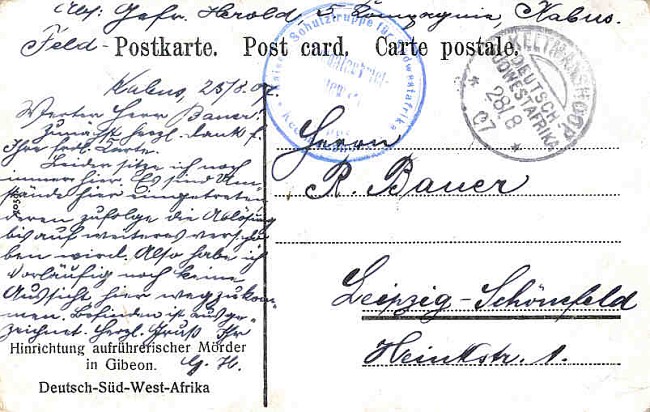
Copyright of Photo: Dr. Klaus Dierks
In the case of the Namibian genocide 1904-1908, consecutive German governments, regardless of their political affiliation, have consistently evaded even a formal political apology for the first genocide of the 20th century. This has been declined on the grounds that it might constitute an argument for the descendants of the surviving Namibians to claim for damages. For instance, the German Social Democratic Chancellor Gerhardt Schröder, during his first visit ever to the African continent in January 2004, visited South Africa and overflow Namibia on his way from South Africa to Ghana. He studiously avoided setting foot in the former German colony and thereby simply evaded this German contribution to Namibia's colonial history. This happened when his Social Democratic ancestor August Bebel made his famous speech before the German Parliament on 17.03.1904, a hundred years ago: He condemned the "suppression war" against the Ovaherero. He further demanded the termination of the war and refused to budget for its continuation. He called the resistance of the Ovaherero a "justified liberation war".
During World War One Ovaherero soldiers under the
command of South African army officers and dispatched by their leader Samuel Maharero,
assisted in the invasion of German SWA. As the South African forces moved on deeper into
SWA, Ovaherero at all levels of society deserted their German employers and returned to
their former areas of living, seek freedom in the bushes, or found employment with the
advancing South African forces. In July 1920, Frederick Maharero, oldest son of Samuel
Maharero, was allowed to visit SWA. Missionaries reported that Maharero was collecting
money from his father’s followers, so that a farm could be bought for Samuel
Maharero. But, Samuel never saw his fatherland again. He died in exile in Serowe in
Bechuanaland on 14.03.1923. On 23.08.1923 Samuel Maharero’s body was brought to
Okahandja. A uniformed Ovaherero honour guard which was led by Hosea Kutako, Samuel’s
sons Traugott and Frederick as well as Mr. Warner, the magistrate of Okahandja, met
Maharero’s coffin as his train steamed into Okahandja station. For three days
Samuel’s remains were placed in state in the house of Traugott Maharero. Samuel
Maharero’s burial in Okahandja on 26.08.1923 – alongside his forefathers –
was a gesture of defiance and a symbol of regained pride for the Ovaherero community.
---
Gender: m
Field of activity: POL
Mother: Katare
Father: Maharero (Kamaharero)
Collections/Papers:
1). NAN: A.200 (Report on burial in Okahandja, including his last message his people)
RAW DATA: Lau 1995:243; DSAB II:428; Pool 1991; Sundermeier 1987; Heywood 1992;
Drechsler 1966: passim; Chronology of Namibian History, 2003 (Dierks); The Namibian
(Kössler and Melber): 06.02.2004;


Copyright of Photos: Dr. Klaus Dierks (Graves of the Maharero
Dynasty: Herero Day: August 2003)
002196
Maharero, Traugott
*
+
---
Traugott Maharero was a son of Samuel Maharero. In August 1916 the South African Administrator’s Office (Administrator: E.H.L. Gorges)
informed that: "Under the German Law no native was allowed to possess any riding
animals or large stock. Contrary to the provisions of this law the acquisition of
livestock is now sanctioned as it will tend to make the Native more contented and law
abiding". In consequence of this policy leaders such as Traugott Maharero were
officially recognised as Ovaherero chiefs. However, on 08.08.1918 Traugott Maharero was
physically assaulted by South African soldiers (Labuschagne and Hendrik Jacobus Uys Janse
van Rensburg) in Okahandja. In January 1922 the Universal Negro Improvement Association
(UNIA) opened a branch office in Windhoek. Ovaherero leaders such as Hosea Kutako, Aron
(John) Mungunda (brother of Kutako who had fought during World War One on the British side
against the Germans in Tanganyika), Traugott Maharero (Chief of the Okahandja-Ovaherero)
and Nikanor Hoveka, later appointed by the South Africans as chief of the Epukiro Reserve,
were the dominating figures of UNIA in Windhoek.
---
Gender: m
RAW DATA: Chronology of Namibian History, 2003 (Dierks);
001708
Maharero, Wilhelm
[Kauaita - Otjiherero name]
* ca.1848
+ 12.12.1880 at Okahandja
---
Wilhelm Maharero was born around 1848. His Otjiherero name was Kauaita. He was a son of
Kamaharero Maharero, one of the first christianised Ovaherero. He was one of the first
students at the Augustineum in Otjimbingwe. He married Magdalena, an Ovaherero teacher who
had been trained in Stellenbosch. He travelled with Palgrave to Cape Town in 1879. He died
in action on 12.12.1880 at Okahandja in a fight against the forces of Jan Jonker
Afrikaner.
---
Gender: m
RAW DATA: Schreiber 1884; Irle 1915; Reith 1982;
001709
Maharero, Wilhelm
*
---
---
Gender: m
RAW DATA: Drechsler 1966:355;
001710
Maharero, Willi
*
---
Willi Maharero was a nephew of Samuel Maharero. He fled to Bechuanaland near Rietfontein.
---
Gender: m
RAW DATA: Drechsler 1966:198;
000981
Mähler, Anna Johanna Maria
[Mähler, Annie - short name]
[Delport, Anna Johanna Maria - birth name]
[van Rooyen, Anna Johanna Maria - remarried name]
* 11.10.1887 in South Africa
+ in South Africa
---
Anna Johanna Maria Mähler, née Delport, was born on 11.10.1887 in South Africa. She
married Oskar Mähler at Schweizer-Reneke on 22.06.1896 and followed her husband to
Namibia, where he bought the farm Gui-|ganabis (Marienthal) with his brother-in-law,
Hermann Brandt. After Mähler's killing by Witbooi-Nama on 04.10.1904, she was given safe
passage to Gibeon by the Witboois. She returned to the Transvaal, where she married Johan
Christiaan van Rooyen.
---
Gender: f
Married to: <1>Ernst Oskar Bernhardt Mähler (-1904), married 1896-1904
<2>Johan Christiaan van Rooyen
Children: Sarah Josephine Lilian (Lilly) Mähler (1897-)
RAW DATA: Zondagh 1991:91-93;
000977
Mähler, Ernst Oskar Bernhardt
*
+ 04.10.1904 at Farm Mariental
---
Ernst Oskar Bernhardt Mähler was a trader and farmer. He purchased the farm Gui-|ganabis
(later named Marienthal) together with his brother-in-law Hermann Brandt from Hendrik
Witbooi on 24.03.1895. He served as a guide and transport rider for the firm Wecke &
Voigts. He was killed by Witbooi fighters, together with his other brother-in-law Izak
Delport, at Mariental on 04.10.1904, while his mother, wife and daughter were given safe
passage by the Witboois to Gibeon.
---
Gender: m
Field of activity: AGR
Married to: Anna Johanna Maria (Annie) Mähler, née Delport, married 1896-
Mother: Josephine Helena Mähler, née Likie (1852-1925)
Father: Karl Bernhard Mähler (-1901)
Children: Sarah Josephine Lilian (Lilly) Mähler (1897-)
RAW DATA: Zondagh 1991:991-94,101;
000978
Mähler, Josephine Helena
[Likie, Josephine Helena - birth name]
* 19.03.1852
+ 14.03.1923 at Mariental
---
Josephine Helena Mähler was born on 19.03.1852 in South Africa. She came in 1901, after
the death of her husband in the Orange Free State, from South Africa to Namibia to live on
her son Oskar's farm Mariental. She died there on 14.03.1923.
---
Gender: f
Married to: Karl Bernhard Mähler (-1901)
Children: Tina Mähler (married Weiland)
Anna Maria Bismarck (Marie) Mähler (married Brandt)
Ernst Oskar Bernhardt Mähler (-1904)
RAW DATA: Zondagh 1991:93-94;
000979
Mähler, Sarah Josefine Lilian
[Mähler, Lilly - short name]
* 10.03.1897 at Otjihavera
---
Sarah Josefine Lilian Mähler was born on 10.03.1897 at Otjihavera. She was baptised by
the Rhenish missionary Heidmann at Rehoboth. she witnessed the killing of her father Oskar
at Mariental on 04.10.1904 but was given safe passage with her mother and grandmother.
---
Gender: f
Mother: Anna Johanna Maria (Annie) Mähler, née Delport (1872-)
Father: Ernst Oskar Bernhardt Mähler (-1904)
RAW DATA: Zondagh 1991:94,101;
000378
Mahomed, Ismail
* .1931 at Pretoria, South Africa
+ 06.2000 at Johannesburg, South Africa
---
Mahomed was born in 1931 in Pretoria and trained as a lawyer in South
Africa. He was admitted as an advocate at the Johannesburg Bar in 1957, where he practiced
under great difficulties as a "non-white" lawyer. He never resided in Namibia,
but was involved in the writing of the Namibian Constitution, and acted in an advisory
capacity to SWAPO. From December 1992 to February 1999, he served in addition to his South
African duties (without pay) as Chief Justice of the Republic of Namibia. In 1996, he was
appointed Chief Justice of South Africa. He died in June 2000 in Johannesburg.
---
Gender: m
Field of activity: LAW
Profession: Lawyer
Functions: Chief Justice of Namibia - 1992-1999
Married to: Hava Mahomed
Namibia National Archives Database
002048
Mahura, Jan
[Molifie, Jan - alias]
[rapiet - alias]
*
---
Jan Mahura was a hunter and trader. He was either a Bechuana or a Griqua. He travelled
with J. Chapman and Edwards from Ngamiland to Walvis Bay in 1855.
---
Gender: m
RAW DATA: Tabler 1973:72;
002076
Majavero, Alfons
[Fumu, traditional title]
*
+
---
Fumu Alfons Majavero, together with Fumu Frans Dimbare, ruled on Tanhwe
Island in the Okavango River as Chief of the Mbukushu area in the Kavango from 1969 until
1991. He was the sixteenth in the recorded genealogy of the Mbukushu kings.
---
Gender: m
Field of activity: POL
RAW DATA: Chronology of Namibian History, 2003 (Dierks);
002075
Makushe, Max, Mbukushu Chief
[Fumu, traditional title]
*
+
---
In the Kavango, Mbukushu King Disho II was deposed by the South Africans in 1947 (due to
alleged illegal hunting of the "royal" game, a hippopotamus) and banned to
Botswana. He was the fourteenth in the recorded genealogy of the Mbukushu kings. From 1947
until 1969 Fumu (traditional title) Max Makushe was the Mbukushu Chief. After him
the Mbukushu Kings Fumu Alfons Majavero and Fumu Frans Dimbare ruled on
Tanhwe Island in the Okavango River.
---
Gender: m
Field of activity: POL
RAW DATA: Chronology of Namibian History, 2003 (Dierks);
001021
Malherbe, Izak Abraham
* 15.10.1914 at Paarl, South Africa
---
Izak Abraham Malherbe was born on 15.10.1914 at Paarl in South Africa. He was educated at
the Paarl Boys High School and the University of Cape Town. He was a Managing Director of
Motors Tractors (SWA) in Windhoek.
---
Gender: m
Field of activity: BUS
Profession: Businessman
Father: I.A. Malherbe
RAW DATA: WWSA 1959;
001022
Malherbe, Petrus Jacobus
* 01.08.1922 at Bloemfontein, South Africa
---
Petrus Jacobus Malherbe was born on 01.08.1922 at Bloemfontein in South Africa. He was
educated at the University of the Orange Free State and Stellenbosch. He was an auditor
and accountant. He became a partner of P.J. Malherbe & Co. and Chairman of the
Rehoboth Beleggings- en Ontwikkelings Korp.
---
Gender: m
Field of activity: BUS
Married to: Wilma Malherbe, née Willemse, married 1951-
Father: Daniel Francois Malherbe
Namibia National Archives Database
000380
Malima, Nashikoto Elizabeth
* .1897 at Omangongo
+ 06.2000 at Windhoek
---
Nashikoto Elizabeth Malima, who was born in 1897 at Omandongo in the Oshikoto Region,
became known as the mother of Andimba Toivo ya Toivo but also as a political activist in
her own right and as a mentor of young SWAPO activists in the 1970s. She lived in Iino,
Omangundu, Omkhozi and Oluno, until South African police harassment forced her to move to
Windhoek in 1980. She died in Windhoek at the age of 103 in June 2002.
---
Gender: f
Married to: Toivo Andimba Uushona Mwandeke (-1935)
Mother: Shinyenge Amutenya
Father: Malima Kamushila
Children: Andimba Herman Toivo ya Toivo
Nestory Toivo
Ester Shikongo
Namibia National Archives Database
001711
Malinowski, Johann
* at Posen, Germany (now Poland)
First entry to Namibia: 1899
---
Johann Malinowski was born at Posen in Germany (now Poland). He was a Roman-Catholic
missionary, of Polish nationality but German citizen. He came to Africa in 1899. He was
ordained as a priest in Pella on 12.11.1899, and stationed in Heirachabis on 26.11.1899.
Having the trust of both sides, he served an important role as peace mediator in several
negotiations between German and !Gami-#nun (Bondelswarts) forces during the German-Nama
War 1903-1907. In April 1905 first peace negotiations between
Germans and Jakob Marengo (Father Johann Malinowski as mediator) were unsuccessful.
Renewed peace negotiations between the Germans and Jakob Marengo
and Cornelius Frederiks in 5Khauxa!nas (again with Father Johann Malinowski as mediator) failed because the
Germans attacked the Nama during the armistice. Lieutenant Thilo von Trotha was killed
during the skirmishes. Apparently because of his financial indiscipline,
which left the Heirachabis mission heavily indebted, Malinowski was recalled to Europe and
spent the rest of his life as spiritual advisor in a nun's convent in Chotieschau in
Czechia.
---
Gender: m
Field of activity: REL
Profession: Missionary
RAW DATA: Wehrl 1994; Drechsler 1966:230-231, 235;
001023
Mandume ya Ndemufayo, Ovamboland (Uukwanyama)
King
* ca.1894
+ 06.02.1917 at Oihole, Angola
---
Mandume ya Ndemufayo became the fifteenth King of Uukwanyama after the death of King Nande
in 1911, at the age of about seventeen. King Mandume was not a
direct descendant of the Uukwanyama kings. Despite some despotic traits of
his rule, he became popular among the people by centralising power and reducing the power
of the nobles, whose strength and arbitrary action had grown under the previous weak
kings. The larger part of Uukwanyama was, according to the colonial delimitation, situated
in Angola, and Mandume was quite successfully fighting the Portuguese military.
In 1914, in southern Angola the Ombandja King Shihetekela Hiudulu was re-organising his resistance against the Portuguese troops. He was able to hand over a large consignment of conquered Portuguese weaponry to his ally, King Mandume ya Ndemufayo. However, during World War One the Portuguese troops forced King Shihetekela to retreat from Ombandja into the Uukwanyama area. On 02.09.1915, the British commander Pritchard (the British had just conquered German SWA) agreed to protect King Mandume ya Ndemufayo against further Portuguese advances from Angola, after Mandume and his fighters failed, despite a three-day battle against Portuguese General Pereira de Eça at Omongwa (16.08.-19.08.1915), to halt the Portuguese invasion into that part of his kingdom.
Consequently Mandume moved his capital from Ondjiva in Angola to Oihole in the south, 6 km north of Odibo in present-day Angola. The Ombandja King Shihetekela supported Mandume. He settled at Etomba. The headman Ndjukuma Shilengifa moved from Oihole to the Omedi area. He later supported the South African forces. The Ovahimba Chief Vita Tom, however, again fought on the Portuguese side. South African officials initially favoured Mandume, whom they perceived as a strong leader who efficiently controlled his subjects. The administration in northern SWA after the SA takeover from Germany was very small in scale. Aside from the military expedition of 1917 aimed at removing Mandume, the South African colonial presence was weak for the first 15 years, and was only consolidated after the serious drought, famine and depression of the late 1920s and early 1930s. On 05.09.1915 Mandume’s capital Ondjiva was taken by the Portuguese. On 11.09. an agreement that resolved the Kunene border "waterfall dispute" was reached between South Africa and Portugal. The disputed 11 km strip (neutral zone) would be jointly administered by the two powers. The 17°23'10" south position was the provisional "cut-line border". Namakunde became the place of residence of a South African and a Portuguese representative. This partitioning of the Uukwanyama area brought Mandume into an impossible situation, where he was forced to defy both the SA and Portuguese authorities. The British demanded from him an undertaking not to fight the Portuguese any more, and to send migrant workers, both of which he refused.
In 1916, in order to secure control
over Ovamboland, and especially over King Mandume ya Ndemufayo, South Africa appointed
Carl Hugo "Cocky" Hahn as Intelligence Officer to gather information on Mandume.
In 1917 King Mandume ya Ndemufayo finally refused to accept the boundary between Angola
and SWA. Therefore the South Africans sent an expeditionary force which
attacked Mandume. SA Colonel M.J. de Jager started moving his
forces against King Mandume’s capital, Oihole on 03.02.1917. On 06.02. Mandume’s
royal residence, although deserted, was destroyed by the South Africans. According to
Uukwanyama oral "evidence", Mandume committed suicide during the ensuing battle.
The South Africans claimed that he was killed by Maxim machine-gun fire, and apparently
they (Lieutenant Thomas Edward Moroney) later decapitated him. A popular
myth has it that the British buried the head under the Mandume Campaign Memorial at the
Windhoek Railway Station. On 18.02.1917 SA Lieutenant Carl Hugo
"Cocky" Hahn witnessed the traditional burial of King Mandume ya Ndemufayo. The
Uukwanyama kingdom was left without an heir to the throne following Mandume’s death. The
memory of Mandume was kept alive and served as an inspiration to the ongoing Namibian
anticolonial resistance struggle. Only in 1998, after the independence of the Republic of
Namibia, Cornelius Mwetupunga Shelungu was sworn in as the new
Uukwanyama King.
---
Gender: m
Field of activity: POL
RAW DATA: Kotse/Botha/van Staden; An alleged signature by Mandume's own hand is reproduced
in: Keiling: Quarento años de Africa, p.176; Chronology of Namibian History, 2003
(Dierks);

Copyright of Photo: Namibia Scientific Society
001713
Manning
*
---
In 1878, clerk and deputy of Palgrave; 1879, government official in Walvis Bay.
---
Gender: m
RAW DATA: Tabler 1973:72;
001026
Manning, Peter
*
---
Peter Manning was a full-time functionary of SWAPO in Namibia between 1976 and 1978. He
went into exile, and in 1978-1989 he was based in SWAPO's London Office as information
officer.
---
Gender: m
Field of activity: POL
001656
Mannhardt, Johannes
* 26.04.1880
---
Schutztruppe officer.
---
Gender: m
Field of activity: MIL
Profession: Military officer
RAW DATA: Fischer 1935:260;
001027
Mans, Philip Gert
* 02.03.1927 at Carnarvon, South Africa
First entry to Namibia: 1952
---
Philip Gert Mans was born on 02.03.1927 at Carnarvon in South Africa. He came to Namibia
in 1952. He was the Managing Director of Furniture Packers and Removers (Pty) Ltd.
---
Gender: m
Field of activity: BUS
Profession: Businessman
Married to: Anna Mans, née Visser, married 1952-
Father: John Mans
Namibia National Archives Database
001657
Mansfeld, Arthur
* 21.01.1869
---
Schutztruppe officer.
---
Gender: m
Field of activity: MIL
Profession: Military officer
RAW DATA: Fischer 1935:143;
000715
Marais, Charl Francois
* 02.05.1904 at Maraisburg, South Africa
First entry to Namibia: 1955
---
Charl Francois Marais was born on 02.05.1904 at Maraisburg in South Africa. He was
educated at Maraisburg, Villiersdorp and the University of Pretoria in South Africa.
In 1924 he joined the South African Civil Service. In 1944 he was a Magistrate and in 1950
a Senior Magistrate. In 1952 he became an Assistant Secretary in the South African
Department of Justice and in 1954 Under-Secretary. On 01.07.1955 he was transferred to the
SWA Administration. He became the Secretary for South West Africa as from the 03.08.1957.
He was the Chairman of the SWA Tender Board, the SWA Import Control Committee, the Land
Bank Board, the Farming Interests Board, the SWA Diamond Board, the Fisheries Development
Board and the Municipal Advisory Board.
---
Gender: m
Field of activity: ADM
Profession: Civil servant
Married to: Anna Cecilia Marais, née du Plessis, married 1930-
Father: Gert Hendrik Pretorius Marais
RAW DATA: WWSA 1959;
000755
Marais, Francois Johannes
* 06.02.1902 at Ebenezer, South Africa
First entry to Namibia: 1926
---
Francois Johannes Marais was born on 06.02.1902 at Ebenezer in South Africa. He was
educated at the University of Cape Town and the Trinity College in the United Kingdom. He
was a medical practitioner. He came to Namibia in 1926. He was the Resident Medical
Officer Windhoek since 1930. He was the Chairman of the United Building Society, the
Chairman of the United National South West Party and the Deputy Mayor of Windhoek from
1957 to 1958.
---
Gender: m
Field of activity: MED POL
Married to: Julia Marais, née Rood, married 1929-
Father: Francois Johannes Marais
RAW DATA: WWSA 1959;
001714
Marais, Pieter
*
First entry to Namibia: 1761
Last departure from Namibia: 1762
---
Participant of Hendrik Hop's expedition to Namibia, 1761/62.
---
Gender: m
Namibia National Archives Database
001715
Maratjo
*
---
---
Gender: m
RAW DATA: Drechsler 1966:176;
000756
Marchand, Jacques
*
---
French anti-apartheid activist. Was President of the Mouvement Anti-Apartheid in Paris.
---
Gender: m
Namibia National Archives Database
000368
Marcks, Gerhard
* .1889 in Germany
+ .1981
---
Gerhard Marcks was one of the greatest German sculptors of the 20th century and made
several study tours to Africa, including Namibia, resulting in a number of impressive
sculptures and graphic art. His life-size sculpture of a Ovaherero woman in traditional
dress and several graphic sheets are held by the National Art Gallery of Namibia.
---
Gender: m
Field of activity: ART
Namibia National Archives Database
000049
Marengo, Jakob
[Marengo, Jacob - alternative spelling]
[Marenga, Jakob - alternative spelling]
[Marengo, Jacob - alternative spelling]
[Marinka, Jakob - alternative spelling]
[Morenga, Jakob - alternative spelling]
* ca.1875 at Vaalgras (Koichas)
+ 20.09.1907 at Eenzamheed, South Africa
---
Jakob Marengo was born around 1875, probably at Vaalgras (Koichas) some 60 kilometres east
of Tses. Bishop John Marie Simon, then the priest at the Pella Roman Catholic
Mission station, just south of the Oranje River in the South African Cape Colony, recorded
that Marengo had a Ovaherero father and a !Gami-#nun mother, although the names of his
parents have not been ascertained. Marengo was probably brought up by a man known as
Carolus Damara, who later lived in Simon's parish at Pella, after he and his family had
been converted to Catholicism. The name "Marengo" appears in a variety of
spellings in the documentary record, and is probably derived from the Mbanderu name
Marenga. Today a Nama speaking Ovaherero Community still lives at Koichas, in the vicinity
of Vaalgras. Many of his early biographical details are only based on oral evidence, such
as the information that he has worked as a labourer/clerk at the O'okiep copper mines in
the Cape Colony in South Africa, and that he allegedly visited Germany in the company of a
missionary. He was the famous warrior leader of the !Gami-#nun (Bondelswarts) in the
anti-colonial resistance war against the Germans from 1903-1907, whose strategic
brilliance and bravery was much commented upon by his enemies. A highly acclaimed novel by
the German writer Uwe Timm made his name (in the spelling "Morenga", probably
reflecting the similarity to a name of a German Schutztruppe soldier with the
same name) known to a broad audience in German-speaking countries.
Marengo was a leader in the Bondelswart rising in 1903, which was quelled by German troops with Witbooi auxiliaries in January 1904. On 10.12.1903 a battle was waged at the south-eastern edge of the Great Karas Mountains in which H. von Burgsdorff and his Witbooi Nama allies defeated the Bondelswarts under the command of Jakob Marengo and Abraham Morris. The latter, who had a Scottish father and a !Gami-#nun mother, became Marengo’s military right hand. Jakob Marengo continued the war in the Great Karas Mountains where, as reported by Leutwein, Marengo exercised an "unusual human war style". Two days later Lieutenant Böttlin was defeated by the Bondelswarts in the battle of Hartebeestmund at the Oranje River. Böttlin and some of his men were wounded. They were taken across the river to British territory, to the Roman-Catholic mission station at Pella. He escaped later to the Cape Colony, but returned to Namibia even before the great Nama rising in October 1904, and fought many battles all over southern Namibia against the German Schutztruppe, his main base being the Karas Mountains (with possible ||Khauxa!nas in the eastern part of the Great Karas Mountains being his hidden mountain fortress). His skillful guerrilla tactics gave the Germans a hard time.
His first attack on a German unit at ||Khauxa!nas (Gugunas) on 30.08.1904 commenced the Great Resistance War of the Nama communities against the Germans from 1904 to 1908 (some skirmishes were waged until 1913), in which German Commander Lieutenant Nikolai von Stempel was killed. At the beginning of September 1904 he was involved in two skirmishes with the Germans under the command of Major von Lengerke, first in Garabis and then in Platbeen. One of the "white" allies of Marengo was George St. Leger Lennox (nickname Scotty Smith). A further encounter between Marengo and the Germans in Gais (Geis), north of Kanus, ended with losses for the Germans. On 02.11.1904 Marengo attacked the German military station at Hasuur. The Germans were forced to flee over the border into British territory. Three days later he was involved in a skirmish with the Germans at Umeis, south of Warmbad. On 25.11.1904 the battle of Alurisfontein, south of Warmbad, was fought between the Germans under Captain von Koppy and Lieutenant Count Kageneck and Jakob Marengo with Johannes Christian, Captain of the !Gami-#nun. Lieutenant von Heydebreck was killed. The battle ended with heavy losses for the Germans. Two days later Warmbad was attacked by Jakob Marengo and his second-in-command, Abraham Morris. At the beginning of March 1905 Captain Kirchner was defeated by Jakob Marengo in the battle of Aob. On the 11.03 1905 the battle of Narudas ("Robber Henrick’s Place") was fought against three German sections under Major von Kamptz and Captain Friedrich von Erckert (in presence of the commander of the southern front, Colonel Berthold von Deimling)(coming from the west), Captain von Koppy (coming from the south) and Major von Lengerke (sealing off the east). Marengo and Abraham Morris were defeated and escaped in the direction of 5Khauxa!nas. Marengo was wounded during the battle. After the battle of Narudas a three kilometre German column of wagons with captured material headed for Keetmanshoop. In spite of Marengo’s injury, a battle was fought between him and the Germans at Uchanaris, 60 km south east of Keetmanshoop. The Germans suffered more casualties than they had at Narudas. The Nama managed to recover some of their material losses suffered at Narudas.
In April 1905 first peace negotiations between Germans and Marengo (Father Johann Malinowski as mediator) were unsuccessful. In April 1905 Jakob Marengo attacked a German military post under the command of Captain d’Arrest at Narudas. The Germans suffered losses. Some days later the united forces under Jakob Marengo and Cornelius Frederiks of the !Aman (Bethany Nama) attacked the Germans under Von Kamptz at Ganams, with heavy losses for the latter. In May 1905 various battles and skirmishes were fought around 5Khauxa!nas between the Germans and Marengo. On the 19.05.1905 Jakob Marengo suffered losses in the skirmish of Leukop near the British border against the Germans under the command of Captain Siebert. Some Nama soldiers escaped into British territory, returned, however, in the next couple of days. In June 1905 a battle was fought at Narus at the upper reaches of the Kareb River south of 5Khauxa!nas between the Germans and Jakob Marengo with Jan Hendrik of the 5Hawoben as his ally, with heavy casualties for the Germans. Renewed peace negotiations between the Germans and Jakob Marengo and Cornelius Frederiks in 5Khauxa!nas failed because the Germans attacked the Nama during the armistice. Lieutenant Thilo von Trotha was killed during the skirmishes. On 03.07.1905 Jakob Marengo attacked the Germans at Wasserfall. In September 1905 The battle of Nochas was fought between Jakob Marengo and Johannes Christian of the !Gami-#nun and the Germans under Von Erckert. After the battle Marengo and Christian moved southwards. On their way to the Oranje River they intercepted a German supply convoy at Naruchas, south-west of Kalkfontein- Süd (present-day Karasburg). On 23.09.1905 Marengo continued his attacks on the Germans at Oas. Five days later he and Johannes Christian attacked Heirachabis. Early in October 1905 Marengo and Christian attacked and destroyed a small German reconnaissance post at Jerusalem, south of Heirachabis. They then moved south to the Oranje River where they attacked the military border post of Schuitdrift (Naob)(Groendorn)(10.10.). On 24./25.10.1905 the battle of Hartebeestmund near Pelladrift on the Oranje River was fought between Jakob Marengo with Johannes Christian and the Germans, with heavy losses for the Germans (three officers were killed, three were wounded and 14 soldiers were killed, 35 wounded).
After Captain Hendrik Witbooi was killed in action on 29.10.1905 at Vaalgras/Koichas, Marengo continued the war. On 05.01.1906 the battle of Duurdrift South was fought between Jakob Marengo and the Germans under Captain von Lettow-Vorbeck. At the beginning of March 1906, the battle of Wasserfall at the Oranje River was fought by Johannes Christian, Jakob Marengo and Abraham Morris against the Germans under Beyer. On 11.03.1906 Marengo was involved in a skirmish at Pelladrift. One day later he was defeated by the Germans under Von Erckert and Von Hornhardt in the battle of Kumkum. Marengo escaped in the direction of the Great Karas Mountains. On 21.03.1906 Marengo and Christian again attacked the German military post at Jerusalem. After the encounter the two leaders decided to split forces. Christian turned westwards, while Marengo moved north. Five days later Marengo attacked a German supply convoy near Ukamas. On 05.04.1906 Marengo was engaged in a skirmish with the Germans (Lieutenant von Mielczewski) on the road between Nababis and Ukamas. Three days later the battle of Fettkluft was fought by Jakob Marengo with Abraham Morris and again with Johannes Christian against the Germans under Heuck, with heavy losses for the Germans. On 10.04.1906 Jakob Marengo continued his attacks on the Germans at Oas. Four days later a skirmish took place at Narudas ("Robber Henrick’s Place") between the Germans and Marengo. On 18.04.1906 he was encountered in a skirmish at Klipdam at the border between SWA and the Cape Colony. After this, he was, in the face of superior German forces, forced to escape to the British Cape Colony.
On 04.05.1906 Marengo surrendered to the British
Cape Police after being defeated by Captain Bech’s troops in the battle of Van
Rooysvley in the Cape Colony, with a loss of 23 of his soldiers. He was transferred by the
British to the railhead at Prieska and from there to Cape Town, to the Tokai prison. In
June 1907 the British in the Cape Colony released Jakob Marengo from Tokai prison in Cape
Town. He was instructed to report to the Civil Commissioner at Upington where he was
ordered not to cross the border into German South West Africa. In spite of this order
Marengo crossed into SWA at Gamsib Ravine (probably during July or August 1907). On
26.08.1907 Captain von dem Hagen co-ordinated the German troops with the British ones in
Cape Town. It was decided to mount a common action against Marengo on 01.09. in order to
prevent Jakob Marengo from uniting his forces with those of Simon Koper of the
!Khara-khoen. On 20.09.1907 the unified German-British efforts were eventually successful.
Jakob Marengo was killed in action by a South African patrol under the command of Major
Elliot in Eenzamheed in the Cape Colony. His son, Samuel Marengo, his nephews, Michael
Marengo, Hendrich Marengo and Johannes Marengo and his secretary Saul Damara were killed
together with him. Petrus Marengo escaped. An ex-combatant at the battle of Narudas
("Robber Henrick’s Place") in March 1905 paid later tribute to Jakob
Marengo: "In those old days, forty years ago, South West was still a wild country.
... Perhaps that is the reason why Jakob Marengo has received no recognition from any one
for his outstanding intelligence and bravery, but I am sure that there are many old people
still alive who like me would bow their heads in respect at the grave of Jakob
Marengo".
---
Gender: m
Field of activity: MIL
Children: Petrus Marengo, Samuel Marengo: also killed in the battle of Eenzamheed, Charly
Marengo: born 1901 and died 28.08.1989 in Kakamas in South Africa, buried at
Vaalgras/Koichas.
RAW DATA: Dt. Koloniallexikon; Lau 1995:243; DSAB III:647;
Drechsler 1966:204-360; Chronology of Namibian History, 2003
(Dierks); Dierks 1992:52-53;

Copyright of Photo: Dr. Klaus Dierks
001716
Marengo, Petrus
*
---
A son of Jacob Marengo.
---
Gender: m
RAW DATA: Drechsler 1966:232;
000231
Maria
*
---
Maria was born of Ovaherero parents. She was taken prisoner and raised by the Orlam
Afrikaners. She was sent to Otjikango by Jonker Afrikaner to work as interpreter for Carl
Hugo Hahn.
---
Gender: f
Namibia National Archives Database
000085
Martin, Henno, Prof. Dr.
* 15.03.1910 at Freiburg/Br, Germany
+ 01.1998 at Göttingen, Germany
First entry to Namibia: 1935
---
Henno Martin was born on 15.03.1910 at Freiburg/Breisgau, Germany. He received his
schooling in Freiburg (Abitur 1930). He studied geology in Bonn, Zürich and Göttingen.
He completed his doctoral dissertation under Prof. Hans Cloos at the University of Bonn in
1935. Being opposed to the Nazi regime, he emigrated in 1935 under the guise of a research
trip to Namibia, together with his like-minded friend, the geologist Hermann Korn. Both
researched the Namib and Naukluft geology, and after their funds were exhausted, they
worked as free-lance consultants, mainly in water exploration. During World War Two, the
two geologists were threatened by internment as enemy aliens and went into hiding in the
desert, from May 1940 until Korn's deteriorating health forced them to surrender
themselves to the South African authorities in September 1942. However, they were not
interned but allowed to carry on working as geologists. After Korn's death in 1946, Martin
stayed in Namibia as head of the Geological Survey. From 1958 to 1960 he lectured as
Professor of Geology at the University of Sao Paulo. In 1963 he became Director of the
Precambrian Research Unit at the University of Cape Town, and in 1965 he was called back
to Germany as Professor and Director of the Geological-Paleontological Institute of the
University of Göttingen, where he continued research on Namibian geology in the context
of the German research group "Sonderforschungsbereich 48". He stayed in
Göttingen after his retirement in 1975, until his death in January 1998. Martin's work
was extremely important in the geological research of Namibia, southern Africa, and the
continental drift theory. Apart from his very productive scientific career, Henno Martin
became known to a wide public by bis book "Wenn es Krieg gibt, gehen wir in die
Wüste" about his Robinson life with Hermann Korn in the Namib Desert (first
published in 1956). The book became very popular and until 1998 saw a number of reprints,
an English translation "The sheltering desert" as well as a French and an
Afrikaans translation, and was also filmed in 1999. The Geological Society of Namibia
instituted an annual "Henno Martin Medal" to honour the best scientific
publication of a geologist in Namibia.
---
Gender: m
Field of activity: NAT WRI
Profession: Geologist
Functions: Head - Geological Survey of SWA - 1947-1967
Namibia National Archives Database
002031
Masche, Bernd
*
---
Bernd Masche joined Namibia Breweries Limited in September 1968 as technical manager. He
served as a Managing Director from 1992 to 2003.
---
Gender: m
Field of activity: BUS
RAW DATA: New Era 01-03.8.2003;
002066
Mashambo, Mbukushu King
*
+ before 1850
---
In the Kavango, one of the earliest known Mbukushu Kings was Mashambo. He was the fifth in
the recorded genealogy of the Mbukushu kings. He succeeded King Kasimana. No life dates
could be traced so far. Successor was King Mbungu (before 1850).
---
Gender: m
Field of activity: POL
RAW DATA: Chronology of Namibian History, 2003 (Dierks);
000726
Masjeb
*
---
Listed as a creditor in Witbooi's "Debt Book", 1888. No further details known. A
trader in Walvis Bay?
---
Gender:
Namibia National Archives Database
000074
Massmann, Ursula
[Massmann-Schenk, Ursula - married name]
* 21.10.1911 at Windhoek
+
---
Ursula Massmann was born on 21.10.1911 in Windhoek. She received her schooling in Germany
and training at the "Koloniale Frauenschule" in Rendsburg. She returned to
Namibia and worked in various occupations, in particular in the karakul industry. She was
a researcher in local history and an archivist of the Sam Cohen Library (Swakopmund).
---
Gender: f
Namibia National Archives Database
002083
Mate I, Uukwangali Queen
[Hompa, traditional title]
*
+ around 1750
---
In the Kavango, the earliest recorded Uukwangali Queen was Mate I. She ruled around 1750.
She left the Mashi area and settled in present-day Kavango, west of Nkurenkuru in today's
Angola. Her sister, Kapango, settled in the Mbunza area of the Kavango. This resulted in
the establishment of the two kingdoms in the western Kavango, the Uukwangali Kingdom and
the Mbunza Kingdom. The possible successor of Hompa Mate I was Queen Nankali
(between 1750 and 1775).
---
Gender: f
Field of activity: POL
RAW DATA: Chronology of Namibian History, 2003 (Dierks);
002086
Mate II, Uukwangali Queen
[Hompa, traditional title]
*
+ .1818
---
In the Kavango, one of the earlier recorded Uukwangali Queens was Mate II. She was the
fourth in the recorded genealogy of the Uukwangali kings and queens. She ruled from 1800
until 1818. She was followed by King Siremo (between 1818 and 1822).
---
Gender: f
Field of activity: POL
RAW DATA: Chronology of Namibian History, 2003 (Dierks);
002049
Matross, Abraham
* in South Africa
---
Abraham Matross was a hunter, trader, wagon driver and servant. He was a Nama from South
Africa who was with J. Chapman on his journeys from 1852 to 1855. It is reported that he
was hunting in the Namibian north in 1876 and 1878.
---
Gender: m
RAW DATA: Tabler 1973:72-73;
002116
Matsharatshara, Yeyi (Mayeyi) Chief
[Shikati, traditional title]
*
+ .
---
Around 1750 the community of the Yeyi (Mayeyi) lived in present-day Caprivi
Strip. They moved from Diyeyi (land of the Yeyi) in the area of Linyanti under the
leadership of three group leaders Shikati Hankuze, Shikati Qunku
together with his brother Qunkunyane and Shikati Matsharatshara into the Okavango
Delta in present-day Botswana. Later they moved back into the Caprivi Strip, to Linyanti
and Sangwali.
---
Gender: m
Field of activity: POL
RAW DATA: Chronology of Namibian History, 2003 (Dierks);
001717
Mattenklodt, Wilhelm
* at Lippstadt, Germany
+ 08.1931 at Swakopmund
First entry to Namibia: 1908
---
Wilhelm Mattenklodt was a farmer and Schutztruppe soldier who in 1916 escaped from British
custody. He lived for two years as an outlaw with extended travels in northern Namibia,
and finally escaped with two other fugitives (Feuerstein and Voswinckel) 1919 into Angola,
and 1920 to Germany. He later wrote a "classic" of German colonial literature
about it: "Verlorene Heimat" (Berlin 1928). The epic escape became part of the
mythology of "German Southwesters", and has been described in several books as
well as widespread orature. Mattenklodt travelled again to Angola as a big game hunter,
caught sleeping sickness and died of it in Swakopmund in August 1931.
---
Gender: m
Field of activity: AGR WRI
Namibia National Archives Database
001035
Matthews, Desmond O'Neil
* 13.01.1923 at Swakopmund
---
Desmond O'Neil Matthews was educated at the Diocesan College at Rondebosch in South
Africa. He served in the South African Air Force during World War Two from 1940 to 1946,
in the rank of a Captain. He was a businessman, Director of Trust Mining Co., United
Building Society, Oamites Mining Co., Anglovaal S.W.A., Falconbridge of S.W.A and Metje
Ziegler. He was the Chairman of the SPCA and the Secretary of the Association of Mining
Companies.
---
Gender: m
Field of activity: BUS
Profession: Businessman
Married to: Gladys Ursula Matthew's, née Wecke, married 1949-
Father: Charles Wheatley Matthew's
RAW DATA: WWSA 1974;
000933
Matjila, Andrew Nick
*
---
Andrew Nick Matjila worked from 1964 until 1975 in Katima Mulilo, first as teacher, later
as school inspector. From 1976 to 1980 he worked for the Caprivi Bantustan government and
as advisor and translator for Turnhalle politicians. In 1981, he attended the Geneva
Namibia Conference as member of the DTA delegation. In 1982 he was appointed by the first
Interim Government to the Government Service Commission. He served Minister of National
Education in the second Interim Government (Transitional Government of National Unity
(TGNU)) before independence.
---
Gender: m
Field of activity: POL
Profession: Teacher
Namibia National Archives Database
000939
Maul, Gerhard Helmut, Dr.
[called himself Dr. Elmau]
* 14.01.1913 at Windhoek
---
Gerhard Maul was born on 14.01.1913 at Windhoek. He was educated at Windhoek, Saalfeld in
Germany, the Universities of Hamburg, Rostock, München, Berlin, Münster. He was a
medical doctor.
---
Gender: m
Field of activity: MED
Profession: Physician
Married to: Ingrid Maul, née Thielmann, married 1955-
Father: Franz Bernhard Maul
RAW DATA: WWSA 1959;
000940
Max, Gerson
*
---
Reverend Gerson Max was particularly involved in the spiritual care for migrant workers, a
subject which he also worked on for an academic thesis.
---
Gender: m
Field of activity: REL
Profession: Clergy
Namibia National Archives Database
001037
May, Abraham Bernard, Dr.
*
---
Abraham Bernard May was educated at the University of Cape Town and the Edinburgh
University, Royal College of Surgeons. He was a medical doctor. He was a district surgeon
and resident medical officer, later in Windhoek. He was the Mayor of Windhoek from 19?? to
??.
---
Gender: m
Field of activity: MED
Profession: Physician
Married to: Myrtle May, née Rosen, married 1940-
Father: Jeanot May
RAW DATA: WWSA 1959, 1974;
000893
Mbamba, Alpo Mauno
* in Namibia
+ .2002 at Paris, France
---
---
Gender: m
Field of activity: EDU
Married to: Sarah Karwitha Mbamba
Children: Christopher Mbamba
Namibia National Archives Database
002080
Mbanbangandu II, Shambyu King
*
+
---
In the Kavango, the Shambyu King Mbanbangandu II got blind in 1947. He was succeeded by
Queen Maria Mwengere (1947-1987).
---
Gender: m
Field of activity: POL
RAW DATA: Chronology of Namibian History, 2003 (Dierks);
002097
Mbandu, Uukwangali King
[Hompa, traditional title]
*
+ .1977
---
In the Kavango, Uukwangali Queen Kanuni was deposed by the South African Native
Commissioner, Harold Eedes and sent into exile to Angola in 1941. Eedes appointed Hompa
Sivute to rule the Uukwangali area until his death in 1958. 1958 Queen Kanuni returned to
Namibia and ruled until her death in 1971. She was succeeded by King Mbandu who ruled
until his death in 1977. He was the fifteenth in the recorded genealogy of the Uukwangali
kings. Mbandu was followed by Hompa Daniel Sitendu Mpasi (1977-).
---
Gender: m
Field of activity: POL
RAW DATA: Chronology of Namibian History, 2003 (Dierks);
001038
Mbauka, Gottlob
*
---
Gottlob Mbauka was the Chairman of the Legislative Assembly of the Herero Bantustan from
19?? to 1987. He was the Chairman of the Executive Committee of the Herero Bantustan from
1987 to independence.
---
Gender: m
Field of activity: POL
RAW DATA: Namibia-Pressedienst 21.09.1987;
000780
Mbingilo, Samuel Natangwe
* 13.02.1976
+ 09.06.2002
---
Artist.
---
Gender: m
Field of activity: ART
Profession: Artist
Namibia National Archives Database
002101
Mbololo, (Last) Kololo King
*
+
---
Kololo King Mbololo (1862-1864) was deposed by Lozi King Lewanika from the Barotse Kingdom
in current-day Zambia (1864-1909). Lewanika expelled the Kololo people from the Caprivi
Strip. Mbololo shifted his capital from Linyanti to Sesheke-Mwandi (not to be confused
with Sesheke opposite Katima Mulilo in present-day Zambia). But the Kololo rule couldn't
survive and disappeared.
---
Gender: m
Field of activity: POL
RAW DATA: Chronology of Namibian History, 2003 (Dierks);
002193
Mbondo, Ovaherero Chief
*
+
---
In ca. 1820 Maharero (or Kamaharero) was born to Ua Tjirue
Tjamuaha and his first wife Otjorozumo, daughter of Ndomo, daughter of Peraa, daughter of
Mbondo, daughter of Mukuejuva of the eanda yomukueyuva (community or clan).
---
Gender: m
Field of activity: POL
Profession: Traditional leader
Functions: Chief - Ovaherero - before 1810
RAW DATA: Chronology of Namibian History, 2003 (Dierks);
002277
Mbulungundju, Ovamboland (Uukwambi) King
*
+
---
The third Uukwambi King on record was King Mbulungundju. He
followed King Nakano. He ruled before 1750. The first seven Uukwambi kings cannot be
dated. His successor was the fourth Uukwambi King Niigogo ya Natsheya.
---
Gender: m
Field of activity: POL
RAW DATA: Chronology of Namibian History, 2003 (Dierks);
001039
Mbumba, Nangolo
* 15.08.1941 in Olukonda
---
Nangolo Mbumba was born on 15.08.1941 in Olukonda. He was educated at the Oshigambo High
School (1962-1965). He subsequently went into exile. Mbumba studied biology at the
University of Connecticut (M.Sc.). From 1980 to 1985 he was the Head of the Namibia Health
and Education centre in Kwanza Sul in Angola. From 1986 until 1988 he was the Deputy
Secretary for Education of SWAPO. From 1988 until 1989 he was the Head of the Teacher
Training Department at the United Nations Institute for Namibia in Lusaka. Mbumba returned
to Namibia in 1989. He was elected to the Constituent Assembly. He was appointed as
Secretary to the Cabinet from 1990 to 1991, then Namibia's Special Representative to the
Joint Administration of Walvis Bay from 1991 to 1993. He became the Minister of
Agriculture, Water Affairs and Rural Development in 1993 until 1996 and Minister of
Finance from 1996 to 2003. As from 2003 he serves as Minister of Information and
Broadcasting. Since 1993 he is a Member of the National Assembly.
---
Gender: m
Field of activity: POL
Married to: Sustjie Mbumba
RAW DATA: WWSA 1996; Chronology of Namibian History, 2003 (Dierks);
002094
Mbuna, Uukwangali King
[Hompa, traditional title]
*
+ .1926
---
In the Kavango, Uukwangali King Kandjimi Hawanga died in 1924 and was succeeded by Hompa
Mbuna who ruled the Uukwangali area until his death in 1926. He was the twelfth in the
recorded genealogy of the Uukwangali kings. Mbuna was followed by Queen Kanuni who ruled
until 1941 and again from 1958 until 1971.
---
Gender: m
Field of activity: POL
RAW DATA: Chronology of Namibian History, 2003 (Dierks);
002189
Mbunga, Ovaherero Chief
*
+
---
Setting out from the Kaokoveld, Ovaherero leader Mutjise, son of Mbunga,
son of Tjituka, son of Kasupi, son of Vatje, son of
Kengeza of the oruzo orwohorongo (community or clan, also religious group from the
father’s side, while eanda is a socio-economic group to which the mother
belongs), moved to Okahandja (probably after 1785). He was followed by Ovaherero Chief Mutjise.
---
Gender: m
Field of activity: POL
Profession: Traditional leader
Functions: Chief - Ovaherero - before 1750
RAW DATA: Chronology of Namibian History, 2003 (Dierks);
002067
Mbungu, Mbukushu King
*
+ before 1850
---
In the Kavango, one of the earliest known Mbukushu Kings was Mbungu. He was the sixth in
the recorded genealogy of the Mbukushu kings. He succeeded King Mashambo. No life dates
could be traced so far. Successor was Queen Rukonga (before 1850).
---
Gender: m
Field of activity: POL
RAW DATA: Chronology of Namibian History, 2003 (Dierks);
001018
Mc Donald, Hermanus Johannes
* 24.08.1908 at Warmbad
---
Hermanus Johannes Mc Donald was born on 24.08.1908 at Warmbad. He was educated at Warmbad
and Keetmanshoop. He was a farmer. He was a Member of the Executive Committee of the
United National Southwest Party.
---
Gender: m
Field of activity: AGR
Profession: Farmer
Married to: Lousia Maria Mc Donald, née Nyhof, married 1938-
Father: Michael Charles Edward Mc Donald
RAW DATA: WWSA 1959;
001017
Mc Connell, James Peter Stroyan
* 14.09.1910 at Sterkstroom, South Africa
---
James Peter Stroyan Mc Connell was born on 14.09.1910 at Sterkstroom in South Africa. He
studied medicine at the Glasgow University in the United Kingdom. He was the Admiralty
Surgeon at Walvis Bay.
---
Gender: m
Field of activity: MED
Profession: Physician
Married to: Agnes Nisbet Mc Connell, née Mc Quistan, married 1936-
Father: James Peter Mc Connell
RAW DATA: WWSA 1959;
001019
Mc Hugh, Michael Francis Joseph
* 27.09.1890 at Malahide County, Ireland
---
Michael Francis Joseph Mc Hugh was born on 27.09.1890 at Malahide County in Ireland. He
was educated in Dublin. He came to South Africa in 1904, and to Namibia in ??. He retired
as magistrate, and was a farmer.
---
Gender: m
Married to: Anne Florence Mc Hugh, née Gair, married 1919-
Father: John Mc Hugh
RAW DATA: WWSA 1959;
001020
Mc Kimmie, Robert
*
---
Robert Mc Kimmie was a trader and hunter in Namibia. He obtained sole rights to prospect
for minerals in Hendrik Witbooi's territory, together with Robert Duncan and Robert Lewis.
He was arrested in 1894 by the German Schutztruppe on charge of supplying smuggled weapons
to the Witboois.
---
Gender: m
Field of activity: BUS
Profession: Trader
Collections/Papers:
1). NAN: A.154 (Letters i.c.w. affairs in Namibia, 1893-1894)
001730
Meier, Friedrich
* 18.03.1873 at Barmen, Germany
+ .1928
First entry to Namibia: 1901
---
Friedrich Meier was born on 18.03.1873 at Barmen in Germany. He was a missionary of the
Rheinische Missionsgesellschaft. he came to Namibia 1901 and was stationed at Windhoek.
---
Gender: m
Field of activity: REL
Profession: Missionary
Married to: Emma Meier, née Ermshaus, married 1904-
RAW DATA: Drechsler 1966:161, 296;
000881
Meinert, John Christian Theodor
* 09.12.1886 at Hamburg, Germany
+ 10.11.1946 in Windhoek
First entry to Namibia: 1906
---
John Christian Theodor Meinert was born on 09.12.1886 at Hamburg in Germany. He came to
Namibia in 1906, first as a businessman in Gobabis. In 1913 he took over as managing
director of the Windhuker Druckerei, and on 01.07.1917 he bought the firm, which over the
decades was the largest printing house in Namibia and also a publishing house. In 1924 he
bought the Swakopmunder Buchhandlung and amalgamated both firms into John Meinert Ltd.
Meinert was also very active in community affairs and served as Windhoek's Mayor from
19??-19?? and as President of the Namibia Scientific Society 1935-1937. He died on
10.11.1946 in Windhoek.
---
Gender: m
Field of activity: BUS
Profession: Businessman
Functions: Mayor - Windhoek
President - SWA Scientific Society - 1935-1937
Children: John Hinrich Meinert (1917-)
RAW DATA: Mitt.SWAWG 43,4-6; WWSA 1929/30; SWA Annual 1975:31;
000891
Meinert, John Hinrich
* 06.05.1917 at Windhoek
---
John Hinrich Meinert was born on 06.05.1917 at Windhoek. He was educated at Rondebosch in
South Africa. He was the Managing Director of John Meinert and Director of the Deutscher
Verlag.
---
Gender: m
Field of activity: BUS
Married to: Ursula Elisabeth Meinert, née Gusinde, married 1941-
Father: John Christian Theodor Meinert (1886-1946)
RAW DATA: WWSA 1959;
001040
Meinert, Jürgen Christian
* 11.01.1919 at Windhoek
---
Jürgen Christian Meinert was born on 11.01.1919 at Windhoek. He was educated at the
Rondebosch Boys High School and the University of Cape Town in South Africa. He was the
Joint Managing Director of John Meinert (Pty) Ltd. and President of the SWA Chamber of
Printing. He was the local director of the SAPM Building Society and the CNA.
---
Gender: m
Field of activity: BUS
Married to: Cynthia Joyce Meinert, née Wadley, married 1943-
Father: John Christian Theodor Meinert (1886-1946)
RAW DATA: WWSA 1959, 1974;
000885
Meiring, Albert J.D., Dr.
* .1899 at Edenburg, South Africa
+ .1986 at Potchefstroom, South Africa
First entry to Namibia: 1957
Last departure from Namibia: 1960
---
Albert J.D. Meiring was born on 1899 at Edenburg in South Africa. He studied zoology at
Bloemfontein (doctorate in 1936). In 1938 he was teaching at the University of Fort Hare.
In 1951 he was appointed to the Museum in Bloemfontein and from 1957 to 1960 to the State
Museum in Windhoek. From 1960 to 1968 he was a Professor of Zoology at the University of
Fort Hare. From 1958 until 1959 he was the President of the SWA Scientific Society.
---
Gender: m
Field of activity: SCI
Profession: Zoologist
Functions: President - SWA Scientific Society - 1958-1959
RAW DATA: Mitt.SWAWG 43,4-6;
001041
Meiring, George Lodewyk
* 18.10.1939 at Ladybrand, South Africa
First entry to Namibia: 1983
---
George Lodewyk Meiring was born on 18.10.1939 at Ladybrand in South Africa. He studied
physics at the University of the Orange Free State in South Africa. He joined the South
African Army as a Captain in 1963. In 1981 he became Chief of Army Staff Logistics and in
1982 Deputy Chief of the Army. In 1983 he was appointed GOC of the SWA Territorial Forces.
In January 1987 he became GOC Far North Command. He became Chief of the South African Army
in 1990.
---
Gender: m
Field of activity: MIL
Profession: Military officer
Married to: Annchen Meiring, née Brink, married 1967-
RAW DATA: South African Military Who's Who;
001731
Meisenholl
* in Germany
First entry to Namibia: 1890 (?)
---
Missionary of the Rheinische Missionsgesellschaft in Ovamboland.
---
Gender: m
Field of activity: REL
Profession: Missionary
Namibia National Archives Database
001662
Meister, Johann
* 24.09.1862
---
Schutztruppe officer.
---
Gender: m
Field of activity: MIL
Profession: Military officer
RAW DATA: Fischer 1935:196-197, 199-200;
001042
Melber, Henning, Dr.
[Baumgärtner, Hans - pseudonym]
* 22.08.1950 in Germany
First entry to Namibia: 1967
---
Henning Melber was born on 22.08.1950 in Germany. He came to Namibia as son of German
immigrants in 1967. He received his schooling at the Deutsche Höhere Privatschule (DHPS)
in Windhoek. He joined SWAPO in 1974, although he never became a Namibian citizen. He
worked as journalist at the "Allgemeine Zeitung". He studied journalism in
München, and politics in Berlin. He was banned from re-entering Namibia until 1989. His
Ph.-D. thesis dealt on education in Namibia. He taught politics at the University of
Kassel from 1982 until 1991. He was a Director of the
Namibian Economic Policy Research Unit
---
Gender: m
Field of activity: SCI
Married to: <1>Mary Melber
<2>Susan Melber, née Wolters
Mother: Melber, née Baumgärtner
Namibia National Archives Database
000104
Melcheor, Marius Isak
*
---
Marius Isak Melcheor was charged in Windhoek under section 3 of the Terrorism Act of
involvement in housebreaking and the murder of four whites and a black police sergeant. He
was found guilty in October 1976 of aiding and abetting Nangolo, who was found guilty and
hanged. Melcheor was sentenced to eight years imprisonment on Robben Island.
---
Gender: m
Field of activity: PO
Namibia National Archives Database
000362
Menzel, Gustav
* 11.12.1908 at Bochum-Langendreer, Germany
+ 05.12.1999
---
Gustav Menzel was born on 11.12.1908 at Bochum-Langendreer in Germany. After studying
theology, he went to Sumatra as a Rhenish Missionary. He experienced internment in Sumatra
and India during World War Two. After the war, he headed the Seminary of the Rhenish
Mission, and the South West Africa Department of the Rhenish Mission. From 1960 to 1967 he
was pastor for the Wuppertal-Unterbarmen congregation, from 1967 until 1974 he served as a
Director of the Rhenish Missionary Society (after 1971, the Vereinigte Evangelische
Mission (VEM)). After his retirement in 1974, he researched on mission history, and wrote
histories of the Rhenish Mission (1978) and the Bethel Mission (1986), and biographies of
C. G. Büttner and Hendrik Witbooi. In 1989, he was awarded a honorary doctorate by the
Kirchliche Hochschule Wuppertal. He died on 05.12.1999.
---
Gender: m
Field of activity: REL
Profession: Pastor
Namibia National Archives Database
001043
Merensky, Alexander
* .1869 at Botshabeo, South Africa
+ .1939
First entry to Namibia: 1896
---
Alexander Merensky was born in 1869 at Botshabeo in South Africa. He grew up at his
father's mission station in Transvaal. He went to Germany in 1882 for schooling and
university training. He came to Namibia in 1896 as a civil servant and served as
Distriktsamtmann Keetmanshoop. He resigned from civil service to become attorney in
Keetmanshoop.
---
Gender: m
Field of activity: LAW
Father: Alexander Merensky
Collections/Papers:
1). NAN: A.299 (Extracts from Merensky's letters; notes on Merensky written by his sister)
001044
Meroro, David Hoveka
* 01.01.1917 at Warmbakkies near Keetmanshoop
+ 18.01.2004 at Windhoek
---
David Hoveka Meroro was born on 01.01.1917 at Warmbakkies near Keetmanshoop. He was
educated at the mission school at Keetmanshoop and St. Barnabas, Windhoek. He worked as a
municipal clerk at Windhoek. In November 1946 the African
Improvement Society (AIS) was founded as a kind of secretariat for the Herero Chiefs’
Council by students and teachers such as Clemence Kapuuo. Its functions were mainly
cultural and educational. It soon began to compete in importance with the semi-official
Bantu Welfare Club (founded at the beginning of the 1930s; "black" committee
members 1937: AE Mogale, AS Mungunda, AS Shipena) operating in the "Old
Location" in Windhoek. Prominent members were Bartholomeus Gerhardt Karuaera
(President), Berthold Himumuine (Secretary), Clemence Kapuuo and David Meroro who also was
a member of the Herero Chief's Council. The first administrator of the AIS was Ananius
Munoko, followed by David Meroro. Meroro established an own business at the
"Old Location" at Windhoek in 1952. Prominent community
leaders such as Sam Nujoma, Moses Makue 5Garoëb, Uatja Kaukuetu, Nathan Mbaeva, Clemence Kapuuo, David Meroro, John Ya
Otto and Emil Appolus witnessed the events around the "Old Location Uprising" in
Windhoek in December 1959. In 1960 Meroro joined the newly founded South West African
National Union (SWANU). In 1962 he joined SWAPO and became the National
Chairman of SWAPO in 1964. On 21.06.1971 the International Court of Justice (ICJ) ruled the presence of South Africa in Namibia as illegal. David Hoveka Meroro,
SWAPO National Chairman, welcomed the court ruling but cautioned that whatever the
international community was doing, freedom for Namibia was primarily a matter to be
decided by its people. On 13.11.1971 the National Convention (NC), also known as the
National Convention of Freedom Parties of Namibia (NCFP), was formed as a "united
front" of liberation forces. SWAPO under Meroro, NUDO under Kapuuo and the Rehoboth Volksparty
under Diergaardt participated. On 09.03.1973 David Meroro tried, together
with Clemence Kapuuo, to present a petition to Waldheim at the
Windhoek International Airport, but was arrested with 100 SWAPO supporters and detained by
the South African authorities. In December 1973 SWAPO’s National Conference in Walvis
Bay took place under the chairmanship of David Meroro. In June 1974 he was again detained
by the South African Administration. On 16.08.1975 the Chief Minister of the tribal Ovambo
Executive and Ondonga King Filemon (Shuumbwa) yElifas lyaShindondola was killed in
Onamagongwa in the Ondangwa area. SWAPO National Chairman David Meroro denied that SWAPO
was responsible for his death. Many SWAPO supporters, inter alia the leader of
SWAPO in Ovamboland, Skinny Hilundwa, were arrested after the killing of Elifas. Many of
SA’s subsequent suppression measures were carried out in terms of legislation which
had now been made applicable to Namibia, namely the Riotous Assemblies Act of 1956 and the
Suppression of Communism Act of 1950, which was later renamed the State Security Act of
1950. David Meroro was again arrested and imprisoned in solicit confinement. After
his release Meroro went into exile to Zambia via Botswana in
September 1975. In exile he, just like John Ya Otto, found himself waging a
different campaign to the one left at home. Though Meroro was called a SWAPO National
Chairman in Namibia he never chaired any party meeting in exile. His position was never
even included in the party structures, but he was a Member of the SWAPO Central and
Politburo. In May 1976, Sam Nujoma visited dissatisfied PLAN fighters at Kaunga in western
Zambia. He brought Meroro with him although Meroro had no chance to assist in solving the
conflict. He was indirectly involved into the Ya Otto Commission and the Kapelwa Military
Tribunal who dealt with the revolting PLAN fighters. In July 1976 most of the dissatisfied
PLAN soldiers were put in an internment camp near Kabwe in Zambia. Some of them were,
allegedly on instruction of Moses Makue ||Garoëb and Mishake Muyongo, executed. According
to Meroro, Richard Kabajani-Kapelwa himself was against the killings but was not
courageous enough to avoid them. Meroro tried to save as many lives as possible. Meroro
continued saving lives of Namibians who had landed between the battle fronts in Angola
until he returned from exile in 1989. He was a Member of the Constituent Assembly in 1989.
David Hoveka Meroro was for some months Member of the National Assembly from 21.03.1990
until August 1990. He died after a long illness in Windhoek on 18.01.2004. He was buried
with military honours at the Windhoek Heroe's Acre on 24.01.2004.
---
Gender: m
Field of activity: POL
Married: Hilya Meroro (1980 in Luanda) with 21 children
RAW DATA: Dickie/Rake 1973; Chronology of Namibian History, 2003 (Dierks), Obituary:
Republikein: 22.01.2004; Windhoek Observer: 28.02.2004;
001045
Mertens, Georg Friedrich
* 21.10.1872 at St. Petersburg, Russia
First entry to Namibia: 1928
---
Georg Friedrich Mertens was born on 21.10.1872 at St. Petersburg in Russia. He was
educated in Russia. He came to Namibia in 1928 and started his business, F.L. Mertens
(Pty) Ltd. He was a karakul merchant, exporter and breeder.
---
Gender: m
Field of activity: BUS
Profession: Businessman
Married to: Xenia Mertens, née Bosse
RAW DATA: WWSA 1959;
000725
Mertens, Guillermo
*
First entry to Namibia: 1883
---
Guillermo Mertens was a German trader who came to Namibia in 1883. He was co-founder of
the firm Mertens and Sichel. He was based in Walvis Bay. He was listed in Witbooi's
"Debt Book" as a creditor, 1888.
---
Gender: m
Field of activity: BUS
Profession: Trader
RAW DATA: Lenssen 1994:6,9,12; Bülow 1891:36;
000554
Merxmüller, Hermann, Prof. Dr.
* 30.08.1920
+ 08.02.1988
---
Botanist at the University of Munich who supervised a substantial research programme on
Namibian botany.
---
Gender: m
Field of activity: SCI
Namibia National Archives Database
001046
Metje, Adolf Heinrich Wilfred
* 31.07.1898 at Hannover, Germany
---
Adolf Heinrich Wilfred Metje was born on 31.07.1898 at Hannover in Germany. He was
educated at Cape Town, Lüderitz and Hannover. He came to Cape Town in 1899. He entered
his father's business Metje & Ziegler in 1920. He was Managing Director and
chairperson until 1957.
---
Gender: m
Field of activity: BUS
Profession: Businessman
Father: Herman Metje
RAW DATA: WWSA 1959;
000581
Meyer, Freerk
* 02.04.1847 at Emden, Germany
+ .1922
First entry to Namibia: 1876
---
Freerk Meyer was born on 02.04.1847 at Emden in Germany. He was a missionary of the
Rheinische Missionsgesellschaft at Otjikango between 1877 and 1888, and at Otjimbingwe
from 1888 to 1900. He then returned to Germany and worked for several years as supervisor
of the Barmen mission house.
---
Gender: m
Field of activity: REL
Profession: Missionary
Married to: Amalie Meyer, née Schöl, married 1878-
RAW DATA: Drechsler 1966:334;
001047
Meyer, William Johann Chapman
* 06.12.1923 in Angola
---
William Johann Chapman Meyer was born on 06.12.1923 in Angola. He was educated at the
University of Cape Town and the London University College. He was an architect and town
planning consultant. he came to Namibia in 1953. He was the President of Institute of SWA
Architects.
---
Gender: m
Profession: Architect
Married to: Jean Meyer, née Steinhobel, married 1954-
Father: E.J. Meyer
RAW DATA: WWSA 1959;
001048
Michau, Carel Petrus
* 11.04.1905 at Bethulie, South Africa
---
Carel Petrus Michau was born on 11.04.1905 at Bethulie in South Africa. He was educated in
Gobabis. He was the Secretary of the Farmers Union from 1927 until 1947. He served as
Secretary of the United National South West Party from 1929 to 1947. He was the Chairman
of the United National South West Party from 1947 until 1955. He was a Member of the
Hospital Board between 1927 and 1929. He served as a Member of the Legislative Assembly
from 1947 until 1950.
---
Gender: m
Field of activity: POL
Profession: Politician
Married to: Olga Cecilia Verhoef Michau, née Wuister, married 1934-
Father: Gert Michau
RAW DATA: WWSA 1959;
001734
Middendorff, Hermann Johannes
* .1886
+ .1975
---
Hermann Johannes Middendorff was a well-known karakul breeder.
---
Gender: m
Field of activity: AGR
Namibia National Archives Database
001735
Miksch, Erwin
[Mix, Tom - nickname]
*
---
---
Gender: m
Namibia National Archives Database
001736
Milner, Lord
*
---
British High Commissioner for South Africa around 1900.
---
Gender: m
Field of activity: POL
RAW DATA: Drechsler 1966:259, 296, 302, 305, 319;
001049
Minnaar, Daniel
[Minnaar, Dan]
* 24.05.1914 at Paulpietersburg, South Africa
---
Daniel Minnaar was born on 24.05.1914 at Paulpietersburg in South Africa. He was educated
at the University College Potchefstroom. He was a journalist and served in World War Two
in the Middle East and Italy. He came to Namibia after the war. He was the editor of
Windhoek Advertiser 1953-. He was active in the Windhoek Show Society, SA Artists
Association (SWA) and the Afrikaans Dramatic Society.
---
Gender: m
Profession: Journalist
Married to: Isabel Minnaar, née Froneman, married 1941-
Father: P.D. Minnaar
RAW DATA: WWSA 1959;
001050
Minty, Abdul Samad
* in South Africa
---
Abdul Samad Minty was a South African who went to Britain in 1958 and, together with
others, founded the Anti-Apartheid Movement (AAM) of which he was the Honorary Secretary
for decades. He has been active in international anti-apartheid campaigns, participated in
numerous UN and other conferences, lobbied governments and organisations on behalf of AAM
and addressed the UN Security Council. Since 1979 he was involved in the World Campaign
against Military and Nuclear Cooperation with South Africa.
---
Gender: m
Field of activity: POL
Namibia National Archives Database
000941
Mnakapa, Zen-Asser
*
+ 30.03.2002 at Lilongwe, Malawi
---
Zen-Asser Mnakapa was a politician and human rights activist. Together with Phil ya
Nangoloh, he established the "National Society for Human Rights" in Namibia. He
died on 30.03.2002 at Lilongwe in Malawi
---
Gender: m
Field of activity: POL
Namibia National Archives Database
001737
Moeller, H.
* in Germany
---
Rhenish missionary in Hereroland 1893-1896 (?)
---
Gender: m
Field of activity: REL
Profession: Missionary
Namibia National Archives Database
001738
Moeller, Richard
* 20.11.1877 at Kassel, Germany
First entry to Namibia: 1899
Last departure from Namibia: 1903
---
Richard Moeller was born on 20.11.1877 at Kassel in Germany. He was a missionary of the
Rheinische Missionsgesellschaft. He came to Namibia 1899 and was based in Warmbad. He left
the mission and Namibia in 1903. He was very critical against the mission.
---
Gender: m
Field of activity: REL
Profession: Missionary
Married to: Emmi Möller, née Gundlach, married 1900-
Namibia National Archives Database
000232
Moffat, Mary
[Smith, Mary - birth name]
* .1795
+ 10.01.1871 at Brixton, England
---
Mary Moffat was born in 1795. She was the daughter of James Smith of Dukinfield, at whose
nursery Robert Moffat was a gardener in 1816. She came to the Cape Colony in South Africa
after considerable opposition from her parents on 06.12.1819, and married Robert Moffat
three weeks later. They had ten children, seven of whom survived into adulthood. She died
on 10.01.1871 at Brixton in England.
---
Gender: f
Married to: Moffat Robert (1795-1883), married 1819-1871
Namibia National Archives Database
000233
Moffat, Robert
* 21.12.1795 at Ormiston, Scotland
+ 08.08.1883 at Leigh, England
First entry to Namibia: 1818
Last departure from Namibia: 1819
---
Robert Moffat was born on 21.12.1795 at Ormiston in Scotland. He was a missionary of the
London Missionary Society. He reached Namaland in January 1818 and worked among the Orlam
Afrikaners. He gained fame with the conversion of the famous outlaw Jager Afrikaner, in
whose company he visited Cape Town in 1919, where he married Mary Smith. He did not return
to Namaland, but from 1821 onwards, he worked among the Tswana at Kuruman. He left Kuruman
for England in 1870 after fifty years of work and study among the Tswana, which led to
numerous publications in the Tswana language, including the New Testament and Pilgrim's a
Progress. Moffat also published in English about his experiences. In England, he remained
active in promoting foreign missions. He died on 08.08.1883 at Leigh in England.
---
Gender: m
Field of activity: REL
Profession: Missionary
Married to: Mary Moffat, née Smith (1795-1871), married 1819-1871
Children: Mary Livingstone (married Moffat)(1821-1862)
John Smith Moffat (1835-1918)
Collections/Papers:
1). SOAS: GB 0102 CWM/LMS Africa Personal Box 4 (Collected papers (1819-1970), deposited
by various donors)
(There are other repositories with Moffat material, but largely from later periods)
RAW DATA: P.Reiner 1992:424; Lau 1985:V1277; v.Schumann;
http://www.mundus.ac.uk/cats/4/245.htm;
001051
Möhlig, Wilhelm J.G., Prof. Dr.
* in Germany
---
Wilhelm J.G. Möhlig obtained his first degree in Law in 1963. He got his doctorate with a
dissertation on the Gciriku language in 1967. He received his habilitation at the
University of Cologne in 1972. He was a visiting professor of the University of Nairobi
from 1973 to 1975, and a full professor at the University of Cologne from 1975 until 1999.
He retired 1999. He was the speaker of the Deutsche Forschungs-Gemeinschaft (DFG) special
research centre 389 ACACIA from 1995 until 1999. His research interests were Bantuistics,
dialectology, oral literature, traditional law. He undertook field research in Namibia (as
well as in other southern African countries, East Africa, Sierra Leone). He was the author
of numerous publications.
---
Gender: m
Field of activity: SCI
Profession: Anthropologist Linguist
Namibia National Archives Database
001052
Möller, Peter August
* at Västergotland Province, Sweden
First entry to Namibia: 1895
Last departure from Namibia: 1896
---
Peter August Möller became an officer in the Swedish Army. Between 1883 and 1886, he was
in the service of the Association internationale du Congo. He was also one of Henry
Stanley's assistants. In 1895-96 he travelled through southern Angola and northern
Namibia, and wrote a book on this trip entitled "Resa i Afrika genom Angola, Ovampo-
och Damaraland", published in 1899.
---
Gender: m
RAW DATA: Winquist: Scandinavians;
002113
Moraliswani, Subya (Masubya) King
[Liswani, traditional title]
*
+ .1996
---
When the Subya (Masubya) leader, Liswani Chikamatondo died in July 1945, Liswani
Moraliswani became his successor. In 1975 during the Turnhalle Constituent Assembly,
Moraliswani was one of the representatives of the Caprivi Strip. 1976 Mamili
Richard Muhinda replaced Moraliswani as Chief Minister of the Lozi. In April 1983
Moraliswani tried unsuccessfully to obtain by court action recognition as paramount chief
of all groups in the Eastern Caprivi Strip. This led increasingly to tensions between the
Fwe and Subya communities. The Fwe community supported the DTA, while the Subya community
supported SWAPO. Moraliswani died in 1996 and was followed by Munitenge
Maiba Kisco Liswani III (1996-).
---
Gender: m
Field of activity: POL
RAW DATA: Chronology of Namibian History, 2003 (Dierks);
002103
Moremi II, Tswana King
*
+ .1890
---
In 1885 a conflict between Lozi King Lewanika and Tswana King Moremi II (1876-1890) was
caused about the control over the Mbukushu community in the eastern Kavango. These
conflicts were further expanded to the Gciriku and Shambyu communities in the Kavango
under Moremi's successor, Tswana King Sekgoma Lethsolathebe (1891-1906). Both kingdoms
fought for influence in present-day Caprivi Strip.
---
Gender: m
Field of activity: POL
RAW DATA: Chronology of Namibian History, 2003 (Dierks);
000234
Morgenrood, W.D.M.
* 08.09.1821 at Cape Town, South Africa
---
W.D.M. Morgenrood was born on 08.09.1821 at Cape Town in South Africa. He was an agent of
the Rhenish Missionary Society at the Cape Colony in South Africa. He received and
organised the sending of goods and letters. During the 1850s, he was one of the four
persons from the Cape Colony who were seminarists in the mission house.
---
Gender: m
Field of activity: BUS
Namibia National Archives Database
000410
Moritz, Eduard, Prof.
*
---
Professor Eduard Moritz was a high school teacher (Oberlehrer) who travelled in Namibia
around 1909, published a travel report and an extensive compilation of early travel
reports from Namibia.
---
Gender: m
Field of activity: EDU
Profession: Teacher
Namibia National Archives Database
000347
Moritz, Walter
*
First entry to Namibia: 1960
---
Walter Moritz was a Lutheran pastor. He came to Namibia in 1960 as missionary of the
Rhenish Missionary Society (later, United Evangelical Mission (VEM) in
Wuppertal-Barmen/Germany). After linguistic studies in Swakopmund, Usakos and in South
Africa, he worked for three years as a pastor in Wupperthal (Cape Province, South Africa).
From 1965-1972, he was stationed in Walvis Bay to serve the Lutheran parishes of
Kuisebmond, Narraville, Rooibank and Tamariskia. He had to leave Namibia in 1972 when the
South African Government revoked all work permits for pastors of the United Evangelical
Mission. Moritz took a special interest in Khoekhoegowab ("Nama/Dama language"),
in Nama and Dama culture, historical and onomatic research, and has written extensively
about these subjects. He continues to visit Namibia regularly from Germany, where he
served parishes in Spenge and is now retired.
---
Gender: m
Field of activity: REL
Profession: Missionary Lutheran pastor
Namibia National Archives Database
001739
Morrell, Benjamin
*
---
Benjamin Morrell was the Captain of the ship "Antarctic" which anchored at the
Namibian coast in 1828. He travelled into the interior and wrote a report of the country's
resources. His reports led to the guano rush to the Penguin Islands.
---
Gender: m
RAW DATA: SWA Annual 1972:25;
000582
Morris, Abraham, !Gami-#nun (Bondelswart) Commander
* ca.1872 at Warmbad
+ 29.05.1922 at Bergkamer in the *Haib River Gorge near the Oranje River
---
Abraham Morris was born in ca. 1872 at Warmbad. He was a !Gami-#nun (Bondelswarts)
military commander under Jakob Marengo between 1903-1906. During the beginning of the
German Nama War 1903-1913, the !Gami-#nun uprising in October 1903, he was Marengo's most
important commander. On 25.10.1903 a dispute about judicial power
and the right to possess weapons arose between the Bondelswart Nama and the Germans.
Bondelswarts Chief Jan Abraham Christian and German District Chief Lieutenant Walter Jobst
were killed during a violent clash in Warmbad. The Bondelswarts rose up under the
leadership of Johannes Christian, who succeeded his elder brother Abraham Christian, and
Leutwein later reported that Jobst was mistaken in his judgement to use violence against
Abraham Christian. In the ensuing war against the Bondelswarts, the Germans were supported
by Hendrik Witbooi. After the death of Jobst, Lieutenant von der Bussche organised the
defence of Warmbad. On 10.12.1903 a battle was waged at the south-eastern edge of the
Great Karas Mountains in which H. von Burgsdorff and his Witbooi Nama allies defeated the
Bondelswarts under the command of Jakob Marengo and Abraham Morris. The latter, who had a
Scottish father and a !Gami-#nun mother became Marengo’s military right hand. Jakob
Marengo, together with Morris,continued the war in the Great Karas Mountains where, as
reported by Leutwein, Marengo exercised an "unusual human war style". Two days
later Lieutenant Böttlin was defeated by the Bondelswarts in the battle of Hartebeestmund
at the Oranje River. Böttlin and some of his men were wounded. They were taken across the
river to British territory, to the Roman-Catholic mission station at Pella.
During the Great Nama Uprising as from October 1904 he again joined Jakob Marengo. His skillful guerrilla tactics gave the Germans a hard time. On 25.11.1904 the battle of Alurisfontein, south of Warmbad, was fought between the Germans under Captain von Koppy and Lieutenant Count Kageneck and Jakob Marengo with Abraham Morris and Johannes Christian, Captain of the!Gami-#nun. Lieutenant von Heydebreck was killed. The battle ended with heavy losses for the Germans. Two days later Warmbad was attacked by Jakob Marengo and Abraham Morris. On 10.03.1905 Abraham Morris was forced by Captain von Koppy to abandon the Garup waterhole. The battle of Narudas ("Robber Henrick’s Place") was fought against three German sections under Major von Kamptz and Captain Friedrich von Erckert (in presence of the commander of the southern front, Colonel Berthold von Deimling)(coming from the west), Captain von Koppy (coming from the south) and Major von Lengerke (sealing off the east). Jakob Marengo and Abraham Morris were defeated and escaped in the direction of 5Khauxa!nas. Marengo was wounded during the battle. On 21.03.1905, after the battle of Narudas, a three kilometre German column of wagons with captured material headed for Keetmanshoop. In spite of Marengo’s injury, a battle was fought between the Bondelswarts and the Germans at Uchanaris, 60 km south east of Keetmanshoop. The Germans suffered more casualties than they had at Narudas. The Nama managed to recover some of their material losses suffered at Narudas. On 05.08.1905 Abraham Morris attacked the Germans at Wortel (Nomaos). On 13.09.1905 a skirmish was fought at Guigatsis between Morris and the Germans.
After Captain Hendrik Witbooi was killed in action on 29.10.1905 at Vaalgras/Koichas, Morris continued the war. In March 1906 the battle of Wasserfall at the Oranje River was fought by Captain Johannes Christian from the !Gami-#nun, Jakob Marengo and Abraham Morris against the Germans under Beyer. On 08./09.04.1906 the battle of Fettkluft was fought by Jakob Marengo with Abraham Morris and Johannes Christian against the Germans under Heuck, with heavy losses for the Germans. On 23.07.1906 Johannes Christian and Abraham Morris attacked Uhabis. After this skirmish he moved to Steinkopf in the northern Cape Colony. Morris refused to return to Namibia, despite German attempts at negotiating a return to have him under control, as he was considered a threat. Morris served as a scout to British forces in Namibia during World War One.
In April 1922, Abraham Morris, Jakob Marengo's
co-commander who had fled German SWA (c. 1906) during the German-Nama War 1903-1913,
returned home from exile in South Africa. He crossed the Oranje River at Haibmund. Morris
and his party reached Guruchas (|Guruxas) near |Haib on 28.04.1922, where he was greeted
by the Bondelswart Captain Jakobus Christian. This was reported to the South African
authorities in Warmbad and Windhoek. The SWA Administrator issued a warrant for Morris'
arrest. An attempt was made to bring Morris to Warmbad but the !Gami-#nun (Bondelswarts)
refused to allow this. Negotiations between the South Africans (Noothout, Superintendent
of the Dreihoek reserve and Roman Catholic Father Krolikowski from Guruchas) and the
Bondelswarts were stalled. On 25.05.1922 Noothout's house at Dreihoek was raided by the
!Gami-#nun. Four days later the !Gami-#nun were attacked by South African soldiers using
war planes, bombs and submachine guns, and there were more than 100 casualties on the
!Gami-#nun side. Abraham Morris was killed on 29.05.1922 in Bergkamer in the |Haib Gorge
near the Oranje River. A famous South African novel, James Ambrose Brown's "The
return", was modelled after Morris' life story.
---
Gender: m
Field of activity: MIL
RAW DATA: Lau 1995:2543; DSAB III:650; Drechsler 1966:231, 234, 280; Chronology of
Namibian History, 2003 (Dierks);

Copyright of Photo: Dr. Klaus Dierks (83 years old Anna Veldskoen, daughter
of Abraham Morris)

Copyright of Photo: Dr. Klaus Dierks (Timotheus Morris, grandson of Abraham
Morris)
000235
Morris, James
* 08.08.1817 at Ashby de la Zouch, England
+ 16.03.1904 at Maitland, Cape Town
First entry to Namibia: 1841
Last departure from Namibia: 1849
---
James Morris was born on 08.08.1817 at Ashby de la Zouch in England. He was a trader who
came to the country from the Cape Colony in South Africa in 1841 or 1844. He established a
small venture that sent meat from Walvis Bay to the island of St Helena. At the beginning
of 1846, Jonker Afrikaner owed Morris 800 head of cattle, and Jonker's people were also
heavily in debt to the trader. When Morris exerted pressure on Jonker to pay his debt,
Jonker raided the herds of the Ovaherero. The export of meat to St Helena was ceased
shortly afterwards. James Morris handed over his business to his nephew, Thomas Morris, in
1850, and retired to Cape Town. He died on 16.03.1904 at Maitland, Cape Town.
---
Gender: m
Field of activity: BUS
Profession: Trader
Collections/Papers:
1). NAN: A.411
2). Cape Archives: A.610
RAW DATA: Lau 1985:V1277; Tabler 1973:78-79; Esterhuyse 1968:11;
001740
Mortimer, Charles Broughton Gifford
* 16.01.1900 at Hanover, Cape, South Africa
---
Charles Broughton Gifford Mortimer was born on 16.01.1900 at Hanover in the Cape Colony,
South Africa. He was educated at the Diocesan College at Rondebosch. He was a solicitor
and notary public. He had a law practice in Walvis Bay.
---
Gender: m
Field of activity: LAW
Profession: Lawyer
Married to: Pauline Mortimer, née Coetzee, married 1924-
Father: Robert Richmond Mortimer
RAW DATA: WWSA 1929/30;
000105
Moses, Michael Ifingilwa
*
---
Michael Ifingilwa Moses was tried with other Namibians in the Pretoria Terrorism Trial
from September 1967 to February 1968. He was sentenced to life imprisonment on
Robben Island.
---
Gender: m
Field of activity: PO
Namibia National Archives Database
000583
Mottel, Gert
*
+ 23.10.1880 at Zwartmodder
---
Gert Mottel was probably a member of the Kalkfontein Basters, who became allied to the
Witboois. He died on 23.10.1880 at Zwartmodder.
---
Gender: m
Namibia National Archives Database
002308
Mouton, Albert, Baster Captain
*
+
---
After the death of Cornelius Van Wyk on 25.04.1924, Albert Mouton
became the third Baster Captain. He kept this position until the South African crushed the
Baster Uprising in 1925. In 1924 Baster demands for
complete independence of the Rehoboth Gebied were answered by the South African
administration by Proclamation No. 31 of 1924 which transferred all powers of the Baster
Captain, Raad and Judiciary to the Rehoboth Magistrate. In 1925 the population in
the Rehoboth Gebied numbered 3 500 Baster, 2 500 "blacks" and 30
"whites". The Gebied allowed squatting and was a sanctuary to
"black" stock owners. This combination together with the independence dreams of
the Baster, caused the "Rehoboth Rebellion of 1925". The Rehoboth Baster
resisted attempts to do away with their rights to autonomy in terms of Proclamation No.31
of 1924 and kept the position of their Captain, Albert Mouton. On 05.04.1925 South African
war planes threatened to attack Rehoboth. There was no bloodshed and a complete surrender
followed. Martial law was declared, and 632 people including 289 Baster, 218 Ovaherero, 75
Nama and 50 Dama were detained. Johannes and Samuel Beukes landed up with 42 other Baster
before a South African firing squad but were saved when the League of Nations intervened
literally at the last minute. After the suppression of the rebellion, the SWA
Administration began to move the Ovaherero out of the Gebied. The Ovaherero leader,
Festus Kandjou, later complained that "they have been forced to leave their cattle
behind". As a consequence of the "Baster Rebellion of 1925", the position
of Baster Captain was finally abolished by the South Africans. On 20.09.1926 a Commission
of Inquiry under Jacob de Villiers tabled its report on the events in Rehoboth of April
1925. The result was the establishment of an Advisory Council of six members to assist the
local magistrate. The Permanent Mandates Commission of the League of Nations informed the
SWA Administration that the Baster had no case in terms of their claim for independence.
Ben Africa was only in 1977 elected as fourth Baster Captain (until 1979).
---
Gender: m
Field of activity: POL
RAW DATA: Chronology of Namibian History, 2003 (Dierks);
000889
Mouton, Christiaan Johannes, Judge
* 30.04.1919 at Farm Johann-Albrechtshöhe
+ 25.06.1998 at Windhoek
---
Christiaan Johannes Mouton was born on the 30.04.1919 at the farm
Johann-Albrechtshöhe. He obtained his schooling in Grootfontein and Windhoek. He studied
history and political science at Bloemfontein, and law at Pretoria. Mouton practised law
at Pretoria from 1945 to 1952. He returned to Namibia as Advocate in 1952. He was a member
of the South African Parliament (four years) and a Senator. He was a Judge at the
High Court from 1982 to 1987. Mouton was the Ombudsman from 1987 until 1990. He was a
member of the Scientific Society, a board member from 1955 until 1957 and President from
1993 until 1995. He published a historical kaleidoscope of Namibia in Afrikaans,
"Togte in Trekkersland". He died on 25.06.1998 at Windhoek.
---
Gender: m
Field of activity: LAW
Profession: Lawyer Judge
Functions: President - Namibia Scientific Society - 1993-1995
Ombudsman - Namibia - 1987-1990
Married to: Esther Cecilia Uys Mouton, married 1951-
Father: Pieter Hendrik Mouton
RAW DATA: Mitt.NWG 43,4-6;
002091
Mpande, Uukwangali Queen
[Hompa, traditional title]
*
+ .1886
---
In the Kavango, Uukwangali Queen Mpande succeeded King Mpasi who died in 1880. She was the
ninth in the recorded genealogy of the Uukwangali kings and queens. Hompa Mpande
ruled the Uukwangali area until her death in 1886. Mpande was followed by King Himarua who
ruled until 1910.
---
Gender: f
Field of activity: POL
RAW DATA: Chronology of Namibian History, 2003 (Dierks);
002090
Mpasi, Uukwangali King
[Hompa, traditional title]
*
+ .1880
---
In the Kavango, Uukwangali King Mpasi succeeded King Sikongo who died in 1870. He was the
eighth in the recorded genealogy of the Uukwangali kings. Hompa Mpasi ruled
until his death in 1880. Mpasi was followed by Queen Mpande who ruled until 1886.
---
Gender: m
Field of activity: POL
RAW DATA: Chronology of Namibian History, 2003 (Dierks);
002098
Mpasi, Daniel Sitendu, Uukwangali King
[Hompa, traditional title]
*
+
---
In the Kavango, King Mbandu died in 1977. Mbandu was followed by Hompa Daniel
Sitendu Mpasi (1977-). He was the sixteenth in the recorded genealogy of the Uukwangali
kings.
---
Gender: m
Field of activity: POL
RAW DATA: Chronology of Namibian History, 2003 (Dierks);
002088
Mpepo, Uukwangali King
[Hompa, traditional title]
*
+ .1833
---
In the Kavango, Uukwangali King Mpepo overthrew his brother, King Siremo, with assistance
of the Uukwanyama community in Ovamboland in 1822. He was the sixth in the recorded
genealogy of the Uukwangali kings. During his rule many of his subjects fled the
Uukwangali area, due to his ruthless misuse of power. Mpepo was murdered in 1833 and
followed by King Sikongo who ruled until 1870.
---
Gender: m
Field of activity: POL
RAW DATA: Chronology of Namibian History, 2003 (Dierks);
001032
Mubiana, Stoney
* at Katima Mulilo
+ 02.02.2003 at Windhoek
---
Stoney Mubiana was born at Katima Mulilo. He was a musician from an early age. He joined
the SWABC in 1989. He was a popular performer of live music and recorded several albums.
He worked as music librarian at the Namibia Broadcasting Corporation. He died on
02.02.2003 at Windhoek.
---
Gender: m
Field of activity: MUS
RAW DATA: The Namibian 09.03.2001;
000491
Mudge, Dirk Frederik
* 16.01.1928 at Otjiwarongo
---
Dirk Frederik Mudge was born on 16.01.1928 at Otjiwarongo. He studied at the Stellenbosch
University. He was a farmer and politician. He was active in the National Party, Member of
the Legislative Assembly from 1961 until 1980. He served on the "white"
Executive Committee from 1965 until 1977. He was the co-founder and chairman of the
Republican Party (1977) and the DTA. From 01.07.1980 to 18.01.1983 he was the Chairman of
the "Council of Ministers". In 983 he was the representative of the DTA in the
Multi-Party Conference. He was a Member of the Constituent Assembly from 1989 to 1990 and
the First National Assembly 1990-1993. He retired from politics on 04.04.1993. He donated
all his personal archive material to the University of South Africa (UNISA) in Pretoria
and not to the Namibia National Archives.
---
Gender: m
Field of activity: POL
Profession: Politician Farmer
Father:
Collections/Papers:
1). UNISA Library
2). Chronology of Namibian History, 2003 (Dierks)
002057
Muhera, Gciriku King
*
+ .1879
---
In the Kavango, the Gciriku King Muhera died in 1879. He was the first in the recorded
genealogy of the Gciriku kings. Successor was King Nyangana (1879-1924).
---
Gender: m
Field of activity: POL
RAW DATA: Chronology of Namibian History, 2003 (Dierks);
002109
Muhinda, Richard, Fwe (Mafwe) King
[Mamili, traditional title]
* at Chinchimani
+ .1987
---
After the death of Fwe (Mafwe) King Simata Simasiku in 1971, he was succeeded by Mamili
Richard Muhinda (1971-1987) who originated from Chinchimani. He was the fifth in the
recorded genealogy of the Mafwe kings. In 1975 during the Turnhalle Constituent Assembly,
Muhinda was one of the Caprivi representatives. 1976 Mamili Richard Muhinda
replaced Liswani Moraliswani as Chief Minister of the Lozi. Muhinda was followed
by Mamili Boniface Bebi (1987-1999), originating from Linyanti.
---
Gender: m
Field of activity: POL
RAW DATA: Chronology of Namibian History, 2003 (Dierks);
002192
Mukuejuva, Ovaherero Chief
*
+
---
In ca. 1820 Maharero (or Kamaharero) was born to Ua Tjirue
Tjamuaha and his first wife Otjorozumo, daughter of Ndomo, daughter of Peraa, daughter of
Mbondo, daughter of Mukuejuva of the eanda yomukueyuva (community or clan).
---
Gender: m
Field of activity: POL
Profession: Traditional leader
Functions: Chief - Ovaherero - before 1800
RAW DATA: Chronology of Namibian History, 2003 (Dierks);
002224
Mukulu, Oswin Shifiona, Ovamboland (Ombalantu) King
*
+
---
The Ombalantu King Oswin Shifiona Mukulu rules since 1983.
---
Gender: m
Field of activity: POL
RAW DATA: Chronology of Namibian History, 2003 (Dierks);
002275
Mukwambi, Ovamboland (Uukwambi) King
*
+
---
The first Uukwambi King on record was King Mukwambi. He ruled
before 1750. The first seven Uukwambi kings cannot be dated. His successor was the second
Uukwambi King Nakano.
---
Gender: m
Field of activity: POL
RAW DATA: Chronology of Namibian History, 2003 (Dierks);
001743
Mullaschleu
*
---
Pastor of the AMEC in Windhoek before 1953.
---
Gender: m
Field of activity: REL
RAW DATA: Schlosser 1958:115;
001741
Müller
*
---
Lüderitz' manager in Angra Pequeña 1885.
---
Gender: m
RAW DATA: Esterhuyse 1968:103;
001055
Mueller, Franz Ludwig Wilhelm
[Müller, Franz Ludwig Wilhelm]
* 07.09.1850 at Friedrichsthal, Germany
First entry to Namibia: 1895
Last departure from Namibia: 1903
---
Franz Ludwig Wilhelm Mueller was born on 07.09.1850 at Friedrichsthal in Germany. He
joined the Prussian military in 1868. He came to Namibia 1895 in the rank of Major. He
served as Leutwein's deputy in his function as commander of the Schutztruppe. He commanded
the campaign against the Swartboois and Northwestern Ovaherero in 1897/98. In 1903, he was
transferred to Cameroon to serve as Schutztruppe commander. He retired in 1908 in the rank
of Generalmajor. After retirement, he was active in colonial organisations, most
prominently as chairman of the Kolonialkriegerdank.
---
Gender: m
Field of activity: MIL
Profession: Schutztruppe officer
RAW DATA: Dt. Koloniallexikon; Drechsler 1966:114, 182, 344;
001744
Muller, G.J.E.
* 08.04.1876 at Clausthal, Germany
First entry to Namibia: 1907
---
G.J.E. Muller was born on 08.04.1876 at Clausthal in Germany. He came to Namibia (or to
South Africa?) in 1907. He was a Technical Assistant at the Mines Department of the SWA
Administration.
---
Gender: m
RAW DATA: WWSA 1929/30;
001742
Müller, H.
*
---
"Kirchenmusikdirektor" of the German Lutheran Church in Namibia.
---
Gender: m
Field of activity: REL MUS
Namibia National Archives Database
001053
Müller, H. Peter
* 17.07.1929 at Windhoek
---
H. Peter Müller was born on 17.07.1929 at Windhoek. He was educated at Cape Town. He was
the proprietor of Boysen, Wulff Co.
---
Gender: m
Father: Peter Müller (1873-1934)
RAW DATA: WWSA 1959;
001054
Müller, Peter
* .1873 in Germany
+ .1934
First entry to Namibia: 1897
---
Peter Müller was born on 1873 in Germany. He came to Namibia in 1897. He was employed by
Boysen, Wulff Co and later took over the firm. He fought in the German Namibian War of
1904. He was the Mayor of Windhoek from 1911 to 1916 and 1920 to 1922. He was the member
of numerous advisory bodies and commissions. He died in 1934.
---
Gender: m
Field of activity: BUS
Functions: Member - Gouvernementsrat - 1906-1908
Chairman - Windhoek Chamber of Commerce
Mayor - Windhoek - 1911-1916 + 1920-1922
Member - Advisory Council
Member - Legislative Assembly - 1926-1934
Children: H. Peter Müller
Collections/Papers:
1). NAN: A.231;
001056
Muller, Gert Johannes
* 07.02.1926 at Prince Albert, South Africa
First entry to Namibia: 1948
---
Gert Johannes Muller was born on 07.02.1926 at Prince Albert in South Africa. He was an
attorney, notary and conveyancer. He came to Namibia in 1948.
---
Gender: m
Field of activity: LAW
Profession: Attorney
Married to: Anna Magdalena Muller, née Bothma, married 1949-
Father: Gert Johannes Muller
RAW DATA: WWSA 1959;
001663
Müller, Max
* 20.09.1873
---
Schutztruppe officer.
---
Gender: m
Field of activity: MIL
Profession: Military officer
RAW DATA: Fischer 1935:221-222, 228;
01057
Mulongeni, Valentina
* in Bulgaria
---
Valentina Mulongeni is a historian with a MA 1987 degree (University Sofia in Bulgaria)
with a thesis on the Namibian liberation movement. She came to Namibia with her husband,
Ben Mulongeni. From 1991 to 199? she was the history curator at the National Museum, then
Director in the Ministry of Labour in Windhoek.
---
Gender: f
Profession: Historian
Married to: Ben Mulongeni
Namibia National Archives Database
002199
Mungunda, John Samuel Aaron, Ovaherero Chief
*
+
---
Ovaherero Chief John Samuel Aron Mungunda was the Chief in
Otjombuindja in the Ozongoto area around 1840. On 12.03.1851 Francis Galton offered to arrange for a peace treaty between the Ovaherero communities of
Oove ua Muhoko Kahitjene, one of Jonker’s former allies, and Chief John Samuel Aron
Mungunda, but Kahitjene declined the offer. In a subsequent skirmish between
Mungunda’s sons and Kahitjene, the latter was killed. The Ovaherero decided that the
Mungunda community should settle together with Tjamuaha’s son,
Maharero (or Kamaharero).
---
Gender: m
Field of activity: POL
Profession: Traditional leader
Functions: Chief - Ovaherero - around 1840
RAW DATA: Chronology of Namibian History, 2003 (Dierks);
000760
Mungunda, Willem, Rev.
* 25.12.1915 at Gemsbokvlei, Gibeon District
+ 22.09.2002
---
Willem Mungunda was born on 25.12.1915 at Gemsbokvlei in the Gibeon District. He was a
pastor of the ELCRN Church, a community activist, musician and composer. In the 1950s and
1960s he extended help to abused contract labourers, whom he sheltered and helped get back
to northern Namibia. He died on 22.09.2002.
---
Gender: m
Field of activity: REL
Profession: Clergyman
Namibia National Archives Database
002078
Munika, Erwin Mbambo
[Fumu, traditional title]
*
+
---
Fumu Erwin Mbambo Munika was inaugurated as the Chief of the Mbukushu area in the
Kavango in 1991. He was the seventeenth in the recorded genealogy of the Mbukushu kings.
He resides in Mukwe.
---
Gender: m
Field of activity: POL
RAW DATA: Chronology of Namibian History, 2003 (Dierks);
000236
Munnik, James Barry
*
---
James Barry Munnik was an entrepreneur from Cape Town who established a fishery at Walvis
Bay in 1858/59, exporting fish. The fish was generally dried and then exported to
Mauritius. Owing to the inadequate infrastructure, there was too much sand in the dried
fish. As a result the prices received for the final fish product were so low that the
venture did not prove economically feasible. Small-scale fishing operations and whaling
did, however, continue in Walvis Bay.
---
Gender: m
Field of activity: BUS
RAW DATA: Wilken et al, 1978:56-58; Berichte, 1853:283;
001745
Murangi, Gottlieb
* in Namibia
---
Herero evangelist
---
Gender: m
Field of activity: REL
Namibia National Archives Database
002079
Muronga, Frans Haingura
[Hompa, traditional title]
*
+
---
Hompa Frans Haingura Muronga was inaugurated as the Chief of the Mbunza area in
the Kavango in 1996.
---
Gender: m
Field of activity: POL
RAW DATA: Chronology of Namibian History, 2003 (Dierks);
000237
Murray, Mungo
*
---
Mungo Murray was a Scotchman who hunted in Bechuanaland with William Cotton Oswell in
1845. Together with Oswell, he financed the expedition during which he, Oswell and David
Livingstone, reached Lake Ngami in 1849.
---
Gender: m
Namibia National Archives Database
001746
Musgrave, Benjamin d'Urban
*
First entry to Namibia: 1880
Last departure from Namibia: 1882
---
Benjamin d'Urban Musgrave was the representative of the British Government in Okahandja
from 1880 to 1882.
---
Gender: m
RAW DATA: Esterhuyse 1968:23, 29-30, 32-34;
002294
Mushindi uaKanene, Ovamboland (Uukwanyama) King
*
+ around 1600
---
The first Uukwanyama King on record was King Kambungu kaMuheya
(together with King Mushindi uaKanene in the first line of the Uukwanyama genealogy). He
ruled around 1600. The first seven Uukwanyama kings cannot be precisely dated. His
successor was the second Uukwanyama King Kavonga kaHaidongo.
---
Gender: m
Field of activity: POL
RAW DATA: Chronology of Namibian History, 2003 (Dierks);
001747
Mustakallio, J.
* in Finland
---
Finnish missionary in Ovamboland.
---
Gender: m
Field of activity: REL
Profession: Missionary
Namibia National Archives Database
002190
Mutjise, Ovaherero Chief
*
+
---
Setting out from the Kaokoveld, Ovaherero leader Mutjise, son of Mbunga,
son of Tjituka, son of Kasupi, son of Vatje, son of
Kengeza of the oruzo orwohorongo (community or clan, also religious group from the
father’s side, while eanda is a socio-economic group to which the mother
belongs), moved to Okahandja (probably after 1785). He was followed by Ovaherero Chief Tjirwe.
---
Gender: m
Field of activity: POL
Profession: Traditional leader
Functions: Chief - Ovaherero - around 1750
RAW DATA: Chronology of Namibian History, 2003 (Dierks);
002327
Mutongulume, Maxton Joseph
* 1933
+ 07.04.2004 at Windhoek
---
Maxton Joseph Mutongulume was born in 1933. On 02.08.1957 the
Ovamboland People’s Congress (OPC) was launched by Herman Andimba Toivo Ya Toivo in
Cape Town (in formal terms the OPC was never constituted). Among the founding members were
Simon "Mzee" Kaukungua, Eliazer Tuhadeleni (Kaxumba kaNdola), Peter Hilinganye
Mweshihange, Solomon Mifima, Maxton Joseph Mutongulume, Jariretundu Kozonguizi, Emil
Appolus, Andreas Shipanga, Ottiliè Schimming and Kenneth Abrahams. The OPC
was reconstituted as the Ovamboland People's Organisation (OPO) in 1958. On 19.04.1960 the OPO’s reconstitution as SWAPO was triggered by national leaders such as
Sam Nujoma, Mburumba Kerina, Andimba Toivo Ya Toivo, Jacob Kuhangua, Solomon Mifima, Paul
Helmuth, Andreas Shipanga, Erasmus Erastus Mbumba, Emil Appolus, Maxton Joseph Mutongulume
and Carlos Hamatui. As from the early 1960s Mutongulume organised SWAPO's
office in Francistown in Botswana. He was elected as Assistant Organising Secretary for
the 1969 SWAPO Tanga Consultative Congress. He was for many years (until his death) the
Secretary for Transport on the SWAPO Central Committee. He died on 07.04.2004 at Windhoek
after a long illness. Mutongulume was buried at the Heroe's Acre in Windhoek with full
military honours on 17.04.2004.
---
Gender: m
Field of activity: POL
RAW DATA: Namibia Handbook and Political Who's Who, 1990 (Pütz, Von Egidy and Caplan);
Chronology of Namibian History, 2003 (Dierks);
000934
Mutwa, Prince George
* in Namibia
+ 03.09.2002 in Namibia
---
Mutwa was a pioneer of the communal conservancy movement and chairman of the Salambala
Conservancy in Caprivi. He was the leading figure in changing the attitude of people in
Caprivi towards the conservation of wildlife, and making wildlife tourism a major income
generating factor for local communities. For his effort, he was honoured posthumously with
the Namibia Nature Foundation Environmental Award 2002. He died on 03.09.2002.
---
Gender: m
RAW DATA: Allgemeine Zeitung 22.11.2002;
001058
Muyongo, Mishake
[Muyongo, Mishek]
* 28.04.1940 at Linyanti
---
Mishake Muyongo was born on 28.04.1940 at Linyanti. He was educated at the Catholic
mission school in Katima Mulilo, then the Gokomero Mission School in Rhodesia (now:
Zimbabwe), where he graduated from high school in 1961. He worked as a teacher. In March
1964, he became the co-founder and vice-president of the Caprivi African National Union
(CANU). In September 1964, he went into exile to Zambia after a mass demonstration in
Katima Mulilo which ended in bloodshed. He negotiated the merger of CANU with SWAPO in
Dar-Es-Salaam in November 1964. He was the SWAPO representative in Zambia from 1965 until
1966. He was the SWAPO secretary for education from 1966 until 1970. Muyongo was elected
as SWAPO Vice-President at the Tanga Conference in 1970. With his connections to Zambian
government circles, he was instrumental in crushing the so-called "Shipanga
Rebellion" in 1976. In 1980 he was expelled from SWAPO. He returned to Namibia on
08.07.1985 where he led his faction of CANU into the DTA. He was the DTA Vice President
from 1987 until 1992 and DTA President from 1992 to 1999 and presidential candidate for
the 1994 Presidential Elections. He was implicated in the bloody secessionist attempt of
1998/99 in the Caprivi Region. Consequently he was relieved of his DTA post, went into
exile and found asylum in Denmark.
---
Gender: m
Field of activity: POL
Profession: Politician
RAW DATA: Dickie/Rake 1973; Chronology of Namibian History, 2003 (Dierks);
002273
Mwaala gwa Nashilongo, Ovamboland (Uukwaluudhi) King
*
+ .1960
---
The eleventh Uukwaluudhi King Omukwaniilwa (traditional
title) was Mwaala gwa Nashilongo. He followed Iita ya Nalitoke in 1909. He ruled from 1909
until 1960. He played a major role in contributing to peace, stability and the restoration
of human rights in the Uukwaluudhi area. Mwaala gwa Nashilongo died in 1960. His successor
was the 12th Uukwaluudhi King Hosea Shikongo Taapopi Shitaatala (since
20.09.1960).
---
Gender: m
Field of activity: POL
RAW DATA: Chronology of Namibian History, 2003 (Dierks);
001059
Mwase, Ngila
* .1948 in Tanzania
---
Ngila Mwase studied in Dar-Es-Salaam, Leicester and Newcastle upon Tyne. He was an
economist. He taught first at the University of Dar-Es-Salaam, and from 1982 until 1990 at
the United Nations Institute for Namibia in Lusaka. He was the author of several studies
on the Namibian economy and transport matters.
---
Gender: m
Namibia National Archives Database
002081
Mwengere, Maria
*
+
---
In the Kavango, the Shambyu Queen Maria Mwengere ruled from 1947 until 1987. She was
succeeded by Queen Hompa Angelina Matumbo Ribebe (1989-).
---
Gender: f
Field of activity: POL
RAW DATA: Chronology of Namibian History, 2003 (Dierks);
000116
Mweshihange, Peter Hilinganye
[Mueshihange, Peter Hilinganye - alternative spelling]
* 05.05.1930 at Epinga
+ 20.03.1998 at Windhoek
---
Peter Hilinganye Mweshihange was born on 05.05.1930 at Epinga in northern Namibia. His
father was Mweshihange Shilema, and his mother was Naemi Mwashekapo Hafeni. He started
schooling at the St. Marys' Mission in Odibo, in 1941. In 1946, he left for contract work
to Tsumeb, then he became a truck driver and later head of transport services of SWANLA.
After work in Johannesburg and Cape Town, where he was involved with the Ovamboland
People's Congress (OPC) and the Ovamboland People's Organisation (OPO), he went into exile
from Cape Town to Tanganyika in 1960. After studies in Dar-Es-Salaam (1961-1962) and in
Ghana (1963-1964), he worked for SWAPO and was elected Secretary for International
Relations at the Tanga Congress, 1969/70. He held this post until 1986 when he became
SWAPO Secretary for Defence. In 1990, he became Namibia's first Minister of Defence, a
post which he held until 1995. In 1996, he became Namibia's first Ambassador to China. On
20.03.1998, he died in Windhoek.
---
Gender: m
Field of activity: POL MIL DIP
Married to: Julia Mweshihange, married 1985
Collections/Papers:
1). Namibia National Archives Database
2). Chronology of Namibian History, 2003 (Dierks)
000300
Mweshipandeka sha Shaningika, Ovamboland (Uukwanyama)
King
[Tjipandeka - alternative spelling]
* in Namibia? Angola?
+ .1882 in Ondjiva
---
Mweshipandeka sha Shaningika was the eleventh King of Uukwanyama from 1862 until 1882. During his reign the Uukwanyama kingdom experienced a political and economical
upswing. He founded the capital Ondjiva (in resent-day Angola). Carl Hugo
Hahn visited him during his journey to Ovamboland in August 1866. Ondonga King Shikongo
sha Kalulu and several of Nangolo's children had sought refuge with Mweshipandeka after
having been ousted by Shipanga shAmukwiita in 1859, despite the fact that Mweshipandeka
has assisted Shipanga in doing so. In 1871 the Swedish trader Eriksson,
together with the Ovaherero/Ovahimba chiefs Tom Bechuana and Vita Tom visited King
Mweshipandeka sha Shaningika in Ondjiva. In the middle of 1871 the Finnish missionary
Tolonen obtained permission from Mweshipandeka sha Shaningika to build a house in the
Uukwanyama area, but in October the same year he returned to Ondonga because he was not
well received in the area. King Mweshipandeka sha Shaningika died in 1882. His successor
was the 12th Uukwanyama King Namadi ya Mweihanyeka (1882-1884).
---
Gender: m
Field of activity: POL
Functions: King - Uukwanyama - 1852-1882
RAW DATA: Chronology of Namibian History, 2003 (Dierks);
001031
Mwesihange, Kweni
* at Luanda, Angola
---
Born in exile at Luanda, grew up in Germany, and repatriated to Namibia in 1990. Rap
singer.
---
Gender: f
Field of activity: MUS
RAW DATA: The Namibian 09.03.2001;
002306
Mwetupunga Shelungu, Cornelius, Ovamboland (Uukwanyama) King
*
+
---
Cornelius Mwetupunga Shelungu is the sixteenth
Uukwanyama king and indirect successor of King Mandume ya Ndemufayo who was killed by the
South Africans in February 1917. He was sworn in 1998, after the independence of the
Republic of Namibia in 1990.
---
Gender: m
Field of activity: POL
RAW DATA: Chronology of Namibian History, 2003 (Dierks);
001748
Nachtigal, Gustav, Dr.
* 23.02.1834 in Germany
+ 20.04.1885
First entry to Namibia: 1884
Last departure from Namibia: 1884
---
Gustav Nachtigal was born on 23.02.1834 in Germany. He was a German Africa traveller,
famous for his travels in the Sahara and Sudan 1869-1884. He was tasked by Bismarck with
the formal occupation of Togo, Cameroon and South West Africa, for which he was given the
rank of Consul-General. On 07.10.1884 and after having been
appointed Commissioner for West Africa, Gustav Nachtigal arrived with the German
battleship Möwe in Angra Pequeña. On 28.10.1884 a protection treaty was agreed between
Joseph Frederiks II of Bethany and Gustav Nachtigal, this being the first such treaty
between Germany and the territory’s indigenous communities. Nachtigal
died on 20.04.1885.
---
Gender: m
RAW DATA: Esterhuyse 1968:72; Drechsler 1966:32-33, 328-329; Dt.Koloniallexikon;
000106
Nailenge, Shinema
[Nailenge, Shimina - alternative spelling]
*
---
Shinema Nailenge was tried with other Namibians in the Pretoria Terrorism Trial, between
September 1967 and February 1968. He was sentenced to life imprisonment, reduced to 20
years on appeal, on Robben Island.
---
Gender: m
Field of activity: POL
Collections/Papers:
1). NAN: PRI 3/27 (Prison file)
002264
Nakakwiila, Ovamboland (Uukwaluudhi) King
*
+
---
The second Uukwaluudhi King on record was King Nakakwiila. He
followed King Amukwa yAmunyela. He ruled before 1850. The first seven Uukwaluudhi kings
cannot be dated. His successor was the third Uukwaluudhi King Kamongwa.
---
Gender: m
Field of activity: POL
RAW DATA: Chronology of Namibian History, 2003 (Dierks);
002276
Nakano, Ovamboland (Uukwambi)
King
*
+
---
The second Uukwambi King on record was King Nakano. He followed
King Mukwambi. He ruled before 1750. The first seven Uukwambi kings cannot be dated. His
successor was the third Uukwambi King Mbulungundju.
---
Gender: m
Field of activity: POL
RAW DATA: Chronology of Namibian History, 2003 (Dierks);
002282
Nakantu kaNakwedhi, Ovamboland (Uukwambi) King
*
+ .1780
---
The eighth Uukwambi King on record was King Nakantu kaNakwedhi
(1750-1780). He followed King Nakwedhi (Mukwiilongo). His successor was the ninth Uukwambi
King Nuukata waTshiinga (1780-1800).
---
Gender: m
Field of activity: POL
RAW DATA: Chronology of Namibian History, 2003 (Dierks);
000107
Nakanyala, Risto
*
---
Risto Nakanyala was detained in December 1975. He was held in Pretoria. He was charged in
May 1976 in Windhoek under the Terrorism Act, accused of involvement in the murders of
four whites and a black police sergeant. He was convicted October 1976. The sentence is
unknown.
---
Gender: m
Field of activity: POL
Namibia National Archives Database
002255
Nakashwa, Ovamboland (Ongandjera) Queen
*
+
---
The seventeenth Ongandjera Queen was Nakashwa in 1862 who ruled for
a short while during 1862. She succeeded King Ekandjo lya Kadhila. She was overpowered by
King Tsheya tsUutshona (1862-1878).
---
Gender: f
Field of activity: POL
RAW DATA: Chronology of Namibian History, 2003 (Dierks);
002162
!Na-khom Gamab, Kai||khaun Captain (Red Nation)
*
+ .1840
---
!Na-khom Gamab was the Captain of the Kai||khauan (Red Nation) from 1824 until 1840. He
was the ninth in the genealogy of the Kai||khaun. He was succeeded by ||Oaseb !Na-khomab
(1840-1867).
---
Gender: m
Field of activity: POL
Profession: Traditional leader
Functions: Captain - Kai||khaun (Red Nation) - 1824-1840
RAW DATA: Chronology of Namibian History, 2003 (Dierks);
002281
Nakwedhi (Mukwiilongo), Ovamboland (Uukwambi) King
*
+ ca. 1750
---
The seventh Uukwambi King on record was King Nakwedhi
(Mukwiilongo). He followed King Nuyoma wAmutako. He ruled before 1750. The first seven
Uukwambi kings cannot be precisely dated. His successor was the eight Uukwambi King
Nakantu kaNakwedhi (1750-1780).
---
Gender: m
Field of activity: POL
RAW DATA: Chronology of Namibian History, 2003 (Dierks);
002251
Nalukale, Ovamboland (Ongandjera) King
*
+
---
The thirteenth Ongandjera King on record was Nalukale. He ruled
before 1858. The first 14 Ongandjera kings cannot be dated. His successor was the
fourteenth Ongandjera king Namutenya who ruled until 1858.
---
Gender: m
Field of activity: POL
RAW DATA: Chronology of Namibian History, 2003 (Dierks);
002304
Namadi ya Mweihanyeka, Ovamboland (Uukwanyama) King
* in Namibia? Angola?
+ .1884
---
Namadi ya Mweihanyeka was the thirteenth Uukwanyama
king. He followed Mweshipandeka sha Shaningika in 1882. He ruled
from 1882 until 1884. King Namadi ya Mweihanyeka died in 1884. His successor was the 13th
Uukwanyama King Ueyulu ya Hedimbi (1884-1904).
---
Gender: m
Field of activity: POL
Functions: King - Uukwanyama - 1882-1884
RAW DATA: Chronology of Namibian History, 2003 (Dierks);
002245
Namatsi, Ovamboland (Ongandjera) King
*
+
---
The seventh Ongandjera King on record was Namatsi. He ruled before
1858. The first 14 Ongandjera kings cannot be dated. His successor was the eighth
Ongandjera king Amunyela gwIileka.
---
Gender: m
Field of activity: POL
RAW DATA: Chronology of Namibian History, 2003 (Dierks);
002250
Namatsi, Ovamboland (Ongandjera) King
*
+
---
The twelfth Ongandjera King on record was Namatsi. He ruled before
1858. The first 14 Ongandjera kings cannot be dated. His successor was the thirteenth
Ongandjera king Nalukale.
---
Gender: m
Field of activity: POL
RAW DATA: Chronology of Namibian History, 2003 (Dierks);
002232
Nambala yaKadhikwa, Martin, Ovamboland (Ondonga) King
*
+ .1942 in Namibia
---
The 12th Ondonga King Martin Nambala yaKadhikwa ruled from 1912
until 1942. In 1939 he rebelled against the SWA Administration.
Three war planes intimidated King Martin into ending the rebellion. He died in 1942. He
was followed by the 13th Ondonga King Kambonde kaNamene (1942-1960).
---
Gender: m
Field of activity: POL
RAW DATA: Chronology of Namibian History, 2003 (Dierks);
000108
Nambinga, Rehabeam Olavi
*
---
Rehabeam Olavi Nambinga was tried with other Namibians in the Pretoria Terrorism Trial,
between September 1967 and February 1968. He was sentenced to life imprisonment on Robben
Island.
---
Gender: m
Field of activity: POL
Collections/Papers:
1). NAN: PRI 3/24 (Prison file)
000109
Nampala, Karel
*
---
Karel Nampala was charged in Windhoek in May 1976 under the Terrorism Act with involvement
in housebreaking and the murders of four whites and a black police sergeant. He was
sentenced in October 1976 to seven years imprisonment, three years suspended.
---
Gender: m
Field of activity: POL
Namibia National Archives Database
000352
Namuhuja, Hans Daniel
* 22.12.1924
+ 22.07.1998 at Windhoek
---
Hans Daniel Namuhuja was born on 22.12.1924 in northern Namibia. He received his primary
education at Walvis Bay, then at Oniipa, and his secondary education at Ongwediva Boys
School from 1941 to 1943. He attended the Oniipa Training School from 1944 until 1946 and
afterwards taught at Oniipa Training School. From 1948 to 1953 he completed a Higher
Teaching Diploma in South Africa, and after his return again taught at Oniipa Training
School. In 1963, he was appointed as Inspector of Schools in Ovamboland. He further
pursued his studies with the University College of the North (South Africa) and graduated
with a BA (Hons.). He also served as chairman of the Oshindonga Language Committee and as
Examiner for Oshindonga in missionary schools. Namuhuja was a prolific writer in his
native Oshindonga, and his novel "Omahodhi gaavali", published in 1959 by the
Finnish Mission Press in Oniipa, was the first novel of a "black" Namibian to be
published. Most of his published work became prescribed reading in schools teaching
Oshindonga, and saw several reprints. One of his novels was translated into Finnish. Apart
from his original literary work, he also translated Shakespeare's Julius Caesar into
Oshindonga. He died on 22.07.1998 at Windhoek after suffering a stroke.
---
Gender: m
Field of activity: EDU WRI
Profession: Teacher
Functions: Chairman - Oshindonga Language Committee
Namibia National Archives Database
000476
Namundjebo, Eliakim
* 16.12.1937
+ 13.02.1991
---
---
Gender: m
Field of activity: BUS
Profession: Businessman
Namibia National Archives Database
000238
Namupapa
*
+ 31.07.1857
---
Namupapa was a son of Ondonga King Nangolo dAmutenya (ca. 1820-1857) who was in command of
the Ondonga warriors who attacked Carl Hugo Hahn's party in Ovamboland on 31.07.1857, and
who was presumably killed during the attack.
---
Gender: m
Namibia National Archives Database
002252
Namutenya, Ovamboland (Ongandjera) King
*
+ .1858
---
The fourteenth Ongandjera King on record was Namutenya. He ruled
until 1858. His successor was the fifteenth Ongandjera king Amunyela gwa Tshaningwa
(1858-1862).
---
Gender: m
Field of activity: POL
RAW DATA: Chronology of Namibian History, 2003 (Dierks);
002305
Nande, Ovamboland (Uukwanyama) King
*
+ .1911
---
Nande was the fourteenth King of the Uukwanyama area. He ruled from 1904 until
1911. He succeeded King Ueyulu ya Hedimbi in 1904. In 1904, in
Angola, the Portuguese attacked further positions of the Angolese people south of the
Kunene River. Several battles were fought with warriors from the Ombandja area at
Omwandiwoshivandje, Ouhekeweenghenghe, Omakhungu and Evelo la Pembe. During 1904 the
Ombandja King Shihetekela Hiudulu entered a coalition with various Ovambo communities
(Uukwambi, Ombalantu, Uukwaluudhi and Ongandjera) against the Portuguese. Various battles
were fought between the Ombandja-Ovambo coalition and the Portuguese (Onhundayevala
(1904), Eloveya la Nanghanga, Omufilu, Omukoyimo, Omufitu uaNdeiteja, Oda yanangeda and
Onangovo (1907). After the Portuguese defeated the Ombandja-Ovambo coalition, King
Shihetekela retreated into the Uukwanyama area, to Onangodji near Ombuba yomanyoshe, in
order to re-organise his resistance against the Portuguese colonial power. Because his
relationship with the Uukwanyama King Ueyulu ya Hedimbi and his successor, King Nande, was
not good, he had to wait until King Nande's successor, Mandume ya Ndemufayo, assisted him
to step up Ombandja resistance. King Nande died in 1911. He was followed by the 15th Uukwanyama King Mandume ya Ndemufayo (1911-1917).
---
Gender: m
Field of activity: POL
Raw Data: Chronology of Namibian History, 2003 (Dierks);
002241
Nandigolo uIitula, Ovamboland (Ongandjera) King
*
+
---
The fourth Ongandjera King on record was Nandigolo uIitula (in the
fourth genealogy level have been three kings: Nandigolo, Niita and Nuunyango). He ruled
before 1858. The first 14 Ongandjera kings cannot be dated. His successor was Ongandjera
king Nuunyango uIitula.
---
Gender: m
Field of activity: POL
RAW DATA: Chronology of Namibian History, 2003 (Dierks);
000228
Nangolo dAmutenya, Ovamboland (Ondonga) King
* .1790
+ 31.07.1857
---
Nangolo dAmutenya (ca. 1820-1857) was the fifth king of Ondonga after his uncle Nembungu
lyAmuntundu (1750-ca. 1820), son of Amutundu's sister Nambahu, in matrilineal succession.
He was powerful, rich, and had many children. He established the
capital Ondonga. During his reign his kingdom grew in power and wealth. He
died on 31.07.1857, apparently of a heart attack, shortly after some of his men attacked
Carl Hugo Hahn's expedition in 1857, and was succeeded as king by his brother Shipanga
shAmukwiita (1857-1859), followed by Shikongo sha Kalulu (1859-1874).
---
Gender: m
Field of activity: POL
RAW DATA: Chronology of Namibian History, 2003 (Dierks);
002244
Nangombe, Ovamboland (Ongandjera) King
*
+
---
The sixth Ongandjera King on record was Nangombe. He ruled before
1858. The first 14 Ongandjera kings cannot be dated. His successor was the seventh
Ongandjera king Namatsi.
---
Gender: m
Field of activity: POL
RAW DATA: Chronology of Namibian History, 2003 (Dierks);
002238
Nangombe ya Mangundu, Ovamboland (Ongandjera) King
*
+
---
The second Ongandjera King on record was Nangombe ya Mangundu. He
ruled before 1858. The first 14 Ongandjera kings cannot be dated. His successor was the
third Ongandjera king Amatundu ga Nima.
---
Gender: m
Field of activity: POL
RAW DATA: Chronology of Namibian History, 2003 (Dierks);
002227
Nangombe yaMvula, Ovamboland (Ondonga) King
*
+ .1750
---
The second Ondonga King Shindongo shaNamutenya gwa Nguti was
defeated by Nangombe yaMvula in 1700 who became the third Ondonga King. He lived at
Oshamba village. He ruled until 1750.
---
Gender: m
Field of activity: POL
RAW DATA: Chronology of Namibian History, 2003 (Dierks);
002139
||Nanib, !Gami-#nun Captain (Bondelswarts)
*
+
---
||Nanib was the successor of the mythological Captain of the !Gami-#nun
(Bondelswarts),#Oab, (meaning "Wind"), around 1800. He was the fifth in the
recorded genealogy of the !Gami-#nun captains. His successor was Amaxab (before 1850).
---
Gender: m
Field of activity: POL
Profession: Traditional leader
Functions: Captain - Bondelswarts - before 1850
RAW DATA: Chronology of Namibian History, 2003 (Dierks);
002085
Nankali, Uukwangali Queen
[Hompa, traditional title]
*
+ around 1775
---
In the Kavango, one of the earliest recorded Uukwangali Queens was Nankali. She was the
second in the recorded genealogy of the Uukwangali kings and queens. She ruled around
1775. During the reign of Nankali tensions between neighbouring Kavango groups
developed. The Kwangali community moved from Makuzu to Sihangu (near Mukukuta). Later they
moved from Mukukuta to Karai in Angola (opposite Nkurenkuru in present-day Namibia). The
successor of Hompa Nankali was Queen Simbara (between 1785 and 1800).
---
Gender: f
Field of activity: POL
RAW DATA: Chronology of Namibian History, 2003 (Dierks);
000110
Nankudhu, Johannes yaOtto
*
---
On 04.03.1965 Johannes yaOtto Nankudhu (together with Tobias Hainjeko and Peter Nanyemba)
led the first group of SWAPO combatants from Kongwa/Tanzania via Nakonde/Zambia to the
Namibian border at Sesheke to commence the armed liberation struggle in Namibia. Johannes
yaOtto Nankudhu was charged in mid-1967 under the Terrorism Act. He was tried with other
Namibians in the Pretoria Terrorism Trial, between September 1967 and February 1968. He
was sentenced to life imprisonment on Robben Island.
---
Gender: m
Field of activity: POL
Collections/Papers:
1). NAN: PRI 3/14 (Prison file)

Copyright of Photo: Dr. Klaus Dierks
002136
|Nanub, Mythological !Gami-#nun Captain (Bondelswarts)
*
+
---
|Nanub (meaning "Cloud Man") was the second mythological Captain of the
!Gami-#nun (Bondelswarts) after !Hûb, before 1800. His mythological successor was |Aib
(meaning "Fire Man").
---
Gender: m
Field of activity: POL
Profession: Traditional leader
Functions: Captain - Bondelswarts - around 1800
RAW DATA: Budack 1972:243-244; Chronology of Namibian History, 2003 (Dierks);
001749
Nanyemba, Peter
* in Namibia
+ 04.1983 in Angola
---
On 04.03.1965 Peter Nanyemba (together with Tobias Hainjeko and Johannes yaOtto Nankudhu)
led the first group of SWAPO combatants from Kongwa/Tanzania via Nakonde/Zambia to the
Namibian border at Sesheke to commence the armed liberation struggle in Namibia. 1965
Nanyemba became SWAPO Secretary of Defence. He died in 1983 in a car accident in
Lubango/Angola.
---
Gender: m77
Field of activity: POL MIL
RAW DATA: Chronology of Namibian History, 2003 (Dierks);
001750
Narciss, Regierungsrat
* in Germany
---
Bezirksamtmann of Windhoek 1907-1909.
---
Gender: m
Field of activity: ADM
Functions: Bezirksamtmann - Windhoek - 1907-1909
RAW DATA: Hubatsch;
00111
Nashandi, Sacharia
*
---
Sacharia Nashandi was detained in February 1976 and held in Pretoria. He was charged in
Windhoek under the Terrorism Act, with involvement in housebreaking and the murders of
four whites and a black police sergeant. He was sentenced to an unknown term in 1976.
---
Gender: m
Field of activity: POL
Collections/Papers:
1). NAN: PRI 3/27 (Prison file)
000734
#Nasmab, Abraham
*
---
Appears in Hendrik Witbooi's "Debt Book" in a list of unclear purpose.
---
Gender: m
Namibia National Archives Database
000735
#Nasmab, !Aib
*
---
Appears in Hendrik Witbooi's "Debt Book" in a list of unclear purpose.
---
Gender: m
Namibia National Archives Database
001036
Nataniel "Maxuilili", Immanuel Gottlieb
* 10.10.1927 at Tsumeb
+ 23.06.1999 at Walvis Bay
---
Immanuel Gottlieb Nataniel "Maxuilili" was born on 10.10.1927 at Tsumeb. In 1959
he joined the Ovamboland People's Congress (OPO). Since 1960 he was SWAPO Acting President
(inside Namibia). On 07.09.1966 Andimba Toivo Ya Toivo,
SWAPO’s secretary at Ondangwa, and 44 other prominent SWAPO members were detained and
later tried and imprisoned on Robben Island ("Terrorism Trial": The State vs
Tuhadeleni and Others). Some of those arrested were detained without trial for over a
year, or until the passing of the Terrorism Act, No. 83 of 1967, which was made
retroactive to 27.06.1962. Among the arrested SWAPO members were Immanuel Gottlieb
Nathaniel "Maxuilili". He was convicted to five years in jail.
Since 1977 he lived under a banning order in Walvis Bay (until 1985). In 1989/90 he was
elected into the constituent Assembly. Since independence until his death on 23.06.1999
(in a car accident east of Walvis Bay) he was a Member of the National Assembly.
---
Gender: m
Field of activity: POL
RAW DATA: Chronology of Namibian History, 2003 (Dierks);
002266
Natshilongo shIikombo, Ovamboland (Uukwaluudhi) King
*
+
---
The fourth Uukwaluudhi King on record was King Natshilongo
shIikombo He followed King Kamongwa. He ruled before 1850. The first seven Uukwaluudhi
kings cannot be dated. His successor was the fifth Uukwaluudhi King Shikwa shAmupindi
(Kayambu).
---
Gender: m
Field of activity: POL
RAW DATA: Chronology of Namibian History, 2003 (Dierks);
001751
Ndadi, Vinnia
* .1928 in Namibia
---
Vinnia Ndadi was a contract worker. He joined SWAPO and went into exile 19??. His
autobiography, recorded in the 1970s, was published in Canada 1974 (German translation
1979, Dutch translation). He served as SWAPO representative in several countries.
---
Gender: m
Field of activity: POL
Namibia National Archives Database
002052
Ndaitwa, Netumbo Nandi
* 29.10.1952 at Onamutai
---
Netumbo Nandi Ndaitwa was born on 29.10.1952 at Onamutai. She was educated at St. Mary's
Mission in Odibo. She received a Post Graduate Diploma (Public Administration and
Management) at the Gellesgow College of Technology in the United Kingdom. Furthermore she
obtained a Post Graduate Diploma (International Relations) and a M.A. (Dipl.
Studies) degree from the Keele University in the United Kingdom. She joined SWAPO in 1966.
She was a Member of the SWAPO Youth League: Northern Namibia from 1970 until 1974. She
went into exile and joined SWAPO members in Zambia in 1974. She worked at the SWAPO Head
Quarters in Lusaka/Zambia from 1974 to 1975. She attended a course at the High Komsomol
School in the USSR from 1975 to 1976. She became the SWAPO Deputy Representative in Zambia
from 1976 until 1978 and the Chief Representative in Zambia from 1978 to 1980. From 1980
until 1986 she was the SWAPO Chief Representative in East Africa, based at Dar-Es-Salaam.
She was a Member of the SWAPO Central Committee from 1976 to 1986. She became President of
the Namibian National Women's Organisation (NANAWO) from 1991 until 1994. She is a Member
of the National Assembly 1990-. She was Deputy Minister of Foreign Affairs 1990-96,
Director General for Women Affairs in the Office of the President from 1996-2000 and
Minister for Women Affairs since then.
---
Gender: f
Field of activity: POL
Profession: Politician
Married to:
RAW DATA: WWSA 1995-96; Chronology of Namibian History, 2003 (Dierks);
001752
Ndjoba, Cornelius Tuhafeni
* in Namibia
---
Cornelius Tuhafeni Ndjoba was an Evangelical-Lutheran pastor. In 1974 the National Democratic Party (NDP) was founded by him. The NDP joined the Turnhalle
Constitutional Conference in 1975. On 26.08.1975 he was elected as the new Chief Minister
of the tribal Ovambo Executive. On 05.11.1977 the Democratic Turnhalle Alliance (DTA) was
founded, with Ovaherero Chief Clemence Kapuuo as its first President and Dirk Mudge its
Chairman. The NUDO (Clemence Kapuuo), the RBA (Ben Africa), the LP (Andrew Kloppers), the
RP (Dirk Mudge), SWAPDUF (Engelhardt Christy), the Nama Alliance (Daniël Luipert) and the
NDP (Cornelius Tuhafeni Ndjoba) joined the DTA as member parties. On 03.07.1978 Ndjoba,
Chief Minister of the Ovambo Government, Ndjoba, became the new DTA President. In October
1980 DTA President Ndjoba resigned.
---
Gender: m
Field of activity: POL REL
RAW DATA: Chronology of Namibian History, 2003 (Dierks);
002195
Ndomo, Ovaherero Chief
*
+
---
In ca. 1820 Maharero (or Kamaharero) was born to Ua Tjirue
Tjamuaha and his first wife Otjorozumo, daughter of Ndomo, daughter of Peraa, daughter of
Mbondo, daughter of Mukuejuva of the eanda yomukueyuva (community or clan).
---
Gender: m
Field of activity: POL
Profession: Traditional leader
Functions: Chief - Ovaherero - before 1820
RAW DATA: Chronology of Namibian History, 2003 (Dierks);
001068
Neef, Marie Minna
* at Harz Mountains, Germany
First entry to Namibia: 1921
---
Marie Minna Neef arrived from Germany in 1921, and started her own business in Windhoek
1923. she started a real estate business in 1925. She was the owner of Marie Neef Building
in Windhoek.
---
Gender: f
Field of activity: BUS
Profession: Businesswoman
Father: Julius Zahn
Namibia National Archives Database
002291
Negumbo lya Kandenge, Ovamboland (Uukwambi) King
*
+ .1907
---
The seventeenth Uukwambi King was King Negumbo lya Kandenge
(1875-1907). He followed King Nuyoma (1863-1875). Negumbo was a moderate king and managed
to unify the Uukwambi community once again after the decline of its royal power due to the
many wars in the past. In 1890, at the invitation of Ongandjera King Tshaanika Tsha
Natshilongo, the Rhenish Missionary Society sent out two missionaries, August Wulfhorst
and Friedrich Meisenholl, to work in the Ongandjera area in Ovamboland. On their way to
Okahao they were stopped by King Negumbo. Thereafter the missionaries were invited by
Uukwanyama King Ueyulu ya Hedimbi to establish mission stations in the Uukwanyama area
instead (which they do in 1891). In October 1900 Erich Victor Carl August Franke visited
the Ovamboland Kings Kambonde kaMpingana of the Ondonga and Ueyulu ya Hedimbi of the
Uukwanyama areas. Uukwambi King Negumbo refused to allow Franke to visit his territory and
threatened the Germans with war. Franke reported about growing native resistance against
the activities of the Finnish missionaries. In June 1901 war between the Germans and King
Negumbo seemed imminent. Captain Kliefoth had to retreat. For this reason Georg Hartmann
of the OMEG later decided to bypass the Uukwambi area in planning a railway line between
Otavi and Porto Alexandre in Angola. Hartmann investigated a line between Otavi and the
Ondonga areas of Kings Nehale and Kambonde kaMpingana, to be continued to the Uukwanyama
area of King Ueyulu ya Hedimbi, to Humbe, Porto Alexandre and Mossamedes (Namibe in
present Angola). After the death of King Negumbo in 1907, Iipumbu ya Tshilongo (1907-1932)
became the new king (1907-1932).
---
Gender: m
Field of activity: POL
RAW DATA: Chronology of Namibian History, 2003 (Dierks);
000112
Nehale, Festus
*
---
Festus Nehale was arrested in 1966. He was sentenced 1968 in Pretoria to 20 years'
imprisonment.
---
Gender: m
Field of activity: PO
Namibia National Archives Database
001060
Nehale lyaMpingana, Ovamboland (Ondonga (East)) King
[Nechale lyaMpingana - alternative spelling]
* in Namibia
+ 04.1908 in Namibia
---
When the ninth Ondonga King Iitana yaNekwiyu died on 26.09.1884, he was succeeded by two Ondonga kings: King Kambonde
kaMpingana (1884-1909) with the capital Onamayongo (or Okaloko according to other oral
evidence)(western Ondonga) and King Nehale (1884-1908) with the capital Onayena in the
Oshitambi area (eastern Ondonga). Nehale lyaMpingana was the younger brother
of Ondonga (West) King Kambonde kaMpingana. He was an an ambitious leader, he instituted a
secession of the eastern part of Ondonga from his brother's kingdom where he ruled as a
parallel king. Nehale was much less conciliatory towards the missions and towards
Europeans in general than his brother. Consequently the Finnish
Missionary Society supported King Kambonde against King Nehale with weapons and ammunition
because King Nehale was perceived to be an "enemy of the European mission work in
Africa". On 21.04.1885, William Worthington
Jordan bought 50 000 km2 of land from King Kambonde. Jordan called this area
"Republic Upingtonia" and a group of Dorsland-Trekkers from Angola
settled there – in the area of Otavi and Otjiwanda (Oshiwambo: Oshaandashongwe;
Khoekhoegowab: Kai|aub)(present-day Grootfontein) which included the copper mines at
Tsumeb. This deal increased the tensions between the two kings Kambonde and Nehale. Jordan
was murdered in 1886 in Ondonga, allegedly inspired by King Nehale. The Republic
Upingtonia was consequently dissolved (June 1887). During
the German Ovaherero War 1904-1908 Samuel Maharero tried in vain to draw the Ovambo into
the war. According to Finnish missionary Albin Savola, an Ovaherero messenger requested
King Kambonde kaMpingana to help the Ovaherero against the Germans. But the Finnish
missionaries counselled the Ovambo to remain neutral, and in only one instance – King
Nehale’s attack on Namutoni – did they side with the Ovaherero. On 28.01.1904
five hundred Ovambo soldiers under King Nehale of the Ondonga area attacked Fort Namutoni.
The seven German defenders under the command of Sergeant Großmann fled via Nagusib to
Tsumeb during the night. At Nagusib they were rescued by a patrol which was sent by
Lieutenant Volkmann from Grootfontein. The Fort Namutoni was destroyed by Nehale’s
forces. In January 1905 the Finnish missionary Martti Rautanen persuaded King Kambonde
kaMpingana not to support King Nehale, who under Ovaherero influence was ready to rise
against the Germans again. After the death of King
Nehale in April 1908, the Ondonga kingdom once again becomes a unified whole.
---
Gender: m
Field of activity: POL
RAW DATA: Dt.Koloniallexikon; Drechsler 1966:356; Chronology of Namibian History, 2003
(Dierks);
000418
Nekwaya, Andreas
[Kuthilandjeko - nickname]
*
+ 11.05.2001 at Oshakati
---
Andreas Nekwaya, also widely known as "Kuthilandjeko", was a well-known
businessman in northern Namibia, owner of several stores and lodges. He died at the age of
43 on 11.05.2001 at Oshakati.
---
Gender: m
Field of activity: BUS
Profession: Businessman
Namibia National Archives Database
001069
Nel, Elias Albertus
* 07.08.1921 at Kakamas, South Africa
First entry to Namibia: 05.1949
---
Elias Albertus Nel was born on 07.08.1921 at Kakamas in South Africa. He was educated at
the Kakamas High School and Stellenbosch University. He worked as geneticist at Nelspruit.
He came to Namibia in May 1949. He was the Managing Director of the "Ossa"
Bonemeal Factory.
---
Gender: m
Field of activity: BUS
Profession: Businessman
Married to: ? Nel, née Kotze, married 1949-
Father: Gert Stefanus Nel
RAW DATA: WWSA 1959;
000584
Nels, Louis
* 16.12.1855 at Over-Jentz, Germany
+ 13.11.1910 at Neuerburg, Germany
---
Louis Nels was born on 16.12.1855 at Over-Jentz in Germany. As a law graduate, he joined
the German civil service. In May 1885 Heinrich Ernst Göring was
sent to SWA as Imperial Commissioner of Germany. The first German Administration was
established in Otjimbingwe (the first office was established in the building of the
Augustineum), its first officials being Göring, Louis Nels and Hugo von Goldammer.
On 21.10.1885 a protection treaty was concluded between Maharero of
Okahandja and Göring in the presence of Secretary Nels and missionaries Diehl and Rhenish
Missionary Büttner. On 08.01.1886 a protection treaty was concluded between Jan Jonker
Afrikaner and Germany (Nels). Nels regularly deputised for Göring and, in
1890, was promoted to the position of colonial judge. He was frequently referred to as
"Kanzler" Nels. In August 1890 Göring left the colony,
leaving Louis Nels as acting commissioner (until Von Francois took over in 1891). In
1891 he left Namibia, to become a consul in various foreign countries. He died on
13.11.1910 at Neuerburg in Germany.
---
Gender: m
Field of activity: ADM POL
RAW DATA: Lau 1995:243; Drechsler 1966:42, 46, 59, 61, 332, 333, 336, 342; Chronology of
Namibian History, 2003 (Dierks);
002225
Nembulungo lyNgwedha, Ovamboland (Ondonga) King
* ca. 1620
+
---
The first Ondonga (Aandonga) king (Omukwaniilwa in the
Oshivambo language) on record was King Nembulungo lyNgwedha from the Aakwanekamba (Hyena
Clan)(ca. 1650-1690) who was born around 1620. He might had been an Ondonga king around
the time of the third King Heita yMuvale or the fourth King Hautolonde uaNdja of the
Uukwanyama area (the first Uukwanyama-Kings, Kambungu kaMuheya and Mushindi uaKanene, as
well as the second Uukwanyama King, Kavonga
kaHaidongo, cannot be dated). During Nembulungo’s reign the
Aambwenge (Uukwangali Kingdom) from the Kavango invaded the Ondonga area and
Nembulungo’s rule came to an end. After the fall of Ondonga King Nembulungo
lyNgwedha, his successor is the second Ondonga King Shindongo shaNamutenya gwa Nguti.
002228
Nembungu yaMvula, Ovamboland (Ondonga) King
*
+
---
The third Ondonga King Nangombe yaMvula died in 1750. He was followed by
the fourth Ondonga King Nembungu lyAmutundu who ruled until ca. 1820 (1810 according to
different oral evidence). He had his capital in Iinenge. Nembungu was succeeded by Nangolo
dAmutenya (ca. 1820-1857).
---
Gender: m
Field of activity: POL
RAW DATA: Chronology of Namibian History, 2003 (Dierks);
001070
Neuendorff, Werner
* 21.08.1912 at Klossow, Germany
First entry to Namibia: 1950
---
Werner Neuendorff was born on 21.08.1912 at Klossow in Germany. He served in the German
Army from 1932 to 1945 in the rank of a Major. He came to Namibia in 1950. He was a
Director of Brockmann and Kriess.
---
Gender: m
Field of activity: BUS
Profession: Businessman
Married to: Maximiliane Neuendorff
Father: Otto Neuendorff
RAW DATA: WWSA;
001071
Neuhaus, Walther
* 26.08.1912 at Kolmanskop
---
Walther Neuhaus was born on 26.08.1912 at Kolmanskop. He was educated at the German High
School in Windhoek. He was an accountant and auditor. He was the Managing Director of
Keller & Neuhaus Trust.
---
Gender: m
Field of activity: BUS
Profession: Businessman Accountant
Married to: Marianne Neuhaus, née Zabler
Father: Adolf Neuhaus
RAW DATA: WWSA 1959;
001753
Neumeister, Wilhelm
* .1891 in Germany
---
Missionary of the Rheinische Missionsgesellschaft.
---
Gender: m
Field of activity: REL
Profession: Missionary
Namibia National Archives Database
001072
Newman, John Harding
* 05.01.1919 at Wynberg, South Africa
---
John Harding Newman was born on 05.01.1919 at Wynberg in South Africa. He was educated at
the Diocesan College in Rondebosch. During World War Two he served in the South African
Army. He was a director of Ovenstone Industries, Walcanco Ltd. and Ovenstone's S.W.
Investment. He was General Manager of the Walvis Bay Canning Co. He was the Chairperson of
the Walvis Bay Fishing Factories Executive Committee. He was a Member of the Walvis Bay
Harbour Advisory Board.
---
Gender: m
Field of activity: BUS
Profession: Businessman
Married to: Linda Newman, née Sampson, married 1946-
Father: Frank Newman
RAW DATA: WWSA 1959;
002279
Neyema, Ovamboland (Uukwambi)
King
*
+
---
The fifth Uukwambi King on record was King Neyema. He followed King
Niigogo ya Natsheya. He ruled before 1750. The first seven Uukwambi kings cannot be dated.
His successor was the sixth Uukwambi King Nuyoma wAmutako.
---
Gender: m
Field of activity: POL
RAW DATA: Chronology of Namibian History, 2003 (Dierks);
002501
Ngavirue, Zedekia
* 04.03.1933 at Okakarara
---
Zedekia Ngavirue was born on 04.03.1933 at Okakarara. He was educated at the Waterberg,
Stofberg and the Augustineum. He served as a Dipl. Social Worker in Johannesburg from 1959
to 1960. He received a B.Phil. degree from the University of Uppsala in Sweden and a
D.Phil. from the Oxford University in the United Kingdom. He was a Member of SWAPA and
later SWANU. Members of SWAPA (and other political organisations)
created The South West News, a newspaper in English, Afrikaans, Otjiherero and
Oshivambo (one article even appeared in German) which promoted "black"
nationalism in Namibia (first edition appeared on 05.03.1960). The publisher was the
"black" African Publishing Company. The first editors were Emil Appolus and
Zedekia Ngavirue who later played a prominent role in the South West African National
Union (SWANU). The paper was supported by liberal "whites" like Karl Friedrich
Lempp from the Allgemeine Zeitung (AZ), Daan Minnaar from the The Windhoek
Advertiser and Dan Tregoning from Otjiwarongo. Only nine editions (last edition:
03.09.1960) were printed. The only "black" publishing house in Namibia, the
African Publishing Company (founded on 28.10.1959) had to be closed in 1961 because it
could not be sustained financially and most of its editors were in the mean time in exile.
In January 1960 the Hall Commission of Inquiry, which commenced on 11.01.1960 and which
included the SWA Judge President, was appointed by the South African Government to
investigate the "Old Location Uprising" of December 1959. Sam Nujoma,
Uatja Kaukuetu and Zedekia Ngavirue represented the Old Location community. The Ovamboland
People's Organisation (OPO) hired the law company Tambo and Mandela from Johannesburg. On
the request of the Chief Native Commissioner Brewer Blignaut, Tambo was deported back to
South Africa. Consequently OPO was defended by Advocate van Niekerk. However, the deeds of
the SA police were completely exonerated. Consequently Ngavirue went into
exile after 1960. He was a Lecturer/Sen. Lecturer at the University of Papua/New Guinea
from 1972 until 1978. After his return to Namibia in 1981 he was a Manager for Education
and Training at the Private Sector Foundation in Windhoek from 1981 to 1983. He became
then a Director for Personnel and Training at Rössing Uranium Ltd. from 1983 until 1984.
He served as the Deputy Chairman of Rössing Uranium Ltd. from 1984 to 1985 and as
Chairman of Rössing Uranium Ltd. from 1985 until 1989. After independence he became the
Director General of the National Planning Commission from 1990 to1995. He served as
Namibian Ambassador to the European Union and the Kingdom of Belgium in Brussels from 1995
to 2003. Since then he lives in retirement.
---
Gender: m
Field of activity: BUS
Profession: Businessman
Married to: Ellis-Bertha Boniswa Ngavirue, née Nombe, married 1959-
Father: Josaphat Ngavirue
Mother: Rachel Ngavirue, née Tjatjitua
RAW DATA: WWSA 1995-96; Chronology of Namibian History, 2003 (Dierks);
000113
Nghidinua, Jacob Shinkiku
[Nghiduna, Jacob Shinkiku - alternative spelling]
*
---
Jacob Shinkiku Nghidinua was the Vice-Chairman of the SWAPO Youth League. He was tried
under the Sabotage Act in November 1973 and accused of incitement of others to violence
and unlawful acts. He was sentenced to eight years imprisonment on Robben Island.
---
Gender: m
Field of activity: POL
Collections/Papers:
1). NAN: PRI 3/12 (Prison file)
000114
Nghidipo, Manfika
[Nqhidipo, Manfika - alternative spelling]
*
---
Manfika Nghidipo is believed to have been sentenced to 20 years imprisonment in 1968.
---
Gender: m
Field of activity: POL
Namibia National Archives Database
002215
Nguvauva, Hiatuvao, Ovaherero (Ovambanderu) Chief
*
+
---
Hiatuvao Nguvauva was the son of the famous Ovambanderu Chief Kahimemua Nguvauva
(ca.1880-1896). After the German Ovambanderu War 1896 he was sent by his
father into exile to Bechuanaland (present-day Botswana) with a group of followers in
order to escape the Germans. He died in exile. He was indirectly followed by his grandson, Nguvauva II, Munjuku, Ombara Onene JovaMbanderu (traditional
title)(Ovambanderu Chief) when the latter returned from Botswana (1952-).
---
Gender: m
Field of activity: POL
RAW DATA: Chronology of Namibian History, 2003 (Dierks);
000585
Nguvauva, Kahimemua, Ovaherero (Ovambanderu) Chief
* ca.1850
+ 12.06.1896 at Okahandja
---
Kahimemua Nguvauva (ca.1880-1896) was born around 1850. He was a famous leader of the
eastern section of the Ovaherero, the Ovambanderu. While his relations with the Ovaherero
of central Namibia were strained, his relations with Hendrik Witbooi were marked by
outright mutual hostility and several cattle raids and counter-raids. He participated in
the Ovaherero Nama War of the 1880s. In August 1880 Gobabis was
destroyed by him. Many Nama were killed. Kahimemua Nguvauva allied himself
with Nikodemus Kavikunua, whose position towards
Samuel Maharero (subordinate or equal) was in dispute. When in August 1891 the Germans
recognised Samuel Maharero as Paramount Ovaherero Chief, this was
not accepted by other Ovaherero leaders, such as Manasse Tyiseseta of Omaruru, Kandji
Tjetjo of Owikokorero and Kahimemua Nguvauva, as well as Riarua, Maharero’s former
advisor. They were all serious contenders to the Ovaherero chieftaincy of Okahandja. In
January 1895 a dispute over the southern border in the eastern sector arose between
Ovambanderu leaders Kahimemua Nguvauva and Nikodemus Kavikunua and the Germans. Nikodemus
still opposed Samuel Maharero, also on the border dispute, because the land question was
an extremely sensitive issue for the Ovaherero and Ovambanderu. The fierce and bitter
border quarrel brought the dispute between Maharero on the one side and Kahimemua and
Kavikunua on the other to a head. On 18.05.1895 Theodor Leutwein, Samuel Maharero and
Riarua met Kavikunua and Kahimemua at Otjinauanaua. An agreement was reached which
eventually led to the downfall of Nikodemus and Kahimemua. During April 1896 Leutwein
issued a proclamation at Kowas where, in agreement with Samuel Maharero, he dismissed
Kahimemua and Kavikunua from their positions as chiefs. During the German Ovambanderu War
of 1896 the Ovambanderu were defeated in the battle of Otjunda (Sturmfeld). Kahimemua
surrendered to the Germans. Kavikunua, however, did not participate in the battles of
Gobabis and Otjunda. Kahimemua sent Ovambanderu to Ngamiland (present-day Botswana) under
the leadership of his son, Hiatuvao Nguvauva, father of the later Ovambanderu Chief
Munjuku Nguvauva II. This was the first wave of Ovaherero to flee to present-day Botswana.
Some Ovaherero escaped into the north-east of the territory. They settled in the area of
Karakuwisa. There the Ovaherero were involved in violent clashes with local San groups. Kahimemua
Nguvauva was executed by s shooting squad on 12.06.1896 after an official trial by
the Germans in Okahandja for his co-responsibility in the war, together with Nikodemus
Kavikunua. Theodor Leutwein was prepared to pardon the two leaders, but Samuel Maharero
insisted on the executions, in order to get rid of two rivals of his own position as
Paramount Chief of the Ovaherero. Before his execution, Kahimemua is said to have uttered
a curse on his enemies which foretold the rinderpest which reached Namibia in late 1896.
Kahimemua's story as told by Ovaherero and Ovambanderu informants has been documented in
two publications, see Sundermeier (1987) and Heywood (1992). For additional biographical
details, see Van Rooyen and Reiner (1995) and Pool (1991). One of the other Ovambanderu
leaders, who was involved in the war against the Germans, Kanangati
Hoveka, died shortly after the executions. His successor was Nikanor Hoveka (born around
1875).
---
Gender: m
Field of activity: POL
RAW DATA: Drechsler 1966:101, 111-112, 114-115; Chronology of Namibian History, 2003
(Dierks);
002216
Nguvauva, Munjuku II, Ovaherero (Ovambanderu) Chief
* 01.01.1923 at Maun (Botswana)
+
---
Ombara Onene JovaMbanderu (traditional title)
Munjuku Nguvauva II was the grandson of Hiatuvao Nguvauva, who was the son of the famous
Ovambanderu Chief Kahimemua Nguvauva (ca.1880-1896). Nguvauva was
born on 01.01.1923 at Maun (Botswana), to Keharanjo
Nguvauva and his mother Kavitjindire Nguvauva. He received no formal western education but
was educated by his father and father's Advisory Council. He was inducted into upholding
tradition and fulfilling traditional Ovaherero rites such as maintaining the holy fire and
communicating with his ancestors. He was trained also to be a leader in the sense of being
a parent to his community. His education was steeped in the history of the Ovambanderu and
his predecessors. Because of his royal lineage his upbringing was aimed at preparing him
for an eventual leadership role. He was consequently installed as leader of the
Ovambanderu in Botswana in 1951 in accordance with the legacy of the great Chief Kahimemua
Nguvauva (ca.1880-1896) who was killed opposing
German colonial rule. Munjuku returned from Botswana in 1952.
The Ovambanderu (Mbanderu Council) of Epukiro and Aminuis appointed
Munjuku Nguvauva II as Ovambanderu Chief on 15.12.1952 at Epukiro Pos 3. On 10.10.1960 the Ovambanderu (Mbanderu Council) appointed him as Paramount
Chief. In August 1961 the Mbanderu Council managed to obtain SA’s recognition of
their leader, but the SWA Administration refused to acknowledge his title of Paramount
Chief. When Sam Nujoma went into exile from Windhoek to Botswana in February 1960, he was
supported by Munjuku Nguvauva II on his way to Francistown in Botswana. When the
Ovambanderu repudiated Stephanus Hoveka, backed by the South African authorities as
Paramount Chief, South Africa promised to accept Munjuku Nguvauva II in that
position. But, when Munjuku openly called for the independence of Namibia in talks he had
with the United Nations Representative Vittorio Carpio in Windhoek in 1962, they reneged
on their promise. The then South African Bantu Commissioner, furious at Munjuku's appeal
to Carpio, installed Gerson Hoveka, who was Stephanus' cousin and
whose forefather, Nikanor Hoveka, was appointed by the German authorities as Chief of the
Epukiro Reserve, as a rival. This is the cause of a long dispute over the Ovambanderu
chieftaincy. Chief Munjuku has consistently refused to serve on any South Africa sponsored
government body or advisory council. He rejected several overtures by the South African
Government and Prime Minister John Vorster to become a member of the Multi-National
Advisory Council for SWA, established on 01.03.1973. The Advisory Council, excluding
SWAPO, SWANU and the National Convention, met three times. Clemence Kapuuo rejected it
because of its "ethnic" foundation. Munjuku related with relish how he and other
communities were wined, dined and feasted with oxen by Vorster at this event. The South
Africans, suspecting Munjuku would refuse to co-operate during the Multi-National Advisory
Council session, made him the last speaker at the function which stretched
over days. When his turn came he told the assembled guests he rejected any attempts by
South Africa to solve the Namibian issue since "one cannot rebuild a cracked house on
weak foundations - one must first tear the building down before one starts anew."
Attempts by the National Party leader Dirk Mudge to include him in the Turnhalle
Constitutional Conference in 1975 failed when it became clear that Chief Munjuku would
serve under Clemence Kapuuo, Paramount Chief of the Ovaherero. Munjuku found this
unacceptable since he considered the Ovambanderu a separate community and would only join
as a separate delegation. Mudge and Kapuuo then turned to Headman Elifas Tjingaete as
Ovambanderu representative in the Democratic Turnhalle Alliance (DTA) in 1977. Instead,
Chief Munjuku Nguvauva II participated in the National Convention (NC) of 1971 and the
Namibia National Convention (NNC) of 1974 as well as the 1975 Okahandja Conference. He
later took the Mbanderu Council into the opposition Namibia National Front
(NNF), and refused to participate in the South Africa sponsored December 1978 general
elections. Attempts to include him in the Multi-Party Conference (MPC) of
1983 also failed. He attended the 1984 Lusaka Conference as an observer at
the invitation of SWAPO which led to a confrontation with the then Administrator-General
Willie van Niekerk. The Mbanderu Council consequently supported SWAPO's aim of an
independent Namibia, but after a subsequent meeting with SWAPO leaders in Kabwe in Zambia
in November 1988, Munjuku took the Mbanderu Council into an alliance with SWAPO, an
alliance which holds until the present day.
---
Gender: m
Field of activity: POL
RAW DATA: Namibia Handbook and Political Who's Who, 1990 (Pütz, Von Egidy and Caplan);
Chronology of Namibian History, 2003 (Dierks);

Copyright of Photo: Dr. Klaus Dierks
001754
Niederwelland, Caspar Heinrich
* in Germany
+ 13.06.1885 at Okombahe
---
Caspar Heinrich Niederwelland was a missionary of the Rheinische Missionsgesellschaft in
Okombahe from 1883 until his death on 13.06.1885 at Okombahe. Before this, since 1880,
Niederwelland supported the Rhenish Missionary Friedrich Wilhelm
Gottlieb Viehe at Omaruru.
---
Gender: m
Field of activity: REL
Profession: Missionary
RAW DATA: Chronology of Namibian History, 2003 (Dierks);

Copyright of Photo: Dr. Klaus Dierks
001073
Nieft, Klaus
* 30.11.1940 at Goslar, Germany
First entry to Namibia: 1950
---
Klaus Nieft was born on 30.11.1940 at Goslar in Germany. He came to Namibia in 1950. He
was educated in Germany and the Windhoek High School. He was an investment manager of
Keller Neuhaus from 1966 until 1969 and a Director of the Keller Neuhaus Trust since then.
---
Gender: m
Field of activity: BUS
Profession: Businessman
Married to: Rhomaa Nieft, née van Schalkwyk, married 1964-
Father: Franz Nieft
RAW DATA: WWSA 1974;
001074
Niehaus, Jacques Pierre De Mowbray
* 30.01.1910 at Clanwilliam, South Africa
---
Jacques Pierre De Mowbray Niehaus was born on 30.01.1910 at Clanwilliam in South Africa.
He was an advocate, farmer and politician. He was educated at Tulbagh, Morreesburg,
Rondebosch, the University of Cape Town and the University of London. He was the Assistant
Attorney-General for SWA from 1934 until 1942. During World War Two he was serving in the
SA Army in Egypt and Italy. He was a Member of the Legislative Assembly for the Okahandja
Constituency, from 1945 to 1950. He also was a Member of the Executive Committee from 1948
to 1950. He was the Chairman of Native Labour Commission from 1948 until 1950 and the
Chairman of the Local Board of Farmers Co-operative Union from 1946 until 1950. He also
was a Member of the Board of Karakul Breeders Association. He was representing SWA at the
1949 Session of the Permanent Mandates Commission in Geneva. He served as a Member of the
Legislative Assembly for Windhoek East Constituency from 1955- . He was the Leader of the
UNSW Party. He served as an United Party Senator for Natal form November 1970. He was the
Chairman of the Board of Verenigde Pers Bpk.
---
Gender: m
Field of activity: LAW POL
Profession: Lawyer
Father: Jacobus Petrus Niehaus
RAW DATA: WWSA 1974;
001075
Nienhaus, J.A.
*
+ 2004 at Omaruru
---
J.A. Nienhaus came to Omaruru for the company A. Schemmer in 1913. He founded an own
construction company in 1919. He was responsible for the erection of several
representative buildings in the town, including the municipal buildings (1926/27) and the
post office (1954). In 1990, the firm closed permanently. Nienhaus died in 2004.
---
Gender: m
Namibia National Archives Database
002019
Nieukerken, Jan
*
First entry to Namibia: 1761
Last departure from Namibia: 1762
---
Participant of Hendrik Hop's expedition to Namibia, 1761/62.
---
Gender: m
Namibia National Archives Database
002278
Niigogo ya Natsheya, Ovamboland (Uukwambi) King
*
+
---
The fourth Uukwambi King on record was King Niigogo ya Natsheya. He
followed King Mbulungundju. He ruled before 1750. The first seven Uukwambi kings cannot be
dated. His successor was the fifth Uukwambi King Neyema.
---
Gender: m
Field of activity: POL
RAW DATA: Chronology of Namibian History, 2003 (Dierks);
002271
Niilenga yAmukwa, Ovamboland (Uukwaluudhi) King
*
+ .1908
---
The ninth Uukwaluudhi King was King Niilenga yAmukwa. He followed
Shikongo shIipinge in 1902. He ruled from 1902 until 1908. Niilenga yAmukwa died in 1902.
His successor was the tenth Uukwaluudhi King Iita ya Nalitoke (1908-1909).
---
Gender: m
Field of activity: POL
RAW DATA: Chronology of Namibian History, 2003 (Dierks);
002268
Niilenge ya Shipula, Ovamboland (Uukwaluudhi) King
*
+
---
The sixth Uukwaluudhi King on record was King Niilenge ya Shipula.
He followed King Shikwa shAmupindi (Kayambu). He ruled before 1850. The first seven
Uukwaluudhi kings cannot be dated. His successor was the seventh Uukwaluudhi King Uushona
uEndjila.
---
Gender: m
Field of activity: POL
RAW DATA: Chronology of Namibian History, 2003 (Dierks);
002237
Niilwa, Ovamboland (Ongandjera) King
*
+
---
The first Ongandjera King on record was King Niilwa. He ruled
before 1858. The first 14 Ongandjera kings cannot be dated. His successor was the second
Ongandjera King Nangombe ya Mangundu.
---
Gender: m
Field of activity: POL
RAW DATA: Chronology of Namibian History, 2003 (Dierks);
002240
Niita yIitula, Ovamboland (Ongandjera) King
*
+
---
The fourth Ongandjera King on record was Niita yIitula (in the
fourth genealogy level have been three kings: Nandigolo, Niita and Nuunyango). He ruled
before 1858. The first 14 Ongandjera kings cannot be dated. His successor was Ongandjera
king Nandigolo uIitula.
---
Gender: m
Field of activity: POL
RAW DATA: Chronology of Namibian History, 2003 (Dierks);
001755
Nissen, Sönke
* .1870 in Germany
+ .1923
---
Sönke Nissen was born in 1870 in Germany. He was a railway engineer who was involved, in
a leading position, in the construction of railways in German East Africa (Tanzania) and
Namibia (Lüderitz to Aus railway line). He made a fortune in diamond mining shares, and
used much of it for philanthropic purposes, in particular for reclaiming agricultural land
from the North Sea in his native Schleswig-Holstein in Germany. The reclaimed land is
named after him (Sönke-Nissen-Koog).
---
Gender: m
Field of activity: ENG
Profession: Engineer
Namibia National Archives Database
001719
Nitze, Albert
* in Germany
+ 10.1898 at Windhoek
First entry to Namibia: 1892
---
Albert Nitze was a Prussian landowner from Weissenburg/Posen (now Poland). He emigrated to
Namibia in 1892 and settled in Klein Windhoek, where he took over the former Rhenish
Mission house, established a gardening business and introduced the first Simmentaler
cattle in Namibia. He brought his family to Namibia in 1894. He died in October 1898 in
Windhoek. The widow sold the property to the Catholic Mission, and only the daughter
Helene stayed in Namibia.
---
Gender: m
Field of activity: AGR
Profession: Farmer
Children: Helene von Falkenhausen (married Nitze)(1875-1945)
RAW DATA: AHK 1975:91;
002243
Nkandi kAmwaama, Ovamboland (Ongandjera) King
*
+
---
The fifth Ongandjera King on record was Nkandi kAmwaama. He ruled
before 1858. The first 14 Ongandjera kings cannot be dated. His successor was the sixth
Ongandjera king Nangombe.
---
Gender: m
Field of activity: POL
RAW DATA: Chronology of Namibian History, 2003 (Dierks);
002163
Noach Tsai-Tsaib, Kai||khaun Captain (Red Nation)
*
+ .1948 at Hoachanas
---
Noach Tsai-Tsaib was the Captain of the Kai||khaun or Red Nation at Hoachanas between 1936
and 1948. He was the fifteenth in the genealogy of the Kai||khaun. He died at Hoachanas in
1948 and was followed by Matheus Kooper (1948-1986).
---
Gender: m
Field of activity: POL
RAW DATA: Chronology of Namibian History, 2003 (Dierks);

Copyright of Photo: Dr. Klaus Dierks
001076
Noble, John
*
+ 08.02.1987 at Lusaka, Zambia
---
John Noble was a SWAPO member in exile and educationist. He was teaching at UNIN (Lusaka)
from November 1979 until his death from a heart failure on 08.02.1987.
---
Gender: m
Field of activity: EDU
RAW DATA: UNIN news 1/1987;
000075
Nöckler, Herbert Carl
* 13.03.1906 at Bloemfontein, South Africa
+ 29.11.1997 at Windhoek
First entry to Namibia: 1930
---
Herbert Carl Nöckler was born on 13.03.1906 in Bloemfontein in South Africa. He received
his schooling in Jena (Germany) and Vrede (South Africa) and obtained his Matric in 1925.
From 1926 until 1929 he studied at the University of Bloemfontein (BA 1928, Higher
Teachers Diploma 1929, MA 1931). From 1930 until 1946 he was teacher at the Deutsche
Höhere Schule Swakopmund, from 1947 to 1951 Head of the Privatschule Lüderitzbucht, and
from 1952 until 1956 Head of the Deutsche Privatschule Johannesburg, as well as from 1959
until 1962 Head of the Deutsche Höhere Privatschule (DHPS) in Windhoek. From 1963 until
1971 he was a subject advisor (German) in the SWA Department of Education. He was active
in the SWA Scientific Society and served as their President in 1958-1960 and from 1961 to
1965. He died on 29.11.1997 at Windhoek.
---
Gender: m
Field of activity: ED
Profession: Teacher
Functions: President - SWA Scientific Society - 1958-1960, 1961-1966
Married to: Gertrud Schulte, married 1932
RAW DATA: Mitt.NWG 43,4-6;
001077
Nöh, Irene
*
First entry to Namibia: 1965
Last departure from Namibia: 1975
---
Sister Irene Nöh was sent to Namibia by the Rhenish Mission and worked for the
Evangelical Lutheran Church in South West Africa from 1965-1975. She was active in the
women's work, and teaching at the ELKSWA Bible School. In 1975, she returned to Germany to
work for the VEM, and from 1980-1988 she worked in Tanzania.
---
Gender: f
Field of activity: EDU
RAW DATA: In die Welt - für die Welt 12/1988;
001665
Nolte, Hans Erich
* 03.11.1880
---
Schutztruppe officer.
---
Gender: m
Field of activity: MIL
Profession: Military officer
RAW DATA: Fischer 1935:155, 260;
001078
Nolte, Karl
* 12.10.1863 at Frankfurt/M, Germany
---
Karl Nolte was born on 12.10.1863 at Frankfurt/M in Germany. He travelled in Namibia,
South Africa and Botswana during the 1880s. He was deemed an expert in ostrich farming. He
later worked as engineer and patent lawyer in London, and from 1896 worked for an ostrich
farming company in German East Africa.
---
Gender: m
RAW DATA: Giesebrecht: Behandlung der Eingeborenen;
001756
Nolting, H.
* .1904 in Germany
---
Missionary of the Rheinische Missionsgesellschaft.
---
Gender: m
Field of activity: REL
Profession: Missionary
Namibia National Archives Database
001757
Nordenflycht
*
---
Official responsible for South West Africa affairs ("Südwestafrika-Referent")
at the Kolonialabteilung des Auswärtigen Amtes in Germany.
---
Gender: m
Field of activity: ADM
RAW DATA: Drechsler 1966:71, 73, 336-337, 340-341;
000586
!Noreseb Gamab, Manasse, Kai||khaun Captain (Red Nation)
[!Noresib, alternative spelling]
[Noreseb - faulty spelling]
[Novisib - faulty spelling]
[Manasse of Hoachanas]
* ca.1840
+ 01.12.1905 at Gubuoms
---
Manasse !Noreseb Gamab was the Captain of the Kai||khaun or Red Nation at Hoachanas
between 1880 and 1905. He was the son of Gaméb ||Nanimab and Gamis, one of the late
Captain Barnabas' nieces. There is oral evidence that !Noreseb Gamab (Manasse) allegedly
had given instruction to kill Captain |Gôbeb #Goraxab (Petrus) during the battle of
Otjikango in December 1880. He was the thirteenth in the genealogy of the
Kai||khaun. Apparently !Noreseb's leadership was disputed by many
who joined Hendrik Witbooi in the Namaland conflicts of the 1880s, and also by his rival,
!Hoëb ||Oasmab (Fritz Lazarus ||Oaseb)(Frib). In June 1882 Rhenish
missionaries Diehl, Krönlein and Eich, together with the Ovaherero, managed to establish
peace with most of the Nama groups, negotiating with Jakobus Isaak
of Berseba, Manasse !Noreseb of Hoachanas and Hendrik "Kol" Windstaan of the
Groot Doden. In 1884 Manasse !Noreseb suppressed a rebellion of Isaak
!Noëteb. In September 1885 !Noreseb signed a German
protection treaty. He was in war with Hendrik Witbooi for a considerable period during
this time. In 1887 Paul Visser, Moses Witbooi’s rival, gained
the support of Nama leaders such as Manasse !Noreseb of Hoachanas, the ||Hawoben leader
Karl "Ses" Hendrik, Hendrik Windstaan of the Groot Doden, and possibly also Jan
Jonker Afrikaner, to defeat Moses. Moses called on his son, Hendrik Witbooi, for help. At
the end of 1887 Hendrik Witbooi and his ally !Hoëb ||Oasmab (also named Fritz Lazarus
||Oaseb) of the Kai||khaun from Hoachanas (who became Manasse !Noreseb’s opponent and
rival chief), engaged Paul Visser in a series of skirmishes but failed to attain victory.
Karl "Ses" Hendrik from the ||Hawoben was killed in one of these skirmishes. In
February 1888 Paul Visser shot the Witbooi Chief, Moses Witbooi, who was then succeeded by
his son Hendrik Witbooi. Hendrik Witbooi was directly confronted by Visser’s allies,
Manasse !Noreseb, Hendrik Windstaan of the Groot Doden, Jan Jonker Afrikaner and sections
of the ||Hawoben. Consequently Manasse !Noreseb made peace with his rival chief, !Hoëb
||Oasmab (Fritz Lazarus ||Oaseb). In August 1888 Hendrik Witbooi conducted several
campaigns against Manasse !Noreseb from Hoachanas (until April 1889). In March 1889 !Hoëb
||Oasmab (Fritz Lazarus ||Oaseb) again joined Hendrik Witbooi. Manasse !Noreseb sought the
protection of the Ovaherero Chief Maharero and settled at Seeis. Between
August and December 1890 Witbooi led several successful attacks against Seeis and the
Kai||khaun, driving off a large number of cattle. Manasse returned to Hoachanas only in
December 1894, i.e. after Witbooi's peace treaty with the Germans. He was joined by but a
few people. It seems that the place was only inhabited again by 1898. In January 1904,
after the outbreak of the German Namibian War 1903-1908, the German commander, Von
Heydebreck, marched to Hoachanas and disarmed the Kai||khaun under
Manasse !Noreseb who showed interest in joining the Ovaherero in their resistance war. The
German colonial forces established a strong military station at Hoachanas. After the
outbreak of the Nama-German War in October 1904 the Kai||khaun joined Hendrik Witbooi,
!Noreseb's former adversary, without hesitation. After the defeat of the Nama, the
traditional ethnic structures were disbanded and all communal land confiscated as
punishment for the "rebellion". Hoachanas ceased to exist as an important Nama
community centre. !Noreseb Manasse died in action against the Germans in the
Battle of Gubuoms (!Gu-!oms), south-east of Aminuis, on 01.12.1905. The Kai||khaun of Hoachanas got a new Captain only in 1922, !Hoëb ||Oasmab (Fritz Lazarus ||Oaseb)(1922-1936).
---
Gender: m
Field of activity: POL
Mother: Gamis
Father: Gameb |Nanimab
RAW DATA: DSAB IV:346, Drechsler 1966:139, 208, 210; Chronology of Namibian
History, 2003 (Dierks);
001758
Nowack, Kurt
* 26.08.1878 at Leobschütz, Germany (now Poland)
First entry to Namibia: 1907
---
Kurt Nowack was born on 26.08.1878 at Leobschütz in Germany (now Poland). He was a
missionary of the Rheinische Missionsgesellschaft. He came to Namibia in 1907. He left the
mission in 1919 and was later a teacher in Windhoek.
---
Gender: m
Field of activity: REL EDU
Profession: Missionary Teacher
Namibia National Archives Database
001079
Nuhn, Walter
* .1928 at Norderney, Germany
---
Walter Nuhn was born on 1928 at Norderney in Germany. He was educated in Wilhelmshaven and
Cuxhaven. He studied theology and English in Hamburg, Kiel and Göttingen from 1951 to
1955. He worked as a translator for the US and German military bodies. He had an interest
in colonial history. He visited Namibia on various occasions and wrote several books on
colonial military history, in particular about the German-Namibian War of 1903-1908.
---
Gender: m
Field of activity: MIL WRI
Namibia National Archives Database
001080
Nujoma, Elina Shali
* in Namibia
+ .199? at Windhoek
---
Elina Shali Nujoma went into exile in 1974. She studied in Sierra Leone and at the Patrice
Lumumba University in Moscow. She worked for the SWAPO Women's Council in Luanda. From
1990 to 1991 she was a research director at the SWAPO Headquarters and from 1991- she was
a history curator at the National Museum. She died in 199?.
---
Gender: f
Field of activity: HIS
Profession: Historian
Namibia National Archives Database
00001
Nujoma, Sam Shafiishuna
* 12.05.1929 at Okahao/Ongandjera
---
Sam Shafiishuna Nujoma (Shafiishuna is Nujoma's battle name and means
"lightening") was born on 12.05.1929 at Okahao. He visited the Finnish Primary
School, Okahao, 1937-48. Thereafter he visited the Night School, St. Barnabas, "Old
Location", Windhoek, 1949-1954. Nujoma has obtained numerous Honourary Doctorates.
He worked at the railways 1949-1957, then at the Windhoek Municipality. He entered active politics as a member of the Mandume Movement 1954. Nujoma was a founder member of both, SWANU and OPO, 1959. With Jacob Kuhangua he led the first Windhoek Branch of OPO, becoming OPO President the same year. He was elected to the SWANU Executive September 1959 when SWANU co-opted members onto the party executive. Having been fired from the South African Railways because of his trade union and political activities in 1957, Nujoma became one of the leading opponents of the South African authorities' decision to relocate all "natives" from Windhoek's "Old Location" to a new location far outside Windhoek, present-day Katutura. The organised resistance led in December 1959 to the "Old Location Uprising" with many people killed by the South African Police. Nujoma was arrested in December 1959 after the uprising.
Nujoma went into exile with the assistance of Hosea Kutako in February/March 1960. He went first to Botswana, where he was assisted by Ovambanderu Chief Munjuku Nguvauva II. From there he went into Tanzania via Botswana and Northern Rhodesia (present-day Zambia) under the false name of David Shipanga. In Ndola (Northern Rhodesia) he met with Zambian UNIP leaders. From Ndola he went into Katanga to meet with Moise Tshombe and reached eventually Mbeya in Tanzania via Salisbury (present-day Harare). From Mbeya he sent a telegram to the United Nations requesting a hearing at the Fourth Committee of the UN. Tanzanian (British) post office authorities alerted the colonial police in Tanganyika and a manhunt was started while Nujoma was treated for Malaria in the Mbeya hospital with the aid of TANU's Ali Chandara. With the assistance of Julius Nyerere (then Member of the Legislative Council of Tanganyika), he received a passport. In April 1960 he travelled to Khartoum, meeting Fanuel Kozonguizi and Michael Scott. From there Nujoma travelled to Liberia which was in the process of taking the Namibia Case to the International Court of Justice (ICJ). Via Ghana and with the help of Kwame Nkruhma, he made to the USA with Kozonguizi and appeared before the UN Committee for SWA in June 1960.
In New York from April to November 1960, he met up with Mburumba Kerina and on 19.04.1960 the OPO was renamed and reconstituted as SWA People's Organisation (SWAPO) with himself as President. He returned to Tanzania and set up the SWAPO provisional headquarters at Dar-Es-Salaam 1961, where in 1963 his position as President of SWAPO was ratified. From Dar-Es-Salaam he spent much time travelling around the world in order to gain recognition for the liberation and independence of Namibia. Nujoma gained a major success in 1964 when SWAPO was recognised as a receiver of OAU aid - said to have been the result of his friendship with Tanzanian Foreign Minister and Chairman of the OAU Liberation Committee, Oscar Kambona.
After the 1966 ICJ judgement, Nujoma flew by charter back to Windhoek on 20.03.1966 with Lukas Pohamba to test the legalities but they were arrested by the South African authorities at arrival and deported the following day. Officially SWAPO committed to the armed struggle in 1966 after the International Court of Justice went against the UN and the first SWAPO cadres were trained in Egypt. "We started the armed struggle with only two sub-machine guns and two pistols. I got them from Algeria, plus some rounds of ammunition. I had to travel with the guns from Algeria to Cairo and then in transit through to Tanzania. The late Peter Nanyemba was our representative in Tanzania at the time, and I asked him to arrange a press conference at the airport when I arrived there. So I arrived in Tanzania with four bags of guns. So I find an immigration officer there ... Four times he looked me up and down. And then he asked me, what do you have in those bags? And I told him 'I have used clothing for refugees'. And then he looked at me again, and he laughed and let me pass. I was almost dead with relief". With Nanyemba they brought the arms through Zambia at night in UNIP Landrovers. From there they were taken by SWAPO soldiers across the Zambezi River to Katima Mulilo to Omugulu-gOmbashe where SWAPO's armed struggle started on 26.08.1966.
In 1969 Nujoma was reconfirmed as SWAPO President at the Tanga Consultative Congress and has retained the position ever since. He gained official recognition for SWAPO at the United Nations and official member status of the Non-Alignment Movement in 1979. Nujoma led negotiations with the UN, the Western Five, South Africa and the Frontline States in successive rounds of international negotiations for an acceptable settlement to the Namibia dispute since the middle of the 1970s and has attended numerous sessions of the UN, the OAU and other international forums. He has met with various private party-political delegations from Namibia on different occasions over the years and has repeatedly reassured Namibian "whites" that the party's policy is based on the policy of "national reconciliation". Nujoma was awarded with the Lenin Peace Price in 1968 and the November Medal Price 1978.
Nujoma returned to Namibia on 14.09.1989 with the implementation of the UN SC Resolution 435. He is the President of the Republic of Namibia since 21 March 1990. He served for three terms of five years each.
During the SWAPO Central Committee Meeting from 02.04.2004
to 03.04.2004 in Windhoek, Hifikepunye Lucas Pohamba (proposed by Sam Nujoma), Nahas
Angula (proposed by Andimba Toivo Ya Toivo, seconded by Libertine Amathila) and Hidipo
Hamutenya (proposed by Mosé Penaani Tjitendero, seconded by Hartmut Ruppel) were elected
as the three SWAPO presidential candidates for the Presidential Election 2004 in order to
succeed the President of the Republic of Namibia, Sam Nujoma.The sole SWAPO presidential
candidate will be elected during an Extraordinary SWAPO Congress at the end of May 2004. Sam Nujoma's willingness not to stand for a fourth term as President of
the Republic of Namibia was endorsed by both, the SWAPO Politburo and the SWAPO Central
Committee.
---
Gender: m
Field of activity: POL
Profession: Politician
Married: Katjimune, Kovambo Theopoldine since 06.05.1956;
three sons (Ndeshipanda, Nefungo, Utoni) and one daughter
Mother: Helvi Mingana Kondombola
Father: Daniel Utoni Nujoma (who was arrested 1966 as the father of SWAPO President
Sam Nujoma by the South Africans and died as consequence of the prison term in Pretoria)
Collections/Papers:
1). Namibia Handbook and Political Who's Who, 1990 (Pütz, Von Egidy and Caplan)
2). Chronology of Namibian History, 2003 (Dierks)
3). Autobiography: Where Others Wavered, 2001 (Nujoma)
4). Oral Evidence to Author

Copyright of Photo: Namibia National Archives
000115
Nunjango, Betuel
*
---
Betuel Nunjango was charged in mid-1967 under the Terrorism Act. He was tried with other
Namibians in the Pretoria Terrorism Trial from September 1967 to February 1968. He was
sentenced to life imprisonment on Robben Island.
---
Gender: m
Field of activity: PO
Collections/Papers:
1). NAN: PRI 3/2 (Prison file)
002283
Nuukata waTshiinga, Ovamboland (Uukwambi) King
*
+ .1800
---
The ninth Uukwambi King on record was King Nuukata waTshiinga. He
followed King Nakantu kaNakwedhi (1750-1780). His successor was the tenth Uukwambi King
Iilonga yaNyango (around 1800).
---
Gender: m
Field of activity: POL
RAW DATA: Chronology of Namibian History, 2003 (Dierks);
002242
Nuunyango uIitula, Ovamboland (Ongandjera) King
*
+
---
The fourth Ongandjera King on record was Nuunyango uIitula (in the
fourth genealogy level have been three kings: Nandigolo, Niita and Nuunyango). He ruled
before 1858. The first 14 Ongandjera kings cannot be dated. His successor was Ongandjera
king Nkandi kAmwaama.
---
Gender: m
Field of activity: POL
RAW DATA: Chronology of Namibian History, 2003 (Dierks);
002290
Nuyoma, Ovamboland (Uukwambi)
King
*
+ .1875
---
The sixteenth Uukwambi King was King Nuyoma. He followed King
Tshikesho tshEelu (1863). He had his capital first in Iihanguti and later in Onatshiku. In
1866 King Nuyoma made first contacts with European traders and hunters in Ovamboland
(Green). 0n 18.07.1870 the Finnish mission station Elim in the Uukwambi area, was founded.
The first missionaries there were Kurvinen (until 21.05.1872), Martti Rautanen and
Piirainen, followed by Weikkolin. Kurvinen had to leave due to poor relations with King
Nuyoma. Iipumbu ya Tshilongo (son of Tshilongo Uupindi), later the King of the Uukwambi
area, was born at Onatshiku near Elim in 1873, during the reign of King Nuyoma. In 1875
the 17th King Negumbo lya Kandenge (1875-1907) succeeded King Nuyoma.
---
Gender: m
Field of activity: POL
RAW DATA: Chronology of Namibian History, 2003 (Dierks);
002280
Nuyoma wAmutako, Ovamboland (Uukwambi) King
*
+
---
The sixth Uukwambi King on record was King Nuyoma wAmutako. He
followed King Neyema. He ruled before 1750. The first seven Uukwambi kings cannot be
dated. His successor was the seventh Uukwambi King Nakwedhi (Mukwiilongo).
---
Gender: m
Field of activity: POL
RAW DATA: Chronology of Namibian History, 2003 (Dierks);
002287
Nuyoma wIipumbu, Ovamboland (Uukwambi) King
*
+ ca. 1862
---
The thirteenth Uukwambi King was King Nuyoma wIipumbu (1860-1862).
He followed King Tshikongo in 1860. Due to the frequent wars with the Ongandjera area, the
Uukwambi area was repeatedly devastated. Capital during this time was Iino. The 14th King Iipumbu ya Nangaku (1862-1863) followed King Nuyoma wIipumbu.
---
Gender: m
Field of activity: POL
RAW DATA: Chronology of Namibian History, 2003 (Dierks);
001081
Nyamu, Jesaya
* 20.03.1942 at Oshigambo
---
Jesaya Nyamu was born on 20.03.1942 at Oshigambo as the son of Abyatar Nyamu and Albertine
Shipanga. He went into exile in 1964, firstly to Tanganyika and then into the USA. He
studied in the United States and graduated in economics at the University of California,
and in Russia where he obtained a diploma in technology in economic planning. He was SWAPO
chief representative in several African countries and the OAU. From 1971 until 1973 he was
the Political Secretary in Dar-Es-Salaam in Tanzania, form 1971 to 1973 he was the SWAPO
Chief Representative in Lusaka in Zambia, from 1976 to 1980 he was the SWAPO Deputy
Secretary for Information in Luanda in Angola and from 1980 to 1985 he served as the Chief
Representative of SWAPO in Addis Ababa in Ethiopia. He was a Member of the SWAPO Central
Committee since 1975. He served first as a Deputy Permanent Secretary in the Ministry of
Foreign Affairs from 1990 to 1991 and then as Deputy Minister of Mines and Energy from
1991 to 1999, as Minister of Mines and Energy from 1999 to 2002 and Minister of Trade and
Industry from 2002-.
---
Gender: m
Field of activity: POL
Married to: <1> Beneva Williams (divorced 1986)
<2>Elizabeth Unoovene (since 20.07.1989)
RAW DATA: WWSA 1995-96; Chronology of Namibian History, 2003 (Dierks);
002058
Nyangana, Gciriku King
*
+ .1924
---
Gciriku King Nyangana (1879-1924) succeeded King Muhera in 1879. He was the second in the
recorded genealogy of the Gciriku kings. In 1893 the Tswana King Sekgoma Lethsolathebe
attacked the Kavango communities of the Shambyu and the Gciriku. Gciriku King Nyangana was
taken prisoner. 1909 he is visited by Roman Catholic missionaries (Father Joseph
Gotthardt). In May 1910 Gotthardt established the RC mission station Nyangana in the
Gciriku area of the Kavango. Nyangana died 1924 and was succeeded by King Shampapi
(1924-1944).
---
Gender: m
Field of activity: POL
RAW DATA: Chronology of Namibian History, 2003 (Dierks);
001082
Nyhof, Hermann L.
* 19.07.1871 at Nyverdal, Netherlands
+ 25.12.1936 at Warmbad
First entry to Namibia: 1900
---
Hermann L. Nyhof was born on 19.07.1871 at Nyverdal in the Netherlands. He was a Rhenish
missionary. He came to Namibia in 1900. He was stationed at Concordia (South Africa) for
some years. He took over the mission station at Warmbad in 1907 and remained there until
his death.
---
Gender: m
Field of activity: REL
Profession: Rhenish missionary
Married to: Maria Nyhof, née Stotyn, married 1903-
Collections/Papers:
1). NAN: A.280
RAW DATA: Otto-Reiner 1991; Baumann 1967; Gedenkboek 1955;
002138
#Oab, Mythological !Gami-#nun Captain (Bondelswarts)
*
+
---
#Oab (meaning "Wind") was the fourth mythological Captain of the
!Gami-#nun (Bondelswarts) after |Aib, around 1800. His successor was ||Nanib (before
1840).
---
Gender: m
Field of activity: POL
Profession: Traditional leader
Functions: Captain - Bondelswarts - around 1800
RAW DATA: Budack 1972:243-244; Chronology of Namibian History, 2003 (Dierks);
000587
||Oaseb, !Nakhomab, Kai||khaun Captain (Red Nation)
[||Oaseb, Cornelius - alternative name]
* ca.1800 in Namibia
+ .1867 in Namibia
---
!Nakhomab ||Oaseb (Cornelius ||Oaseb) was the Captain of the Kai||khaun (Red Nation) since
1840, as successor to !Na-khom Gamab (1824-1840). He was the tenth in the genealogy of the
Kai||khaun. Probably during the 1840s, he moved with some of his followers from the upper
reaches of the Fish River to the Skaap River (Kubakop River) near Hatsamas. He wanted to
settle near his ally, Jonker Afrikaner. The Kai||khaun also settled at Rehoboth (|Anhes)
and Tsebris. ||Oaseb concluded a peace treaty with the Captain of the Kai|khauan, Amraal
Lambert, in 1841. In August 1843 Orlam Afrikaner Captain Jonker Afrikaner asked Rhenish
Missionary Heinrich Kleinschmidt to write a letter to !Gami-#nun (Bondelswart) Captain
Abraham Christian, not to proceed with his plans to attack the Ovaherero, together with
the Kai||khaun. In 1843 ||Oaseb visited Windhoek for the first time in order to establish
a link with Jonker Afrikaner. In 1844 Carl Hugo Hahn reported that ||Oaseb had established
a kind of a "tourist police" to protect foreign travellers. In 1844 he attacked
Ovaherero leader Kahitjene without Jonker Afrikaner, his protector, lifting a finger to
assist him. Kahitjene's defeat can be directly attributed to his attempt to have tried to
win independent access to arms and horses, with assistance of Rhenish missionary Carl Hugo
Hahn. In December 1846 ||Oaseb attacked Ovaherero and Ovambanderu, in co-operation with
Jonker Afrikaner. But, right from the beginning ||Oaseb's relations with Jonker Afrikaner
were characterised by a mixture of co-operation and conflict. In February 1850, for
instance, he sought the support of Swartbooi Captain Willem Swartbooi (!Huiseb #Haobemab)
against Jonker Afrikaner, but Swartbooi refused. During the same time Captain Tseib split
from the Kai||khaun and formed the separate group of the Kharo-!oan in Keetmanshoop.
||Oaseb established a new centre at Hoachanas with Rhenish Missionary Vollmer in 1853.
But, many Kai||khaun refused to leave their settlements at the Skaap River and to live
with the missionary. In 1854 it is reported that he fought against Jonker Afrikaner. In
1856 ||Oaseb, together with Hendrik Henricks of the ||Hawoben, attacked Ua Tjirue
Tjamuaha, without success. The arrival of European miners
intensified various conflicts between Jonker Afrikaner and other Namaland chiefs, such as
||Oaseb of the Kai||khaun and Willem Swartbooi (!Huiseb #Haobemab) from Rehoboth. Jonker
had Hendrik Henricks (or !Nanib gaib #Arisemab) of the ||Hawoben and Piet Koper !Gamab of
the Fransman Nama or !Khara-khoen as allies. In the end, the Kai||khaun-Swartbooi alliance
became the weaker party. Jonker was, however, not successful to win over Kido Witbooi (or
#A-||êib). But the dividing lines between Jonker and the other Nama groups were not clear
cut. During the peace treaty of Hoachanas on 09.01.1858, ||Oaseb
acknowledged Jonker Afrikaner as an equal leader in Hereroland. The
new political constellation as it consolidated itself in the late 1850s can be described
as follows: The chiefs ||Oaseb of the Kai||khaun, Amraal Lambert or #Gai|nub of the
Kai|khauan, Piet Koper !Gamab of the Fransman Nama or !Khara-khoen, Hendrik Henricks or
!Nanib #gaib Arisemab of the ||Hawoben and Jacobus Boois from Bethany supported Jonker
Afrikaner, while Willem Swartbooi or !Huiseb #Haobemab from Rehoboth, the chiefs from
Bethany and Berseba and later Kido Witbooi or #A-||êib from Gibeon, assisted by Chief
Tseib from Keetmanshoop, represented the anti-Jonker coalition. The Rhenish missionaries
and European traders greatly added to these polarisations of different Namibian groups.
The intent was to destroy Jonker’s nascent state structures in order to weaken any
local political power that might resist the missionaries’ objectives and later
colonial annexation. Jonker’s slogan: "Africa to Africans, but Namaland and
Hereroland to us" was a challenge which was not acceptable to the missionaries. On
15.06.1863, ||Oaseb, together with the Orlam Afrikaner Chief Christian Afrikaner, Piet
Koper !Gamab of the Fransman Nama and the ||Hawoben leader, Karl Hendrik (Ses)(!Nanib
#karib #Arisemab), was defeated by Andersson's "Private Army" in the battle of
Otjimbingwe. In the conflicts of the 1860s in Namaland, ||Oaseb fought again on Jonker
Afrikaner's side and lost against an alliance of Namaland rulers led by Kido Witbooi; his
defeat was confirmed in writing by his son #Goraxab |Oasmab (Barnabas) in 1867. However,
it is reported that on 03.12.1864 ||Oaseb together with Hendrik Henricks and the Captain
of the Groot Doden (||Ô-gain), #Aimab, attacked the Witbooi Nama in Gibeon, destroying
this centre. The place and cause of ||Oaseb's death in 1867 could not be traced, possibly
Hoachanas. ||Oaseb had at least two wives, Hoes and #Goraxas. For details of his lineage
and recorded praise songs, see Budack 1970:51; 1971:66. ||Oaseb was followed by his son
#Goraxab ||Oasmab (Barnabas)(1867-1877).
---
Gender: m
Field of activity: POL
Functions: Captain - Kai||khaun - 1840-1867
Married to: <1>Hoes
<2>#Goraxas
Children: #Goraxab ||Oasmab (1867-1877)
RAW DATA: Lau: Andersson I; Lau: Emergence:174-177; BRMG 1854:279; Lau 1985:Vm; Chronology
of Namibian History, 2003 (Dierks);
001666
Oberg, Bodo
* 21.01.1877
---
Schutztruppe officer.
---
Gender: m
Field of activity: MIL
Profession: Military officer
RAW DATA: Fischer 1935:111, 137, 260;
002141
|O-bib, !Gami-#nun Captain (Bondelswarts)
*
+
---
!Gami-#nun (Bondelswart) Captain |O-bib was the successor to Amaxab, before 1860. He was
the seventh in the recorded genealogy of the !Gami-#nun captains. His successor was Jan
Christian (|Garimûb)(before 1860).
---
Gender: m
Field of activity: POL
Profession: Traditional leader
Functions: Captain - Bondelswarts - before 1860
RAW DATA: Chronology of Namibian History, 2003 (Dierks);
001759
Obst, Erich
*
---
German geographer who researched in Namibia.
---
Gender: m
Field of activity: SCI
Profession: Geographer
Namibia National Archives Database
001760
Odendaal, Frans Hendrik
* .1898
+ .1966
---
Frans Hendrik Odendaal was the Chairman of the Commission which drew up the infamous
Odendaal plan to carve up Namibia into Bantustan "homelands".
---
Gender: m
Field of activity: POL
RAW DATA: DSAB IV:417;
001083
Oelhafen von Schöllenbach, Hans
* .1885 in Germany
+ .1943
First entry to Namibia: 1911
---
Hans Oelhafen von Schöllenbach served in the Schutztruppe from August 1911 until April
1919. He was the German Consul-General in Windhoek from 1936 to 1939. He was the author of
"Die Besiedelung Deutsch-Südwestafrikas...".
---
Gender: m
Field of activity: MIL DIP
Collections/Papers:
1). Politisches Archiv des Auswärtigen Amtes (Reports and notes from his service as
consul in Windhoek)
RAW DATA: Mommsen 1,I;
001084
Oelkers, Friedrich
* 08.07.1926 at Bahlum, Germany
---
Friedrich Oelkers was born on 08.07.1926 at Bahlum in Germany. He was educated at
Thedinghausen and Bochum. He came to Namibia in 1954. He was a businessman in the
construction and electrical engineering industry. He was the Managing Director of F.
Oelkers (Pty) Ltd., Director, Building Systems (Pty) Ltd., F.O. Investment (Pty) Ltd. and
Electric Engineering (Pty) Ltd.
---
Gender: m
Field of activity: BUS
Married to: Adele Adelheid Oelkers, née Wendt, married 1957-
RAW DATA: WWSA 1974;
001761
Oertel, Curt
*
---
Oertel served as Secretary of the Gesellschaft für Wissenschaftliche Entwicklung in
Swakopmund.
---
Gender: m
Namibia National Archives Database
001762
Ohlemann, Julius, Dr.
* 13.01.1877 at Vegesack, Germany
+ 15.09.1962 at Hameln, Germany
First entry to Namibia: 1904
Last departure from Namibia: 1908
---
Julius Ohlemann was born on 13.01.1877 at Vegesack in Germany. He grew up in Germany and
the United States. He studied medicine in Göttingen and Berlin. He joined the Prussian
army as medical officer and served in the Schutztruppe in Namibia 1904-1908, i.a. in
Erckert's camel corps. After return to Germany, he continued as medical officer until
1918. He was qualified as pediatric specialist and practiced in Hameln/Weser. He died on
15.09.1962 at Hameln in Germany.
---
Gender: m
Field of activity: MED
Profession: Medical practitioner
Married to: Charlotte Ohlemann, née Kampf, married 1911-
Namibia National Archives Database
001763
Ohlenschläger, Gustav Georg August, Dr.
* 16.08.1867 at Frankfurt/M, Germany
First entry to Namibia: 01.04.1913
---
Gustav Georg August Ohlenschläger was born on 16.08.1867 at Frankfurt/M in Germany. He
studied law in Germany. He came to Namibia on 01.04.1913. He was a lawyer in Omaruru.
---
Gender: m
Field of activity: LAW
Profession: Lawyer
Married to: Magda Ohlenschläger, née Jansen, married 1921
Father: Gustav Ohlenschläger
RAW DATA: WWSA 1929/30;
000240
Ohlssen, Anders
*
---
Anders Ohlssen was a brewer who entered into a partnership with Axel Wilhelm Eriksson in
1871 (until 1886). This trading company, which had its base in Omaruru and a depot at
Walvis Bay, contributed considerably to the extermination of large game in what is today
central Namibia (forty white hunters were employed by the company in 1878).
---
Gender: m
Field of activity: BUS
RAW DATA: Esterhuyse 1968:12, 32, 58-59, 62, 122, 124; Tabler 1973:37-39;
001086
Ohly, Rajmund, Prof. Dr.
* in Poland
---
Rajmund Ohly studied Oriental and African languages in Krakow under Roman Stopa. He
received a Ph.-D. in African languages at Warsaw University, teaching there for 10 years,
then for another 10 years at the University of Dar-Es-Salaam. In 1982 he was working at
the African Languages Bureau of the Department of National Education in Windhoek, he was
then professor for African languages at the Academy and the University of Namibia until
199?. Since 199? he is teaching at the University of Vienna.
---
Gender: m
Field of activity: LIN
Profession: Linguist
RAW DATA: Namibiana 10;
001087
Ohta, Itaru, Prof.
*
---
Itaru Ohta is a Japanese anthropologist who researched among pastoral peoples in northern
Kenya since 1978, and among the Ovahimba in Namibia since 1994.
---
Gender: m
Field of activity: LIN
Namibia National Archives Database
000119
Olivier, Anneli
[Bayer, Anneli - Birth name]
* .1928 at Louwater
---
Anneli Olivier was born in 1928 at the farm Louwater near Mariental, as daughter of the
former Schutztruppe soldier Bayer and his wife, née Diergardt from Rehoboth. In ... she
married Neels Olivier. For many years, she was active in community work at Rehoboth,
has founded educational facilities and has considerably contributed to the Rehoboth
Museum.
---
Gender: f
Married to: Neels Olivier
Mother: Bayer, née Diergaardt
Father: Bayer
Namibia National Archives Database
000241
Olpp, Johannes (Snr.)
* 05.07.1837 at Merklingen, Germany
+ 13.02.1920 at Herford, Germany
First entry to Namibia: 1864
Last departure from Namibia: 1879
---
Johannes Olpp (Snr.) was born on 05.07.1837 at Merklingen near Stuttgart in Germany. He
was the son of a baker. He was a tailor who was sent to Namibia by the Rheinische
Missionsgesellschaft after being ordained on 10.08.1864. He was stationed at Berseba from
1865 to 1868 as assistant to missionary Johann Georg Krönlein. He went on exhausting
journeys through Namaland to explore virtually unknown areas and always tried to get in
touch with the Nama communities. Studying assiduously, he gradually mastered the difficult
Nama language. He was also interested in tribal customs. For the sake of his studies he
stayed at Bethany, Hoachanas, Rehoboth, Otjimbingwe, Otjikango, Okahandja, Otjizeva,
Windhoek, Keetmanshoop and Warmbad and even crossed the Oranje River to the north-western
areas of the Cape Colony, where he visited Steinkopf, O'okiep, Concordia, Springbokfontein
and Port Nolloth. On 09.01.1868 at Gibeon, he succeeded Rhenish missionary Jacob Knauer
who had left Gibeon on 27.11.1867. By that time the Namaland conflicts of the 1860s had
also reached Gibeon and had destroyed the station. Olpp worked determinedly to restore the
mission works and re-establish Gibeon's scattered residents. Even the ageing Captain, Kido
Witbooi, asked to be prepared for baptism and was consequently baptised. In 1876 a new
church was consecrated. Olpp served the mission station Gibeon until 1879 when he left
Namaland for health reasons, and after initially being an agent for the RMS in Herford as
from 1883, he was responsible for the Girl's School in Herford from 1889 onwards. While in
Gibeon, he was teaching Hendrik Witbooi, and developed a friendship with him which they
continued through correspondence after Olpp's return to Germany. Olpp also continued to
defend Witbooi in correspondence with other missionaries as well as to the German public.
Apart from Hendrik Witbooi, he also taught and baptised other prominent leaders such as
Hendrik Witbooi Jnr. and Samuel Izaak. He was married to Luise Wagner on 18.06.1867. They
had seven children, one of whom also became a missionary in Namibia, Johannes Olpp (Jnr.).
He died on 13.02.1920 at Herford.
---
Gender: m
Field of activity: REL
Profession: Missionary
Married to: Luise Olpp, née Wagner, married 1967-
Children: Johannes Olpp (1870-)
RAW DATA: DSAB II:525-526; P.Reiner 1992:424; Lau 1989:189; Vergissmeinnicht
1893:10+42-43;
001764
Olpp, Johannes (Jnr.)
* 22.10.1870 at Gibeon
---
Johannes Olpp (Jnr.) was born on 22.10.1870 at Gibeon. He was a missionary of the
Rheinische Missionsgesellschaft and linguist in Namibia from 1895-. He was stationed in
Karibib and Otjimbingwe.
---
Gender: m
Field of activity: REL
Profession: Missionary
Married to: Maria Olpp, née Johansen, married 1896-
Mother: Luise Olpp, née Wagner
Father: Johannes Olpp
Namibia National Archives Database
001765
Omu-Koatjombe
*
---
Ovaherero noble.
---
Gender: m
RAW DATA: Drechsler 1966:114;
002158
#Ô-||nâib ||Khaumab, Kai||khaun Captain (Red Nation)
*
+ .1740
---
The Nama Captain of the Kai||khaun (also called Red Nation), #Ô-||nâib
||Khaumab (1740-1755), was probably the fourth Chief on record of
this community. He was followed by |Hanab #Ô||nâimab (1755-1770).
---
Gender: m
Field of activity: POL
Profession: Traditional leader
Functions: Captain - Kai||khaun (Red Nation) - 1740-1755
Married to: |Hanas
RAW DATA: Budack 1972:242; Chronology of Namibian History, 2003 (Dierks);
000242
Onesimus
*
---
Onesimus was an Omuherero by birth, but brought up in Namaland. He was the interpreter for
Francis Galton between 1850 and 1852, and was also employed by Andersson during his
exploration of Lake Ngami. He operated independently from Otjimbingwe after 1860, and was
later described as one of the "chief men at Otjimbingwe". Onesimus, whom
Palgrave described as a "petty chief (from) Otjimbingwe", attended a meeting
between William Coates Palgrave and Maharero at Okahandja in 1876.
---
Gender: m
Field of activity: POL
Namibia National Archives Database
000877
Orban, Wilhelmus
* .1892 in Netherlands
+ .1949 in South Africa
First entry to Namibia: 1934
Last departure from Namibia: 1948
---
Shortly after Wilhelmus Orban's birth in 1892, his parents emigrated from the Netherlands
to South Africa. He received his teacher's training in the Netherlands, but returned to
South Africa in 1911 where he was teaching and did distance courses culminating in a MA in
philosophy and ethics. He was appointed the Director of Education in the SWA
Administration from 1934 until 1948, when he was transferred back to South Africa. He was
a Member of the SWA Scientific Society, which he served for a short period in 1937 as
President. He died in 1949 in South Africa.
---
Gender: m
Field of activity: EDU
Profession: Teacher
Functions: Director of Education - SWA Administration - 1934-1948
- SWA Scientific Society
RAW DATA: Mitt.NWG 43,4-6;
001088
Orman, Myer Reuben
* at Windhoek
---
Solicitor and Notary. Educated at Rondebosch BHS.
---
Gender: m
Field of activity: LAW
Profession: Lawyer
Father: Joseph Orman
RAW DATA: WWSA 1959;
001766
Ortmann, Wilhelm
*
---
Wilhelm Ortmann was a !Gami-#nun (Bondelswart) who fled 1908 to the Cape Colony, and was
extradited to German South West Africa.
---
Gender: m
RAW DATA: Drechsler 1966:269;
000243
Oswell, William Cotton
* 27.04.1818 at Worthing, Essex, England
+ 01.05.1893
---
William Cotton Oswell was born on 27.04.1818 at Worthing, Essex in England. He was a
sportsman and explorer. He came to the Cape Colony in South Africa in 1844 to recover from
a severe fever he had acquired in Madras (now Chennai in (India). Together with
David Livingstone and Mungo Murray, he reached Lake Ngami in August 1849. He was married
to Agnes Rivas in April 1860. He died on 01.05.1893.
---
Gender: m
Married to: Agnes Oswell, née Rivas, married 1860
Namibia National Archives Database
000588
Otto, Friedrich
[Schönherr, Friedrich Hermann - real name]
* 11.1854 at Zwickau, Germany
+ 29.10.1896 at Windhoek
---
Friedrich Hermann Otto (alias Schönherr) was born in 11.1854 at Zwickau in Germany. He
was a settler and trader. Apparently his real name was Friedrich Hermann Schönherr. It
seems that the assumption of a false name served to prevent the Cape police from tracing
him and charging him with fraud or theft. In June 1892, Hendrik Witbooi officially sued
Otto for not returning his property. The case was postponed: even after the seventh
Witbooi letter of 01.02.1893 the colonial administration felt that a date for the trial
need not be set "in a hurry" due to "the present political situation".
However, on 28.04.1893, two weeks after Von François' attack on Hoornkrans, the date for
the trial was hurriedly set for 15.05.1893. On 11.05., von François left Windhoek for
another attack on Hoornkrans. Hendrik Witbooi, duly informed of the trial date, could
therefore not appear. This automatically made him the guilty party, liable to carry the
costs of the trial. Interestingly, Otto offered to pay. He died on 29.10.1896 at Windhoek.
---
Gender: m
Field of activity: BUS
RAW DATA: GWI 1 a.8/1892; NLA 97 O.4; Conradt s.d.:171-72; v.Bülow 1896:42;
001090
Otto-Reiner, Antje
[Otto, Antje, birth name]
* in Namibia
---
Antje Otto-Reiner was an ethnologist and Curator of Ethnology at the State Museum Windhoek
from 1974 until 1992. She is the author of numerous publications and a long-term board
member of the SWA Scientific Society.
---
Gender: f
Field of activity: SCI
Profession: Ethnologist
Married to: Peter Reiner
Namibia National Archives Database
001767
Paasio, Kustaa Aadolf
* in Finland
---
Finnish missionary in Namibia.
---
Gender: m
Field of activity: REL
Profession: Missionary
Namibia National Archives Database
001768
Pabst, Heinrich
* 12.06.1847 at Sankt Goar, Germany
First entry to Namibia: 1877
---
Heinrich Pabst was born on 12.06.1847 at Sankt Goar in Germany. He was a missionary of the
Rheinische Missionsgesellschaft. He came to Namibia in 1877. He was stationed in
Keetmanshoop, later in Rietfontein (South).
---
Gender: m
Field of activity: REL
Profession: Missionary
Namibia National Archives Database
001081
Pagels, Karl Werner
* 23.03.1925 at Rostock, Germany
First entry to Namibia: 1953
---
Karl Werner Pagels was born on 23.03.1925 at Rostock in Germany. He was educated at
Rostock. He served in German Army from 1943 to 1944. He came to Namibia in 1953. In 1953
he was a farm manager, 1954 employed in building dams in Ovamboland and in 1957 Technical
Manager of SWA Concrete Products. He was the Managing Director of Precast Industries of
SWA (Pty) Ltd.
---
Gender: m
Field of activity: BUS
Profession: Businessman
Married to: Cordelia Pagels, née Goericke, married 1958-
Father: Werner Pagels
RAW DATA: WWSA 1974;
001769
Pager, Harald
* in Germany
---
Rock art researcher (Brandberg).
---
Gender: m
Namibia National Archives Database
000244
Palgrave, William Coates
* 31.03.1833 at Windsor, England
+ 21.07.1897 at George, South Africa
First entry to Namibia: 1860
---
William Coates Palgrave was born on 31.03.1833 at Windsor in England. He came to South
Africa in 1859 to cure tuberculosis. Having joined a travelling-party into the interior,
he arrived in central Namibia in 1860. He was fitted out by Charles John Andersson and
stayed in the country until 1869, leading a life of hunting and prospecting (which
included an attempt to exploit the Ebony mine), but never succeeded in repaying Andersson.
On 28.04.1866 Samuel Afrikaner was involved in a skirmish with the
expedition of William Coates Palgrave at Namutoni. Palgrave was on his way to Ovamboland.
On 05.07.1867 he obtained permission from the Paramount Ovaherero Chief Kamaharero
Maharero to move freely in Hereroland. On 07.06.1868 European settlers in Otjimbingwe
signed a petition addressed to the Cape Governor, Philip Wodehouse, requesting British
protection against the Nama/Orlam communities’ efforts to gain independence, after
Jan Jonker Afrikaner had urged that all Europeans should leave the country (letter to
Hahn: May 1868). The petition was signed by Palgrave who had already visited Ovamboland in
1866 (before missionary Hahn’s visit). From 1869 until his retirement,
he held several posts in the Civil Service of the Cape Colony. On 21.06.1874, in the presence of Frederick Green, Maharero, together with Chief Therawa from
Omaruru and Chief Kambazembi wa Kangombe (Kangombe was Kambazembi’s father) from
Otjozondjupa (Waterberg), requested Henry Barkly as British High Commissioner in the Cape
Colony to prevent a group of Transvaal Boers (Hendrik van Zyl) from settling in
Damaraland. This led the Cape authorities to find a Special Commissioner for Damaraland. On
16.03.1876 William Coates Palgrave was appointed Cape
Special Commissioner for Namaland and Hereroland, to determine their possible annexation
by Britain. The extensive documentary record of his five missions (1876-1877, 1877-1879,
1879, 1880 and 1884-1885) constitutes an important historical source. On 10.04.1876
Palgrave left Cape Town for Walvis Bay (arriving on 25.04.1876)(his
first official journey to the territory). In June 1876 Palgrave visited Chief Kambazembi
wa Kangombe. In July the Ovaherero chiefs and Palgrave held the Conference of Okahandja,
with missionary Brincker as translator. On 07./10.07.1876 Palgrave negotiated with the
Swartbooi leader Abraham Swartbooi at Ameib. From 04. to 09.09.1876 the Ovaherero chiefs
and Palgrave held the Main Conference of Okahandja. Kambazembi did not attend. The letter
to Cape Governor Barkly was signed by Maharero, Christian Wilhelm Zeraua from Omaruru, the
Ovambanderu Chief, Salomo Aponda from Otjikango and Wilhelm Maharero, oldest son of
Maharero. As witnesses the letter was also signed by missionaries Peter Heinrich Brincker,
Carl Ludwig Hermann Hegner and Botolf Bernhard Björklund, and traders Heinrich
Kleinschmidt, Robert Lewis and J.J. Christie. On 23.09.1876 negotiations between Palgrave
and Jan Jonker Afrikaner yielded no results. Two weeks later, on 05.10.1876, negotiations
between Palgrave, Hermanus van Wyk from Rehoboth and Abraham Swartbooi from Ameib took
place at Rehoboth. Later Palgrave also visited the Dama community of Okombahe and reported
that the Dama were economically independent due to their intensive agricultural activities
there. On 27.11.1876 negotiations between Palgrave and Jakobus Isaak were held at Berseba,
following Palgrave’s visit to Claas Swart in Grootfontein (in the south). On
22.12.1876 negotiations between Palgrave and Wilhelm Christian, Chief of the Bondelswarts
(!Gami-#nun), took place at Warmbad. In 1877 Rhenish Missionary Johann Albrecht Friedrich
Böhm moved with the Swartbooi community to Zesfontein but was stopped by Palgrave because
Zesfontein is "Herero territory". On 10.04.1877 Palgrave left the territory and
returned to Cape Town (arrival: 24.04.1877). On 02.08.1877 Palgrave sent a letter to
Maharero informing him that the Cape Government was considering establishing Hereroland as
a protectorate. On 27.09.1877 Palgrave travelled from Cape Town to Walvis Bay (his second
official journey to the territory) and in October he landed in Walvis Bay and travelled as
Civil Commissioner to Okahandja. He implemented a prohibition of alcohol imports into the
territory. In June 1878 he initiated the Conference of Hoachanas, but it was only attended
by Jan Jonker Afrikaner from Windhoek, Chief Gôbeb #Goraxab (Petrus) from Hoachanas and
Karl "Ses" Hendrik from the ||Hawoben. On 18.06.1878 Jakobus Isaak of Berseba
and Moses Witbooi of Gibeon contacted Hermanus van Wyk of Rehoboth to establish a united
front due to their distrust of Palgrave. One day later Isaak and Witbooi communicated this
motion of no-confidence in Palgrave to Maharero. On 08.08.1878 Palgrave requested Jakobus
Isaak to restore "peace and order in the north-east of Namaland". On 22.01.1879,
after failing to "pacify" the Ovaherero and most of the Namaland communities,
Palgrave travelled to the Cape Colony accompanied by Maharero’s sons Wilhelm and
Samuel. On 24.09.1879 Palgrave travelled from Cape Town to Walvis Bay (his third official
journey to the territory)(Trek-Boer Relief Expedition). The purpose of this journey was to
assist a group of Dorsland Trekkers who planned to erect an independent republic at
the west coast. Palgrave received orders to ensure British control over this group. But
Palgrave’s interference and his offer of a permanent settlement in the Kaokoveld was
rejected by the trekkers on the ground that they didn't want to live under British
control. This led to the movement of the Dorsland Trekkers to Angola (with
assistance of William Worthington Jordan). Jakobus Botha was the leader of the first
deputation into Angola through Swartbooisdrift. The trekkers arrived on 04.01.1881 at
Humpata in Angola. Further treks into Angola took place during 1893 and 1905. During the
Angola period of the Dorsland-Trekkers (until 1928) most of the elephants in the
Kaokoveld were massacred by the trekkers. One of the notorious hunters was Jan Harm
Robberts. Robberts’ Boers moved through the Ombuku and Omuhonga Rivers to Okonguati
and Otjiyandjasemo, where many elephants existed. After his unsuccessful encounters with
the trekkers Palgrave returned to Cape Town on 09.11.1879. On 20.01.1880 Palgrave returned
to Walvis Bay (leaving Cape Town on 10.10) as magistrate and Commissioner for Hereroland
(his fourth official journey to the territory), after travelling extensively through the
lands of the Nama and Ovaherero, and after the British Government had turned down Jan
Jonker Afrikaner’s request for protection. In June 1880 Palgrave travelled to Gobabis
to again attempt to "pacify" the Namaland communities. The Witbooi Paul Visser
and Headman Frederik Vlermuis of Gobabis planned an uprising against Palgrave’s
efforts. David Christian Frederiks of Bethany advised Palgrave to leave the territory.
This was the outcome of Palgrave’s third effort to place the territory under Cape
protection. After the outbreak of the war between the Ovaherero and various Nama
communities on 23.08.1880 Palgrave left the territory on 04.09.1880. On 08.11.1884
Palgrave returned to SWA to persuade Maharero to accept British instead of German
protection (his fifth official journey to the territory). On 03.02.1885 Palgrave was
recalled by the Cape authorities. He died on 21.07.1897 at George in South
Africa.
---
Gender: m
Field of activity: POL BUS
RAW DATA: Esterhuyse 1968:12, 14-15,17-24, 29-30, 72, 75, 77-81, 83, 99. 236; Drechsler
1966:25-26, 296, 326; Chronology of Namibian History, 2003 (Dierks);
000416
Palme, Olof
* 13.70.1922 in Sweden
+ 28.02.1986 at Stockholm, Sweden
---
Olof Palme was born on 30.01.1927 in Sweden as son of a middle class family. He studied
law and became politically involved in the Swedish Social Democrat Party. He was elected
to the Swedish Parliament in 1958, and became Minister of Communications in 1965. From
1968-1976 and 1982-1986, he served as Prime Minister of Sweden. Throughout his political
career, he was a staunch supporter of the Third World, anticolonial and democratisation
movements worldwide. He criticised the US role in Vietnam, Apartheid in South Africa and
military regimes, and the international arms race. Under his leadership, Sweden gave much
material and diplomatic support to Third World Liberation Movements, including SWAPO. He
was an early supporter of the Namibian struggle, and a substantial transfer of
humanitarian aid to Namibian refugees came from Sweden. On 28.02.1986, he was gunned down
in Stockholm while walking home at night from a cinema. The identity of his murderer and
his motif have never been established. - Olof Palme was honoured in independent Namibia by
naming a street in Klein Windhoek after him.
---
Gender: m
Field of activity: POL
Namibia National Archives Database
001082
Paradisgarten, Hymie Charles
* 25.12.1917 at Keetmanshoop
---
Hymie Charles Paradisgarten was born on 25.12.1917 at Keetmanshoop. He was educated at
Keetmanshoop and Oudtshoorn Boys High School and the University of Cape Town in South
Africa. He was a radiologist at the Windhoek State Hospital. He was the Honorary Secretary
of the Medical Association of SA, SWA Branch from 1953 to 1958. He was the President of
the Medical Association of SA, SWA Branch from 1958 to 1959. He served on numerous boards,
including the SWA Scientific Society and the Museum Society. He was the President of the
Windhoek Hebrew Congregation from 1960 to 1962. He served the Boy Scouts Organisation, the
Road Safety Organisation, the Windhoek Public Library, the Hockey Association, and school
boards. He was a Windhoek Town Councillor.
---
Gender: m
Field of activity: MED
Profession: Medical practitioner
Married to: Milly Paradisgarten, née Fivelowitz, married 1942-
Father: Abraham Paradisgarten
RAW DATA: WWSA 1974;
001770
Pardey, Heinrich
* 21.12.1880 at Schlüsselburg/Minden, Germany
First entry to Namibia: 1908
---
Heinrich Pardey was born on 21.12.1880 at Schlüsselburg/Minden in Germany. He was a
missionary of the Rheinische Missionsgesellschaft. He came to Namibia in 1908. He was
stationed at Grootfontein.
---
Gender: m
Field of activity: REL
Profession: Missionary
Married to: Ella Pardey, née Jacobs, married 1910
Namibia National Archives Database
001093
Passarge, Siegfried, Prof. Dr.
* 26.02.1867 at Königsberg in East Prussia, Germany (Now: Russian Federation)
---
Siegfried Passarge was born 26.02.1867 at Königsberg in East Prussia in Germany (Now:
Russian Federation). He studied medicine and sciences from 1886 until 1892. He travelled
extensively, i.a. to Cameroon (1893/94), South Africa/Botswana/Namibia (1896/99), South
America (1901/02) and Algeria (1906/07). In 1904/05 he was a lecturer in Geography at
Berlin, from 1905 to 1908 he was Professor of Geology in Breslau and from 1908- in
Hamburg.
---
Gender: m
Field of activity: SCI
Profession: Geographer
RAW DATA: Dt.Koloniallexikon;
000245
Paterson, Captain
*
---
Captain Paterson hailed from Hamburg in Germany. He was the Captain of the Danish ship
Christine, on which the Hahns travelled to Europe in 1853. Later, he was apparently
employed by De Pass, Spence & Co., and was the Captain of the Seabird.
---
Gender: m
Namibia National Archives Database
001771
Paterson, William
* .1744
+ .1810
First entry to Namibia: 1779
---
W@illiam Paterson was the leader of an expedition to the
Oranje River in 1779. It was Paterson who named the river after the Dutch Royal House of
Oranje.
---
Gender: m
RAW DATA: DSAB IV;
001094
Pechuel-Loesche, Eduard, Prof.
[Pechuel-Lösche - alternative spelling]
* 26.07.1840 at Zöschen, Germany
+ 29.05.1913 at München, Germany
First entry to Namibia: 1884
---
Eduard Pechuel-Loesche was born on 26.07.1840 at Zöschen in Germany. He studied sciences
and geography with a doctorate in Leipzig. He travelled in Africa from 1874 to 76 (Loango
Expedition), from 1881 to 1883 (Congo). 1884 he visited Namibia for the "Deutsche
Kolonialgesellschaft für Südwestafrika", with a brief to buy mining concessions. He
received his habilitation for geography in Jena 1886. From 1895 until 1912 he was a
Professor of Geography at Erlangen. He died on 29.05.1913 at München.
---
Gender: m
Field of activity: SCI
Profession: Geographer
Collections/Papers:
1). Geographisches Seminar Hamburg (400 aquarel paintings from his travels)* Not known if
it contains Namibiana. Not established if still at the institute.
RAW DATA: Dt.Koloniallexikon; Esterhuyse 1968:68;
001095
Pekalski, Elisabeth Magdalena
[Ramin, Elisabeth Magdalena - birth name]
* at Mildenberg, Germany
First entry to Namibia: 1949
---
Elisabeth Magdalena Pekalski was educated at Jena in Germany. She came to Namibia in 1949.
She was the owner of the Hotel Sandberg in Mariental.
---
Gender: f
Field of activity: BUS
Married to: Marian Zygmunt Pekalski
Father: O. Ramin
RAW DATA: WWSA 1974;
001096
Pekelaar, Bernardus Hendrik
* 09.02.1924 at Cape Town, South Africa
---
Bernardus Hendrik Pekelaar was born on 09.02.1924 at Cape Town in South Africa. He was
educated in Cape Town, at the University of Cape Town. He was the Dutch Honorary Consul
for SWA in 1953 and Manager of Reinforced Concrete Engineering.
---
Gender: m
Field of activity: BUS
Married to: Sylvia Pekelaar, née Rodseth, married 1952-
Father: E.W. Pekelaar
RAW DATA: WWSA 1959;
002194
Peraa, Ovaherero Chief
*
+
---
In ca. 1820 Maharero (or Kamaharero) was born to Ua Tjirue
Tjamuaha and his first wife Otjorozumo, daughter of Ndomo, daughter of Peraa, daughter of
Mbondo, daughter of Mukuejuva of the eanda yomukueyuva (community or clan).
---
Gender: m
Field of activity: POL
Profession: Traditional leader
Functions: Chief - Ovaherero - before 1810
RAW DATA: Chronology of Namibian History, 2003 (Dierks);
001772
Pestalozzi
* in Switzerland
---
Employee of Lüderitz, accompanied Vogelsang on his trip to Bethany 1884.
---
Gender: m
RAW DATA: Esterhuyse 19168:39;
001773
Peter, Wilhelm
* 22.08.1876 in Germany
First entry to Namibia: 1906
---
Wilhelm Peter was born on 22.08.1876 in Germany. He was a missionary of the Rheinische
Missionsgesellschaft. He came to Namibia in 1906 and was stationed in Bethany.
---
Gender: m
Field of activity: REL
Profession: Missionary
Married to: Olga Peter, née Haak, married 1908-
Namibia National Archives Database
000076
Peters, Walter Hermann, Prof. Dr.
* 10.06.1948 at Durban, South Africa
---
Born on 10.6.1948 in Durban, South Africa. Schooling in Neu Hannover and Hermansburg,
South Africa. Studied architecture in Durban, 1967 to 1972 (B.Arch. 1972), Edinburgh
(M.Sc. 1974), Hannover, Germany (Dr.). Teaches architecture in Durban since 1975. The
doctoral dissertation "Baukunst in Südwestafrika 1884 bis 1914" was published
in Windhoek, 1981, and serves as the standard work on the subject. Numerous articles on
colonial architecture in Namibia.
---
Gender: m
Profession: Architect
Namibia National Archives Database
000246
Peters, Wilhelm Karl Hartwig
* 22.04.1815 at Koldenbüttel, Germany
+ 20.04.1883 at Berlin, Germany
---
Wilhelm Karl Hartwig Peters was born on 22.04.1815 at Koldenbüttel in Germany. He was a
natural scientist and travelled extensively in Africa. He was an appointed professor of
medicine in 1851, and in 1856 became professor of zoological collections in Berlin. The
Hahns sent him specimens for his studies on African fauna and flora, for which they
received payment. Peters died on 20.04.1883 at Berlin.
---
Gender: m
Field of activity: SCI
Namibia National Archives Database
001774
Pettinen, August
* in Finland
---
Finnish missionary in Namibia'
---
Gender: m
Field of activity: REL
Profession: Missionary
Namibia National Archives Database
000814
Pfeifer, Eduard, Dr.
* 23.03.1900 at Vienna, Austria
+ 01.12.1977 at Swakopmund
First entry to Namibia: 11.1929
---
Eduard Pfeifer was born on 23.03.1900 at Vienna in Austria. He studied agriculture at
Vienna, with a doctoral degree. He came to Namibia in November 1929 and was employed by
the SWA Administration to head the karakul breeding programme at Neudamm and Omatjenne. He
was interned at Andalusia during World War Two from 1941 to 1946, where he taught at the
"camp university". He worked from 1946 until 1956 for the Karakul Breeders
Association, and from 1956 to 1963 for the SWA Administration. He published about karakul
breeding. He was also active in cultural affairs, being a founder member of the Arts
Association, and from 1947 to 1966 Secretary of the SWA Scientific Society. After
retirement, he lived at his farm Brack, and later until his death on 01.12.1977 in
Swakopmund.
---
Gender: m
Field of activity: AGR SCI
Profession: Scientist
Functions: Secretary - SWA Scientific Society - 1947-1955
Married to: Editha Pfeifer, née Nappe
Father: Anton Pfeifer
RAW DATA: Mitteilungen Nam.Sci.Soc. 43:7-12(2002):37-38; WWSA 1959; Yearbook KBSSA
17(1975):35-36; Yearbook KBSSA 20(1978):12;
000247
Philip, Jane
* 21.07.1792
+ 22.10.1847
---
Wife of the London Missionary Society's superintendent in South Africa, John Philip, whom
she married in 1809.
---
Gender: f
Married to: John Philip, married 1809-
Namibia National Archives Database
000248
Philip, John
* 14.04.1777 at Kirkcaldy, Scotland
+ 27.08.1851 at Hankey, Cape, South Africa
---
John Philip was born on 14.04.1777 at Kirkcaldy in Scotland. He was the Superintendent of
the London Missionary Society in South Africa from 1819 to 1847. He came to South Africa
in 1819. He became influential in South African politics, promoting the abolition of
slavery in the 1820s and 1830s. Two doctor titles were bought for him by the London
Missionary Society to enhance his status. He was married to Jane Ross in 1809. He died on
27.08.1851 at Hankey, Cape Colony in South Africa.
---
Gender: m
Field of activity: REL
Married to: Jane Philip, née Ross (1792-1847), married 1809-1847
Namibia National Archives Database
001098
Philip, Thomas Peter
* 20.10.1923 at Belleville, South Africa
First entry to Namibia: 1962
---
Thomas Peter Philip was born on 20.10.1923 at Belleville in South Africa. He was educated
at Lydenburg, Stellenbosch University in South Africa and the University Arizona in the
United States. He was an engineer. He came to Namibia in 1962. He was the Superintendent
of Smelters in Tsumeb from 1968 to 1971. He was an Asst. General Manager of the Tsumeb
Corporation.
---
Gender: m
Field of activity: ENG
Profession: Engineer
Married to: Adriana Petronella Philip, née van Schalkwyk, married 1954-
Father: David Henderson Philip
RAW DATA: WWSA 1974;
001775
Pienaar, Peter
*
First entry to Namibia: 1793
---
Peter Pienaar joined an expedition on the ship Meermin to Walvis Bay in 1793, on behalf of
Willem van Reenen, and travelled along the Swakop River. It is not clear whether this is
the same Pienaar who was killed by Jonker Afrikaner.
---
Gender: m
RAW DATA: Esterhuyse 1968:7;
001099
Piennaar, Michael Johannes
* 23.05.1912 at Lichtenburg, South Africa
---
Michael Johannes Piennaar was born on 23.05.1912 at Lichtenburg in South Africa. He was
educated in Zwartruggens, the Pretoria University, and in Germany. He came to Namibia in
1955. He was a Manager of Old Mutual SWA.
---
Gender: m
Field of activity: BUS
Married to: Käthe Pienaar, née Hartel, married 1940
RAW DATA: WWSA 1959;
001776
Piers, Charles
*
---
Cape Colony special commissioner to Namaland, 1868.
---
Gender: m
RAW DATA: Esterhuyze 1968:16;
001100
Pieters, Jan Hermanus
* .1873 in Netherlands
+ .1911
---
Jan Hermanus Pieters was born in 1873 in the Netherlands. He was of Dutch origin. He was
employed by the Kaiserliche Eisenbahnkommando in SWA from 1901 until 1906 and the Otavi
Minen und Eisenbahngesellschaft from 1906 to 1911 when he died.
---
Gender: m
Collections/Papers:
1). NAN: A.11 (Personal papers)
RAW DATA: NAN List of Accessions;
001777
Pieters, Sid
*
---
Businessman, minerals collector and trader.
---
Gender: m
Field of activity: BUS
Namibia National Archives Database
000249/001101 *Duplicate entry into Namibia National Archives Database
Piirainen, Andreas (Antti)
* in Finland
+ 12.05.1910 at Omaruru
First entry to Namibia: 1868
---
Andreas (Antti) Piirainen was a Finnish mission assistant who landed at Walvis Bay
together with six Finnish missionaries (inter alia Martti Rautanen and Botolf Bernhard
Björklund) on 14.02.1869. He was a member of the party which left Otjimbingwe for
Ovamboland on 27.05.1870. After a meeting with Ondonga King Shikongo sha Kalulu
(1859-1874) at Omandongo on 10.07.1870, it was decided that Piirainen should leave for the
Uukwambi area together with Rautanen, Weikkolin and Kurvinen, while the others remained
behind in the Ondonga area. His bride arrived at Otjimbingwe on April or May 1871, and
they were married at the station shortly afterwards. The main purpose of his coming to the
territory was to teach handicraft, but as the local chiefs required the services of the
mission assistants virtually for themselves, this objective could not be realised, and in
1872 he moved to Omaruru, where he erected his own property, but was killed in an accident
while building his house on 12.05.1910. The Rev. August Kuhlmann of the Rhenish Missionary
Society purchased and completed it, and it became known as the second mission house at
Omaruru.
---
Gender: m
Field of activity: REL BUS
Profession: Mission assistant
RAW DATA: Chronology of Namibian History, 2003 (Dierks);
001779
Pilet, Ms
*
---
Ms Pilet was a farmer's wife from Frauenstein. It was alleged that she have been killed in
the German Ovaherero War of 1904, an atrocity story which was later found untrue.
---
Gender: f
Married to: Charlotte Krenz, née Nickel, married 1928-
Mother: Mary Francis Krenz, née Talbot-Bowe
Father: Friedrich Krenz
RAW DATA: Drechsler 1966:170;
001102
Pillay, Vella
*
---
Vella Pillay was an international economist. He was a Director of the Greater London
Enterprise Board, and Vice-Chairman of the British Anti-Apartheid Movement. As such, he
was also involved in solidarity for Namibia.
---
Gender: m
Namibia National Archives Database
000589
Pitter, Daniel
[Pitters, Daniel]
*
---
Also called Daniel Magistraat. An office-bearer under Hendrik Witbooi. His wife's name was
Hanna.
---
Gender: m
Married to: Hanna Pitter
RAW DATA: Drechsler 1966:96;
000590
Pitter, Jakob
[Zoardeb - Nama name]
* 15.11.1872 (?) at Gibeon
+ 10.1888 at near Zwartmodder
---
Jakob Pitter was born on 15.11.1872 (?) at Gibeon. He was a Witbooi who was killed by
lightning near Zwartmodder in October 1888 while pursuing Manasse !Noreseb's war party.
This is probably the same Jakob Pitter who is mentioned as messenger ("bode") in
Hendrik Witbooi's list of officials of 23.09.1888; it is not clear whether he was the
Jakob Pitter who according to the Gibeon church book was born on 15.11.1872.
---
Gender: m
RAW DATA: Lau 1995:245
000591
Pitter, Jakob
*
---
Jakob Pitter is mentioned as a "veldkornet" in Hendrik Witbooi's proclamation to
the Hoornkrans community on 06.04.1893.
---
Gender: m
RAW DATA: Lau 1995:245;
001778
Platje, Paulus
*
+ .1905 in Namibia
---
Paulus Platje was a teacher in Koës. He was accused of spying, and executed in 1905 by
the Germans.
---
Gender: m
Field of activity: EDU
RAW DATA: JBRMG 1905:22;
001103
Plietz, Albert
* 06.04.1884 in Germany
---
Albert Plietz was born on 06.04.1884 in Germany. He was educated in Germany. He was a
mechanical engineer. He came to Namibia (or South Africa?) in 1905.
---
Gender: m
Field of activity: ENG
Married to: Gertrude Plietz, née Rosner, married 1910
Father: Albert Plietz
RAW DATA: WWSA 1959;
001780
Plewzke, Lieutenant
*
---
Schutztruppe officer, "Etappenkommandant" in Omaruru.
---
Gender: m
Field of activity: MIL
RAW DATA: Drechsler 1966:357;
002182
Plichta, Oskar Valentine
[Plichta, Hampie]
* 05.11.1934 at Keetmanshoop
+ 29.06.2001 at Windhoek
---
Oskar Valentina Plichta was born on 05.11.1934 at Keetmanshoop. He studied civil
engineering at the University of Stellenbosch in South Africa. He joined the National
Party of SWA in the 1950s. In 1978 he joined the Republican Party (DTA) and supported the
DTA in various functions in Keetmanshoop. In 1992 he joined SWAPO. For many years he was
the Mayor of Keetmanshoop. He was a founding member and chair person of the Southern
Tourist Forum (STF). He always supported the economic and tourist interests of Namibia's
south. In March 1995 he was appointed by President Sam Nujoma as Minister for Works,
Transport and Communication and as a non-voting member of the National Assembly
(Constitutional quota of six non-voting members of the National Assembly, appointed by the
President of the Republic of Namibia). He retired on 20.03.2000 and returned to
Keetmanshoop. He died on 29.06.2001 in Windhoek.
---
Gender: m
Field of activity: POL
Profession: Civil Engineer
RAW DATA: Chronology of Namibian History, 2003 (Dierks);
000717
Poech, Rudolf
*
---
Austrian ethnographer and physical anthropologist who did fieldwork in Namibia and
Botswana.
---
Gender: m
Field of activity: SCI
Collections/Papers:
* Possibly in the archives of Akademie der Wissenschaften or Institute of Ethnography,
Vienna/Austria
000542
Pohamba, Hifikepunye Lucas
* 18.08.1935 at Okanghudi
---
Hifikepunye Lucas Pohamba was born at Okanghudi on 18.08.1935. He was educated at the
Anglican Holy Cross mission school at Onamunama from 1947 to 1954. Later he worked at the
Tsumeb copper mine. Pohamba joined SWAPO in April 1959. Pohamba returned home to
Ovamboland at the end of his contract, becoming an organiser for SWAPO. He was arrested by
the South African Native Commissioner and was handed over to the Tribal Authorities who
chained him to a pole because there was no jail at Ondangwa and was flogged 24 strokes. He
was told to leave Ovamboland under threat that his father, who was a headman, would have
his area confiscated. He went into exile three times - first in 1961 when he left via
Rundu pretending to be an Angolan looking for work in South Africa. He signed up hoping to
escape but was kept in a compound in Botswana and taken to work on a gold mine near
Johannesburg. Pohamba escaped from the mine compound and travelled to Dar-es-Salaam via
Botswana and Northern Rhodesia (present-day Zambia) to arrive at the time of independence
of Tanganyika (present-day Tanzania), meeting Sam Nujoma for the first time as well as
Hidipo Hamutenya. After a meeting of the SWAPO exile group it was decided that he and
others should go return to Namibia to mobilise the people back home. He was arrested in
Rhodesia (present-day Zimbabwe) 1972 and spent a month in jail in Bulawayo. He was
deported to Johannesburg in August 1962 where he was arrested but released and put in the
Carlton Hotel for some days pending his return to Windhoek by train. He met other SWAPO
members including Aaron Hamutenya, Hidipo Hamutenya's father. Pohamba was again arrested
and tried for illegally leaving the country. He spent six months in jail before returning
to Ovamboland and put under house arrest. At a large meeting between Ovamboland chiefs and
the South African Minister for Bantu Affairs, De Wet Nel, SWAPO supporters under Simon
Kaukungua asked provocative questions. When the chiefs in their embarrassment challenged
the SWAPO supporters, they got up and left taking most of the people with them. When the
chiefs later tried to threaten the SWAPO group with rifles the people opposed tem with
knives and the chiefs were forced to withdraw. Kaukungua and Pohamba left into exile in
1964 with police hunting them. He opened the SWAPO offices in Lusaka in August 1964 where
he met Mishake Muyongo from CANU and was involved in discussions concerning a merger
between SWAPO and CANU. On 20 March 1966, he accompanied Sam Nujoma on his flight to
Windhoek, challenging the South African claim that there was no ban on the movement of
SWAPO leaders in and out of the country. They were detained and deported to Livingstone in
Zambia on the next day. He moved to Dar-Es-Salaam and was appointed Deputy Administrative
Secretary on the SWAPO Central Committee at the 1969 Tanga Consultative Congress. Pohamba
moved to Lusaka and was transferred to Algeria 1971 as Chief Representative for northern
Africa. He was appointed Secretary for Finance and Administration in the SWAPO Politburo
at the enlarged meeting of the SWAPO Executive in Lusaka 1975 (until the date of
independence on 21.03.1990). He became the SWAPO Chief of Operations in Lusaka/Zambia in
1979. Pohamba was transferred to the SWAPO Head Quarter in Luanda/Angola 1982. He studied
in the USSR 1981/82. Pohamba was appointed Minister of Home Affairs at Independence
(1990-1995), then Minister for Fisheries (1995-1997), later Minister without Portfolio
(1997-2000), SWAPO Secretary-General (2000-2002) and Minister of Lands Resettlement and
Rehabilitation (2002-). During the SWAPO Central Committee Meeting from 02.04.2004 to
03.04.2004 in Windhoek, Hifikepunye Lucas Pohamba (proposed by Sam Nujoma), Nahas Angula
(proposed by Andimba Toivo Ya Toivo, seconded by Libertine Amathila) and Hidipo Hamutenya
(proposed by Mosé Penaani Tjitendero, seconded by Hartmut Ruppel) were elected as the
three SWAPO presidential candidates for the Presidential Election 2004 in order to succeed
the President of the Republic of Namibia, Sam Nujoma.The sole SWAPO presidential candidate
will be elected during an Extraordinary SWAPO Congress at the end of May 2004.
---
Gender: m
Field of activity: POL
Profession: Politician
Married to: Penny Pohamba, née Hasho, married 1983-
Father: Pohamba Hamukoto
Mother: Kaupumote Pohamba née Nghituwamata
Collections/Papers:
1). Namibia Handbook and Political Who's Who, 1990 (Pütz, Von Egidy and Caplan)
2). Chronology of Namibian History, 2003 (Dierks)
RAW DATA: Dickie/Rake 1973;
001782
Pohl, Dr.
* in Germany
---
Mining engineer, led an expedition to Namibia in the employ of Lüderitz, 1885.
---
Gender: m
Field of activity: ENG
RAW DATA: Esterhuyse 1968:89-90, 122;
001781
Pönnighaus, Friedrich
* .1885 in Germany
+ .1975
---
Friedrich Pönnighaus was born in 1885 in Germany. He was a missionary of the Rheinische
Missionsgesellschaft. Pönnighaus was the leader of the Paulinum at Karibib, a college to
train Namibian Evangelical-Lutheran theologists, during the 1950s. He was in contrast to
the most Rhenish missionaries one of the few (together with Heinrich Rust) who did not
support the Nazi ideology in SWA and later the South African Apartheid ideology.
---
Gender: m
Field of activity: REL
Profession: Missionary
RAW DATA: Chronology of Namibian History, 2003 (Dierks);
002315
Pönnighaus, Ursula
* 06.05.1924 at Swakopmund
+ 02.01.2004 at Wuppertal/Germany
---
Ursula Pönnighaus was the daughter of Rhenish Missionary Friedrich Pönnighaus and was
born on 06.05.1924 at Swakopmund. She was a missionary herself and was in contrast to the
most Rhenish missionaries one of the few who did not support the South African Apartheid
ideology. She started to assist her father at the Paulinum in Karibib as from May 1953.
From 1964 she took over the Rhenish missionary station of Okombahe. She also served on the
Board of the Rhenish Missionary Society as from 1963. In the same year she started service
at the missionary station of Omatjette and thereafter at Rehoboth. From 1968 to 1978
Pönnighaus was shifted again to Karibib in order to edit the church magazine
"Immanuel". She also served the congregation of the "white" Deutsche
Lutherische Evangelische Kirche (DELK) at Karibib. Due to her critical attitude towards
the South Apartheid policy which was supported by the overwhelming majority of German
speaking Namibians, she was forced to leave the DELK. From 1981 to 1983 she served the
"black" Evangelical Lutheran Church (ELC) in Windhoek. She went on retirement in
October 1983 and went back to Germany where she worked at the head quarter of the Rhenish
Missionary Society in Wuppertal until 1986. There she died on 02.01.2004.
---
Gender: f
Field of activity: REL
Profession: Missionary
Father: Friedrich Pönnighaus
Mother: Martha Pönnighaus
RAW DATA: Obituary: Allgemeine Zeitung: 22.01.2004;
001783
Poppe, C.
*
---
An agent of Lüderitz.
---
Gender: m
RAW DATA: Rohlfs 1884:13;
001668
Pöppl, Alfred
* 13.04.1879
---
Schutztruppe officer.
---
Gender: m
Field of activity: MIL
Profession: Military officer
RAW DATA: Fischer 1935:143;
001090
Power, Phillip Terry
* .1898 at County Cork, Ireland
First entry to Namibia: 1936
---
Phillip Terry Power was born in 1898 at County Cork in Ireland. He was educated at the St.
Colman College in County Cork in Ireland. He was an accountant with the South African
Railways & Harbours. He came to Namibia in 1936. He served in the two world
wars, from 1914 to 1918 and from 1939 to 1946.
---
Gender: m
RAW DATA: WWSA 1959;
001109
Preiss, Willy Max
* 30.04.1928 at Swakopmund
---
Willy Max Preiss was born on 30.04.1928 at Swakopmund. He was educated at Swakopmund and
Vereeniging in South Africa. From 1950 to 1953 he was an electrician at the Swakopmund
power station and from 1954 to 1962 installation inspector at the Windhoek Municipality.
In 1963 he founded the "Rocks and Gems" lapidary shop.
---
Gender: m
Field of activity: BUS
Married to: Edith Beatrice Preiss, née Verster, married 1953
Father: Willy Max Preiss
RAW DATA: WWSA 1974;
001784
Prescher, Paul
*
---
Was in Namibia 1884 in the employ of Lüderitz to search for copper.
---
Gender: m
RAW DATA: Esterhuyse 1968:89;
002050
Pretorius, Jacobus Willem Francois (Kosie)
* 05.09.1935 at Swakopmund
---
Jacobus Willem Francois (Kosie) Pretorius was born on 05.09.1935 at Swakopmund. He was
educated at Otjiwarongo. He received a B.A. and a M.A. (Pol.Sc.) from the University of
the Orange Free State (O.F.S.). He was the Organising Secretary of the Afrikaanse
Studentebond from 1957 to 1958. He was a farmer since1959-. He was the First Chairman of
the Junior Rapportryers in Windhoek from 1960 to 1981. He served as Chief Secretary of the
National Party from 1961 until 1969. He was the Deputy Chairman of the SWA National Party
from 1977 until 1981. He represented the Gobabis Constituency in the SWA
"all-white" Legislative Assembly from 1962 to 1989. He served on the SWA
Executive Committee from 1969 until 1988. He was the Chairman of the SWA Executive
Committee of the "Administration for Whites" from 1981 to 1988. He served
as Minister of the Interim's Government for Water Affairs, Post and Telecommunications
from 1988 to 1989. He was the Leader of the NPSWA from 1981 until 1991 (changed to an
opinion forming pressure group "Monitor Action Group (MAG) in 1991)". He was
elected to the Constituent Assembly for Namibia 1989-1990. He is a Member of the National
Assembly for "MAG" from 1990-. He is the Chairman of the Monitor Action Group
since 1991-.
---
Gender: m
Field of activity: POL AGR
Profession: Politician Farmer
Married to: Drix Pretorius, née Potgieter, married 1962-
Father: Pieter Jacobus Pretorius
Mother: Catherine Maria Dorothea Pretorius née Koch
RAW DATA: WWSA 1995-96;
001110
Pretorius, Marthinus Theunis
* 11.06.1920 at Klerksdorp, South Africa
First entry to Namibia: 1946
---
Marthinus Theunis Pretorius was born on 11.06.1920 at Klerksdorp in South Africa. He was
educated at the Paarl Boys High School and the University of Cape Town. He came to Namibia
in 1946. He was a land surveyor, councillor and Deputy Mayor in Windhoek.
---
Gender: m
Married to: Pearl Charlotte Pretorius, née Meneke, married 1948-
Father: Andries Petrus Pretorius
RAW DATA: WWSA 1959;
001111
Pretorius, Pieter Jacobus
* 16.03.1901 at Cradock, South Africa
First entry to Namibia: 04.1929
---
Pieter Jacobus Pretorius was born on 16.03.1901 at Cradock in South Africa. He was
educated at the Cradock Boys High School. He came to Namibia in 1929. He was a farmer at
Okanjande, and politician. He was a Member of the Meat Control Board from 1946 until 1951.
He was the Chairperson of the S.W.G.A.C. from 1949 to 1950. He was the Chairperson of the
Otjiwarongo Show Society from 1948 to 1949. He was a Member of the SWA Legislative
Assembly from 1950-. He was an elder of the Dutch Reformed Church (D.R.C.) from 1952
to 1956.
---
Gender: m
Field of activity: AGR
Profession: Farmer
Married to: Catharina Maria Dorothea Pretorius, née Koch, married 1933-
Father: Jacobus Willem Francois Pretorius
RAW DATA: WWSA 1959;
001112
Priflinger, Josef
* 13.12.1892 at Augsburg, Germany
First entry to Namibia: 1913
---
Josef Priflinger was born on 13.12.1892 at Augsburg in Germany. He was educated in
Germany. He came to Namibia in 1913 and joined the Deutsche Afrika-Bank. He started his
own business in 1932. He was a Registered Accountant of J. Priflinger and G. Roll in
Windhoek.
---
Gender: m
Married to: Hildegard Priflinger, née Mueller, married 1924
Father: Johan Priflinger
RAW DATA: WWSA 1959;
001785
Prinsloo, Hendrik Frederik
* .1890
+ .1966
---
South African officer who tracked down the !Gami-#nun leader Abraham Morris in the 1922
Bondelswart War against the South Africans.
---
Gender: m
Field of activity: MIL
RAW DATA: DSAB IV;
001114
Pupkewitz, Harold
* 14.07.1915 at Vilna, Poland (now: Lithuania)
First entry to Namibia: 1925
---
Harold Pupkewitz was born on 14.07.1915 at Vilna in Poland (now: Lithuania). He was
educated at the Windhoek High School. He received a B.Com. from the University of Cape
Town. He is a businessman, Managing Director of Pupkewitz Holdings (Pty) Ltd. and director
of various companies. He is the Hon. Life President of the Windhoek Hebrew Congregation.
---
Gender: m
Field of activity: BUS
Married to: Ethel Pupkewitz, née Meyerovitz, married 1952-
Father: Max Pupkewitz
RAW DATA: WWSA 1959; WWSA 1974; WWSA 1995-96
001115
Pupkewitz, Julius
* 07.10.1919 at Vilna, Poland (now: Lithuania)
First entry to Namibia: 1925
---
Julius Pupkewitz was born on 07.10.1919 at Vilna in Poland (now: Lithuania). He was
educated at the Windhoek High School and the University of Cape Town. He is a businessman.
---
Gender: m
Field of activity: BUS
Father: Max Pupkewitz
RAW DATA: WWSA 1974;
001116
Pupkewitz, Morris
* 19.07.1914 at Vilna, Poland (now: Lithuania)
First entry to Namibia: 1925
---
Morris Pupkewitz was born on 19.07.1914 at Vilna, Poland (now: Lithuania). He is a
businessman and director of various companies.
---
Gender: m
Field of activity: BUS
Married to: Rose Pupkewitz, née Sanders, married 1944-
Father: Max Pupkewitz
RAW DATA: WWSA 1974;
000397
Quade, Ferdinand
* .1860 in Germany
---
Ferdinand Quade was born in 1860 in Germany. He served in Namibia as the chief of staff in
the Schutztruppe, 1904 under Theodor Leutwein. From 1906, he headed the Oberkommando of
the Schutztruppe.
---
Gender: m
Field of activity: MIL
Profession: Military officer
RAW DATA: Gann: Rulers; Nuhn 1988;
001117
Quarmby, John Gay
* 23.01.1922 at East London, South Africa
---
John Gay Quarmby was born on 23.01.1922 at East London in South Africa. He was educated at
the Dale College in Kingwilliamstown. He was an attorney and Notary Conveyancer.
---
Gender: m
Field of activity: LAW
Married to: Ruth Ann Quarmby, née Smith, married 1950-
RAW DATA: WWSAA 1959;
002117
Qunku, Yeyi (Mayeyi) Chief
[Shikati, traditional title]
*
+ .
---
Around 1750 the community of the Yeyi (Mayeyi) lived in present-day Caprivi
Strip. They moved from Diyeyi (land of the Yeyi) in the area of Linyanti under the
leadership of three group leaders Shikati Hankuze, Shikati Qunku
together with his brother Qunkunyane and Shikati Matsharatshara into the Okavango
Delta in present-day Botswana. Later they moved back into the Caprivi Strip, to Linyanti
and Sangwali.
---
Gender: m
Field of activity: POL
RAW DATA: Chronology of Namibian History, 2003 (Dierks);
002118
Qunkunyane, Yeyi (Mayeyi) Chief
[Shikati, traditional title]
*
+ .
---
Around 1750 the community of the Yeyi (Mayeyi) lived in present-day Caprivi
Strip. They moved from Diyeyi (land of the Yeyi) in the area of Linyanti under the
leadership of three group leaders Shikati Hankuze, Shikati Qunku
together with his brother Qunkunyane and Shikati Matsharatshara into the Okavango
Delta in present-day Botswana. Later they moved back into the Caprivi Strip, to Linyanti
and Sangwali.
---
Gender: m
Field of activity: POL
RAW DATA: Chronology of Namibian History, 2003 (Dierks);
 |
|
